
The past three years, Big Tech and Wall Street have financed the artificial intelligence boom on a simple premise: build the infrastructure now, and a historic wave of corporate productivity will soon pay the tab. Within 48 hours, two of the market’s most closely watched economists, both at firms financing that buildout, challenged the premise, publishing back-to-back warnings that AI spending is outpacing its economic payoff. Neither doubts where AI is headed, only how quickly the rest of the economy will get there.
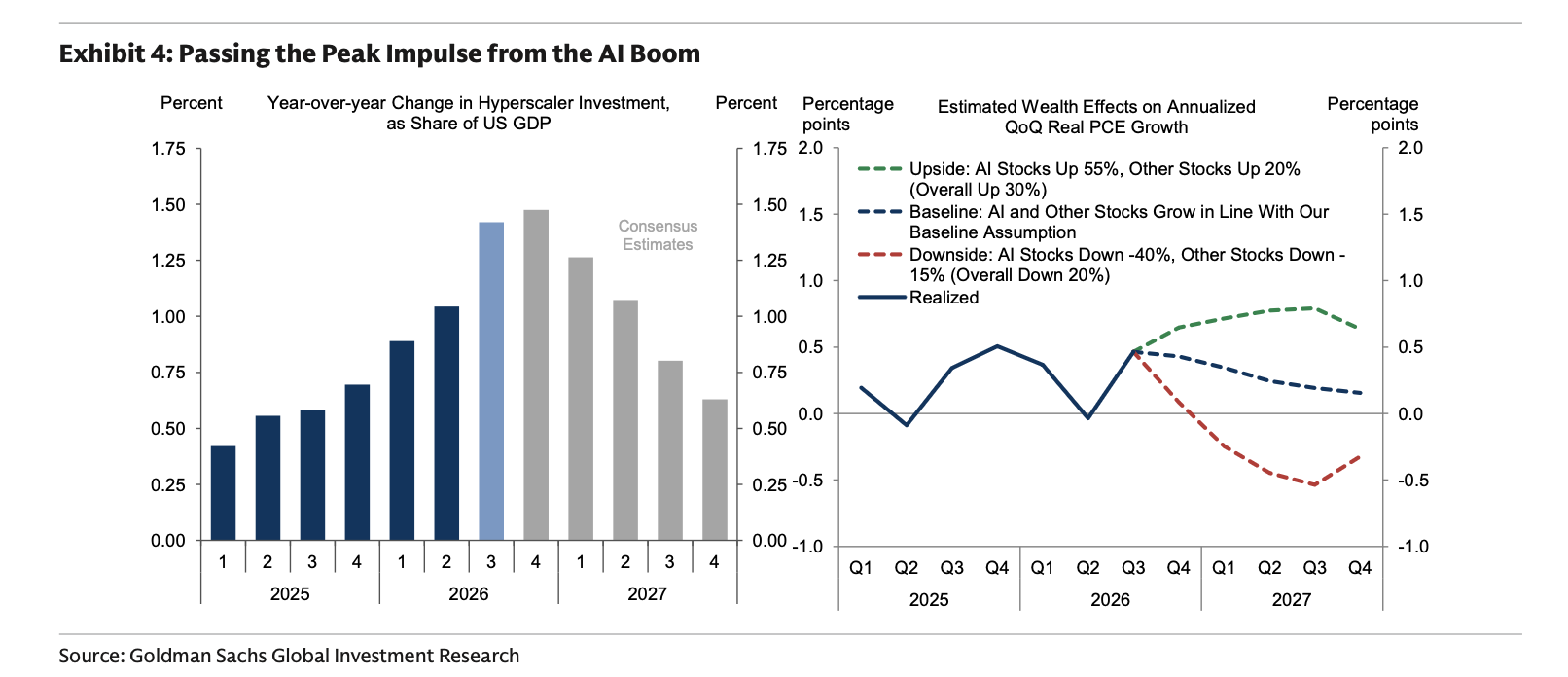
At Goldman Sachs, chief economist Jan Hatzius estimates that the growth impulse from the AI buildout will peak in late 2026 or early 2027. An expansion meant to hand off smoothly from historic capital spending to economy-wide productivity gains is instead hitting an air pocket. The initial spending surge is climbing but losing steam as AI capex growth as a share of GDP slows, the boost from last year’s tax depreciation incentives fades, and the stock-market wealth effect cools. Goldman still believes in the long-term payoff, but getting there requires wading through near-term labor-market disruption that will weigh on growth before lifting it.
Meanwhile, the productivity handoff that was supposed to cushion the slowdown is absent from the data. Days before the Goldman note, Apollo chief economist Torsten Slok showed that while profit margins and revenue per worker are rising among the Magnificent Seven, they remain flat across the remaining 493 companies in the S&P 500. Outside the tech sector, mainstream companies are coming to view token spending “not as a source of growth but as a cost center that weighs on margins.” As Slok puts it, the fate of the AI boom “will be decided in the S&P 493, not the Mag 7”—and right now, the 493 are barely moving.
The opening of Charles Dickens’ 1859 historical novel, “A Tale of Two Cities,” labelled the French Revolution “the best of times and the worst of times.” As we detail in our upcoming book When Machines Act: The Promise and Peril of our Agentic AI Future (MIT Press/Penguin Random House), there may be a path of harmony between these contrasting views, with vital implications for investors, managers, and public officials.
The view from the corner office
Step out of the research department and into the boardroom, however, and the caution evaporates. Inside the corner office, AI is not a margin drag to be managed, but an existential race against time and competitors moving at unprecedented speed. Some of the boldest convictions come from the executives at the top of firms whose economists are flashing warning lights. At Goldman Sachs, CEO David Solomon said in January that “the pace of capital investment is going to continue,” while Apollo chief Marc Rowan has described the AI transition as “certainly” the biggest technology cycle of his career, one in which “almost every job will be enhanced or replaced.”
That urgency echoes across corporate America. In his April letter to JPMorgan shareholders, Jamie Dimon predicted that AI adoption would unfold “far faster than prior technological transformations, like electricity or the internet.” AI will fundamentally reshape how work gets done, unlock major productivity gains, and, in time, lift both revenue and earnings. From the top floor, the upheaval looks profound enough that executives are already rethinking labor demand and reskilling their workforces. BlackRock’s Larry Fink has openly asked what happens to everyone else “if AI does to white-collar workers what globalization did to blue-collar workers,” and Rowan expects “some amount of political upheaval.” Whether the modern “social contract” among corporations, government, and community can hold under that strain is a question executives and politicians are quietly considering.
Where both are right
Both camps are right. The chief executives are right about the destination, and the economists are right about the distance. The tension between them is a classic financial mismatch. Short-term capital, raised on an impatient timetable, is financing a technological transition whose payoff runs on a multi-year horizon. No one will wake up one morning to find the global economy transformed. Productivity gains will filter in gradually, almost indiscernibly at first, taking a year or more to register in corporate earnings and macroeconomic data. Even Goldman’s Solomon has acknowledged that enterprise implementation may unfold more slowly than people now expect—and behind closed doors, his peers agree. In our own polling of 200 chief executives at the Yale CEO Summit in June 2025, 40% said AI hype has led to overinvestment, and more than 40% admitted that AI investments have been allocated inefficiently.
Such candor matters as capital pivots from training AI models toward inference, the computing that puts them to work for customers. Filling that capacity, however, will take far longer, requiring financing patient enough to match the slower uptake by businesses and households. Putting AI to work in the real world is proving far harder than training it in a lab. Deploying models at scale exposes customer relationships, proprietary data, and brand reputation to a young technology that still fails at an unacceptable rate. The risk grows as applied AI shifts toward agentic systems—software designed to execute multi-step workflows autonomously—where small errors compound at every stage. A model that is 95% accurate at each step will likely be far less reliable as errors accumulate.
Both customers and employees are already feeling the fallout from premature deployments. In polling Morning Consult conducted for the 2026 Yale CEO Summit, 82% of American adults said human customer-service representatives have become too hard to reach, and 44% said a company’s use of AI in customer service makes them less likely to engage with the business at all. Nearly twice as many consumers said AI takes longer or fails outright to resolve their problems (51%) as said it solves them faster (26%). Workers inside the enterprise describe the exact same drag. Among employed adults in the survey, only 26% said AI mostly improves their productivity, while roughly a third reported that it frequently adds friction through extra processes, deeper inspection, verification, and rework. Tellingly, among daily AI users—the workers closest to the technology—the share reporting that friction jumped to 44%.
Corporations have responded with caution, especially in regulated sectors like banking and healthcare, confining deployments to narrow pilots whose early returns are far more modest than AI enthusiasts advertise. McKinsey’s 2026 State of AI survey found that only about 6% of companies report a significant bottom-line impact from AI—defined as attributing at least 5% of EBIT to the technology—a figure unchanged from a year earlier. About one in five respondents said operating costs, including tokens, have constrained their AI use. Nor is consumer demand picking up the slack. Andreessen Horowitz reported that as of April, barely 2% of US households were paying for an AI service, a share the firm characterizes as growing but “still tiny in the big scheme of things.” The AI revolution is as real as its boosters claim, but its financial payoff is on a much longer clock than markets have priced in.
The overbuild risk
The market may already have overbuilt relative to the payback window that data center financing assumes. Much of what corporate America spends on AI today funds exploratory pilots, a far cry from commercial deployments that generate measurable productivity gains. A pullback to reassess is not only the likely next step, but a healthy one.
Navigating the recalibration will test leaders across the economy. Investors will need a longer time horizon, since returns on new inference capacity will arrive over years, on the timetable of enterprise adoption. Chief executives will have to manage expectations inside their organizations and with their boards so that modest early pilot results are understood as necessary progress rather than failure. And policymakers must guard against speculative data center overbuilding in their communities, where a stalled project can leave behind stranded power commitments, idle land, and a local economy built around jobs that never materialize. The AI revolution is real. The herd has simply run ahead of it.
In his essay “The Crack-Up,” F. Scott Fitzgerald advised, “The test of a first-rate intelligence is the ability to hold two opposed ideas in the mind at the same time, and still retain the ability to function.”
The opinions expressed in Fortune.com commentary pieces are solely the views of their authors and do not necessarily reflect the opinions and beliefs of Fortune.
This story was originally featured on Fortune.com