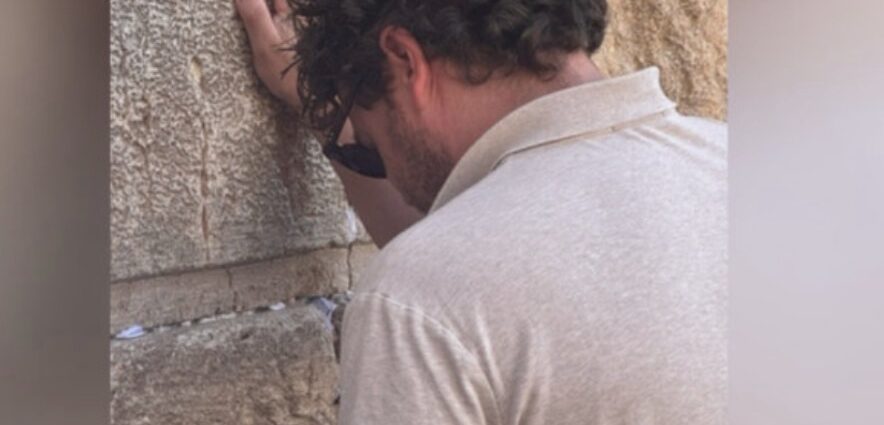
Rep. Aaron Pilkington had an extra day in Israel, and he spent it in an industrial park north of Tel Aviv.
The Arkansas Republican came with a delegation of state legislators organized by the Combat Antisemitism Movement. The July itinerary ran through the Knesset, Yad Vashem, Kibbutz Nir Oz, the Nova festival site, and a meeting with US Ambassador Mike Huckabee. The stop Pilkington mentions first is the one that was not on the schedule.
“I went to go and tour a data center over there in Tel Aviv owned by Serverfarm, which is the same company that’s building one in my district in Clarksville,” he said. “I’ve been to other data centers, but to see one that’s owned by the same company was really great.”
Serverfarm operates ISR1, a 100,000-square-foot facility just north of Tel Aviv. It is also developing a multi-building campus in Clarksville, Arkansas, inside Pilkington’s District 45, which local reporting has described as a $6.6 billion project. The company says it plans to finish the first two buildings by January 2028.
Pilkington, a healthcare administrator now in his fifth term in the Arkansas House, was the lead House sponsor of HB1444, which became Act 548 in April 2025 and amended the state’s sales-and-use-tax exemption for data centers. He does not claim to have brought Serverfarm to Clarksville, and the public record does not show that he did.

Why he defends the aid
It was his first trip, and he says he had wanted to make it for years.
“As a Christian, it’s always fascinating to visit the Holy Land,” he said. “But then of course, in Arkansas we have a deep connection to Israel.”
That connection is concrete. In November 2025, a joint venture between Israel’s Rafael and the US defense firm Raytheon opened a manufacturing facility in East Camden, Arkansas, producing Tamir interceptors used by the Iron Dome and a related American variant. The Arkansas Economic Development Commission puts the investment at roughly $63 million and projects as many as 60 jobs. East Camden lies outside Pilkington’s district, but it sits at the center of his argument.
Asked what he tells younger Republicans who question US aid to Israel, a debate that has grown louder inside his own party, he answers with a payroll.
“A lot of that aid gets spent in American factories,” he said. “It comes back to us in a different way. For us, I say it’s helping the economy of Arkansas.”
The picture is more complicated than that. The current US-Israel security assistance memorandum covers fiscal years 2019 through 2028 and pledges $38 billion, subject to congressional appropriations. Most Foreign Military Financing is tied to US defense procurement, and Israel’s longstanding permission to spend a portion of the funds on Israeli-made goods is being phased out entirely by 2028. Pilkington’s underlying point, that a meaningful share of the money circulates through American factories, holds.

His second argument is the phrase he used in a statement released by the delegation organizers.
“Israel is the vanguard of Western civilization over there,” he said. “If Israel is gone, the next person on the list is the United States of America. When you see what they say, I believe them when they tell us ‘Death to Israel, death to America.'”
“I would much rather send aid money to Israel and fight these extremists over there than have Israel be wiped off the map and then now be fighting them on our shores,” he added.

What surprised him? Not the security situation, rather the construction.
“I was shocked at the amount of cranes,” he said. He asked whether Israel had the American problem of neighborhood opposition to development. “The people I talked to were like, ‘That’s not really a thing here. We’re constantly trying to grow.'”
Then the farmland. “The amount of irrigation you have going on and the amount of agriculture that you’ve got going on in Israel was fascinating,” he said. Agriculture is Arkansas’s largest industry, contributing more than $24.3 billion a year, and Huckabee, the former Arkansas governor now serving as ambassador, pressed the delegation on exactly that overlap.
“One thing Ambassador Huckabee talked to us about was just the technologies that are being made in Israel when it comes to farming could be useful back in the United States.”
He was also surprised by the size and visibility of Israel’s Muslim population, a reaction he traced to time spent in Jaffa.
Asked where else Arkansas and Israel might do business, he named technology transfer and, given his day job, medicine.
“Some of the breakthroughs that are happening in the research and development that’s happening in Israel can have massive effects and help us to address some of the health crises that are happening in Arkansas.”
Pilkington was the lead House sponsor of the Healthy Moms, Healthy Babies Act, which became law in February 2025 as a $45.3 million maternal and infant health package. Its provisions include presumptive Medicaid eligibility for pregnant women, remote ultrasounds, and remote blood-pressure and glucose monitoring for rural patients.
“If we’re going to be pro-life, then we should take care of these mothers and take care of these babies,” he said. “They’re the most vulnerable in society.”
Campuses and faith
In April 2024, Pilkington was the lead sponsor of HR1042, a resolution condemning displays of antisemitism on US university campuses, adopted by the Arkansas House that month. He is candid about its limits.
“Resolutions are not statute, so they’re not as strong as an actual piece of legislation,” he said. “But it sent a signal to all our universities that we were not going to tolerate those kinds of attitudes.”
He pointed to the later dismissal of a University of Arkansas professor over social media material that university attorneys characterized as violent and antisemitic. The University of Arkansas System Board of Trustees upheld the termination of Shirin Saeidi, former director of the King Fahd Center for Middle East Studies, in May 2026.
Saeidi and her attorney disputed the university’s interpretation, arguing that the action threatened academic freedom and that a faculty committee had unanimously recommended her reinstatement. There is no documented connection between the case and Pilkington’s resolution.
A convert to Catholicism and a father of four, Pilkington said the religious sites mattered to him personally. He attended Mass in Jerusalem and visited the Church of the Holy Sepulcher. “It was really an amazing, once-in-a-lifetime opportunity,” he said.

The delegation also visited Shiloh and the Psagot winery in Samaria. Pilkington does not hedge.
“To me this is Israel; they have every right to be here,” he said.
The Clarksville project, whose Israeli counterpart he toured, has drawn questions at home. A community forum in July drew more than 100 residents asking about transparency, electricity infrastructure, environmental impact, public financing, and how many permanent jobs the campus will produce. Pilkington was out of the country at the time, in Israel. He has since disputed the suggestion that residents were deliberately kept in the dark.