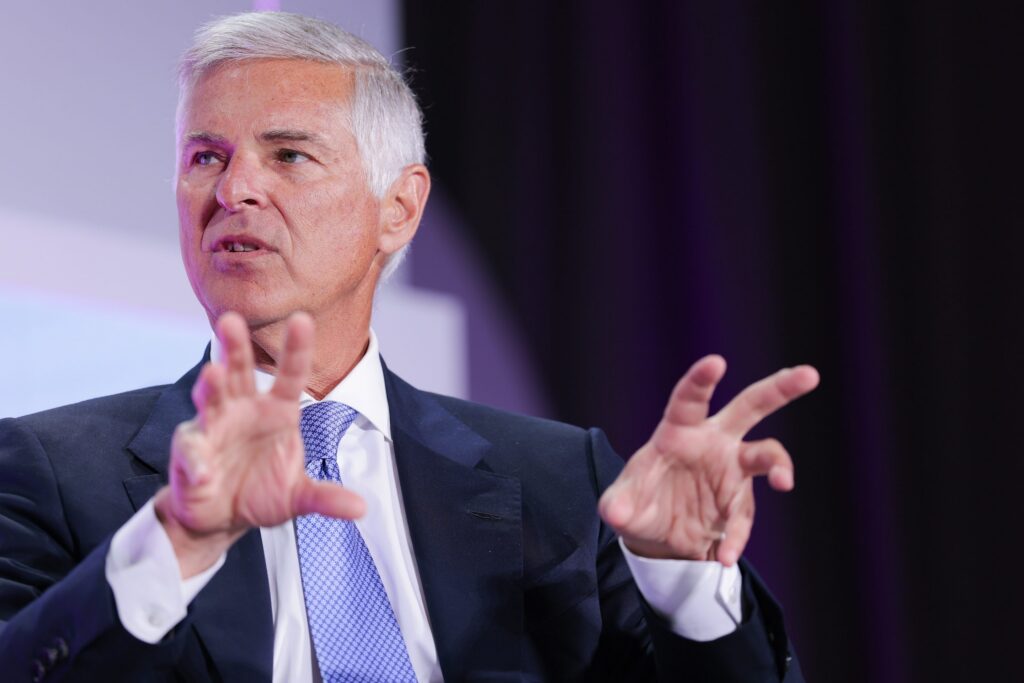
- In today’s CEO Daily: Hilton CEO Chris Nassetta plays the long game.
- The big leadership story: Jensen Huang’s Nvidia exit adds uncertainty to Anthropic’s IPO.
- The markets: Mixed globally as investors weigh the fallout of Huang’s departure.
- Plus: All the news and watercooler chat from Fortune.
Good morning. On one level, the best leadership strategies can sound obvious. “There’s nothing proprietary about it,” says Chris Nassetta, president and CEO of Hilton Worldwide. “It’s about grinding it out, investing in people, having the top-down purpose-driven north star, getting everyone unified, and doing the ground-up granular work. It’s about doing it and doing it and doing it and doing it. And then, when you-know-what hits the fan, it’s about continuing to live the values of the company.”
In a world of shorter cycles, faster innovation and an increased urgency to transform and adapt, Nassetta preaches the power of playing the long game. He became CEO of Hilton in 2007 and told me that transforming a fragmented hotel company into a cohesive high-performing culture took years. It has paid off as Hilton was just named the No. 1 World’s Best Workplace by Fortune and Great Place To Work for the third time and second consecutive year. Leadership, or the lack thereof, is top of mind. Running a founder-led tech company like Nvidia is obviously different from managing a people-centric global hospitality company like Hilton.
We’re paying a lot of attention this week to the perils of tech titans who make it all about themselves. Let’s also look at the playbook of a very different style of leader. We don’t just pick who gets on the Best Workplace list. It’s determined by data like employee engagement, where Hilton scored 93% in a company of more than 500,000 workers across 9,600 properties. And 93% of the leaders across those properties got their start in frontline jobs. They get training, perks, and opportunities to rotate in different roles.
What matters most is who’s in charge. Nassetta thinks a lot about the art and science and execution of leadership. He talks about the need for humility, agility and communicating a “vision in unique and different ways so that people feel part of something bigger than themselves.”
And of course he thinks about AI. “There’s so much money and time being spent trying to scare people as opposed to trying to educate people about where … the different possibilities are,” he told me. “AI, as well as other forms of technology we’ve used, have been tools that we can put in the hands of our frontline team members that help them do their job better, faster, easier.”
Is he replaceable? You bet. He believes building a bench of talent is part of the job, arguing “you take way too much risk trying to bring somebody in from the outside.”
And there’s no shortcut when it comes to listening, learning and building a great workplace. As with diet and exercise, it can take years to see the full results. “If you said to me, you have five years to ring the bell, high-five it, and you’ve totally rebuilt the culture, based on what I know now, I would have said, not possible,” he said. “It’s a marathon, not a sprint.
Contact CEO Daily via Diane Brady at diane.brady@fortune.com
This story was originally featured on Fortune.com