How many students made up your college cohort? Odds are its about 4,000—the same, if not more, than the total number of billionaires on earth.
Think about the last time you went to a sports stadium, to a concert venue, or even visited a small coastal town ahead of the fall holidays. The fewer-than 3,800 billionaires worldwide make up just one-fifth of a full house at MSG, a tenth of Yankee Stadium, and the population of your average New England town. And out of a world of more than 8 billion people, they make up a sliver so thin it barely registers: about 0.00005%, or one in every two million people alive today.
And yet, that sliver holds a record $15.1 trillion, according to Altrata’s Billionaire Census 2026 — close to half the size of the entire U.S. economy (at $32.5 trillion per the St. Louis Fed), and nearly 30% of the combined GDP of the G7 nations (at $52.06 trillion per the IMF).
The population grew 8.2% in 2025, the fastest pace in five years, but the gains are not shared equally. Twenty-nine people now hold fortunes above $50 billion, dubbed superbillionaires in Altrata’s report, and together, they hold $4.1 trillion, or 27.2% of all billionaire wealth. But less than a decade ago, in 2017, just 10 people held that same status and controlled only 7.2% of the total billionaire wealth.
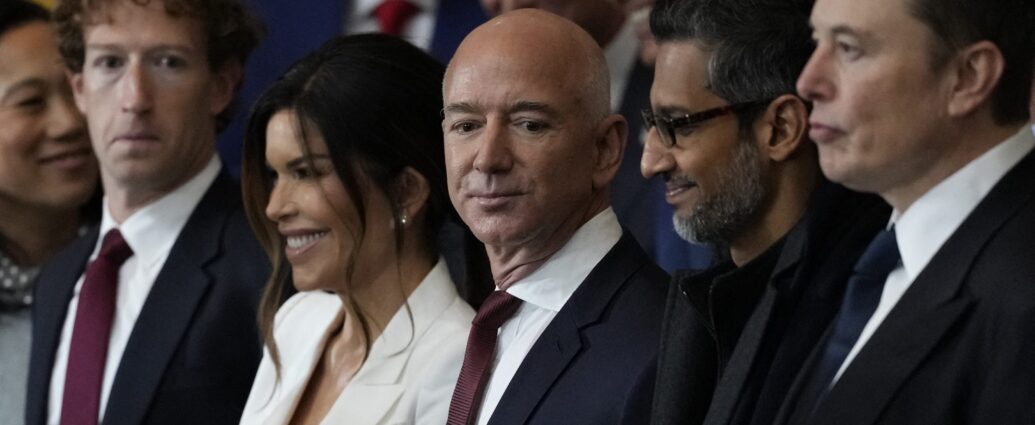
Most of the superbillionaire rise has come in the last two years alone, as the share stood at 16.3% as recently as 2023, while public rankings point to who many of these people are: Elon Musk, Larry Page, Sergey Brin, Jeff Bezos, Larry Ellison, Mark Zuckerberg, Jensen Huang, and Warren Buffett dominate the list.
Maeen Shaban, Altrata’s director of research and analytics and a lead author of the report, points to one cause above the rest: artificial intelligence. Altrata identified the 150 public companies where the most billionaire wealth sits, then split them into two groups: those that made a meaningful investment in AI since 2023, and those that did not. The AI investors beat the rest by 23% in market cap growth over 2024 and 2025 combined.
“Hundreds of billions have been injected into that space,” Shaban told Fortune. But he cautioned against treating the number as precise, since some billionaires built AI companies outright while others simply used it to cut costs elsewhere.
“It’s a very, very complicated thing to do,” he said.
A geographical divide
AI isn’t the only thing that divides billionaires: so do urban areas. New York gained 12 billionaires in 2025, now bringing the total up to 164 in Gotham City, while Singapore and San Francisco grew just as fast. Hong Kong and London were the only two of the top 15 cities to lose billionaires. Still, there’s no rhyme nor reason as to why some cities see this growth while others fall.
“With these really small populations, it’s very hard to call it a trend,” Shaban said.
He said the scale of AI investment in the U.S. is one pull, but there’s a pull in the other direction, too, as some wealthy people have moved back toward the Middle East amid the war there.
“Mobility for them is not a luxury, it’s a need,” he said.
Public data suggests the wealth may be even more concentrated than the city rankings show: The San Francisco Bay Area alone is reportedly home to six of the world’s richest people, including Musk, Zuckerberg, Ellison, Page, Brin, and Huang.
Germany, with the world’s third-largest nominal GDP, still has no German city that cracks the top 15, because, Shaban said, “the wealthy in Germany… are more distributed across the country than you would see, for example, in the UK, where 60% are in London.”
That same pattern shows up in who counts as a local: About one-fifth of the world’s billionaires were born somewhere other than where they now live—Musk a clear example among them—and the share of foreign born climbs above half in Singapore and London.
The great wealth transfer for billionaires
And just as we’re in the middle of the Great Wealth Transfer for all socioeconomic statuses, so too will the billionaire class experience this as well. Altrata expects billionaires to pass $6.6 trillion to spouses and children over the next decade, estimating that amount would be split among roughly 5,000 people, with about 2,000 of them spouses.
“In 10 years, that could be double that,” but said even with the minting of new billionaires through generational wealth, the greater number will still be self-made, Shaban said. “More than 60, 70% are going to be self-made,” he added. “The main contributor to future growth, in our opinion, is not [inheritance]. It’s more like entrepreneurship.”
“Billionaires are literally tiny as a population on the world stage,” he continued. “It’s like a needle in a haystack.”
Even the broader $30 million-plus tier holds only about half a million people worldwide, he said. But the ability to reach millionaire status and above has gotten greater, for everyone. Technology, shifting regulations, and wider entrepreneurial opportunity have made that wealth level more attainable than a generation ago, even if it remains rare in absolute terms. By Altrata’s count, the ultra-wealthy population grew roughly seven times faster than the world’s adult population between 2005 and 2025.
He expects the churn to accelerate. Altrata’s internal estimate, not yet published, is that by 2040, about 70% of the ultra-wealthy population will be people who aren’t in it today.
“That’s just 15 years away,” he said. “If you’ve got banks that are 300 years old, 15 years is nothing.”
This story was originally featured on Fortune.com