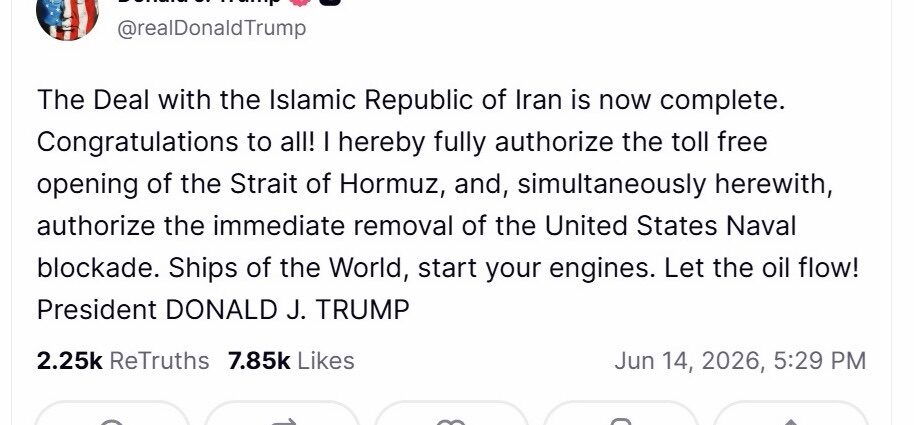
WASHINGTON — President Donald Trump announced on Sunday that the United States and Iran have reached a deal to end their war, declaring on Truth Social that “The Deal with the Islamic Republic of Iran is now complete”  and ordering the Strait of Hormuz reopened to oil traffic. “Let the oil flow!” Trump wrote, saying he had authorized the toll-free opening of the strait and the immediate removal of the U.S. naval blockade .
The statement came minutes after Pakistani Prime Minister Shehbaz Sharif said the peace deal had been reached . Sharif, whose government mediated the agreement, said it includes the immediate and permanent termination of military operations on all fronts, including in Lebanon . The memo is being called the “Islamabad declaration,” and a signing ceremony is expected soon, with Geneva floated as a likely venue and Vice President JD Vance potentially attending .
The deal, if it holds, would end a conflict that has gripped the global energy market since the war with Iran started February 28 . Iran’s effective closure of the Strait of Hormuz — the channel through which about a fifth of global energy flows — choked off supply  and sent prices on a months-long climb.
Brent crude broke $100 a barrel in March , and U.S. WTI crude briefly spiked as high as $117.63 during one of Trump’s reopening deadlines — its highest settlement since June 2022 . Analysts estimated the war had added nearly $30 to the price of every barrel , and FGE NexantECA’s Fereidun Fesharaki warned that a prolonged near-closure could push oil to $150 to $200 .
The pain reached American drivers. The national average for a gallon of regular gas sat near $3.94 early in the war  before climbing past $4.50 in recent weeks, according to AAA .
Reopening Hormuz is meant to reverse that. Each time a truce looked likely, prices fell hard. Brent dropped more than 10% in a single session on an earlier breakthrough, settling near $100.37, while WTI crashed to $88.85 , and gasoline futures fell more than 10% below $3 a gallon when Iran briefly reopened the strait in April .
For the broader economy, cheaper oil works like a tax cut. Economists estimate a sustained 10% drop in oil reduces headline inflation by roughly 0.4 percentage point , giving the Federal Reserve more room to consider rate cuts after a year in which the war undercut its progress against inflation.
Markets had already begun pricing in peace. On Friday, oil sank more than 3% and U.S. stocks rebounded after Trump signaled a breakthrough, with futures for the S&P 500, Dow and Nasdaq all rising .
Relief may still be uneven. Patrick De Haan of GasBuddy has cautioned that pump prices are slow to recover even after a war ends , and some traders noted the gap in oil supply could take months to close . Tankers that have sat idle, insurance markets, and shipping routes all have to normalize before barrels move freely again.
Political risk also lingers. Israel was not included in the negotiations , and Israeli strikes in Lebanon in recent days had threatened the agreement . Trump said the strikes on Beirut “should not have happened” and called on all sides to stand down .
For now, the message from the White House was aimed squarely at the oil market. After more than three months of war, record-high pump prices and whipsawing markets, Trump’s order to reopen the world’s busiest oil-shipping channel set up the prospect of cheaper energy heading into summer — provided the ships, and the barrels, actually start moving.
JBizNews Desk
© JBizNews.com All Rights Reserved. Reproduction or distribution without written permission is prohibited.