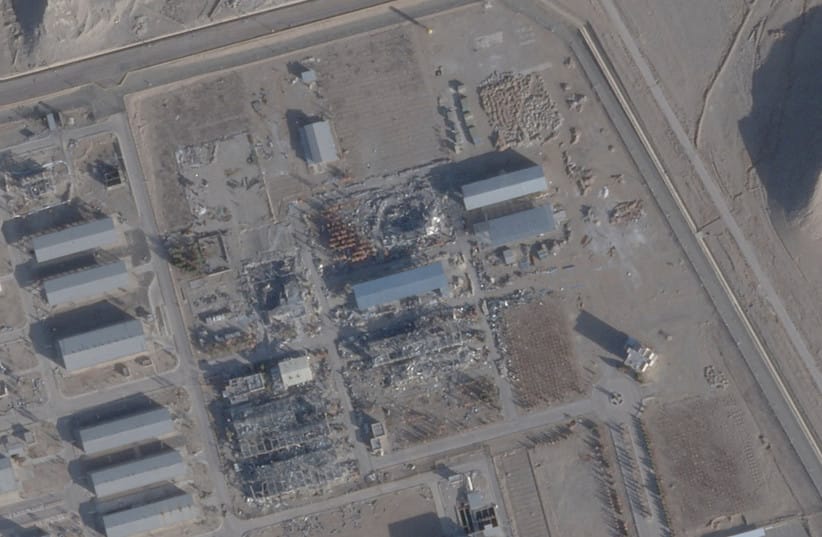
There is a flurry of diplomatic activity by Iran to try to cut some kind of interim deal that would stave off a possible new attack by US President Donald Trump on Tehran.
Some of the activity is also being pushed by US Vice President JD Vance, who has most of the time been the leader against attacks on Iran within the Trump administration.
What is the minimum Trump needs for a new Iran nuclear deal that would get him to postpone another attack?
And note that the answer to this question remains different from what Israel wants.
The answer is partially military and partially political-economic.
Regarding the military part, the keys are getting something that US president Barack Obama did not get in the 2015 nuclear deal and eliminating the potential for a nuclear threat over the next period of years.
At minimum, Trump needs a nuclear deal with Iran to reduce the enrichment to zero for some period of time, even if only for a few years, or to last for longer than Obama’s 10-15 years.
This would allow him to claim a better deal, even if he did not eliminate the whole nuclear program.
Regarding eliminating the potential for a nuclear threat in the coming years (it is at least around two years away due to successful Israeli-US strikes in June 2025), Trump would need to have shipped out or diluted Iran’s stockpile of 60% highly enriched uranium, limit its enrichment capabilities regarding the several hundred centrifuges (out of around 20,000) which survived the June 2025 attacks, and restore effective inspections by the International Atomic Energy Agency (IAEA.)
He would not get all of this next week, but he would need a down payment on one or more of these items along with a timeline of a couple of months or less by which the rest of the issues would be agreed upon.
Which items would he need a down payment on?
At minimum, restoration of IAEA access and visits.
But as seen with the Islamic Republic repeatedly, access and visits can be taken away in a day.
Trump will want something now that is harder to reverse.
A time-bound commitment regarding some of the enriched uranium, some of the surviving centrifuges, or some concession relating to the Pickaxe Mountain nuclear facility.
All of this would be insufficient from the Israeli perspective because, for Jerusalem, this period since June 2025 has been the once-in-50-years chance to finally end Tehran’s nuclear program.
Anything that allows Iran to enrich at some point and to keep some enriched material and centrifuges will be seen by most Israeli officials (both Prime Minister Benjamin Netanyahu and his main challenger Gadi Eisenkot) as wasting that once-in-a-lifetime opportunity, even if it improves security short-term.
Regardless of the terms, Israel should be investing in more effective means of dealing with Iran’s underground nuclear infrastructure so that it is not entirely reliant on US mega bunker busters and if the US goes back to war, one hopes that it is more ready to defend Arab allies, underwater internet cables, and other sensitive targets than it was in early 2026.
Why might Trump settle for less than Israel when he also sees a nuclear Iran as a threat?
His 2026 war with Iran and the ongoing economic instability are bitterly unpopular with both Democrats and Republicans.
Trump wants to get a “win” and wants to stem the (political) blood loss he has suffered throughout 2026.
This is, in fact, why he cut a deal defined by Netanyahu and Eisenkot as “bad” in July of this year.
If Iran had stuck to the terms of that deal, which got rid of parts, but not all of the Iran nuclear program, they would have started healing months ago.
But Tehran decided that Trump’s readiness to cut such a deal showed he was worn down. As soon as the military threat was lifted, they started violating the deal at the Straits of Hormuz.
This raises another difference between the US and Israel.
Hormuz’s instability and being partially closed is not great for Israel, but does not have a large impact.
For the US, it has a major economic impact and is politically almost as bad as a new war because gas prices remain high.
So Trump needs a deal with Iran that will fully open the Straits and give him a horizon by which he can withdraw most American naval vessels without worrying that the Islamic Republic will then immediately violate the deal again.
Trump still may decide to attack, having lost patience with the Iranians.
But if he does cut a deal, Israel will need to pay close attention to the fine print to know exactly what holes are left open, and to convey to Washington what its red lines are, regardless of what the US signs on to.