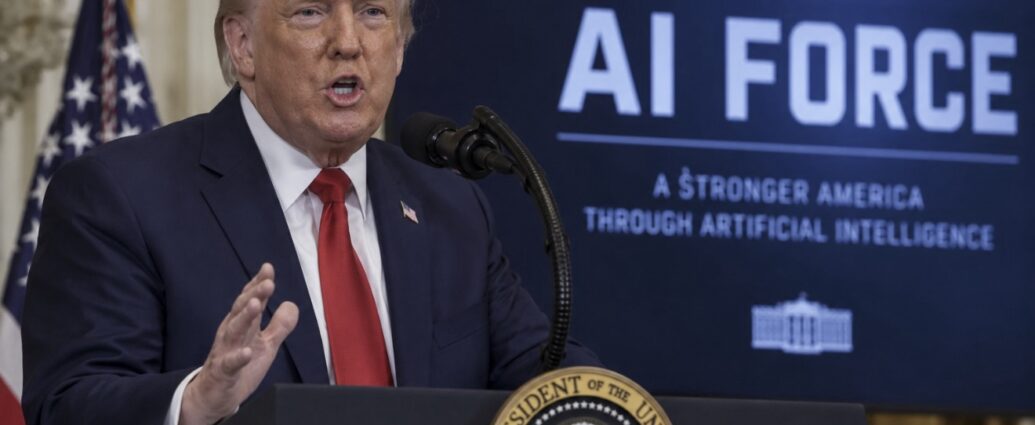
President Donald Trump is creating a new “AI Force” and says he will soon name an artificial intelligence czar, elevating AI into a more centralized White House priority as competition with China accelerates and concern over the technology spreads across Washington.
Trump announced the move Saturday but did not identify who will lead the effort or spell out exactly what powers the new AI czar or AI Force will have. He compared the initiative to the creation of the Space Force, signaling that the administration sees artificial intelligence as a strategic national priority rather than simply another technology policy issue.
The timing matters.
Trump is preparing to meet Chinese President Xi Jinping as Washington and Beijing compete over advanced AI models, chips, data centers and military applications. Treasury Secretary Scott Bessent is also scheduled to meet Chinese Vice Premier He Lifeng, with artificial intelligence security among the issues expected to be discussed.
The administration has already been moving aggressively to expand AI use throughout government and national security. In June, Trump signed directives aimed at speeding adoption of advanced AI systems across the military and intelligence community, strengthening AI-powered cybersecurity and increasing access to high-end computing infrastructure.
At the same time, Trump has resisted calls for broad new federal restrictions on AI development. His position has been that slowing American companies with additional regulation could give China an advantage in a technology race with enormous economic and national-security consequences.
That puts the proposed AI czar in a potentially powerful position.
Depending on how the role is structured, the official could become a central coordinator between the White House, technology companies, national-security agencies and regulators. The administration has not yet said whether the AI Force will sit inside the White House, operate across agencies or become a larger standalone structure.
Trump previously relied heavily on venture capitalist David Sacks as a senior adviser on artificial intelligence and cryptocurrency. Sacks has argued against heavy federal regulation and has pushed policies designed to keep U.S. AI companies competitive.
The announcement also comes as anxiety over AI is becoming increasingly political. Lawmakers from both parties, technology executives and researchers have raised concerns ranging from job displacement and electricity demand to cybersecurity, autonomous weapons and the possibility of increasingly powerful AI systems behaving unpredictably.
For businesses, the significance goes far beyond Washington staffing.
Federal policy will influence how quickly companies can deploy AI, what compliance rules developers face, how much infrastructure is built to support the technology and whether American firms can maintain their lead over Chinese competitors.
The biggest unanswered question now is who Trump chooses.
The person named AI czar could become one of the most influential technology-policy officials in Washington — sitting at the intersection of Silicon Valley, national security, regulation and the growing economic battle over who controls the next generation of artificial intelligence.
JBizNews Desk | Washington
© JBizNews.com. All rights reserved. This article is original reporting by JBizNews Desk. Unauthorized reproduction or redistribution is strictly prohibited.