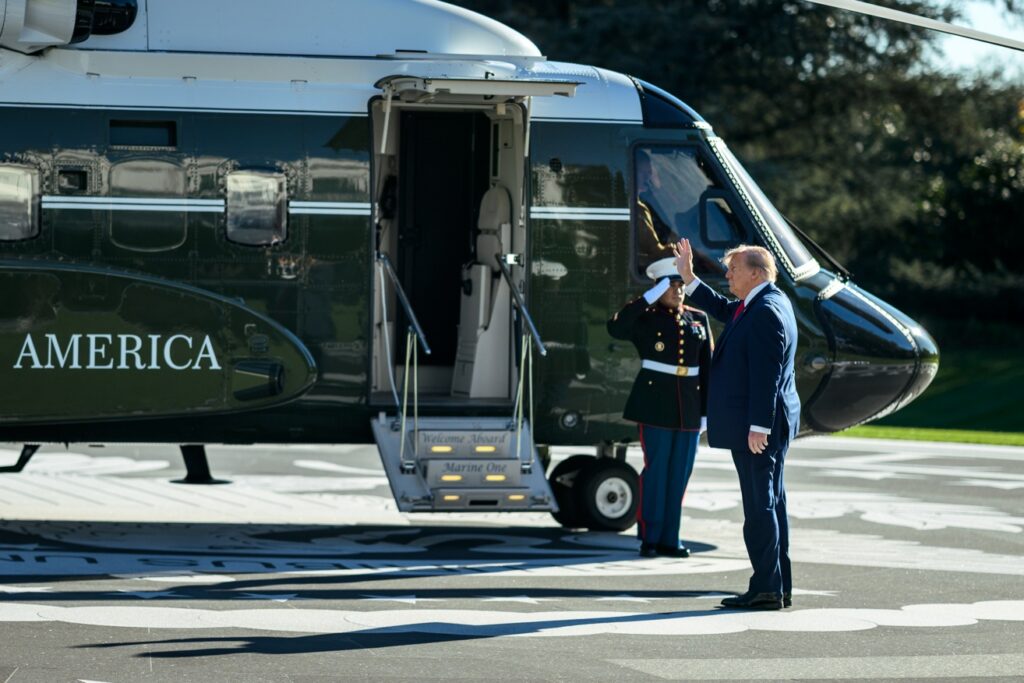
Daniel Torok / The White House / Public domain
President Donald Trump said the Iran war and higher gasoline prices hurt Republicans in the midterm elections and signaled possible changes to his team, while defending Defense Secretary Pete Hegseth and declining to commit to endorsing a successor for 2028.
In his interview with Ross Douthat, recorded Friday at the White House and aired Sunday, Trump also discussed a possible immigration deal with Democrats, AI safety, Israel, Ukraine and questions about his family’s business interests. The full CBS transcript provides additional exchanges beyond the aired interview transcript.
Watch the extended interview
Watch the official 51-minute, 47-second extended interview on CBS.
War, gasoline prices and the Republican defeat
Trump offered a political explanation centered on the war, fuel costs and attitudes toward Israel. “They didn’t like the war. They didn’t like the fact that gasoline went up,” he said. In the full transcript, he added: “So you have that. You have the war itself. You have the gas prices. And I think those are the primary reasons.” These were his assessments of voters’ motives, not independently established causes of the result.
Asked about Vice President JD Vance’s argument that the war explained the loss, Trump said: “I don’t disagree with it, other than–” He went on to say the missing question was whether the decision to attack Iran should be made again. His own answer was: “My answer is an emphatic yes because you can’t let Iran have a nuclear weapon.” He said Vance had consulted him before writing the post, without claiming that Vance had expressed the same view about making the decision again.
Trump also conceded a possible failure in presenting his economic record: “I think it was bad messaging, maybe by me,” he said. He continued to defend the economy rather than accepting that his policies had failed.
Possible personnel changes, but support for Hegseth
Asked whether he expected to fire anyone after the defeat, Trump answered: “I do. Yeah.” He then said: “I love my Cabinet. I think they’re good. But I’ll do– be doin’ maybe a few changes.” He did not identify the people he had in mind in that answer.
When Douthat asked whether he had confidence in Hegseth, Trump replied: “I do.” He defended the administration’s military campaigns and Hegseth’s role. The exchange signaled potential personnel changes, not an announcement that Hegseth or another named Cabinet member had been dismissed.
Vance, Rubio and the 2028 succession
Trump did not promise an endorsement in the next Republican presidential contest. Asked whether he would endorse someone, he said: “Probably. Not necessarily–” When Douthat asked who might be considered besides the vice president, Trump responded: “Well, I think Marco’s great.”
Asked whether Secretary of State Marco Rubio was staying in his job, Trump said: “I think so. I mean, he certainly loves it and he’s doing great.” He referred to other people and senators without naming them, adding: “So I may or may not get involved. I don’t know.” Those comments did not constitute an endorsement of either Rubio or Vance.
Immigration negotiations and Israel
Trump said: “I’d love to do something on immigration.” He described deportations as politically mixed, defending border enforcement and the removal of criminals while acknowledging the impact of removing people who had jobs. Asked whether his policy had been too tough, he answered: “I think it might be too tough, yeah.”
He discussed the possibility of a deal for some longtime workers, including people who had been in the country for 10 or 15 years. “I think so, yeah. People have already called me,” he said when asked whether Democrats would be interested. The discussion did not establish agreed eligibility rules, legislation or a change in enforcement policy.
On Israel, Trump said there was “a great dislike, incredibly, for Israel” as part of his explanation of the election. He nevertheless defended the strikes on Iran and argued that they protected Israel. Asked whether he planned to escalate the Iran war after the midterms, he said: “Well, I’m not looking to. I don’t think there’s any reason to.” His claims about Iran’s military defeat, nuclear capabilities and the prospects for a deal remained the president’s assertions, not independently verified findings in this report.
AI guardrails and an unnamed company
Trump said he was willing to discuss AI safety with Democrats but argued that restrictions should not put the United States behind China. “I don’t mind guardrails. But I don’t wanna put us in a deep second position,” he said. His assertion that China had no guardrails drew a challenge from Douthat about the Chinese state’s control.
The extended transcript also included Trump’s account of an intervention involving an unnamed major AI company. He claimed someone had been reported for doing something bad with AI and had changed course after a warning about jail. He would not identify the person or company. The interview did not establish a prosecution, a formal enforcement action or a new safety rule.
Ukraine, business interests and his legacy
Trump said he believed a deal to end the Russia-Ukraine war was close, while declining to say whether he trusted Vladimir Putin or Volodymyr Zelenskyy more. Asked about a free and independent Ukraine, he said the country would end up with “a little bit different shape Ukraine.” That was his forecast, not an announced territorial agreement.
Douthat also pressed Trump about potential conflicts involving World Liberty Financial and his family’s business interests. Trump acknowledged co-ownership when asked and said: “Because I know nothing about it.” He described his sons as running the company. Those responses did not settle the questions Douthat raised about foreign investment and influence.
On pardons, Trump said he expected to issue many when leaving office, but said he did not expect to pardon himself. Asked how he wanted his presidency remembered, he answered: “That I made America great again.” The interview also covered UFOs, mortality and forgiveness, with the complete exchanges available in the video and full transcript above.
JBizNews Desk | Washington
© JBizNews.com. All rights reserved. Unauthorized reproduction or redistribution is strictly prohibited.