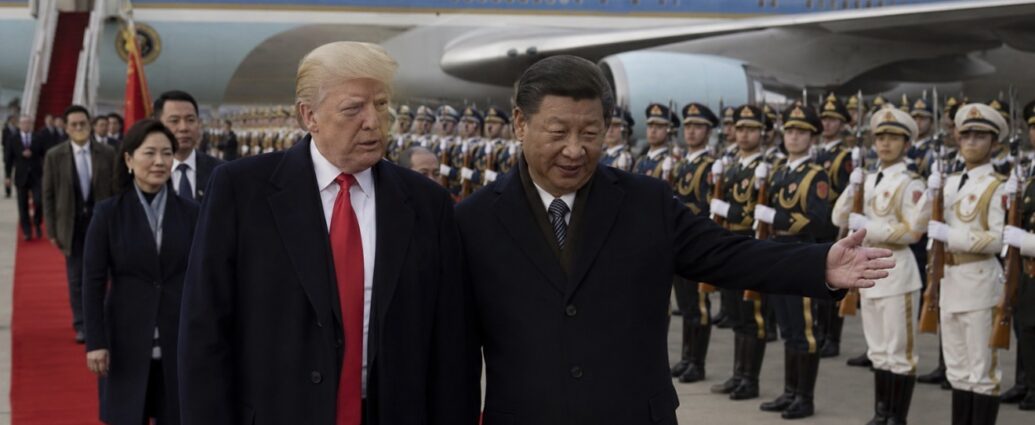
President Donald Trump arrived in Beijing on Wednesday evening local time aboard Air Force One, opening a three-day state visit the White House has framed as a push to pry open Chinese markets for American firms while securing Beijing’s cooperation on Iran, rare earth flows, and artificial intelligence guardrails. The visit, confirmed by China’s Foreign Ministry for May 13 through 15, marks the president’s first trip to China since 2017 and follows the October 2025 Busan truce that temporarily cooled the sharpest tariff escalation between the world’s two largest economies.
Trump was greeted with a full ceremonial welcome at Beijing Capital International Airport, with formal meetings with President Xi Jinping scheduled for Thursday and Friday inside the Great Hall of the People. The president arrived with one of the largest American corporate delegations in years — a 16-member roster distributed by the White House on Monday and headlined by Tesla chief Elon Musk, Apple chief Tim Cook, Boeing chief Kelly Ortberg, BlackRock chief Larry Fink, Goldman Sachs chief David Solomon, Citigroup chief Jane Fraser, Blackstone chief Stephen Schwarzman, and Mastercard chief Michael Miebach. Nvidia chief executive Jensen Huang was added late after earlier reports indicated he would skip the trip. Cisco chief Chuck Robbins withdrew Monday, according to the White House.
The composition of the delegation underscores where the administration believes meaningful progress remains possible despite years of escalating strategic rivalry. Administration officials have signaled two major structural initiatives: a proposed “Board of Trade” and a parallel “Board of Investment,” frameworks first discussed in lower-level negotiations before the summit and described by Council on Foreign Relations senior fellow Heidi Crebo-Rediker as among the most realistic deliverables likely to emerge from the meetings.
On the commercial front, the administration’s demands are highly specific. The U.S. Trade Representative’s Office and White House negotiators have pushed Beijing to commit to multi-year purchases of American soybeans, beef, pork, and poultry, while also lifting the freeze on widebody aircraft orders that has weighed heavily on Boeing since China retaliated against the spring 2025 tariff escalation. Proposals circulated among negotiators reportedly include a Chinese commitment to purchase roughly 25 million metric tons of U.S. soybeans annually over three years, alongside a potential aircraft package that could include as many as 500 Boeing 737 MAX jets in addition to widebody orders, according to summit briefing materials reviewed by Reuters and Bloomberg.
For Apple, the trip carries additional symbolism. Industry analysts widely view the visit as Tim Cook’s final major diplomatic mission before his planned September 1 transition to incoming chief executive John Ternus. Elon Musk enters the summit with equally high stakes. Tesla’s Shanghai facility remains the company’s largest production hub globally, reinforcing the administration’s acknowledgment that full-scale economic decoupling remains unrealistic in sectors deeply tied to Chinese manufacturing.
The inclusion of Jensen Huang has drawn especially close scrutiny across Wall Street and Washington. Nvidia has aggressively lobbied the administration to ease restrictions on advanced semiconductor exports after Commerce Secretary Howard Lutnick acknowledged in April that the export controls had significantly constrained sales to China. Huang’s participation is being interpreted by analysts as an early signal that the administration may be willing to explore a limited thaw in certain categories of advanced chip exports if broader trade and geopolitical concessions can be secured.
Beijing, however, enters the summit with its own priorities. Chinese officials continue pressing Washington to ease restrictions on advanced semiconductor equipment and chip-making technologies. Analysts at Goldman Sachs, led by economist Andrew Tilton, suggested ahead of the summit that the administration could potentially relax controls on certain 14-nanometer and 7-nanometer manufacturing equipment. In exchange, Washington is seeking guarantees of stable rare earth and critical mineral exports after Beijing’s export restrictions in April and October 2025 disrupted supply chains for American automakers, defense contractors, and industrial manufacturers. China currently refines roughly 90% of the world’s rare earth materials.
The most politically sensitive issue hanging over the summit remains Iran. China remains the largest buyer of Iranian crude oil, accounting for more than 80% of Tehran’s exported shipments, according to energy market estimates. The White House is pressuring Xi to use Beijing’s leverage with Tehran to help reopen the Strait of Hormuz and steer Iran back toward negotiations after months of regional instability disrupted global energy markets. Trump told reporters before departing Washington that he expected to have “a long talk” with Xi about Iran, though he emphasized trade would remain the primary focus of the summit.
Financial markets entered the meetings cautiously optimistic. The onshore yuan has strengthened roughly 1.7% against the dollar over the past three months — its strongest performance among major Asian currencies and its highest level since early 2023, according to Bloomberg data. JPMorgan Chase economist Feng Zhu wrote this week that both Washington and Beijing have a strong mutual interest in stabilizing the Middle East conflict and reopening the Strait of Hormuz to calm global energy prices. Macquarie China equity strategist Eugene Hsiao said his firm’s base case remains that existing tariffs — currently estimated by JPMorgan at an effective rate near 22% — will remain in place without significant escalation. Invesco Asia Pacific client solutions head Christopher Hamilton said any reduction in the U.S.-China geopolitical risk premium would likely provide a substantial boost to Chinese equities and broader regional markets.
Few analysts expect a sweeping breakthrough. What investors, manufacturers, and commodity markets will watch closely over the next two days is whether Trump and Xi can produce enough concrete progress — particularly on aircraft purchases, agriculture, semiconductor controls, and rare earth access — to preserve the Busan truce through the November midterms and potentially stabilize the U.S.-China economic relationship into 2027.
JBizNews Desk
© JBizNews.com. All rights reserved. This article is original reporting by JBizNews Desk. Unauthorized reproduction or redistribution is strictly prohibited.