Edgar Connors – JBizNews Desk
The European Union long treated trade policy as one of its clearest instruments of global influence, a domain in which market size could translate into geopolitical leverage. In The trade deal with America shows the limits of the EU’s power, The Economist argued that the bloc’s accord with America instead exposed a more constrained reality: prudence, not defiance, shaped the outcome.
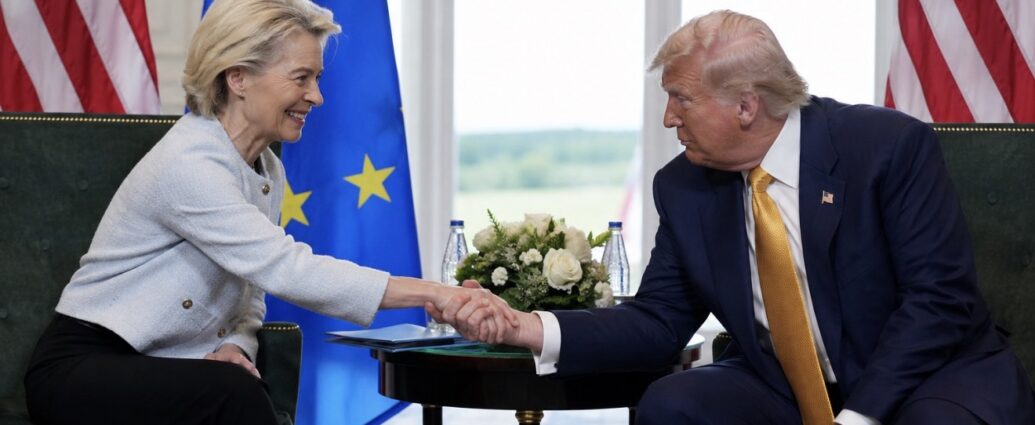
The numerical contrast framed the shift. Donald Trump, White House, set out a threatened 30% tariff on European Union goods in a July letter to Ursula von der Leyen, while European Commission briefings described the eventual framework around a lower 15% tariff ceiling for many exports to the United States.
The stakes extended beyond a narrow tariff dispute. The European Commission has described the transatlantic relationship as the world’s largest trade and investment partnership, with goods and services flows reaching roughly €1.6 trillion annually, placing the accord at the center of pricing decisions for manufacturers, retailers and investors on both sides of the Atlantic.
The European Commission has long presented the single market as a defensive asset, arguing that common external trade policy gives European Union members weight they lack individually. That model helped Brussels set rules for chemicals, digital markets, privacy and competition policy, often forcing multinationals to adjust global operations around European standards.
In the tariff talks, however, The Economist argued in The trade deal with America shows the limits of the EU’s power that regulatory authority did not convert cleanly into bargaining dominance. The article’s subtitle, The bloc opts for prudence over defiance, captured the strategic choice facing Brussels: protect access to its most important foreign market or escalate into a broader commercial fight.
The White House described the framework as including European pledges to expand purchases of American energy and commit additional investment in the United States, while the European Commission presented the arrangement as a way to stabilize commercial ties and avert a sharper tariff shock.
Ursula von der Leyen, European Commission, said the agreement offered predictability for companies operating across the Atlantic, according to public statements from the institution. For executives in autos, machinery, luxury goods and pharmaceuticals, predictability carries financial value even when the tariff line still cuts into margins.
That calculation explains the broader market lesson. The Economist argued that the European Union chose a negotiated disadvantage over a potentially costly confrontation with America, reflecting limited appetite among member states for a trade conflict that could raise prices and weaken industrial orders.
The early architecture of European trade power relied on cohesion. The European Commission says it negotiates trade agreements on behalf of all European Union members, giving the bloc a single voice in external commercial policy. In theory, that centralization creates scale; in practice, national exposure to U.S. tariffs varies widely.
The White House cast the framework as a gain for American industry, citing expanded market access and investment commitments from the European Union. For Brussels, the same terms carried a different meaning: limiting damage for exporters while preserving room for future talks over steel, autos, agriculture and digital levies.
The European Commission said the framework would keep trade channels open between the European Union and the United States, an outcome investors often prefer to retaliatory spirals. Equity analysts typically discount earnings more aggressively when tariff paths lack clarity, particularly in export-heavy sectors with long supply chains.
But the path to compromise exposed volatility inside the bloc. The Economist argued that European Union leaders had to weigh political demands for a tougher response against the economic risk of damaging a relationship central to manufacturers, energy buyers and financial markets.
The tariff ceiling also complicates the bloc’s industrial policy ambitions. The European Commission has promoted competitiveness, clean technology and strategic autonomy, yet higher duties on exports to the United States can dilute the effect of subsidies and tax incentives aimed at keeping production anchored in Europe.
For companies, the consequence comes through margins rather than symbolism. The Economist described the accord as a demonstration of limited European power, and that limitation has practical consequences for pricing, sourcing and capital allocation at firms selling into the American market.
The European Commission has said further engagement with the United States remains necessary to implement and refine the framework. That leaves investors focused on the operational details: product coverage, exemptions, enforcement procedures and the degree to which companies can pass tariff costs to customers.
The White House and European Commission each framed the deal as serving domestic economic interests, underscoring how trade agreements now function as political instruments as much as commercial compacts. For markets, that means tariff risk no longer sits at the edge of valuation models; it belongs in base-case assumptions.
The broader lesson reaches beyond this accord. The Economist argued in The trade deal with America shows the limits of the EU’s power that scale alone does not guarantee leverage when security, energy, capital markets and export demand pull in different directions. The European Union remains a regulatory giant, but the deal shows that even giants sometimes pay for stability.
JBizNews Desk