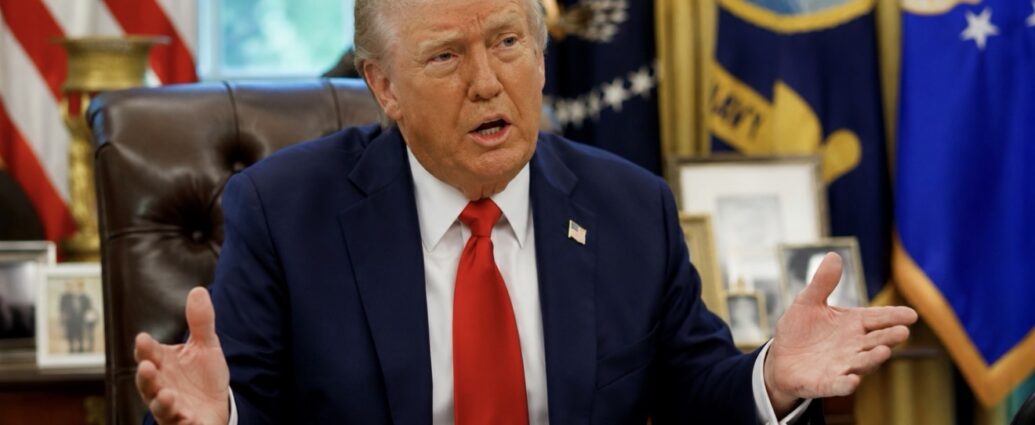
President Donald Trump told reporters in the Oval Office Monday that he would move to “reduce” the federal gas tax to ease the squeeze at the pump, echoing remarks he made in an earlier interview with CBS News in which he said he wanted to pause the levy “for a period of time” — a politically resonant proposal that would shave roughly 18 cents off a gallon of gasoline for the average driver while threatening to gut a federal fund that pays for the roads and bridges that gallon is burned on.
The federal government charges 18.4 cents per gallon on gasoline and 24.4 cents per gallon on diesel fuel, levies that have not been raised since 1993 and that flow into the Highway Trust Fund, the dedicated account that pays for federal highway and mass-transit projects. The national average price of regular unleaded reached $4.50 on Tuesday, according to AAA, up roughly 50 percent since the Feb. 28 outbreak of the U.S.-Israel war with Iran disrupted oil flows through the Strait of Hormuz and drove crude sharply higher. Some California stations are posting prices above $6 per gallon.
Reducing or pausing the tax requires congressional approval, and Republican lawmakers moved within hours of Trump’s comments to put bills on the table. Sen. Josh Hawley, R-Mo., introduced the Gas Tax Suspension Act, which would pause federal taxes on both gasoline and diesel for 90 days from enactment with an option for the president to extend the holiday by another 90.
“American workers and families deserve immediate relief, and this legislation will do just that,” Hawley said in a statement.
Rep. Anna Paulina Luna, R-Fla., said on X that she will introduce a companion bill in the House this week and that her office will work directly with the White House to deliver “this win for the American people.”
The proposals are not the first this year. Sen. Mark Kelly, D-Ariz., and Sen. Richard Blumenthal, D-Conn., introduced a Senate bill in early March to suspend the federal gasoline tax through Oct. 1, with Treasury required to backfill the Highway Trust Fund and the Leaking Underground Storage Tank Trust Fund out of general revenue. Rep. Chris Pappas, D-N.H., sponsored a parallel House measure.
Pappas responded to Trump’s support by posting on X, “This should have happened months ago. Let’s pass it this week.”
The Kelly bill differs from Hawley’s in that it does not extend to diesel — an exclusion that matters for trucking-sensitive consumer prices on everything from groceries to packages.
Senate Majority Leader John Thune has said he is not enthusiastic about a gas tax holiday but is willing to hear out colleagues. Energy Secretary Chris Wright told reporters Monday that the administration is “open to all ideas, everything has trade-offs, all ideas to lower prices for American consumers and American businesses.”
The relief that would actually reach drivers is modest by nearly every measure. A federal pause would lower regular gasoline prices to roughly $4.34 per gallon and diesel to approximately $5.39, levels that would still remain dramatically above pre-war pricing.
Patrick De Haan, head of petroleum analysis at GasBuddy, told CBS News the suspension would cost the federal government roughly $2.1 billion per month in lost revenue and argued that “18 cents doesn’t really amount to a whole lot” against the roughly $1.50 increase in gasoline prices over the past year.
Andrew Lautz, director of tax policy at the Bipartisan Policy Center, summarized the economics bluntly in a social-media post Monday: “The irony of a gas tax suspension is that the higher prices go, the less of an impact it has.”
The larger problem sits inside the Highway Trust Fund itself, which has already operated at a deficit for nearly two decades even with the federal tax fully in place. The Tax Foundation projects the fund will collect approximately $44.2 billion in revenue during 2026 against roughly $61.4 billion in expected spending obligations.
The Bipartisan Policy Center estimates a five-month federal gas-tax holiday would eliminate about $17 billion in revenue — nearly half of the trust fund’s annual intake — accelerating depletion projections already expected by fiscal 2028.
Adam Hoffer, director of excise tax policy at the Tax Foundation, told CNBC the trust fund “is substantially underwater when it comes to being able to finance all of its own projects.”
Carl Davis, research director at the Institute on Taxation and Economic Policy, warned the missing revenue would ultimately be financed through higher federal borrowing.
“The lost revenue gets tacked onto the debt,” Davis said.
The concern comes as U.S. federal debt this month surpassed annual U.S. gross domestic product for the first time since the pandemic-era fiscal surge.
Stephen Kates, a certified financial planner and analyst at Bankrate, said the proposal “would undoubtedly help consumers in the short term by immediately lowering prices at the pump,” but cautioned that delayed infrastructure maintenance, congestion costs, and future borrowing could erase much of the benefit over time.
Several states have already moved far more aggressively than Washington. Kentucky, Georgia, Indiana, and Utah have implemented or advanced state-level fuel-tax suspensions, with some delivering materially larger consumer savings because state fuel taxes are often substantially higher than the federal levy.
State gasoline taxes currently range from roughly 9 cents per gallon in Alaska to nearly 71 cents in California, according to the Tax Foundation, while the national average state tax stands near 32.6 cents per gallon.
De Haan noted on X that Indiana has already seen gasoline prices fall by nearly 60 cents per gallon after suspending portions of its state fuel taxes.
The proposal arrives at a politically sensitive moment for the White House as rising energy costs continue pressuring consumer sentiment and Republican strategists prepare for November’s midterm elections. Historically, gasoline prices remain one of the most visible and emotionally charged inflation indicators for American households.
The administration has already deployed several emergency measures since the Iran war disrupted global energy markets, including releasing roughly 172 million barrels from the Strategic Petroleum Reserve, easing ethanol blending restrictions, and temporarily waiving the Jones Act to allow foreign-flagged vessels to move fuel between U.S. ports.
So far, none of those measures has produced substantial relief at the pump.
That leaves the gas-tax proposal as perhaps the administration’s most direct consumer-facing response to rising fuel prices — even as nearly every major nonpartisan fiscal analysis released this week suggests the policy may ultimately deliver more political symbolism than meaningful economic relief.
JBizNews Desk
© JBizNews.com. All rights reserved. This article is original reporting by JBizNews Desk. Unauthorized reproduction or redistribution is strictly prohibited.