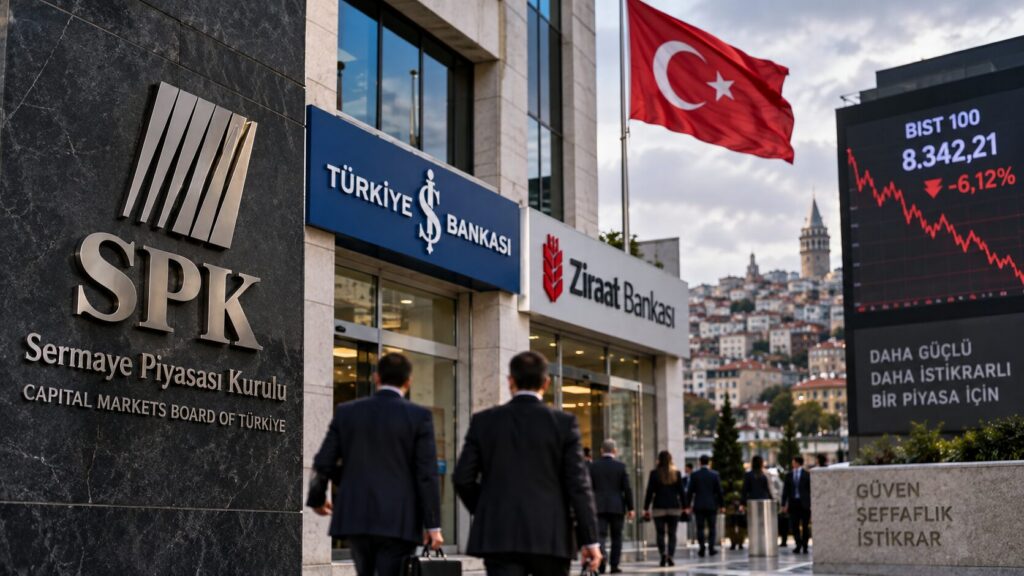
Turkey’s securities regulator has tapped two of the country’s largest banks to oversee the liquidation of 131 investment funds caught in a market crisis that has put more than 890 billion lira — about $18.3 billion — in assets under scrutiny.
The Capital Markets Board, known as the SPK, said Türkiye İş Bankası will oversee the liquidation of funds established by Tera Portföy, while state-owned Ziraat Bank will handle funds associated with six other portfolio managers: A1 Capital, Atlas, Bulls, Hedef, Pardus and Pusula.
The decision affects roughly 353,000 investors and follows a turbulent week in Turkey’s financial markets after some investment funds struggled to meet redemption requests.
What Happens to Investors’ Money?
For investors caught in the liquidation, the process essentially means the funds will be dismantled in an orderly fashion.
The banks will oversee the conversion of fund assets into cash while taking market conditions and investors’ interests into account.
After liabilities and expenses are deducted, the remaining proceeds will be distributed to investors according to the number of fund shares they own.
The process is generally expected to be completed within three months, although the SPK can extend that deadline if necessary.
That does not mean investors are guaranteed to receive back everything they originally invested.
The final amount will depend in part on what the underlying assets can be sold for during the liquidation process. The two banks are overseeing the wind-down; they are not guaranteeing investors a particular payout.
A Rush for the Exits
The crisis intensified after Pusula Portföy was unable to meet some investor redemption requests, raising concerns about liquidity inside parts of Turkey’s rapidly growing investment-fund industry.
Investors subsequently pulled as much as $1 billion from Turkish funds in a single day as fears spread through the market.
The SPK responded by closing TEFAS-traded investment funds established by Tera, Pusula, Hedef, Atlas, A1 Capital, Pardus and Bulls to purchases and redemptions and ordering designated funds into liquidation.
The turmoil spilled into Turkey’s stock market, sending the benchmark BIST 100 sharply lower and prompting authorities to introduce a series of measures intended to stabilize financial conditions.
Turkey’s central bank increased repo funding and expanded banks’ access to interbank liquidity as officials worked to prevent stress in the fund industry from spreading through the wider financial system.
Why the Funds Ran Into Trouble
At the center of the turmoil are concerns about funds with heavy exposure to relatively illiquid stocks — shares that do not trade frequently enough to be easily sold in large quantities without affecting their prices.
Some funds had concentrated investments in smaller companies with limited publicly traded shares.
That can create a dangerous cycle.
Heavy fund buying can push the price of a thinly traded stock sharply higher. Rising stock prices then boost the reported performance of funds holding those shares, potentially attracting additional investors.
But the process can work just as aggressively in reverse.
When large numbers of investors demand their money back, a fund may be forced to sell those holdings. If there are not enough buyers, prices can fall sharply, reducing the value of the fund and potentially encouraging even more investors to head for the exits.
That liquidity mismatch became a central concern as the Turkish fund market came under pressure this week.
Authorities Investigate Market Manipulation
The turmoil has also triggered a wider regulatory and criminal investigation into suspected market manipulation.
Turkish authorities are examining trading activity surrounding some of the companies and funds involved, while several people connected to the investigation have been jailed and others have faced restrictions on travel or assets.
Those allegations remain subject to the legal process.
The investigation adds another dimension to a crisis that began as a liquidity problem but has quickly raised broader questions about how some Turkish investment funds accumulated their holdings and how the underlying securities were traded.
Turkey Says Problem Is Contained
Treasury and Finance Minister Mehmet Şimşek has sought to reassure investors that the turmoil does not represent a broader breakdown of Turkey’s financial system.
Şimşek said Friday there was no widespread systemic risk and that roughly 90% of the market continued to function normally.
For the hundreds of thousands of investors affected, however, the immediate concern is much more personal: how much money they ultimately recover and when they receive it.
Those answers will depend heavily on the liquidation process.
Selling highly liquid securities can be relatively straightforward. Unloading large positions in thinly traded stocks without driving their prices substantially lower can be much more difficult.
That is one reason the regulator has placed two of Turkey’s most established banks at the center of the process.
The next three months will test whether those institutions can convert billions of dollars in fund assets into cash without adding another wave of selling pressure to an already volatile market — and how much value remains for investors once the process is complete.
JBizNews Desk | Istanbul, Turkey
© JBizNews.com All Rights Reserved. Reproduction or distribution without written permission is prohibited.