
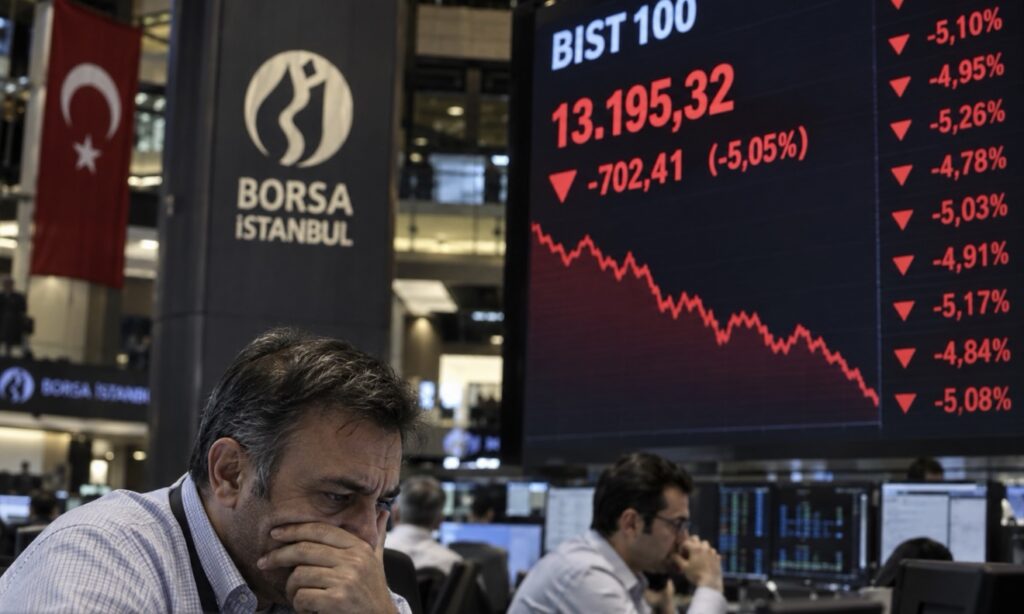
Turkey’s stock market fell as much as 5% Wednesday as a problem that began inside a group of investment funds spread into a broad market selloff.
The BIST 100 dropped to around 13,195, its steepest decline since May. Banks and industrial stocks also fell about 5%, while technology, construction and machinery shares suffered even larger losses.
The immediate concern is liquidity — whether investment funds can raise enough cash when investors ask for their money back.
Pusula Portföy Yönetimi disclosed that some of its funds were unable to make redemption payments on time, resulting in defaults. Investors have pulled roughly 129 billion Turkish lira from Pusula funds since the end of August, according to data compiled by Turkish fund-tracking platforms Fonbul and Fintables.
The damage inside some funds has been extreme. Pusula’s equity-heavy fund has reportedly lost about 92% over that period, while several other portfolios have fallen between 45% and 94%.
That matters far beyond one asset manager.
When investors rush to withdraw money from a fund, the manager needs cash to pay them. If the fund does not have enough cash, it may have to sell stocks quickly — including shares it would otherwise prefer to keep.
Those forced sales push prices lower. Lower prices can trigger additional investor withdrawals and automatic stop-loss orders, creating another round of selling.
That is the fear now moving through Istanbul.
The decline accelerated after the BIST 100 broke below the psychologically important 14,000 level, activating additional stop-loss selling. The index had already dropped 2.41% Tuesday before Wednesday’s losses deepened.
Turkish regulators have also been scrutinizing funds holding large positions in relatively illiquid stocks — shares where a large block cannot necessarily be sold quickly without driving the price sharply lower.
The broader global backdrop is making the problem harder. Oil remains above $100 a barrel, global bond yields are elevated, and investors are awaiting the Federal Reserve’s interest-rate decision Wednesday. Those pressures have already reduced investors’ willingness to hold riskier assets.
For investors, the key question is no longer simply whether several Turkish funds made bad investments.
It is whether funds needing cash will be forced to sell enough stock to drag down otherwise unrelated companies.
That is how a liquidity problem inside a few portfolios can become a market-wide problem.
JBizNews Desk | Istanbul
© JBizNews.com All Rights Reserved. Reproduction or distribution without written permission is prohibited.




