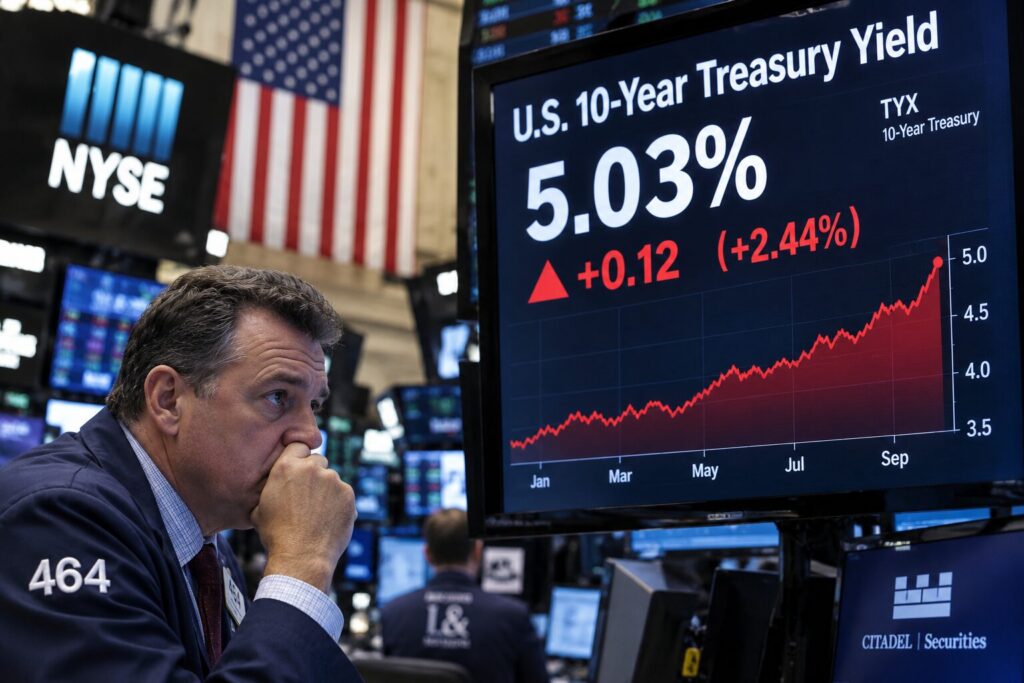
The benchmark U.S. 10-year Treasury yield surged above 5% Tuesday, reaching its highest level since 2007 and adding another layer of pressure on American consumers, businesses and financial markets already dealing with sharply higher oil prices.
The 10-year yield climbed as high as roughly 5.04% during Tuesday’s trading before pulling back, according to market data reported by Reuters. The move marked a level not seen in nearly two decades and came as investors prepared for the Federal Reserve’s next interest-rate decision.
Stock markets reacted negatively. Before the opening bell, Dow Jones Industrial Average futures were down more than 200 points, while S&P 500 and Nasdaq-100 futures also moved lower. Later in Tuesday’s session, the Dow fell roughly 450 points as investors continued to digest the combination of higher Treasury yields, expensive oil and the prospect of tighter monetary policy.
For consumers and businesses, the significance of a 5% 10-year Treasury yield goes far beyond Wall Street.
The 10-year Treasury is an important benchmark for borrowing costs throughout the U.S. economy. Mortgage rates in particular tend to track movements in longer-term Treasury yields. That means a sustained increase in the 10-year yield can make financing a home more expensive, while higher market rates can also raise financing and refinancing costs for businesses and commercial real estate borrowers.
Oil Adds New Inflation Pressure
One of the biggest forces behind the latest bond-market move is the renewed surge in energy prices.
Oil remained above $100 a barrel Tuesday amid concerns about Middle East supplies. Brent crude traded above $107 at points during the session, while U.S. West Texas Intermediate crude moved above $103.
Higher energy prices matter because they can work their way through nearly every part of the economy. Businesses pay more to transport goods, airlines and trucking companies face higher fuel expenses, manufacturers can see operating costs rise, and households may eventually feel the impact at gasoline pumps and through higher prices for goods that must be shipped.
That is especially important for the Federal Reserve because another burst of inflation could make policymakers more willing to keep interest rates elevated — or raise them further.
Markets on Tuesday were assigning a very high probability to a Federal Reserve rate increase at Wednesday’s meeting, with Reuters reporting expectations of a hike had moved close to certainty.
What 5% Means for Homebuyers
For Americans looking to buy a home, the Treasury move is particularly important.
Unlike short-term borrowing costs, which are more directly influenced by the Federal Reserve’s benchmark rate, mortgage rates are closely connected to longer-term bond markets, including the 10-year Treasury.
Thirty-year fixed mortgage rates were already above 6.7% this week, according to CNBC Select. A Treasury yield that remains near or above 5% could make a meaningful decline in mortgage rates more difficult, especially if investors remain concerned about inflation and additional Fed tightening.
Even relatively small changes in mortgage rates can translate into hundreds of dollars in additional monthly payments on a typical home loan, putting further pressure on affordability at a time when many buyers are already struggling with high home prices.
Businesses Face a More Expensive Credit Environment
Businesses could also feel the squeeze.
Higher Treasury yields can translate into higher corporate borrowing costs because government bond yields serve as a baseline for pricing many forms of debt. Companies looking to refinance existing loans, fund expansions, purchase equipment or finance real estate may therefore face more expensive credit.
Commercial real estate is particularly sensitive because properties are frequently financed with substantial amounts of debt. Owners with loans coming due may have to refinance at rates considerably higher than those available several years ago.
The combination of expensive borrowing and $100-plus oil creates an especially difficult environment for businesses that depend heavily on financing, transportation or energy.
Wall Street Watches the Fed
The immediate focus now turns to the Federal Reserve.
Investors will be watching not only what policymakers do with interest rates but also what they say about inflation, energy prices and the direction of monetary policy in the months ahead.
Treasury Secretary Scott Bessent said Tuesday that rising bond yields reflected broader global pressures. Analysts cited by Reuters pointed to higher oil prices, expectations of Federal Reserve tightening, heavy demand for capital and concerns about the U.S. fiscal outlook as factors contributing to the rise in yields.
For households and businesses, however, the practical question is much simpler: How long will borrowing costs remain this high?
If the 10-year Treasury remains around 5%, Americans could face an extended period in which mortgages, business financing and commercial real estate loans remain expensive.
After years in which ultra-low interest rates made cheap borrowing almost routine, a 5% benchmark Treasury yield is another sign that the financial landscape has changed — and that the cost of money is once again becoming one of the biggest economic issues facing businesses and consumers.
JBizNews Desk | Trenton, N.J.
© JBizNews.com All Rights Reserved. Reproduction or distribution without written permission is prohibited.