
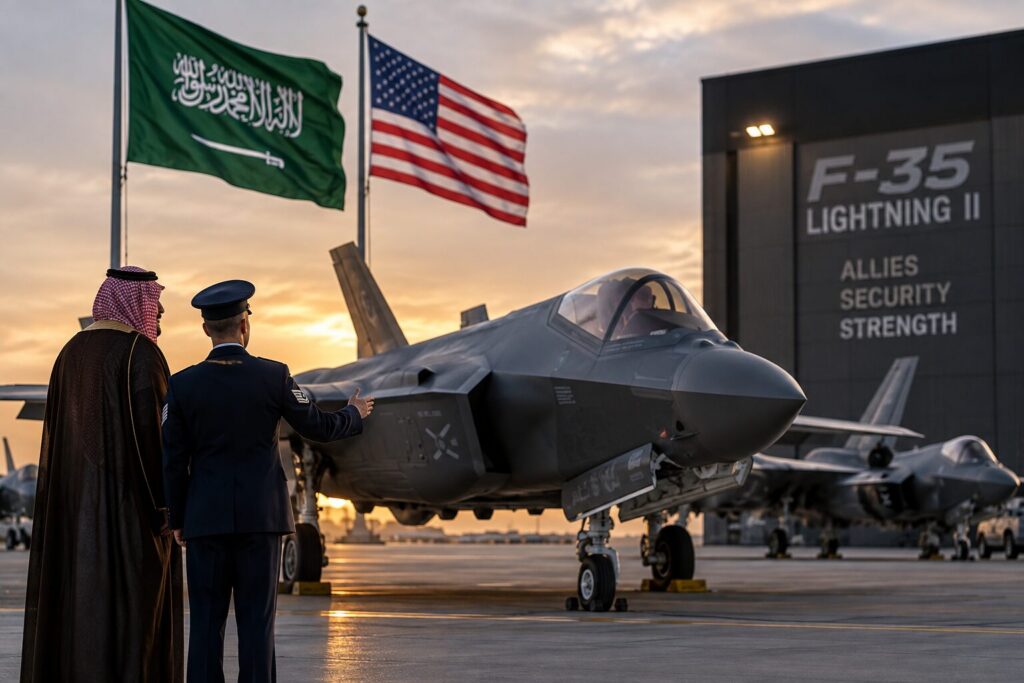
The Trump administration has cleared a potential $24.3 billion sale of 48 F-35 stealth fighter jets to Saudi Arabia, moving the kingdom closer to becoming the first Arab country to operate one of America’s most advanced combat aircraft.
The State Department approved the proposed Foreign Military Sale Thursday and notified Congress, setting up further review before the transaction can move forward.
The package includes 48 Lockheed Martin F-35 Lightning II aircraft and 49 Pratt & Whitney F135 engines, along with secure communications equipment, spare parts, training, software and logistical support.
But the $24.3 billion figure is an estimated maximum value for the proposed package — not a contract already signed with Saudi Arabia. Congressional review remains ahead, and the final value and equipment ultimately purchased could change.
Even if the sale clears the remaining process, delivery would take years.
For the U.S. defense industry, however, the proposal represents a potentially enormous order for one of America’s most important military manufacturing programs.
A $24.3 Billion American Defense Deal
Lockheed Martin is the principal contractor for the F-35, while RTX subsidiary Pratt & Whitney manufactures its F135 engine.
The Saudi package calls for 48 aircraft and 49 engines — enough for one engine per aircraft plus a spare.
The proposed sale also includes secure communications systems, precision-navigation equipment, cryptographic equipment, electronic-warfare support, simulators, software, spare parts, technical documentation, training and logistical services.
That means the economic footprint of the transaction would extend beyond the aircraft themselves and through the F-35’s extensive American defense supply chain.
The F-35 is assembled at Lockheed Martin’s facility in Fort Worth, Texas, while Pratt & Whitney’s F135 program has major operations in Connecticut.
If the sale ultimately proceeds, it would represent years of manufacturing, supply-chain and support work associated with building and maintaining the Saudi fleet.
Saudi Arabia Would Join a Select F-35 Club
Saudi Arabia has never operated the F-35.
Its current combat fleet includes American-made F-15s as well as European Tornado and Typhoon fighters.
Adding the F-35 would represent a major technological upgrade.
The aircraft combines low-observable stealth technology with advanced sensors, electronic warfare capabilities and networked battlefield systems.
Saudi Arabia has sought access to the aircraft for years and made a direct appeal for the jets to President Donald Trump in early 2025.
Trump publicly indicated ahead of Crown Prince Mohammed bin Salman’s November 2025 White House visit that his administration intended to move forward with selling the aircraft to Riyadh.
Thursday’s State Department approval represents a major formal step toward fulfilling that commitment.
Israel’s Military Advantage Is Part of the Debate
The proposal is particularly significant because Israel is currently the only country in the Middle East operating the F-35.
Washington has a longstanding legal commitment to preserve Israel’s “qualitative military edge,” or QME — essentially ensuring Israel retains the military capabilities needed to counter regional threats.
Allowing Saudi Arabia to acquire the same basic fighter platform therefore raises questions about how Washington intends to preserve that advantage.
The State Department said the proposed Saudi sale “will not alter the military balance in the region.”
Israel has operated the F-35 for roughly a decade and has built multiple squadrons around the aircraft.
Saudi Arabia’s proposed purchase would amount to roughly two squadrons.
The exact capabilities provided to foreign F-35 operators can also differ, making the number of aircraft only one element in assessing their relative military capabilities.
Washington Says the Sale Strengthens Saudi Defense
The State Department said the proposed transaction would support U.S. foreign-policy and national-security objectives by improving the security of Saudi Arabia, which Washington designates as a major non-NATO ally.
The department said the aircraft would improve Saudi Arabia’s ability to deter current and future threats, strengthen homeland defense and improve its ability to operate alongside American and other allied forces.
The timing is particularly important.
Saudi Arabia has faced renewed drone and missile threats amid escalating conflict in the Middle East, including attacks associated with Iran-backed Houthi forces in Yemen.
The kingdom is seeking to modernize its military as it confronts those threats while maintaining its decades-long defense relationship with Washington.
Saudi Arabia is already one of the world’s largest customers for American weapons.
In 2025, the United States announced a Saudi defense package valued at nearly $142 billion, which the White House described as the largest defense cooperation agreement between the two countries.
China Raises a Separate Security Concern
The proposed F-35 sale also faces scrutiny over Saudi Arabia’s growing relationship with China.
The concern centers on whether Beijing could potentially obtain information about sensitive F-35 technology through espionage or Saudi military cooperation with China.
The issue is particularly sensitive because the F-35 contains highly classified stealth, sensor and electronic systems.
Similar technology-security concerns have affected previous F-35 transactions.
The United States removed Turkey from the F-35 program in 2019 after Ankara purchased Russia’s S-400 air-defense system, with Washington arguing that operating the Russian system alongside the F-35 could expose sensitive information about the aircraft.
Recent reporting has indicated that U.S. intelligence analysts have raised concerns about the possibility of China obtaining information about F-35 technology through its relationships with Riyadh.
Some members of Congress have already cited those concerns while questioning the proposed sale.
The State Department has said proposed defense transfers undergo assessments required under U.S. law that consider political and economic factors as well as protection of America’s military technological advantage.
The Deal Is Not Final
Despite the size of the announcement, Saudi Arabia has not simply purchased 48 F-35s for $24.3 billion.
The State Department’s approval begins another important stage of the process.
Congress must review the proposed transaction and lawmakers can raise objections.
Congressional scrutiny of U.S. weapons sales to Saudi Arabia is not new.
Some lawmakers have challenged previous deals over issues including the kingdom’s human-rights record, regional military activities and the 2018 killing of Saudi journalist Jamal Khashoggi.
Technology-security concerns and Israel’s military advantage could create additional debate around the F-35 proposal.
Even after government approvals are completed, Saudi Arabia and the contractors would still have to work through the final acquisition and implementation process.
The actual value of the eventual contracts can also be lower than the maximum amount listed in a Foreign Military Sale notification.
What It Means for American Manufacturing
For the American defense industry, the potential order is substantial.
Forty-eight additional F-35s would represent significant production demand for Lockheed Martin and the enormous network of companies supplying components for the aircraft.
The F-35 program supports a broad supply chain spanning numerous U.S. states and international partners.
Pratt & Whitney would also provide 49 F135 engines and associated support.
That makes the transaction more than a foreign-policy story.
If ultimately finalized, billions of dollars would flow through American defense manufacturing, engineering, maintenance and logistics operations.
A Major Deal With Major Questions Remaining
Saudi Arabia is now closer than ever to acquiring the F-35.
But several steps separate Thursday’s announcement from Saudi pilots actually flying the aircraft.
Congress must review the transaction. Technology-security questions remain. Washington must continue addressing its commitment to Israel’s qualitative military edge. Final contracting must take place, and the aircraft themselves would then have to be produced.
Those steps could take years.
What Thursday’s announcement does establish is that the U.S. government has formally opened the door to one of the most consequential American arms sales to Saudi Arabia in years.
For Riyadh, it could transform the capabilities of its air force.
For Washington, it deepens an already extensive defense relationship while raising difficult questions involving Israel, China and the regional military balance.
And for America’s defense industry, the potential order represents another massive source of demand for the F-35 production line and the U.S. workers and suppliers supporting it.
For now, the $24.3 billion transaction remains a proposed sale — but Washington has taken a major step toward making Saudi Arabia the Middle East’s second F-35 operator.
JBizNews Desk | Washington, D.C.
© JBizNews.com All Rights Reserved. Reproduction or distribution without written permission is prohibited.




