American investigators are examining whether money tied to a Shanghai-based businessman with longstanding links to pro-Beijing organizations helped finance groups involved in pro-Palestinian demonstrations in Britain, widening a U.S. foreign-influence inquiry that had already reached activist organizations operating inside the United States.
The investigation centers on Neville Roy Singham, an American technology millionaire who lives in Shanghai and has financed a network of nonprofit and activist organizations across several countries. U.S. lawmakers have spent years examining whether that network has acted independently or whether some of its political activity has advanced the interests of the Chinese Communist Party.
The latest scrutiny reaches into Britain.
According to reporting by The Telegraph, a British company connected to the U.S.-based activist organization Code Pink received more than $250,000 in 2020 and 2021 from entities suspected of being part of Singham’s funding network. The same company received another $94,950 in 2024 from a fund also believed by investigators to be connected to that network, with the payment described as compensation for consulting services.
Those financial transfers do not establish that Beijing financed pro-Palestinian demonstrations, and investigators have not publicly produced evidence showing that the Chinese government directly paid organizers of the marches.
That distinction is important.
What authorities are examining is whether money originating within a private funding network closely associated with Singham eventually reached organizations engaged in political activity that aligned with Chinese foreign-policy interests — and whether any of those relationships required disclosure under U.S. foreign-agent laws.
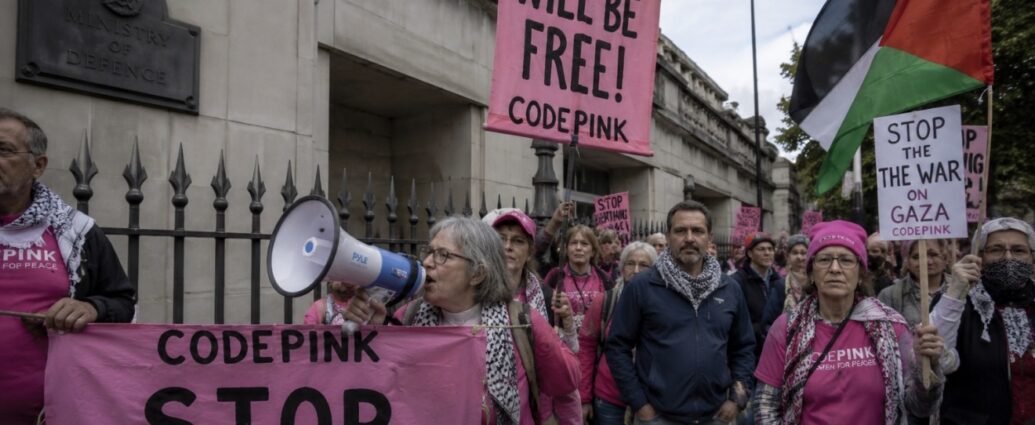
Code Pink has become part of that inquiry because of both its funding relationships and its political activity. The organization has encouraged participation in large pro-Palestinian marches in Britain and has organized demonstrations outside the British Ministry of Defence and the London offices of a weapons manufacturer.
Singham is married to Jodie Evans, one of Code Pink’s founders.
The financial relationship has drawn increasing attention in Washington. Senate Judiciary Committee Chairman Chuck Grassley said last year that evidence suggested Code Pink and The People’s Forum had been “funded and influenced” by Singham and the Chinese government and asked the Justice Department to examine whether the organizations should register under the Foreign Agents Registration Act.
Sen. Tom Cotton separately asked the Justice Department in November 2025 to investigate Code Pink, saying the organization had received more than $1.4 million since 2017 from sources linked to Singham. Cotton said that represented roughly one-quarter of the group’s funding during the period he examined.
Those claims remain allegations, not findings of criminal wrongdoing.
The inquiry surrounding Singham has nevertheless moved beyond congressional letters.
A federal grand jury in New York is investigating Singham and financial activity involving nonprofit organizations associated with his network. CBS News reported in July that investigators were examining possible violations of the Foreign Agents Registration Act as well as tax and nonprofit-financing issues.
The House Ways and Means Committee has also intensified its investigation. Chairman Jason Smith said in June that a federal grand jury had begun issuing subpoenas as part of the Justice Department inquiry, while congressional investigators have separately sought records involving tens of millions of dollars flowing through organizations tied to Singham.
At the center of the legal question is not whether an American citizen may finance controversial political causes. That is generally protected activity. The issue is whether organizations were acting at the direction or under the influence of a foreign government while engaging in political activity in the United States without making disclosures required by federal law.
Foreign Agents Registration Act cases are built around control, direction and transparency, not simply whether a donor lives overseas or holds views favorable to another country.
Singham has denied acting on behalf of China. He has said he is not a member of any political party, does not represent any government and supports the organizations in his network because of his own political beliefs.
Code Pink has likewise denied receiving funding from the Chinese Communist Party. Co-founder Medea Benjamin has said the organization does not take money from the CCP, and the group has rejected congressional allegations that its activism is controlled by Beijing.
That leaves investigators with a difficult financial trail to establish.
Private foundations, donor-advised funds, nonprofit entities and companies can move money through multiple layers before it reaches the organization that ultimately spends it. A payment originating from a Singham-associated organization is not automatically a payment from the Chinese government, which is why investigators are examining the relationships behind the transactions rather than simply following the final bank transfer.
The British connection raises the stakes because it suggests the inquiry may no longer be limited to political activity inside the United States.
If investigators establish that a common funding network supported activist organizations operating in multiple Western democracies, the question becomes broader than Code Pink or any individual protest. Governments would have to determine whether foreign political influence is being exercised through organizations that outwardly operate as domestic grassroots movements.
For pro-Palestinian demonstrators themselves, there is no evidence that ordinary marchers knew of, received or were directed by any foreign funding network. Hundreds of thousands of people have participated in demonstrations for a wide range of personal, political and humanitarian reasons.
The unresolved question sits farther upstream: who financed the organizations helping mobilize parts of that movement, where that money ultimately originated, and whether anyone else was directing how it was used.
That is now what investigators in Washington are trying to find out.
JBizNews Desk | Washington
© JBizNews.com All Rights Reserved. Reproduction or distribution without written permission is prohibited.