
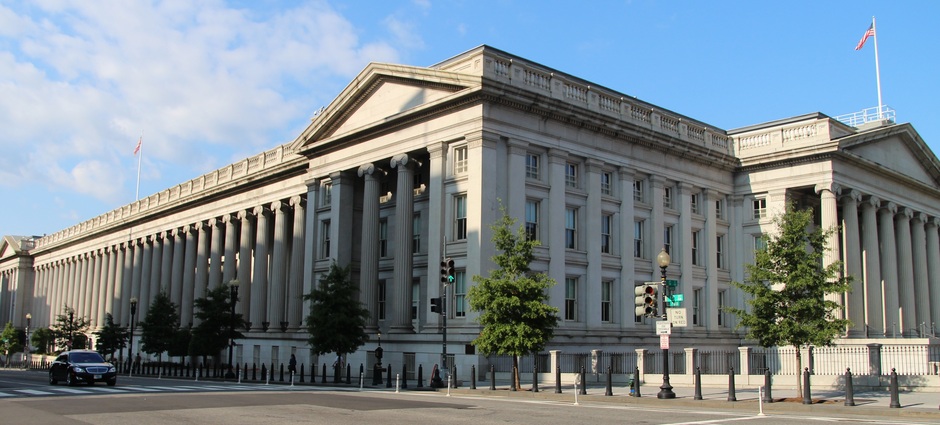
U.S. Treasury Building, Washington, archive photograph (August 2012). Rchuon24 / Wikimedia Commons, CC BY-SA 3.0. Cropped; photograph adaptation under the same license.

The United States imposed sanctions Wednesday on a Lebanese charity, its founder and a gold-and-cash network that the Treasury Department accuses of helping finance Hezbollah. The action blocks covered assets and generally bars U.S. persons from transactions involving the designated parties unless an exemption or authorization applies.
The Treasury Department’s November 18 announcement targets the Wa Ta’awanu Association and its founder, Afif Abdel Rida Chouman, along with brothers Hassan and Ibrahim Khechen and two companies. The Office of Foreign Assets Control’s sanctions-list update confirms that all three individuals and three entities were added to its Specially Designated Nationals list.
Treasury says the measures are part of its effort to disrupt financing for Iran’s regional proxies. The designations are sanctions actions based on the department’s findings, not announcements of criminal convictions.
Charitable services and gold trading under scrutiny
Treasury alleges that Wa Ta’awanu provides emergency relief in southern Lebanon while also channeling outside donations toward Hezbollah’s activities. It says the charity provides cover for the group’s operations in areas where Lebanese authorities are seeking to remove fighters and weapons.
The department says Chouman leads the association and coordinates its activities at Hezbollah’s direction. It designated both the charity and its founder for providing support to the group.
The separate gold-and-cash allegations concern funds Treasury says moved from Iran’s Islamic Revolutionary Guard Corps-Qods Force to Lebanon on Hezbollah’s behalf.
Treasury identifies Hassan Khechen as the owner of Lebanon-based Gold Global Company and says he used the business and a courier network to move funds. It alleges that his brother Ibrahim participated in the network, while Türkiye-based Sankari Gold Kuyumculuk Ticaret Limited Sirketi, also controlled by Hassan Khechen, helped move gold bullion and cash from Africa.
The two brothers were designated for providing support to Hezbollah. The companies were designated for being owned, controlled or directed by, or acting for, Hassan Khechen, according to Treasury.
What the sanctions change for businesses
The immediate business consequence is a restriction on access to property and transactions covered by U.S. sanctions rules. Property belonging to the designated parties that is in the United States, or held or controlled by U.S. persons, is blocked and must be reported to OFAC.
The restrictions also extend to entities owned 50 percent or more, directly or indirectly and in aggregate, by one or more blocked persons. A business therefore can be covered even if its own name does not appear separately on the sanctions list.
Transactions by U.S. persons, or within or passing through the United States, involving covered property are generally prohibited unless licensed or exempt. Blocking property is not the same as announcing that every asset worldwide has been seized.
Treasury also warned that foreign financial institutions can face sanctions exposure for certain significant transactions involving the designated parties. The action puts banks, payment providers, precious-metals businesses and donors on notice about the newly listed names and the ownership rules that accompany them.
JBizNews Desk | Washington
© JBizNews.com. All rights reserved. Unauthorized reproduction or redistribution is strictly prohibited.







