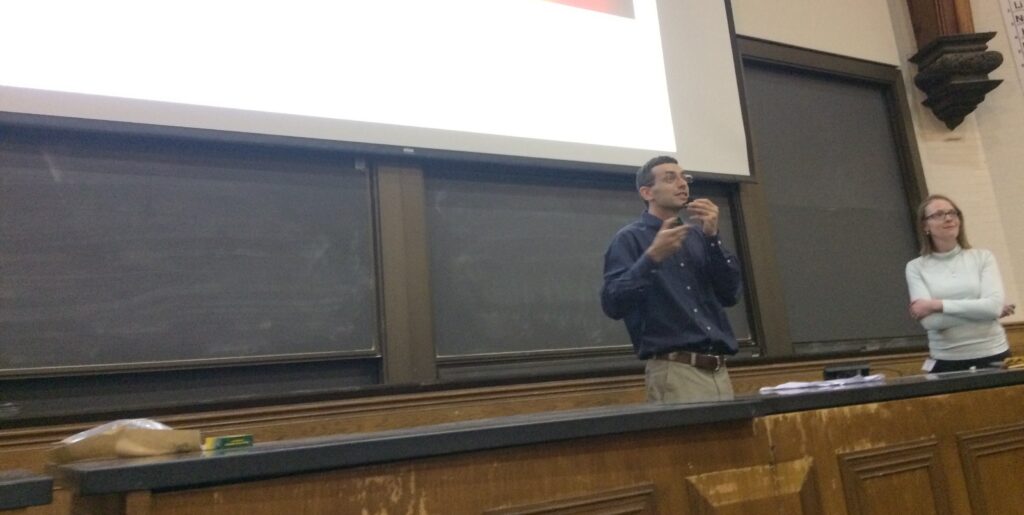
Courtesy of Dan Margalit
Artificial intelligence can accelerate mathematical work without replacing the human ideas and checking behind it, Vanderbilt mathematics chair Dan Margalit argues in an assessment of AI-generated proofs.
In an interview published by Axios on November 4, Margalit described AI as a tireless finisher of work humans have already brought close to a solution, rather than an independent source of every important mathematical insight.
His assessment is an expert’s view of how mathematical work is changing, not a claim that every AI-generated proof is correct or that every reported breakthrough has been independently confirmed.
Human ideas still supply the starting point
Margalit said the problems AI solved were those for which human research had already supplied useful paths. He contrasted those successes with problems where the existing literature offered less direction.
The distinction is between extending known ideas and choosing an original, worthwhile question. Margalit sees a continuing role for mathematicians in framing problems and deciding which lines of inquiry deserve attention.
A proof still needs checking
Margalit also pointed to mistakes found as mathematicians reviewed AI-produced solutions. According to his account to Axios, some papers faced retraction after reviewers identified logic errors.
That makes verification part of the work, not a step that disappears once a system produces a polished answer. A plausible-looking proof can still contain a flawed inference.
He compared the systems’ search through combinations of known theorems with the way computers explore possibilities in chess and Go. The scale of the computation can be impressive without resolving the separate question of mathematical understanding.
A tool for harder questions
Margalit offered software for calculating integrals as a precedent: automation took over work that once filled books, allowing researchers to spend time on harder concepts instead.
Under that view, AI could change what mathematicians spend their days doing while leaving the search for understanding at the center of the discipline.
“Mathematics is the human endeavor of understanding,” he told Axios. His argument is that an answer and an explanation are not interchangeable, and that human judgment remains important even when machines become faster at producing candidate solutions.
Vanderbilt appointed Margalit department chair in 2023. His research focuses on low-dimensional topology and geometric group theory.
JBizNews Desk | Nashville
© JBizNews.com. All rights reserved. Unauthorized reproduction or redistribution is strictly prohibited.