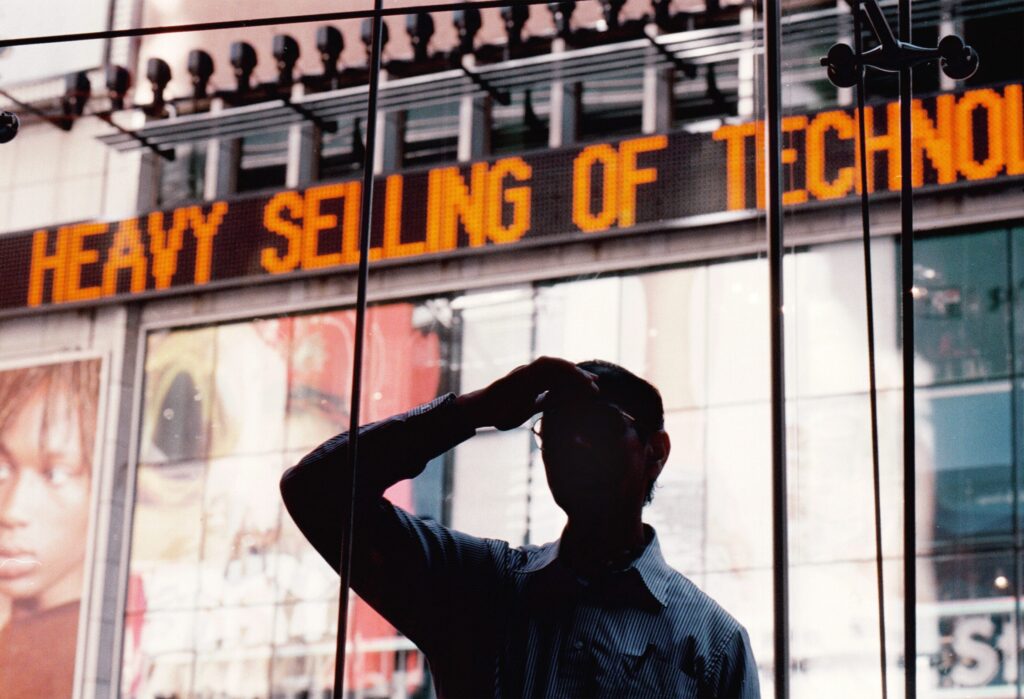
The Nasdaq fell about 5% on Thursday and the S&P 500 nearly 4%, just a day after Wall Street had cheered the Democratic sweep of Congress.
By early Thursday afternoon, the Nasdaq dropped 5.2% and the S&P 500 3.8%, and the Dow was down 2.9%, or more than 1,500 points. The S&P 500 fell as low as 7,394.49, below where it closed on Election Day. Thursday’s drop off seemed to hit AI and tech stocks the hardest: the Philadelphia Semiconductor Index was down about 9.75% in a Reuters intraday snapshot and briefly fell as much as 11%, on track for its steepest daily loss since March 2020. Among other AI-related stocks include AMD and Micron, which each lost roughly 15%, and Nvidia fell almost 9%.
But the drop came a day late. On Wednesday, the Dow rose 1,569 points, or 3%, its best performance after a midterm election in 44 years. The S&P 500 rose 1.6% to 7,688.62, as oil fell more than 8% and investors seemed to hope that a divided government would mean steadier policy.
But by Thursday, U.S. stocks had shed roughly $3 trillion in market value, and the Dow was heading for its worst second trading day after a midterm in data going back to the index’s start in 1896.
Are Democratic policies inherently anti-AI?
Perhaps part of the reason for the huge hit to the AI and tech sectors could be because of the Blue Tsunami. There were 41 ballot measures regarding slowing down data center buildouts, and most of them passed, especially in Ohio. So the midterm risk to AI was showing up on Wednesday, but only in parts of the market, before it showed up in full Thursday.
Vistra plunged 14% and Vertiv fell 13% on fears of data center moratoriums, while Nvidia slipped only 3% on Wednesday. Smaller AI cloud providers such as CoreWeave were also hit hard, since a permitting slowdown in Texas would hurt operators like CoreWeave before it reached the hyperscalers that are their main customers. Meanwhile, some of the biggest tech companies—which pay for the build-out—saw their stocks rise. Some analysts and economists argued political pushback could let air out of an inevitable AI bubble without popping it.
That’s when Asian markets started selling off overnight: South Korea’s Kospi closed down 5.28% with trading halts during the session, Taiwan’s main index fell 3.2% and the Nikkei 1.79%. By Thursday, the largest U.S. tech names had joined the decline: Tesla dropped as much as 10%, Qualcomm fell 11.2% and Arm Holdings 11% after weaker technology earnings. Oil prices also rebounded following Wednesday’s drop.
While the losses were most concentrated in tech, four of the S&P 500’s 11 sectors were up on the day, including consumer staples, which rose 1.5%, and Berkshire Hathaway hit an all-time high.
Texas is the main source of worry about the build-out. Democrat Gina Hinojosa, who wants an immediate moratorium on new data centers, beat Republican Gov. Greg Abbott—Wells Fargo estimates 27% of planned data center gigawatts are in Texas. Amy Acton in Ohio and Keisha Lance Bottoms in Georgia also campaigned on restricting data center development.
The opposition is not purely partisan. Abbott paused new data center permits in September pending a grid audit, and Hinojosa campaigned on extending that moratorium. Hinojosa likely won’t need a new law, since Abbott’s pause on grid connections already freezes data center permits.
This story was originally featured on Fortune.com