Pity poor Rahm Emanuel.
There he went and traveled all the way to Israel last week to gain attention for his nascent presidential campaign by criticizing Israel on Israeli soil, only to be upstaged by Ro Khanna, another Democratic presidential hopeful, who got even more coverage for attacking the Jewish State even more aggressively.
True, Emanuel, as Jonathan Tobin pointed out in a JNS piece on Thursday, understood exactly how to command national media attention. Even before he delivered his speech at Tel Aviv University, The Washington Post devoted three separate articles to previewing it, while The New York Times, CNN, and other major outlets also highlighted his planned remarks. Afterward, they returned with extensive follow-up coverage.
Emanuel, despite barely registering in early Democratic presidential polling, succeeded in making a speech in Israel one of the biggest political stories of the week. How? By signaling in advance that he was coming to Israel to sharply criticize the Israeli government.
If you want national media attention, blast Israel.
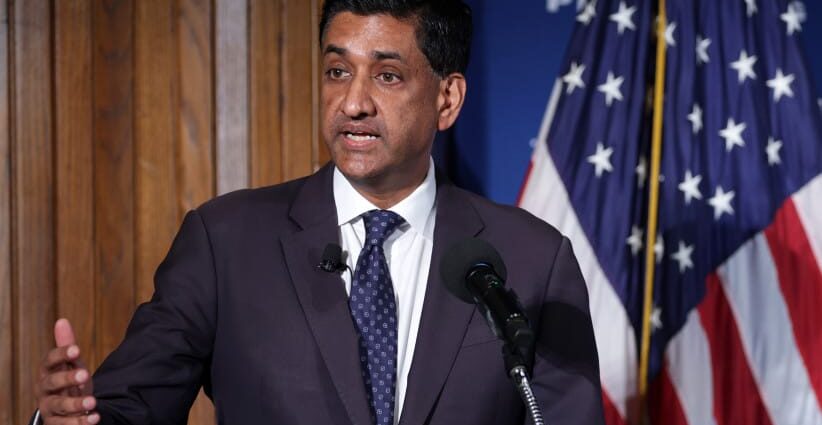
But then Khanna went and upped the ante. He came to Israel, did not meet Israelis, reportedly refusing to do so, went to Judea and Samaria, where his van was blocked.
Khanna has his side of the story, the IDF has a significantly different version
Khanna said he was stopped by settlers with “arrogance in their eyes” and then by IDF soldiers who backed the settlers. The IDF version was significantly different.
Ordinarily, one would like to believe a US Congressman, especially one with presidential aspirations.
But when he comes on a visit exclusively to the West Bank, when he says that being in Israel and the West Bank was the first time that he “really was acutely aware of being brown,” when he says Israel is committing genocide and is guilty of apartheid in the West Bank, two blatant lies, then there is no reason to believe him about Israel on anything else.
These incidents, taking place just days before the sudden, tragic death of Lindsey Graham, one of Israel’s greatest champions on Capitol Hill this generation, a champion in the Henry “Scoop” Jackson, Daniel Moynihan, Daniel Inouye, John McCain, Joe Lieberman mold, throw in stark relief how the tide is shifting for Israel in the US. Pro-Israel support is ebbing, while anti-Israel positions and personalities are rising.
Not too long ago, any presidential hopeful, including Graham in 2015, would come to Israel to burnish foreign policy credentials and show support for the Jewish state in an effort to win over both voters and donors.
Before the 2016 campaign, there was a veritable parade of presidential hopefuls, from Elizabeth Warren among Democrats, to Ted Cruz, Ben Carson, and, yes, Donald Trump among Republicans.
Now the opposite is the case.
Jews once looked to see whether a candidate passed the “kishka test,” whether he or she had a special place in their heart for Israel, with visits here often serving as one indication. Today, many would settle for a candidate who simply doesn’t harbor hostility toward the Jewish state.
Khanna’s aide Cameron Kasky posted on X/Twitter that the congressman and his delegation “got intercepted and captured by settlers wielding American-made rifles. The IDF showed up to back up the settlers, not the US Congressman.”
Khanna posted a thank you “to all those who reached out asking about my safety.” One of those most concerned was Tucker Carlson, he of the story of his own detention, since debunked both by Israel and the State Department, when he came to the airport in February to interview Mike Huckabee.
Israel can do a better job of challenging narratives
Israel cannot change the direction of Democratic presidential politics. It can, however, do a much better job contesting the narrative.
It is not enough simply to dismiss incidents like this as political theater, though they almost certainly are. If Khanna and his staff’s account is inaccurate, and certainly saying the congressman was “captured” certainly is, then Israel must immediately, comprehensively, and loudly release the facts: why he was stopped, whether the visit had been coordinated, whether he entered a closed military zone, and what instructions security forces had received.
The New York Post reported on Sunday that the trip was paid for by the Khanna campaign. And that’s what it was: a campaign trip and stunt. Asked whether he was going to run for president, he said, “I’m strongly considering it, and I’m more resolved to consider it after this trip.”
Ah, Khanna has now found his cause.
As one Jewish political activist in his district told me, Khanna is “a very astute politician who knows which way the winds are blowing, and flows in that direction.” If he believes anti-Israel activism is now his path to the Democratic nomination, that should worry anyone who cares about the future of the US-Israel relationship.
US representatives supported Israel because their constituents supported Israel, which polls show has changed
When Israel enjoyed massive bipartisan support in Congress, one question was often asked: Why were representatives from states such as Idaho, South Dakota, and Tennessee – with their small Jewish populations – so supportive of Israel?
And the answer always given was because the representatives, many of whom were not well acquainted with the intricacies of the Middle East, followed the lead of the public. The perception was that the public supported Israel, at least significant constituencies such as the Jews and the Evangelicals, and as a result, it was good politics to do the same.
The recent polls, including one by AP last week that showed that one in three Americans believes Israel committed genocide in Gaza, show that now the opposite is the case. The perception is that the public does not support Israel – and the reasons for this are manifold.
Yes, some has to do with Israeli actions, with irresponsible statements by government ministers, with Israel’s closeness to US President Donald Trump. Some also has to do with the fact that lies about Israel, such as the genocide libel, have just been allowed to trickle down without sufficient pushback, neither from Israel nor Israel’s supporters abroad.
When The Denver Post, in an editorial ostensibly supportive of Israel following the recent primary victory of Melat Kiros – who, the paper noted, “has made ending Israel a cornerstone of her campaign,” writes matter-of-factly about “an ongoing genocide in Gaza” and refers to the prime minister as the “mastermind of this genocide,” something is clearly not getting through.
Some people’s minds, for whatever reason, are already made up and cannot be convinced otherwise. But another reason these narratives gain traction is that they often go unanswered.
That vacuum creates opportunities for ambitious politicians. Figures like Khanna, who, incidentally, represents a Bay Area district with a significant Israeli-American and Jewish population, see an issue that energizes progressive donors, excites activists and generates national media attention.
Expect to see more of this as the Democratic presidential race gathers momentum. For an increasing number of candidates, criticizing Israel, not embracing it, is becoming the politically rewarding position.
Which brings us back to Lindsey Graham.
His passing marks more than the loss of one of Israel’s staunchest friends on Capitol Hill. It comes at a time when Democratic presidential hopefuls increasingly see political advantage in attacking Israel rather than embracing it. The juxtaposition is striking.