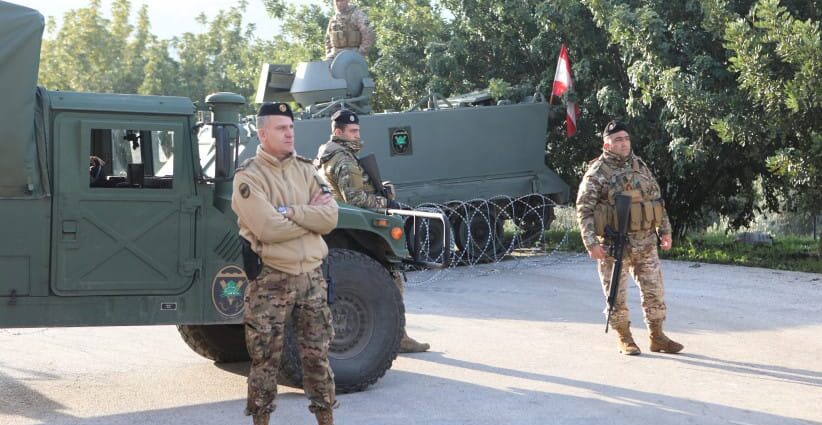
There is heavy skepticism from the IDF about how effective the Lebanese army will be in keeping the peace versus Hezbollah attempts to rearm and restore its capabilities for threatening Israel, IDF Givati Brigade Chief Col. “E” told The Jerusalem Post in a recent interview.
“We are skeptical about their abilities because their power is nothing compared to Hezbollah, but maybe the legitimacy it [allowing the Lebanese army to try peacekeeping] gives us will create some change. We need the Lebanese army to undermine Hezbollah,” said E.
In addition, the IDF Givati Brigade chief said that this legitimacy was critical after October 7.
“We are no longer naive after October 7. We cannot go to sleep. We would prefer to go back to a state of quiet, but we live in the jungle of the Middle East, and we cannot forget this. We need to remember everything that happened to us. We need to be offensive-minded and ready to strike harder and faster in the next round than in this past round,” he said.
IDF Givati Brigade Weapons Commander Lt.-Col. “I” described to the Post watching the Lebanese army move into certain areas where the Givati Brigade was leaving.
According to “I”, higher-level IDF and US officials handled the transition and handover of territory coordination, with I and his forces observing the Lebanese army from a safe distance for a period of minutes.
Curiously, this handover of land occurred some days before the IDF officially acknowledged transferring territory in two key spots in southern Lebanon over to the Lebanese army.
This transfer is being coordinated by US Lt.-Gen. Clearfield, who was the main coordinator with Israel and Lebanon on such issues from fall 2024 until the recent war, with support from around 30 other American military officials.
An official for CENTCOM’s Marine Corps Command (MARCENT), relating to CENTCOM’s Military Coordination Group for Lebanon, declined over the weekend to provide more specific updates about how the transfer of territory was going so far.
Clearfield visited Lebanon amidst regional concern
However, the Post understands that Clearfield met with IDF Chief of Staff Lt.-Gen. Eyal Zamir on July 1 and secretly visited Lebanon on July 2.
Questioned about what impact the June agreement between the US, Israel, and Lebanon will have on future IDF actions and potential withdrawals from Lebanon, he responded, “the IDF is not part of this. We know our place. There is a democratic state,” where the political echelon makes such decisions, and the IDF carries out orders.
But he noted that, “the IDF proved that there is no task it cannot do, including on multiple fronts at the same time. It can handle any threat. If the state makes the required decision, we will carry it out. We are the best trained force in the Middle East – and after this war, in the world.”
Discussing the Givati Brigade accomplishments, he said, “We are always defeating the enemy, destroying its infrastructure, and pushing the threat it can pose backwards and away from the Israeli border.”
Givati Brigade killed hundreds of terrorists, though suffered IDF losses as well
He said that the Givati Brigade had killed over 200 Hezbollah terrorists.
“We also lost people [soldiers], which was hard. Eight soldiers were killed, including the commander of the 52nd battalion,” and there were some dozens of wounded soldiers, though most of the wounds were light,” he said.
In relative terms, he said this was smaller losses than might have been expected, and there were relatively few major battles, though losing even one soldier is painful.
One theme which the Post had heard from multiple IDF commanders on the ground in Lebanon, including during a Post visit to the Lebanese coastal areas, was that there had been weeks of frustration at the earlier stages of the war, when the IDF General Staff and cabinet held them back from penetrating deeper into Lebanon, including crossing the Litani River.
These same officials had expressed great relief and satisfaction when mid-war, Israel authorized them to advance deeper into southern Lebanon.
Questioned about this experience, E said, “We waited, but we were always ready. So two hours after we got the order that we could advance, we were already on the move. Hezbollah was stunned at how fast we advanced.”
He added, “It is important to give respect to the enemy, but they cannot always perform at the level which we expect of them, and here, we hit them fast. The enemy cannot hold its ground versus a full-force IDF onslaught with supporting heavy firepower.”
Pressed to address the challenge of Hezbollah’s FPV drones which caused a rolling list of IDF casualties for several weeks leading into the end of the war, E responded, “Over the course of any war, both sides have surprises which you know [something] about or do not know about at all. Very rapidly you adapt to it and continue.”
Drone attacks are ‘not a huge thing’
He stated that the first-person view (FPV) drone attacks “got lots of headlines. But it is [just] drones. It is not a huge thing. We were struck by it, but then we also met it head on, and already now we are barely ever hearing about it because we got better” at combating the threat.
“The enemy was excited with its strategic success in the media [about the drones], but the success of the drones went down even before the ceasefire,” he declared.
In addition, he said that Israel “will develop [new] technologies” in the future to better combat the drones, though he said to his troops, “we have to deal with new threats even until that technology is ready.”
Returning to “I”, the Givati weapons officer told the Post, “we fought for three years in every part of Gaza and…then during the current war in Lebanon in a few places, including El-Khiam, Bint Jbail, and the Beaufort Castle ridge area. We joined up with the 36th Division to cross over the Litani and to take over various ridges.”
He said that Givati took away Hezbollah’s assets both above and below ground, eliminating their ability to invade or fire anti-tank missiles on Israeli villages.
According to “I”, the combination of the Givati ground forces supported by air power, artillery, tanks, and vast intelligence resources working in perfect synergy led to defeating Hezbollah at every point of contact.
Addressing the FPV threat, I stated, “We learn all the time from what happens in battles, and we are even better now than we were a couple of months ago. We always have new tactics, including for identifying the drones. We are in a different place now. It remains a challenge, but we have responses.”
If needed, he said, “we will return to beat them again. They can pick whatever strategy they want; we are the IDF and Givati. The spirit of the brigade is not something I can explain in words. But there is nowhere we cannot get to.”