Many Israelis and Diaspora Jews were rightly appalled and enraged this week when they learned that a man was arrested for displaying a Palestinian flag on his kippah. When police returned the kippah to its owner, the Palestinian flag had been cut out of the now-defaced skullcap.
Yet this was no isolated incident of abuse by the Israel Police, nor can it be separated from a much bigger problem. The writing has been on the wall for long enough: The police do as they please and answer to no one. But more importantly, the police have been given free license to do so by none other than Israel’s Supreme Court and its proxies.
Too few seem to realize that the staggering ease and the infuriating impunity with which our police regularly break the law is not a bug of corrupt government, but rather a feature of judicial supremacy.
I discuss this symbiotic relationship at length in a chapter titled “Criminal Injustice,” in my new book on Israel’s Supreme Court. Yes – our national police force regularly infringes on statutory rights, flouts the law, and engages in the most egregious abuses. Yes – it does so with unbearable ease and rare consequences. Yes – anyone paying attention was not surprised by the kippah-flag affair.
The Supreme Court hinders police accountability
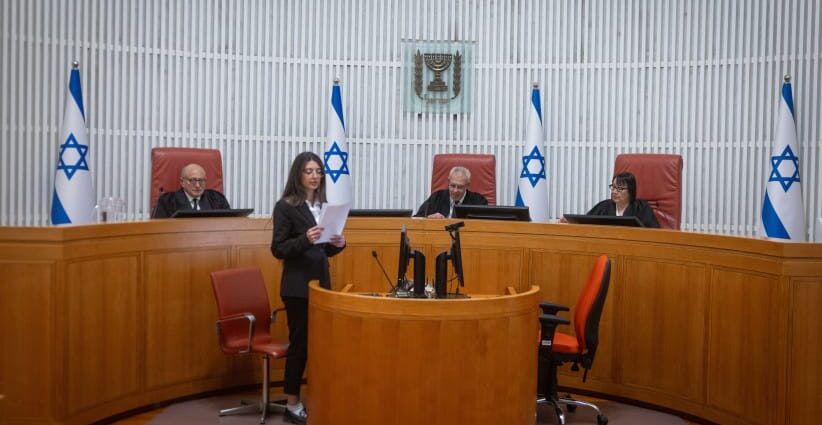
But the simple and far less obvious fact is that the greatest obstacle to improving police accountability – indeed, perhaps the greatest beneficiary of police abuses and lawlessness – has been the Supreme Court itself. All too often, such violations of core individual rights, or police insulation from scrutiny of any kind, have been in the service of ultimate and unfettered judicial power.
How does this work? Using its unparalleled autonomy, insulated from top-down political supervision and from bottom-up communal accountability, the police have emerged as among the court’s most faithful and brutal enforcers of judicial supremacy. In return, the court has ensured that the police evade legislative and public efforts at reigning it in.
Just ask Dror Hoter-Ishay, chairman of the Israel Bar Association in the 1990s, who was hounded out of office by spurious police investigations, after criticizing the court’s activism too sharply. Ask dozens of senior politicians and policymakers considered adverse toward the court’s agenda, who found themselves embroiled in bogus (and ultimately failed) criminal proceedings – prompting future-president (then-MK) Reuven Rivlin to coin the term “the rule-of-law thugs.”
Or ask Shira Shpitz, who in 2020 was arrested, cuffed, and driven away on Shabbat in front of her distraught children, all because she mumbled “Mishpatim busha” (“a disgraceful legal case”) to attorney-general Avichai Mandelblit, while walking past him on the way home from Shabbat morning prayer services.
Ask the bereaved family of Yacoub al-Qian, an Israeli citizen whose killing in 2017 by police was covered up so as not to undermine the police’s public image during the investigations against Prime Minister Benjamin Netanyahu. For that matter, ask Zvika Klein, the editor-in-chief of this newspaper, after his shameful arrest and gross mistreatment by the police in its pursuit of the stalled “Qatargate” investigations.
These examples – just a few among many – are, of course, small fry, but police disregard for basic legality or individual rights tells a larger story. In the Itzhaki affair, the police had compiled a secret mega-dossier with dirt – not part of any formal investigation – against a large portion of Israel’s elected politicians. In the Pegasus affair, it turned out that the police were spying on civilians, including those not suspected of any criminality, with advanced espionage software and at a massive scale, without the remotest legal authorization.
Both examples are widely regarded as tools to intimidate and suppress the electorate and their elected representatives; both were, and remain, especially relevant in the context of threats to judicial power.
Police transgressions going unpunished
For its part, the Supreme Court has been deeply sympathetic and magnanimously forgiving of such police transgressions. The court has consistently ruled evidence admissible even when unlawfully obtained.
It has now become common practice for the police to seize phones first and ask questions (or get a warrant) later; and witness “testimony” given under severe duress is regularly admitted and tolerated by courts, including in the most high-profile and publicly-visible cases. Generally speaking, our courts are among the most pro-prosecution and anti-defendant in the world.
But the Supreme Court really delivers on its side of the bargain when it comes to public oversight. In 2020, the court effectively torpedoed a new Government Commission tasked with reviewing the effectiveness of the Police Investigation Department, which investigates police misconduct, and so ensured that it remains indefinitely under the thumb of the court’s primary proxy and ally, the legal counsel to the government.
In 2022, the court struck down a major piece of legislation that would have granted greater ministerial (that is, elected and accountable) control over broad police policy and priorities. Since 2023, the court has consistently hampered, hindered, and ultimately thwarted the work of a government commission investigating the Pegasus affair.
These examples are not trivial, nor are they incidental – our country’s Supreme Court goes to great lengths to ensure that our police evade meaningful public scrutiny and civilian oversight of any kind.
In 2024, the National Police Commissioner declared that “the Israeli police must remain autonomous! Independent!” By this, he apparently meant autonomous of the electorate and public, and independent of the law.
The Supreme Court seems to agree, as long as the police continue to augment and sustain the court’s vision of judicial supremacy. Small wonder, then, that the result is a patrol officer arresting a civilian for an objectionable symbol on his kippah. Until we recognize the sinister line connecting police impunity and judicial omnipotence, we can expect many more arbitrary arrests, seized phones, and vandalized kippot.
The writer, an Israeli-American attorney, is the author of Rogue Justice: The Rise of Judicial Supremacy in Israel (Academica Press, 2025). He is a Fellow at the Georgetown University Center for the Constitution.