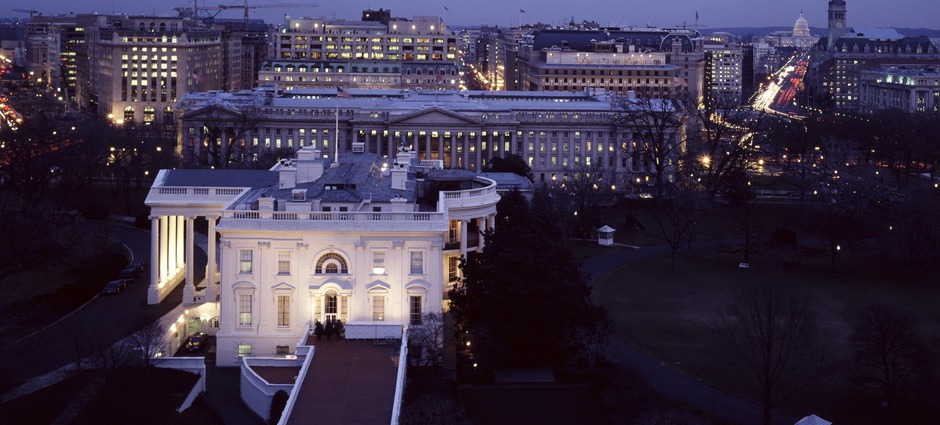
The White House at dusk. Archive photograph, 1980–2006, not Wednesday’s events. Carol M. Highsmith / Library of Congress. Public domain. Cropped.
White House counsel Will Scharf on Wednesday, November 18, told Democratic lawmakers preparing to take over congressional committees that the executive branch is under no obligation to answer oversight demands issued while they are in the minority.
In a letter addressed broadly to ranking members of the House and Senate and made public Wednesday, Scharf argued that their requests in the 119th Congress “do not trigger any obligation” for the executive branch to accommodate them. He also said those requests would not carry over when the 120th Congress convenes in January, even if some of the senders become committee chairs.
The White House’s argument
Scharf cited a May 1, 2017, Justice Department Office of Legal Counsel opinion distinguishing requests from individual lawmakers from oversight conducted by a chamber or an authorized committee.
That opinion says individual members, including ranking minority members, can request information but do not exercise delegated oversight authority unless a chamber, committee or subcommittee has specifically authorized them to do so. The executive branch may answer those individual requests at its discretion, the opinion says. Scharf wrote that the Biden administration took the same position in 2022.
Whether the new letter had actually reached committee leadership was disputed. A spokeswoman for the House Judiciary Committee said the panel had not received it. Making a letter public is not the same as establishing that each intended recipient received it.
Democrats reject the warning
Rep. Jamie Raskin of Maryland, the Democrat in line to chair the Judiciary Committee, said officials and others receiving duly issued congressional oversight inquiries should cooperate. He urged recipients to disregard what he called “third-party ‘advice’ to obstruct and defy Congress on the basis of specious legal theories.”
Earlier Wednesday, Rep. Robert Garcia of California, the ranking Democrat on the House Oversight and Government Reform Committee, announced 12 document-preservation notices concerning figures associated with Trump and his administration.
Garcia said the investigations were intended to identify gaps in existing law and support legislation. The release described the notices as groundwork for future probes and demanded that relevant records and communications be retained. The allegations underlying those investigations are not findings that the recipients committed wrongdoing.
A dispute over authority, not a court decision
Scharf’s letter sets out the White House’s legal position. It is not a court ruling resolving the status of any particular congressional request. Nor is the question of whether a minority member’s letter compels a response the same as whether records must be preserved.
The dispute is also distinct from an announcement of a newly issued committee subpoena or a judicial finding that someone has obstructed Congress. Democrats’ move into committee leadership in January will change who can act on behalf of the panels, but it does not resolve every future disagreement over the scope of an investigation.
The November 18 letter follows an earlier exchange in which Scharf warned that investigations used to harass administration officials could cross legal boundaries. JBizNews covered that November 9 letter and Garcia’s November 11 response. Wednesday’s dispute adds a separate argument about minority-party requests and whether they carry into the next Congress.
JBizNews Desk | Washington
© JBizNews.com. All rights reserved. Unauthorized reproduction or redistribution is strictly prohibited.