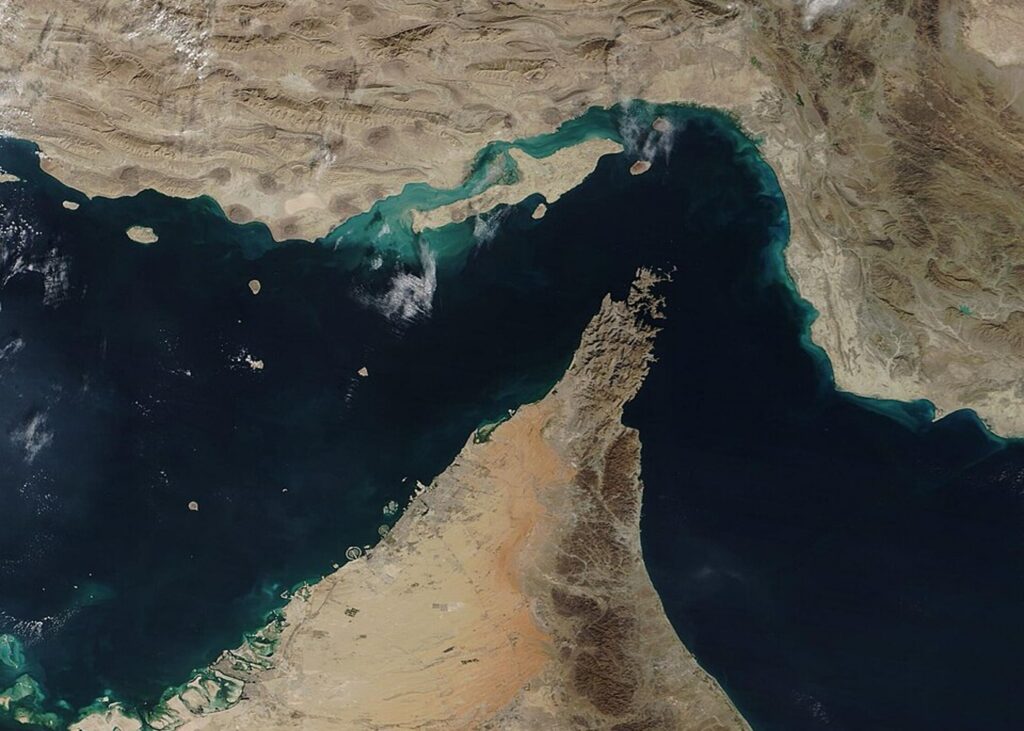
The Strait of Hormuz from space, with Iran above and Oman below, December 2, 2020. Image: MODIS Land Rapid Response Team, NASA GSFC, public domain. Cropped. Image source.
In 2025, about 20 million barrels of oil a day – roughly a quarter of all the oil that moved by ship – passed through a strip of water between Iran and Oman that is only 21 nautical miles wide at its tightest point, with shipping lanes just two miles wide in each direction. That strip is the Strait of Hormuz, one of the world’s most critical oil transit chokepoints, according to the International Energy Agency.
The strait is the only sea route out of the Persian Gulf, where Saudi Arabia, Iraq, Kuwait, the UAE, Qatar and Iran load their tankers. If it closes, there is almost no other way out: pipelines across Saudi Arabia and the UAE could carry only a few million of those 20 million barrels a day.
Drivers in the United States barely buy any of that oil themselves. Only about 2% of U.S. petroleum consumption came through the strait in 2024. U.S. crude imports from Persian Gulf countries that year were at their lowest level in nearly 40 years, the U.S. Energy Information Administration reports. But pump prices are set by world markets, not by where a country’s own oil comes from. The biggest part of the price of a gallon of gasoline is the crude oil itself, and crude trades on global benchmarks. When Hormuz tensions rose in June 2025, the Brent benchmark jumped from $69 to $74 a barrel in a single day – without one ship being stopped.
It is not just oil. In 2024, about one-fifth of the world’s liquefied natural gas trade – fuel used for electricity and heating – moved through the strait, primarily from Qatar, and more than 80% of those cargoes went to Asia, with China, India and South Korea taking over half, according to the EIA. A long disruption would push up gas and electricity costs across Asia and Europe, and pull global energy prices up with them.
The EIA’s bottom line on chokepoints like Hormuz: when oil cannot move, even briefly, it can create supply delays, raise shipping costs and push up world energy prices.
JBizNews Desk | New York
© JBizNews.com. All rights reserved. Unauthorized reproduction or redistribution is strictly prohibited.