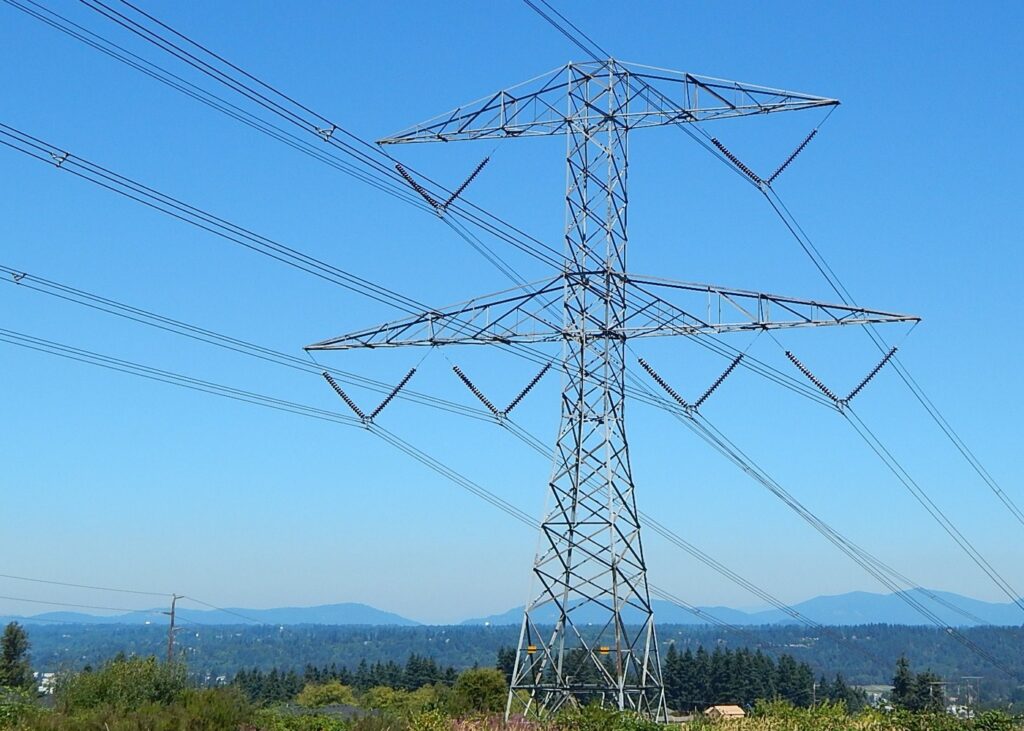
High-voltage transmission lines in Auburn, Washington (Ron Clausen / CC0). Archive photo, 2017; cropped.
JBizNews Analysis
America’s artificial intelligence building boom is doing something unusual: it is making the economy stronger and, at the very same time, giving the Federal Reserve a reason to keep interest rates where they are. Three recent statements from inside the Fed explain how both things can be true.
Start with the growth. Business investment in computers, chips and related equipment has been rising at an average annual rate of more than 20% since the start of 2025 – faster even than the internet boom of the late 1990s, according to Sylvain Leduc, director of research at the Federal Reserve Bank of San Francisco, writing on October 15. At the Fed’s October 28 press conference, Chairman Kevin Warsh said business investment is likely rising at about a double-digit pace, capital spending sits at a historically high share of the economy, and high-tech investment is leading – though the spending is now broadening into other categories too. Growth figures, Warsh said, back him up: the government revised first-half GDP growth up to 2.4%, and the third quarter appears to have been stronger still.
Now the catch. All that building is demand – real orders for real goods – arriving now. Any offsetting relief from the technology making production cheaper is, in Cook’s telling, expected later, and she stresses that its timing is uncertain. Fed Governor Lisa Cook, in a September 28 speech on AI and the economy, laid out the mechanics: when demand is concentrated in one sector, the factories and workers supplying it get stretched, and prices in that sector climb. The San Francisco Fed sees it in the data: prices for information processing equipment rose 13% over the 12 months to August, the fastest since the government began tracking the category in the 1960s, and import prices for AI-related goods are up nearly 20%. Worth keeping the proportion: those tech prices added only about 0.2 percentage point directly to overall inflation, which ran at 3.4% in August. Most of the gap above the Fed’s 2% goal comes from energy and core goods costs tied to the Middle East conflict and higher tariffs – not from AI.
For ordinary American businesses, the squeeze shows up in three places. Electricity: Cook noted that electricity and water costs are each up about 5% over the past year, potentially in part because of AI’s appetite for power. Construction: data centers draw on the same workers and materials every other builder needs, so a warehouse or factory expansion competes with them. Credit: asked whether high interest rates matter for the AI investment surge, Warsh answered plainly – “I believe they do” – pointing out that lenders are already discriminating between borrowers, with credit spreads widening for some kinds of assets.
This is why the boom argues against quick rate cuts rather than for them. The Fed held its benchmark rate steady at 3.75% to 4% on October 28, calling inflation elevated; two members went further and voted for an increase. Strong investment means the economy does not need cheaper money to grow. And the price pressure from all that building means cheaper money could add fuel. Cook warned, though, that using interest rates to fight one sector’s price increases “could be a mistake” – the Fed’s tools are too blunt to target computer chips.
What about the payoff? Cook expects one, but on a slower clock. She said she anticipates productivity gains from AI to deliver “modest disinflation within the next few years” – in plain terms, the economy eventually producing more with less, which pushes prices down. Her caveat matters: she does not expect those benefits “to arrive in time” to offset the price pressures building now. Warsh struck the same note, saying productivity has been improving for a couple of years but is imperfectly measured, and that whether a true productivity miracle arrives quickly or slowly is an open question he is still studying.
The San Francisco Fed’s baseline sums it up: it expects inflation to drift back to the Fed’s 2% goal over the next two years – gradual, not quick – while solid growth keeps unemployment near its normal rate.
Put simply: the AI boom helps the economy today the way any construction surge does – jobs, orders, growth. Cook expects cheaper production to help later, but the timing and size of those gains remain uncertain. Interest rates live in the space between those two clocks, and for now the Fed is keeping them there.
JBizNews Desk | Washington
© JBizNews.com. All rights reserved. Unauthorized reproduction or redistribution is strictly prohibited.