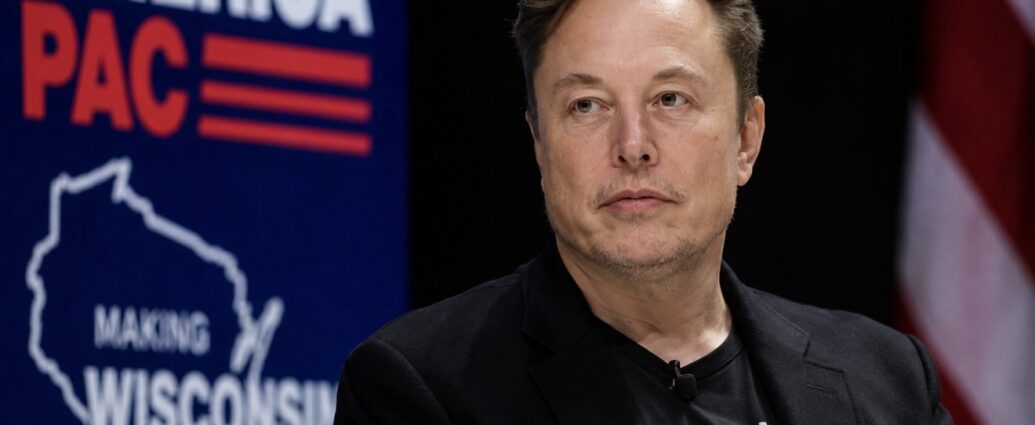
The Wisconsin Elections Commission confirmed Tuesday, July 14, that it voted 5-1 in closed session last week to refer two voter complaints involving Elon Musk to the Brown County District Attorney’s Office after finding probable cause that he may have violated Wisconsin’s election bribery law.
Commission spokesperson Emilee Miklas said the bipartisan panel—made up of three Democrats and three Republicans—approved the referral after reviewing complaints centered on the $1 million checks Musk awarded to voters during Wisconsin’s 2025 Supreme Court election.
According to the commission’s motion, members found probable cause that Musk violated state law through a social media post offering $1 million to individuals who voted in the election “in order to induce them to vote.”
Brown County prosecutors now have 40 days to determine whether criminal charges should be filed.
Brown County District Attorney David Lasee, a Republican, did not respond Tuesday to requests for comment. Representatives for Musk also did not immediately comment.
What Wisconsin Law Says
Wisconsin’s election bribery statute makes it a felony to provide or promise “anything of value” for the purpose of inducing someone to vote.
A conviction carries a maximum penalty of 3½ years in prison, a $10,000 fine, or both.
The underlying complaints remain confidential under Wisconsin law.
They were filed by voters from Milwaukee and Green Bay, where Musk personally distributed million-dollar checks during a campaign rally just days before the election.
Three Wisconsin voters ultimately received $1 million each through the program, including two recipients who accepted oversized ceremonial checks on stage.
Among them was Nicholas Jacobs, who received a check from Musk during a March 30, 2025 town hall event in Green Bay.
Earlier in the campaign, Musk’s political organization, America PAC, also offered $100 payments to voters who signed a petition opposing what it described as “activist judges” or referred others to sign.
A Record-Breaking Judicial Election
The Wisconsin Supreme Court race became the most expensive judicial election in American history.
Musk and organizations supporting him spent at least $20 million backing Republican-endorsed candidate Brad Schimel, who ultimately lost by roughly 10 percentage points to Democratic-backed Susan Crawford.
Overall spending exceeded $100 million.
Major Democratic donors, including George Soros, also invested heavily in the race.
Crawford’s victory preserved a liberal majority on Wisconsin’s highest court, a margin later expanded to 5-2 after Democratic-backed Chris Taylor won another statewide judicial contest.
Following Schimel’s defeat, Musk publicly stated he intended to reduce his political spending.
Federal campaign filings later showed otherwise.
By the end of 2025, Musk had contributed approximately $20 million to two major Republican organizations and another $10 million toward Kentucky’s U.S. Senate race.
One recent analysis ranks Musk as the third-largest political donor of the 2026 election cycle, behind Andreessen Horowitz and George Soros.
Business Implications
The criminal referral carries significance beyond politics.
Musk leads companies—including Tesla and SpaceX—whose businesses depend heavily on government approvals, regulatory oversight and public-sector contracts.
During the Wisconsin Supreme Court campaign, Tesla was actively pursuing litigation against the state seeking permission to expand direct automobile sales.
SpaceX likewise depends on federal launch approvals and billions of dollars in government contracts.
While a referral itself does not establish wrongdoing, any criminal investigation involving the chief executive of companies with extensive government relationships creates additional legal, regulatory and reputational risk.
Additional Legal Challenges
The Wisconsin matter is not Musk’s only ongoing legal dispute over election-related giveaways.
The Wisconsin Democracy Campaign has filed a separate lawsuit seeking to permanently prohibit Musk from offering cash payments connected to future Wisconsin elections, alleging election bribery, unlawful lotteries, conspiracy and public nuisance.
Separately, an Arizona voter has sued Musk in federal court over his 2024 $1 million-a-day voter giveaways, alleging fraud and breach of contract after promotional materials suggested winners would be selected randomly.
During that litigation, Musk’s attorneys acknowledged recipients were not selected purely by chance but instead underwent a screening process similar to job applicants.
U.S. Magistrate Judge Susan Hightower has ordered Musk to sit for a deposition in that case, stating it remains unresolved whether public statements describing the giveaways as random were misleading.
Philadelphia District Attorney Larry Krasner also filed suit against Musk and America PAC in 2025, arguing the giveaways constituted illegal lotteries under Pennsylvania law.
Musk’s Defense
Before Wisconsin’s 2025 election, Attorney General Josh Kaul attempted to halt the payments through a lawsuit, arguing Musk was illegally offering financial incentives tied to voting.
Musk’s attorneys countered that the payments represented protected political speech under both the Wisconsin Constitution and the U.S. Constitution, asserting the campaign promoted civic engagement and opposition to activist judges rather than support for a specific candidate.
The Wisconsin Supreme Court ultimately declined to intervene before the election.
A similar America PAC promotion operated during the 2024 presidential campaign in seven battleground states. A Pennsylvania judge later allowed that program to continue after prosecutors failed to demonstrate it constituted an illegal lottery.
For corporations, political committees and major donors, Wisconsin’s referral highlights an increasingly important legal reality: strategies that survive civil scrutiny in one state may trigger criminal investigations in another.
As the 2026 election cycle accelerates, campaign lawyers nationwide will likely be watching closely as prosecutors in Green Bay decide whether to move forward.
JBizNews Desk | Madison, Wisconsin
© JBizNews.com All Rights Reserved. Reproduction or distribution without written permission is prohibited.