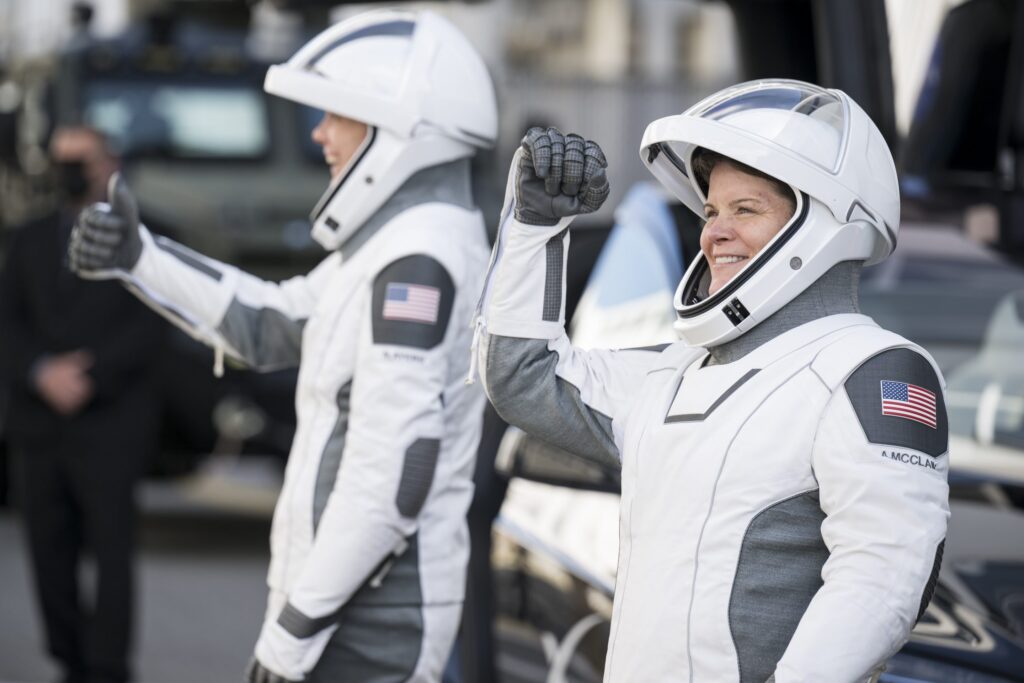
Women astronauts outnumber men in NASA’s new class—they’re now half way through training, and set to earn around $150K with no overtime or hazard pay
If billionaires like Elon Musk, Jeff Bezos and Sam Altman are right, your next job could be on the Moon. And the people lined up to get there first are already in training.
NASA’s newest astronaut class, announced last year, is now just past the halfway point of its two-year training—and it’s doing the rounds on social media again for making history.
For the first time, women outnumber men: six of the 10 candidates, chosen from more than 8,000 applicants.
They’re currently learning “basic astronaut skills,” according to NASA’s website, like spacewalking, operating the space station, flying jet planes and controlling a robotic arm.
Once qualified, they could be assigned to future missions in low Earth orbit and to the Moon, with some potentially playing a role in NASA’s longer-term plans for Mars. But there’s a catch: they’ll earn on par with a mid-career desk job or a skilled trade like electricians—and they won’t get paid overtime or hazard pay.
NASA astronauts earn $152,000—similar salaries to air traffic controllers or psychotherapists
The out-of-this-world job comes with a very down-to-earth paycheck. Candidates earn a government salary during training, and if they qualify, NASA’s website states the pay is around $152,000, as of 2024. NASA didn’t respond to Fortune’s request for comment on their updated pay.
In comparison, psychotherapists, project managers and air traffic controllers can earn similar wages—without the added risk of leaving planet Earth.
“When NASA astronauts are aboard the International Space Station, they receive regular 40-hour workweek salaries,” NASA previously told Fortune. “While in space, NASA astronauts are on official travel orders as federal employees, so their transportation, lodging, and meals are provided.”
Not that they can clock off—the office is orbiting Earth.
Astronauts Suni Williams and Butch Wilmore found that out the hard way. Their eight-day trip stretched to 286 days after problems with Boeing’s Starliner spacecraft, and they received just $5 a day in incidentals, about $1,430 each in extra pay.
Still keen? Here’s what it takes.
How to become a NASA astronaut—and the brutal Jeff Bezos Blue Origin training
First, the odds. With an acceptance rate of about 0.125%, it’s harder to get into NASA’s astronaut class than Harvard, which accepts around 4%.
The qualifications themselves are relatively straightforward. Applicants must:
- Be a U.S. citizen
- Have a master’s degree in a STEM field (engineering, biological science, physical science, computer science, or mathematics) from an accredited institution. You can also meet this requirement with two years of doctoral work in a related field, a medical degree, or completion of a test pilot school program.
- Have at least three years of related professional experience after your degree, or 1,000 hours as pilot-in-command in jet aircraft
- Pass NASA’s long-duration flight astronaut physical
Military experience isn’t required, and neither is flying experience. There’s no age limit, with the average candidate being 34. But applicants must be free of any medical conditions that could impair space flight—and NASA physicians have the final say, with no waivers for medical requirements.
And if you want a taste of what it takes to become an astronaut, look no further than Sara Sabry. She doesn’t work for NASA, but she became the first Egyptian, and the first Arab and African woman, to fly to space on Jeff Bezos’s Blue Origin in 2022, beating more than 7,000 other applicants.
To get there, she woke at 4:30 a.m. to squeeze in training and research before her full-time job as CTO of a Berlin-based startup.
“Back then it was, it was really, really, it was really tough,” she told Fortune. “You would wake up at night, and then you would go back at night, so you barely see the daylight ever.”
“I see a lot of young people now; they’re wanting to take the easy route without working so hard. But the truth is, you have to make sacrifices. You have to put yourself through a lot of discomfort,” Sabry added. “Of course, it’s not easy to wake up at 4:30 a.m. every morning and be completely isolated from the world, right? But it goes to show that you can really transform your life—and you have so much control over your life.”
This story was originally featured on Fortune.com