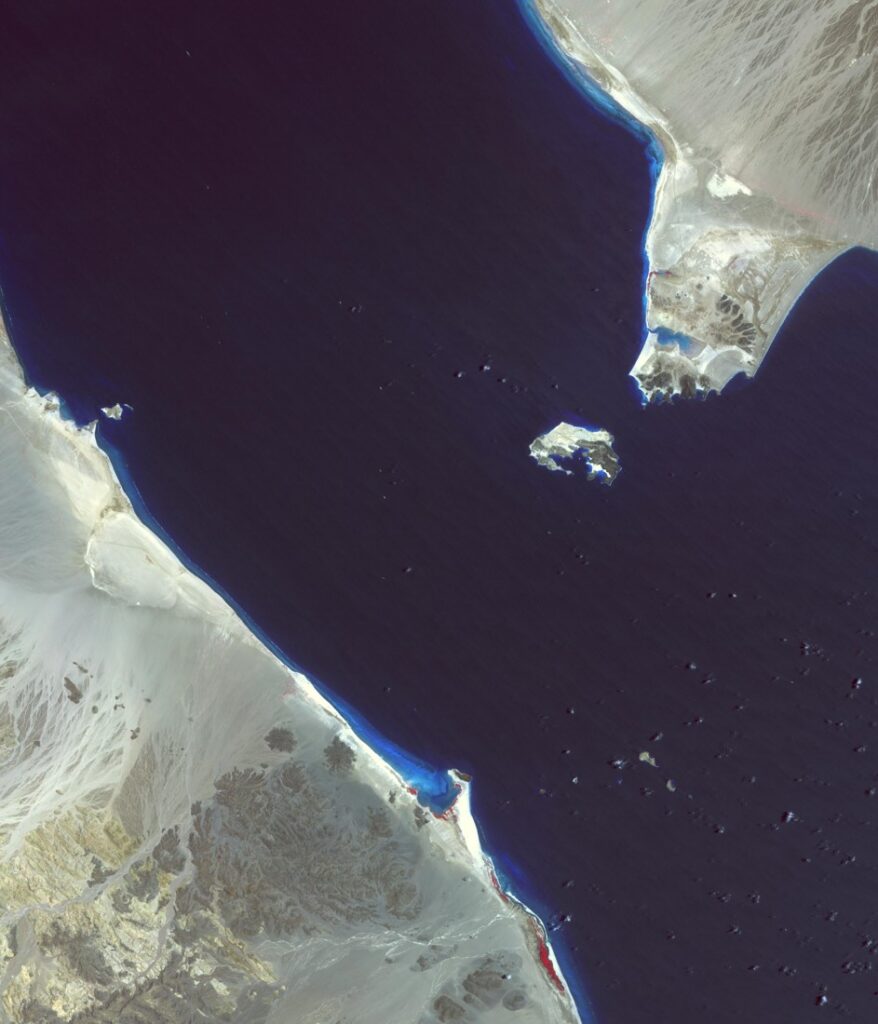
NASA/METI/AIST/Japan Space Systems and U.S./Japan ASTER Science Team / Public domain
Yemen’s internationally recognized government has accused Iran’s Revolutionary Guard and Lebanon’s Hezbollah of deploying 21 military specialists to help the Houthis plan operations, develop weapons and select commercial ships as targets. The allegation puts the security of Red Sea trade and energy routes at the center of a dispute that Hezbollah denies.
Interior Minister Ibrahim Haidan made the accusations in a ministry statement issued Tuesday, November 3. He said 14 members of the group belonged to Iran’s Islamic Revolutionary Guard Corps and seven to Hezbollah.
Haidan warned that the activities threatened seafarers, freedom of navigation through the Bab al-Mandab Strait and the Red Sea, international trade routes and energy supplies. His warning concerned the ability to plan and carry out maritime operations, including choosing merchant vessels as targets.
Hezbollah rejected the accusations Wednesday, November 4, calling them “entirely baseless” and unsupported by facts. In its reported response, the group said Yemenis had the capabilities, resources and expertise to defend their country without outside support or intervention.
According to the ministry, the specialists were spread across six locations: eight in Hodeidah, four in Sanaa, four in Saada, two in Hajjah, two in Amran and one in al-Khawkhah. Their alleged work included command and control, ballistic missiles, drones, surveillance, communications and electronic warfare, alongside military supply networks and the smuggling of weapons components.
The ministry also accused them of developing explosive-laden boats and autonomous underwater weapons, training fighters to lay mines, and teaching siege and urban-warfare tactics. Haidan portrayed the group as a military command staff rather than a training mission, alleging that Iran’s role had moved beyond financing, weapons and instruction to direct operational planning and supervision.
He said an IRGC military figure headed the network and described a structure that included an operations supervisor, a strategic adviser, a joint operations room and technical specialists.
Haidan called for international action to dismantle the Houthis’ financing and arms networks, designate the group a terrorist organization and enforce the arms embargo under United Nations Security Council resolutions 2216 and 2624. He also alleged that the foreign presence supported political, organizational and media networks intended to entrench Iranian influence.
The dispute comes against the backdrop of Yemen’s civil war, which began after the Houthis seized Sanaa in 2014. For businesses following the Red Sea, the immediate issue in the ministry’s account is the alleged command structure behind threats to commercial shipping.
JBizNews Desk | Middle East
© JBizNews.com. All rights reserved. Unauthorized reproduction or redistribution is strictly prohibited.