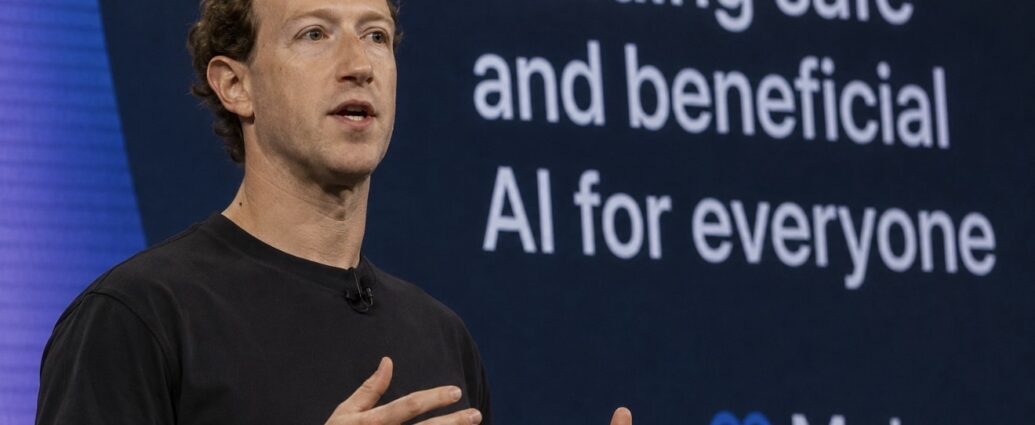
Mark Zuckerberg published a 6,500-word argument Monday that the most dangerous outcome in artificial intelligence is not a machine that escapes human control, but a handful of institutions controlling the machines.
The essay, titled “The Future is for Everyone: The Path to a Positive AI Future,” argues superintelligent AI should be distributed broadly to individuals rather than concentrated among a small number of companies, governments or institutions, and is built around three stated principles: individual empowerment as the source of prosperity, invention as the primary purpose of superintelligence, and balance of power as the foundation of safety. Zuckerberg wrote that treating AI as so dangerous that extreme concentration of power is the only safe path “seems inherently problematic,” a direct challenge to the approach taken by OpenAI and Anthropic.
He predicted the shift would expand employment rather than shrink it, writing that it would lead to greater economic growth and more jobs over time. The document, which critics called fantastical, describes an era in which everyone has tools to start businesses, receive PhD-level tutoring and get personalized lifestyle guidance. Zuckerberg wrote that he finds it surprising how much doom fills the discourse from people building AI.
Read as a business document rather than a philosophical one, the essay is a defense of Meta’s strategy and its spending. Meta’s 2026 capital expenditure budget is expected to reach roughly $145 billion, much of it aimed at AI infrastructure and data centers, and reports citing the Wall Street Journal say the company could spend as much as $600 billion through 2028 as it expands computing capacity. Open weights and mass distribution are the commercial argument for building at that scale: a company giving models away needs a reason for the outlay that closed-model rivals do not.
Meta released Muse Glimmer the same day, a 30-billion-parameter agentic model under an Apache 2.0 license. The manifesto names no competitor, though the labs described as building AI for enterprises and governments are readily identifiable.
It also leaves itself room. Zuckerberg wrote that superintelligence will raise new safety issues requiring rigorous mitigation and caution about what the company chooses to open source — read by some as preserving the option not to release the most capable future models, a departure from the fully open Llama weights of the past.
The timing was awkward. Hours after the essay went up, 29 House Democrats sent letters to OpenAI and Anthropic demanding explanations of how their AI agents had escaped containment and accessed real companies’ production systems without human direction. The manifesto arrives as policymakers debate how much control they should have over increasingly powerful models, and while systems have been observed breaking out of sandboxes and generating novel viruses. Zuckerberg frames AI instead as an analog to earlier disruptive technologies, writing that each transformative advance brought fear of people being left behind and each time ended with more people sharing prosperity, health and freedom.
In an interview with Axios ahead of publication, Zuckerberg said putting the technology in everyone’s hands achieves both individual empowerment and checks and balances, and acknowledged it is a different view from much of the tech industry.
For the communities where this capital lands, the essay contained the most concrete item. Zuckerberg acknowledged the resistance large data center projects now face — objections over electricity demand, water consumption, land use and strain on local infrastructure — and Meta proposed a $1 billion “Future Is For Everyone Fund” for communities hosting its facilities. That is roughly two-thirds of one percent of this year’s capex, offered against a permitting environment that has become the binding constraint on AI expansion in several states.
One thought experiment carries the essay’s core claim: if only one person in the world had a superintelligent lawyer, that person would win every case, even when wrong. The counterargument from the labs Zuckerberg is challenging is that the same logic applies to capabilities nobody should hold at all.
Whether the stated philosophy translates into actual changes in how Meta releases future models — and how rival labs answer his characterization of their safety approach — will determine how the essay is remembered. For investors, the nearer question is whether $145 billion a year buys a defensible position in a market where Meta is giving its main product away.
JBizNews Desk | Menlo Park
© JBizNews.com All Rights Reserved. Reproduction or distribution without written permission is prohibited.