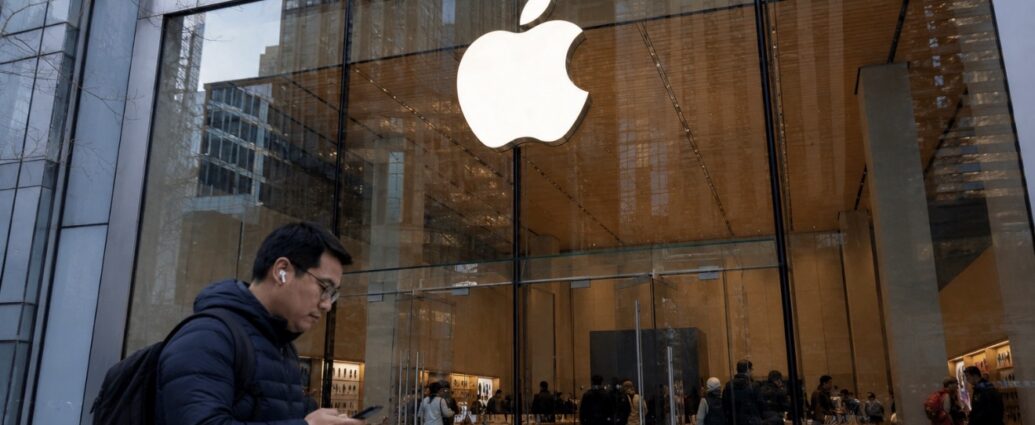
Apple has abandoned the all-glass iPhone it had planned as a 20th-anniversary showpiece, and the reason is a manufacturing one: too few of the glass bodies coming off the line were usable. Supply-chain checks by Jefferies found the device, which had been expected in September 2027, was dropped because of poor production yield. That single engineering failure removed the most expensive iPhone Apple had on its drawing board, and on Monday it cost the company its rating.
Jefferies downgraded Apple to Underperform from Hold and cut its price target to $263.66 from $285.56. Apple closed Friday at $313.33, so the new target sits roughly 16% below where the stock finished last week. Shares slipped more than 1% ahead of Monday’s open, though part of that decline was mechanical: the stock went ex-dividend for its quarterly payout of 27 cents a share.
The logic behind the call is straightforward. Apple sells roughly the same number of phones each year, so the way it grows iPhone revenue is by charging more per handset. The all-glass model was the vehicle for that. Jefferies had estimated the device would carry a blended retail average selling price of $2,060, and Apple’s plan was to carry the all-glass design forward into future Pro and Pro Max models to lift their pricing and margins as well. Analyst Edison Lee wrote that the cancellation shows introducing new iPhone form factors to drive higher selling prices is harder than expected.
With that path closed, Jefferies rebuilt its math. The firm lowered its expected annual growth rate for iPhone average selling prices between fiscal 2026 and fiscal 2031 to 6.8% from 9.0%, and trimmed earnings-per-share estimates for fiscal 2028 and 2029 by 2.1% and 3.4%. Those cuts assume unit sales hold steady — meaning the entire reduction comes from Apple charging less per phone than previously modeled.
That leaves one product carrying the premium strategy. Lee called the foldable iPhone, due to arrive in September 2026, the only near-term driver of higher selling prices and margin. But he warned that surging memory costs, driven by artificial intelligence demand, could push its starting retail price above $2,000, potentially making it a niche product with limited sales volume. Rising memory prices also threaten the storage upgrades Apple typically uses to move buyers up its price ladder, either raising component costs or forcing those upgrades to be pulled.
Lee also addressed a piece of market chatter that had been read as a signal of coming iPhone 17 price increases. Apple raised trade-in values for the iPhone 15 and 16 in several markets, but cut trade-in prices for the iPhone 16 Pro and Pro Max in China by 5% and 2%. Because those values are renegotiated monthly with regional dealers, Jefferies said the moves may carry no implication for new iPhone pricing at all — though richer U.S. trade-in offers could pull demand forward into the iPhone 17 cycle and leave the iPhone 18 with a weaker starting position.
One American supplier came through the news intact. Corning shares rose despite the cancellation. The company struck a partnership with Apple in August 2025 to manufacture all iPhone and Apple Watch cover glass in Kentucky — an arrangement tied to the glass Apple ships today rather than to the abandoned all-glass design.
The downgrade lands on a stock that had already lost its shine with analysts. Six firms now carry sell-equivalent ratings on Apple, matching the most since 2012, with KeyBanc Capital Markets cutting to underweight last month. The consensus recommendation stands at 3.88 out of five, the lowest since 2019, and fewer than 60% of analysts rate the stock a buy — far below Microsoft, Amazon and Nvidia, each endorsed by more than 90% of covering firms. Even so, Jefferies remains in the minority: of 47 analysts covering Apple, 30 rate it buy or strong buy, according to LSEG data.
Apple shares have been under pressure since the company’s most recent results. Management guided fiscal fourth-quarter revenue growth to 9% to 11%, below the 12% Wall Street expected, and warned that memory cost inflation would weigh on margins in coming quarters. The stock remains well below its 52-week high of $344.57. It is still up about 15% for the year. A representative for Apple did not immediately respond to a request for comment made outside normal business hours.
JBizNews Desk | Wall Street
© JBizNews.com All Rights Reserved. Reproduction or distribution without written permission is prohibited.