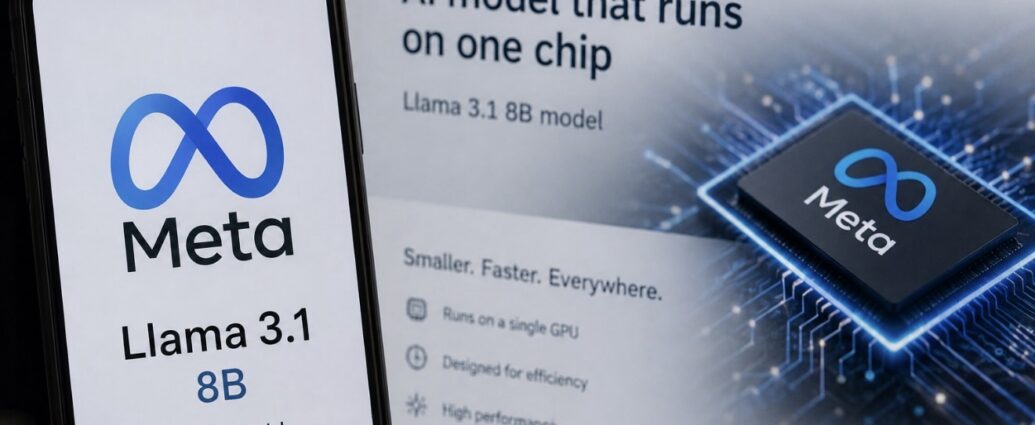
Meta gave away an artificial intelligence model on Monday that is powerful enough to carry out multi-step work on its own and small enough to run on a single graphics card inside an ordinary computer, with no internet connection and no monthly bill to anyone.
The model is called Muse Glimmer, and it comes from Meta Superintelligence Labs, the research group the company built around chief AI officer Alexandr Wang. It has 30 billion parameters — the internal settings that determine what a model knows — and it is built to handle several jobs at once that until now were split across different systems: reasoning through a task in steps, calling outside tools, reading images as well as text, and recovering when something fails partway through.
The part that matters commercially is the price and the license. Meta released the weights — the actual trained model file — under Apache 2.0, a standard open license with no usage restrictions attached. Anyone can download it, run it, change it, and build a paid product on top of it. That is a sharper break than it first appears: Meta’s older Llama models carried the company’s own custom license, which drew years of criticism for conditions such as a cutoff that kicked in once a company passed 700 million monthly users. Glimmer ships with fewer strings than Llama ever did, and it is Meta’s first fully open release since the company moved to the proprietary Muse Spark line in April.
How they made it fit
A 30-billion-parameter model normally needs more than 55 gigabytes of memory to run, which is more than any consumer graphics card offers. Meta compressed the model’s weights down to roughly 4-bit precision, shrinking it to under 20 gigabytes — small enough to leave room for the working memory, the image-reading component, and the speed-up machinery to all operate inside a 24- or 32-gigabyte budget. The practical translation: it runs on a single 24-gigabyte graphics card or a high-end Mac, with no network call at any point.
Speed was the second problem. Language models normally produce text one piece at a time, which drags badly during long chains of reasoning or repeated tool calls, and an agent that takes minutes to decide its next move is not usable for real work. Meta added a technique that lets the model draft ahead in blocks rather than word by word, fast enough to sit inside a live agent loop.
The model was pre-trained on the outputs of Muse Spark, Meta’s larger proprietary system — a method known as distillation, where a big model teaches a small one. Meta then ran two additional training passes, the first to strengthen performance on long prompts and extended reasoning, the second to sharpen its behavior as an agent. Engineers also trained it to retry work it fails on the first attempt rather than simply stopping.
Who it changes things for
A solo developer or an early-stage startup can now run a capable agent on one graphics card with no per-token bill. Mid-sized companies get inference on their own equipment. Regulated businesses — the ones that cannot legally send client data to an outside server — get an agent that can be air-gapped entirely. The model handles more than 100 languages and works with existing agent frameworks. Meta released the weights on Hugging Face along with developer documentation, with tighter integrations for common local-inference tools arriving in the coming days. Ollama, one of the most widely used tools for running models locally, shipped support the same morning.
Meta is framing the release as a competitive argument as much as a technical one, positioning open weights as necessary for American competitiveness against proprietary rivals. Chief executive Mark Zuckerberg pressed that case publicly on Monday, criticizing closed-model developers and defending distillation as a legitimate path to progress. He also said Meta’s board is adopting a governance structure that will set safety criteria the company will apply to each of its future models.
The competitive picture is narrow. Very few American labs have released open-weight models of this class — OpenAI’s gpt-oss pair from August 2025, Google’s Gemma family under a more restrictive custom license, and Thinking Machines’ Inkling. The closest comparison is gpt-oss, which is also Apache 2.0, but those models are text-only. Glimmer takes different ground: it reads images natively, was trained end-to-end around the agent loop, and ships with its own compressed versions tuned specifically for 24-gigabyte consumer machines.
For businesses weighing what AI actually costs them, that is the headline. The recurring expense in most corporate AI deployments is not the software — it is the metered bill for every request sent to someone else’s data center. A capable model that runs on hardware a company already owns takes that meter out of the equation.
JBizNews Desk | Menlo Park
© JBizNews.com All Rights Reserved. Reproduction or distribution without written permission is prohibited.