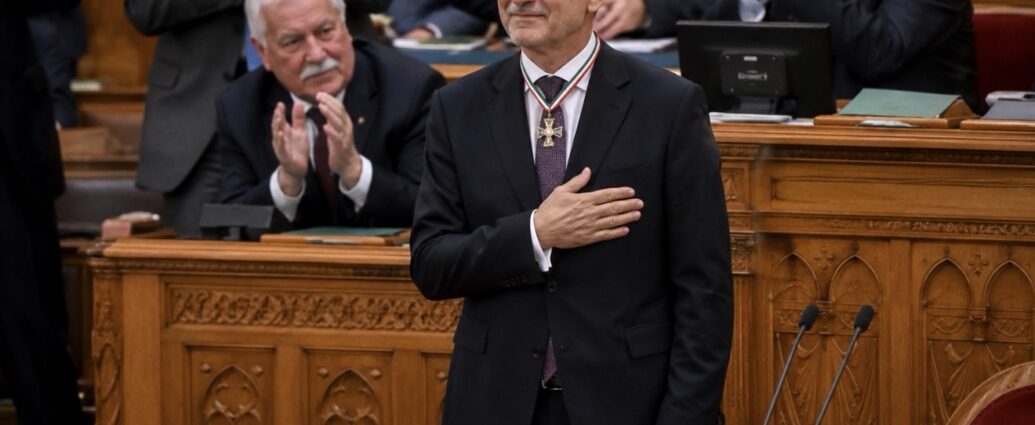
Hungary’s parliament elected András Baka as president on Tuesday, handing the office to a judge whose removal from the Supreme Court became one of the defining rule-of-law disputes of the Viktor Orbán era. Lawmakers approved his election by 140 votes to 6, using the more than two-thirds majority controlled by Prime Minister Péter Magyar, and Baka replaces Orbán-appointed Tamás Sulyok, who was removed from the presidency last month.
The presidency is largely ceremonial. The signal is not.
Who Baka is
Baka served as a judge at the European Court of Human Rights in Strasbourg from 1991 to 2008. He was nominated to head Hungary’s Supreme Court in 2009 and ousted in 2012 after condemning an Orbán-era move to cut the mandatory retirement age for judges from 70 to 62, which he called a judicial purge. The European Union and the United States both called the age-limit reduction illegal, and in 2016 the European Court of Human Rights ruled that his dismissal violated his freedom of expression.
Apart from a brief stint as a lawmaker elected on the Hungarian Democratic Forum list in 1990, Baka has held no political positions. He is 73.
The political arithmetic
Magyar’s Tisza party won a landslide in April, ending Orbán’s 16-year run, and has since moved to unwind his influence over state institutions — including using a constitutional amendment to remove Sulyok from office weeks before nominating Baka. Tisza holds 141 of 199 seats in the National Assembly. Fidesz, now in opposition, boycotted the vote, accusing Tisza of authoritarian tactics, which the party denies.
The constitutional amendment that ended Sulyok’s term provides that the new president serves until a new constitution takes effect, or for a maximum of five years. Tisza has said it intends to adopt a new constitution within this parliamentary term and will consider allowing the president to be elected directly.
Why business is watching
Hungary spent the Orbán years in an extended standoff with Brussels over judicial independence and public procurement, and that dispute cost real money — billions of euros in EU cohesion and recovery funds held back pending rule-of-law changes. Elevating the judge whose dismissal Strasbourg ruled unlawful is the clearest possible statement that the new government intends to settle that argument on Brussels’ terms.
For companies operating in Hungary, the practical questions are narrower and more immediate. Predictable courts change how contracts are enforced, how procurement disputes get resolved, and how much legal risk a foreign investor prices into a Hungarian project. Hungary hosts substantial German automotive manufacturing and a growing battery sector, industries that commit capital on ten- and twenty-year horizons and that have spent years working around a legal environment Brussels flagged as unreliable.
Currency and borrowing costs sit downstream of the same question. The forint and Hungarian government debt have long traded partly on the state of the EU funding dispute, because those transfers are large relative to the size of the economy. A government that resolves the standoff removes a discount that has been priced into Hungarian assets for years.
What comes next
The presidency does not set economic policy, and Baka will not be negotiating with Brussels. What he provides is a signature and a symbol: a head of state who spent his career on the judicial-independence side of the argument, at the moment a government is preparing to rewrite the constitution.
The counterargument is already being made in Budapest. Critics note that removing Sulyok by constitutional amendment and installing Baka in his place uses the same procedural muscle Tisza condemned when Fidesz held the majority, complicating the party’s account of itself as a break from the previous era. A two-thirds majority rewriting the constitution is a two-thirds majority rewriting the constitution, whichever party holds it — and businesses that committed capital under one set of rules have reason to watch how quickly the next set arrives.
JBizNews Desk | New York
© JBizNews.com All Rights Reserved. Reproduction or distribution without written permission is prohibited.