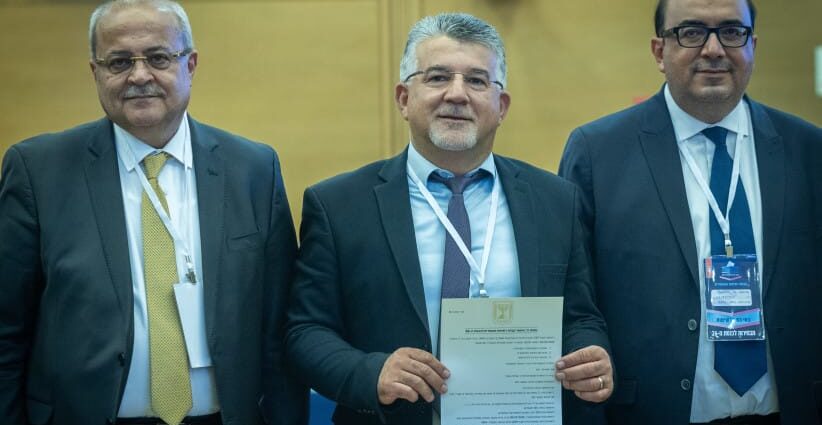
Ra’am, the Joint List, Balad and two Joint List candidates have asked the Central Elections Committee to reject six challenges seeking to bar them from taking part in the election for the 26th Knesset.
Adalah filed responses on Friday on behalf of Ra’am, the Joint List, Balad, MK Ofer Cassif and former MK Sami Abu Shehadeh. No list, party or candidate has yet been disqualified; the committee must first hear the cases and vote on them.
The names reflect a decade of shifting alliances among four political organizations. Ra’am – the Hebrew acronym for the United Arab List – is running independently. The Joint List brings together Hadash, Ta’al and Balad.
All four formed the original Joint List before the 2015 election. Ra’am left in 2021, and the remaining alliance split in 2022, when Hadash and Ta’al ran together, and Balad ran alone. Balad returned for the 2026 election, creating the two lists now at issue: Ra’am and the reconstituted three-party Joint List.
One of the requests for removal came from the Orot Hashachar party, which has asked the committee to disqualify Balad itself, even though Balad is now part of the Joint List. Balad says Israeli election law allows the committee to bar an entire list or an individual candidate, but not one party from inside a joint slate.
If the committee agrees, it could reject the request without deciding whether the allegations against Balad are true.
The other requests invoke grounds set out in Basic Law: The Knesset. A list or candidate may be barred for rejecting Israel as a Jewish and democratic state, inciting racism, or supporting armed struggle against Israel by an enemy state or terrorist organization.
Supreme Court has set high bar for disqualifying Knesset candidates
The Supreme Court has set a high bar for doing so. Disqualification cannot rest on a stray quotation or isolated act; the evidence must clearly show that the prohibited position is central to the list or candidate.
The Central Elections Committee is chaired by Supreme Court Deputy President Noam Sohlberg, but its members are representatives of the Knesset factions. They hear the arguments and vote. If they bar an individual candidate, that decision is not final unless the Supreme Court approves it. Decisions involving full candidate lists can also reach the court on appeal.
Three of the six requests target Ra’am. They were filed separately by Otzma Yehudit and National Security Minister Itamar Ben-Gvir, Likud, and the Choosing Life forum.
The three requests overlap but are not identical. Together, they allege organizational or ideological links between Ra’am, the southern branch of the Islamic Movement and the Muslim Brotherhood, and refer to three nonprofit groups: Aid 48, the Humanitarian Deeds Association and the Al-Aqsa Association. Among the material cited is a July 2025 report by the Registrar of Associations, the Justice Ministry regulator responsible for overseeing nonprofit organizations, as well as court proceedings concerning bank accounts, which the applicants say show that donations promoted through Ra’am channels ultimately reached prohibited organizations or groups affiliated with Hamas.
Ra’am denies any formal or organizational relationship with the nonprofit groups, saying that the material concerns other bodies and does not show that Ra’am supported Hamas’s armed struggle or that of any other organization. It also says no officeholder in the associations was investigated for terror financing or another financial offense.
The party notes that similar claims were rejected in 2022, when the attorney-general submitted a position that included a Shin Bet review and the committee voted 14-0 against disqualification. The current applicants say information released since then changes the case; Ra’am says the new material still cannot be attributed to the party itself.
Islamist party Ra’am highlights chair Abbas’s condemnation of October 7 massacre, work to secure hostage release
Ra’am also points to chairman Mansour Abbas’s condemnations of the October 7 attacks and his contacts with hostage families and efforts to secure the captives’ release.
Likud has asked the committee to bar both the Joint List and Cassif, relying on party platforms, proposed laws, public statements and Cassif’s political activity abroad. The Joint List says much of the material is old, distorted or already considered in earlier election cases, and that the Balad platform quoted by Likud is outdated.
Likud argues that Cassif’s criticism of Israel during the war and his activity overseas amount to support for the enemy’s armed struggle, describing his conduct as “assisting the enemy in wartime,” but Cassif has not been charged with that offense and no court has made such a finding. He says he condemned Hamas’s attack and opposes violence as a political tool.
Otzma Yehudit and Ben-Gvir have filed a separate request against Abu Shehadeh, Balad’s chairman and the third candidate on the Joint List. Their case centers on an Arabic-language article he published on October 8, 2023, describing the Hamas attack as an “important historic event” in military, political and strategic terms and saying others could learn from Gaza’s success in surprising Israel.
Abu Shehadeh says the article analyzed the attack’s political consequences and did not praise the killing of civilians. He said this weekend that he would not have published it had he known the full scale of the atrocities, and he denies supporting the massacre or political violence.
Ben-Gvir argues that the article shows support for Hamas’s attack and says Abu Shehadeh has no place in the Knesset.
The Joint List-Cassif and Balad proceedings are scheduled for Wednesday. The published election timetable sets October 2 as the deadline for the relevant appeals.