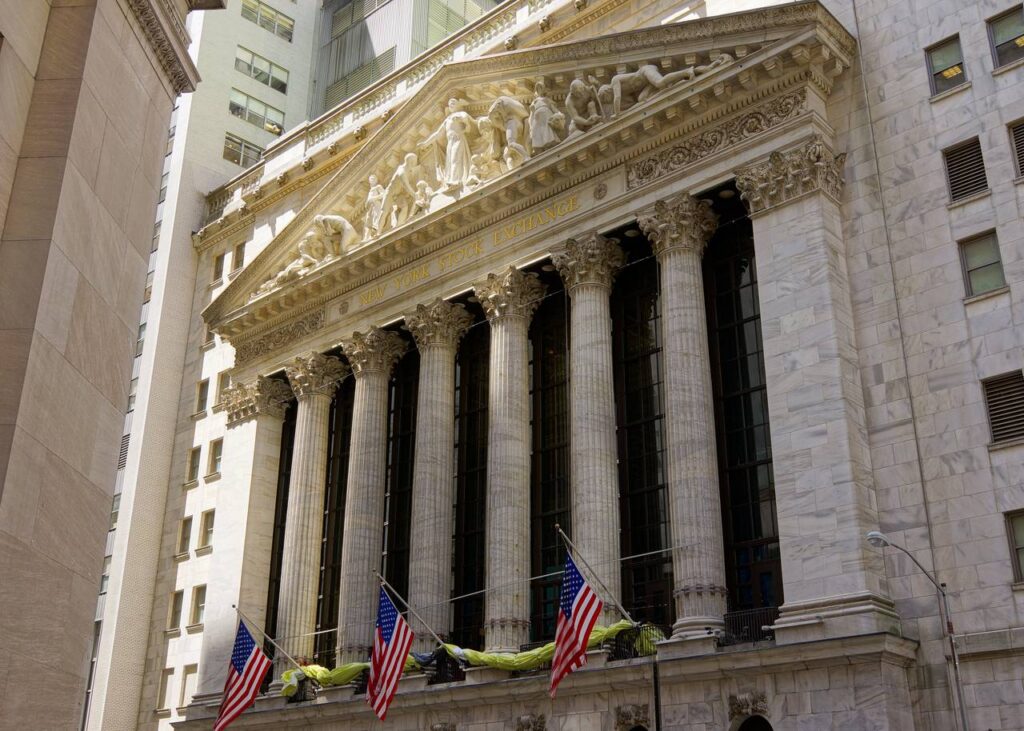
Archive: New York Stock Exchange, April 2012. Jean-Christophe Benoist, CC BY 3.0, cropped.
Intercontinental Exchange, the owner of the New York Stock Exchange, agreed Thursday to work with Trade[XYZ] on bringing Hyperliquid-based perpetual futures markets into a U.S.-regulated framework, expanding its push toward individual traders.
The definitive agreement announced October 29 includes a strategic minority investment by ICE in Trade[XYZ]. The companies intend to seek regulatory approvals for a new retail market and clearing structure. They have not announced that U.S. customers can begin trading the products.
The proposed business would target people seeking short-duration, around-the-clock exposure to markets including crypto, equities, commodities and foreign exchange. ICE says its current participation is more than 99% institutional, making the retail audience a new market opportunity rather than a replacement for its existing commercial-hedging business.
A proposed U.S. venue, not a trading launch
ICE would exclusively operate Trade[XYZ]’s regulated markets under the agreement. Trade[XYZ] currently offers eligible users outside the United States access to perpetual contracts on Hyperliquid, with Hyperliquid supplying underlying infrastructure and Trade[XYZ] designing the products.
A perpetual contract has no expiration date. The companies describe the products as a way to obtain market exposure, rather than to lock in a price for a particular future delivery date. A contract referencing a stock should not be confused with owning the stock itself.
The partners plan to seek the approvals needed for leveraged trading as part of the U.S. structure. The release does not supply a launch date, a list of final approved products or a timetable for obtaining those approvals. The announcement is therefore a plan to build a regulated venue, not evidence that the proposed products have already been cleared for U.S. retail use.
Separate from ICE’s institutional franchise
ICE says the retail perpetuals business would operate through a dedicated regulatory and clearing structure, separate from its institutional futures and clearing franchise. Its existing commercial hedgers would continue to use traditional futures, forward-curve price discovery and centrally cleared physical or cash settlement.
The company describes that separation as a way to keep its existing institutional customers from bearing the retail platform’s trading and counterparty risk. That is the company’s explanation of its intended structure, not a claim that trading on the proposed venue would be risk-free for its own users.
Once approvals are obtained, customers who satisfy know-your-customer and anti-money-laundering checks are expected to access the market through futures commission merchants that become platform members.
OKX is one planned distribution route
The agreement also connects with ICE’s earlier investment in OKX. A joint venture between those companies is intended to link OKX’s retail customer base with ICE-operated markets, providing another possible distribution channel for Trade[XYZ]’s regulated contracts.
That channel has its own approval conditions. ICE says the joint venture’s U.S.-registered broker-dealer and futures commission merchant subsidiaries still require regulatory approvals. Those approvals are separate from the proposed market and clearing framework.
ICE did not disclose the size or financial terms of its minority investment in Trade[XYZ]. It said the position is not expected to materially affect its 2026 adjusted financial results, capital returns or debt-reduction plans.
For now, the milestones to watch are regulatory applications and approvals, the final market structure and a confirmed opening date. None should be assumed from the signing of the commercial agreement alone.
JBizNews Desk | New York
© JBizNews.com. All rights reserved. Unauthorized reproduction or redistribution is strictly prohibited.