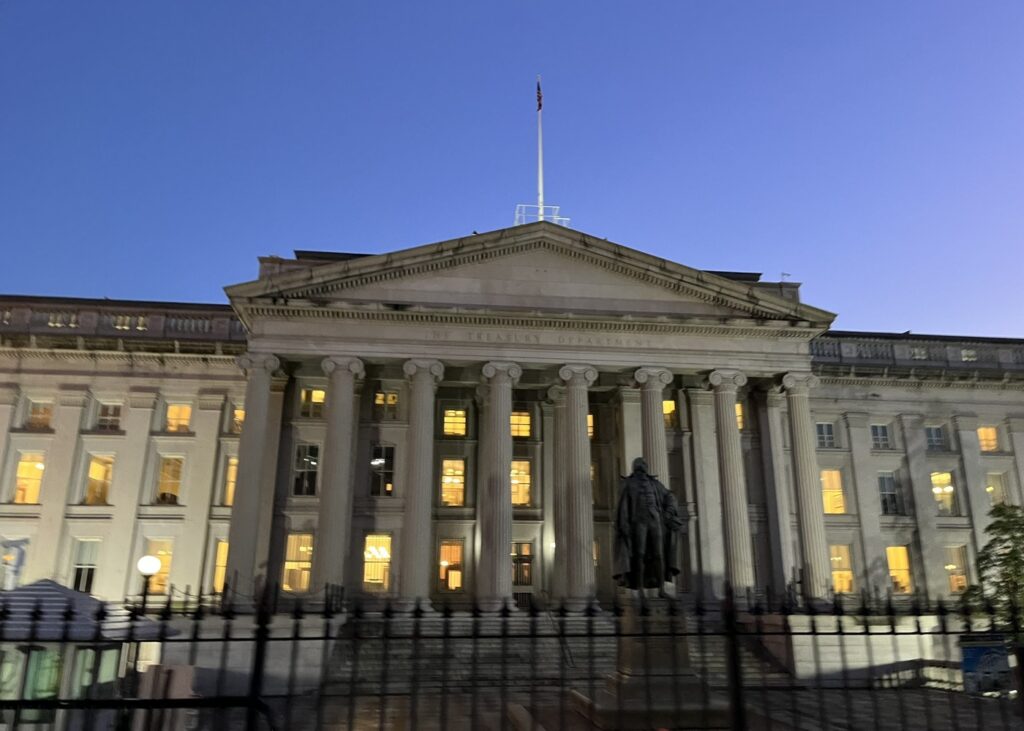
Photo: Wisneyykarin / CC BY-SA 4.0 (archive photo)
The U.S. Treasury will offer $125 billion in notes and bonds in its quarterly refunding, replacing about $97 billion of maturing debt and raising roughly $28 billion in new cash from private investors, the department said Wednesday.
The offering consists of $58 billion in three-year notes, $42 billion in ten-year notes and $25 billion in thirty-year bonds. The $125 billion headline is the total amount being sold, not $125 billion of new deficit financing. Most of it replaces debt coming due.
Auction sizes are expected to hold steady
Treasury said it expects to keep nominal coupon and floating-rate note auction sizes unchanged for the next several quarters, based on current borrowing projections. That is an expectation, not a permanent limit: the department said it continues to assess supply, demand, costs and risks.
Seasonal or unexpected financing needs can be met through changes in regular Treasury-bill auctions or cash-management bills. Treasury expects shorter-dated bill auction sizes to fall in December around tax receipts and rise across the bill curve in January as seasonal outflows increase.
Seven-year notes change format, not monthly frequency
Starting in March 2027, the seven-year note will move from a new issue every month to one new issue each quarter followed by two reopenings. New issues will come in March, June, September and December, with reopenings in the next two months of each cycle.
A reopening sells more of an existing security rather than creating a separate new issue. Seven-year auctions will still take place toward the end of every month. The change therefore does not mean Treasury will stop selling seven-year notes in the intervening months.
Buybacks are debt management, not Fed stimulus
Treasury also anticipates buying back up to $70 billion of older securities for liquidity support and up to $25 billion of securities in the one-month-to-two-year maturity range for cash management during the coming quarter. These are maximum planned amounts, not completed purchases.
The operations are Treasury debt-management buybacks, not a Federal Reserve quantitative-easing program. They should not be described as the Fed injecting an equivalent amount of stimulus or canceling the government’s debt.
What it means for savers and borrowers
For investors buying Treasuries, the announcement sets the supply schedule and the mix of maturities. The final yields will be determined by the auctions and market conditions, not by Wednesday’s offering totals.
For households and businesses, Treasury yields are an important reference for wider borrowing costs, but this announcement does not guarantee a change in mortgage, credit-card or business-loan offers. Stable auction sizes are different from stable interest rates.
The financing plan is also distinct from Treasury’s earlier quarterly borrowing estimate. Wednesday’s statement explains how part of that financing will be carried out, how much replaces maturing debt and which debt-management operations are planned.
JBizNews Desk | Washington
© JBizNews.com. All rights reserved. Unauthorized reproduction or redistribution is strictly prohibited.