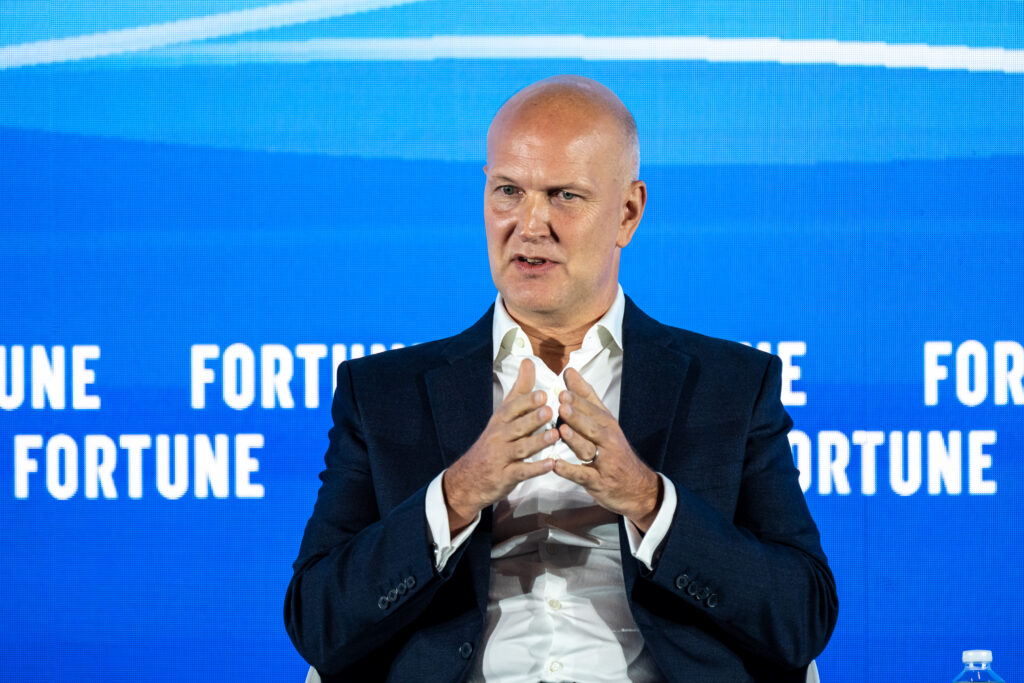
Companies must build supply chains for robustness, not resilience, because “a black swan event has become a flock of black swans,” Thomas Knudson, executive chairman of logistics company Toll Group, said Tuesday.
Supply chain shocks have piled up since 2020, following the COVID pandemic, Russia’s 2022 invasion of Ukraine, Trump’s 2025 tariffs and the end of de minimis, and finally the U.S. war with Iran and the closed Strait of Hormuz.
Before 2020, Knudsen said resilience meant reacting—waiting for a crisis, then calling for help. “And then we call our banks, our logistics companies, and we say, ‘Hey, can you help us get out of this problem?’” he said at the Fortune Southeast Asia 500 Summit in Ho Chi Minh City, Vietnam.
“Now suddenly you’re looking at your tier two, three, and four suppliers,” he added. “We’ve got to build a supply chain that’s much more robust.” Toll Group, founded in 1888 and currently owned by Japan Post, runs freight forwarding and contract logistics across Asia.
In practice, robustness means spare capacity: backup routes by truck and rail alongside ocean and air, and sea-air combinations that fly cargo part of the way and ship it the rest. “Today we’re doing trucking. Tomorrow we’re doing rail. We’re complementing with ocean and air,” Knudsen explained.
But robustness has limits. For low-value goods like cement, he noted, building a resilient supply chain is difficult simply because of the cost.
Tariffs have also forced Chinese companies to look to new markets and manufacturing hubs. “Is that going to move back? I don’t think so,” Knudsen said.
Standard Chartered’s Future of Trade report—a survey of 2,100 senior corporate leaders across 27 markets—reports that ASEAN executives citing geo-economic actions among their top three trade concerns has risen from 49% over the past year to 57% over the next three to five years.
James Nesbitt, managing director and head of global subsidiaries for Singapore and ASEAN at Standard Chartered, said the bank’s corporate clients are making long-term strategic commitments to the region.
“This isn’t simply about a foreign company setting up a factory in Indonesia, waiting for that factory to produce, and then kind of moving on,” Nesbitt said.
Established in 1992, the ASEAN Free Trade Area has fostered regional integration by eliminating tariff barriers among Southeast Asian countries. ASEAN’s 11 economies together are worth about $4.5 trillion and growing about 4.5% a year, according to the IMF—yet only about 22% of the bloc’s trade happens within it, versus roughly 60% for the European Union.
Knudsen pointed to the EU’s single currency and open borders as the model for ASEAN. “We saw when the UK stepped out of the EU on Brexit, that friction became real,” he said. “It wasn’t just a little obstacle.”
Nesbitt said ASEAN’s diversity could also create opportunities to connect its payment systems. Each market has its own real-time payment network, he said, and an integrated overlay could enable them to work together.
“What if there was an opportunity not to create bilateral ties between ASEAN, but instead have an overlay where all of these different payment infrastructures can operate real time?” he asked. “Can blockchain solve that? Is there an opportunity for tokenization? Or stablecoins to solve for that?”
This story was originally featured on Fortune.com