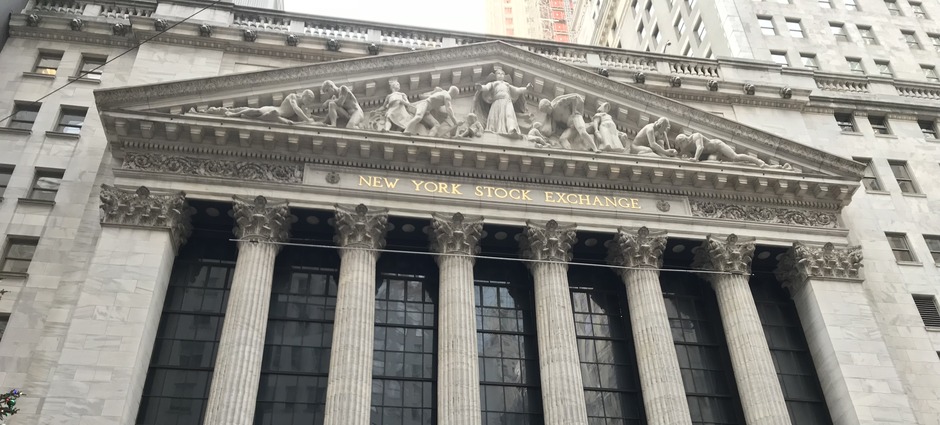
New York Stock Exchange, December 2017. Archive photo: Donatingpictures / Wikimedia Commons, CC BY-SA 4.0; cropped.
U.S. stocks ended Tuesday lower, with the Dow Jones Industrial Average falling 848.75 points, or 1.64%, to 50,759.42. The S&P 500 lost 76.06 points, or 1.03%, to 7,340.53, while the Nasdaq Composite fell 181.37 points, or 0.74%, to 24,328.38, according to the updated closing report. Software shares were among the hardest hit as investors weighed interest-rate risks and waited for Nvidia’s quarterly results.
The declines extended the S&P 500 and Nasdaq Composite’s losing streaks to four sessions, their first four-day slide since September. The selling reached across the market: all S&P 500 sectors finished lower, with software and services, airlines and banks among the weaker groups.
The Nasdaq figure refers to the Nasdaq Composite, not the Nasdaq-100. The index changes below describe the regular U.S. trading session that ended at 4 p.m. Eastern, not after-hours trading.
Closing scoreboard
| Market | Close | Change |
|---|---|---|
| Dow Jones Industrial Average Mon. close 51,608.17 |
50,759.42 | -848.75 (-1.64%) |
| S&P 500 Mon. close 7,416.59 |
7,340.53 | -76.06 (-1.03%) |
| Nasdaq Composite Mon. close 24,509.76 |
24,328.38 | -181.37 (-0.74%) |
| Brent crude Settlement, per barrel |
$93.14 | +$0.70 (+0.76%) |
| U.S. crude (WTI) Settlement, per barrel |
$86.01 | +$0.29 (+0.34%) |
Stock-index levels and changes are from the updated closing report. Oil figures are futures settlement prices, not stock-market closing levels.
Software leads the retreat
Salesforce fell 9.4% by the close, while ServiceNow dropped 6.5% and Atlassian declined 6%, according to a closing report. The losses showed that the pressure extended beyond chipmakers to companies selling enterprise software.
During the session, the iShares Expanded Tech-Software Sector ETF was down more than 3%. Palo Alto Networks and Oracle lost about 4%, while Microsoft and Palantir were down about 3% in intraday reporting. Those readings are not being presented as verified closing changes.
Investors were also preparing for Anthropic’s expected stock-market debut. The company’s IPO process and Nvidia’s results put renewed attention on AI spending, competition and the returns that technology companies can earn on their investment.
The market losses do not establish that AI caused recent technology outages or that the companies whose shares fell were responsible for those disruptions.
Interest-rate risk remains in focus
Economic releases added to the debate over how much more work the Federal Reserve may need to do to bring inflation down. Underlying retail sales were strong, while industrial output weakened, import prices rose and homebuilder sentiment fell to its lowest level since April 2012, according to the closing market report.
St. Louis Fed President Alberto Musalem said several interest-rate increases could be needed before spring 2027. His assessment suggested as many as four increases in coming meetings, but he also described an unlikely, still plausible scenario in which no further increases would be needed. He is not a voting member of the rate-setting committee this year. His remarks are not a decision by the Fed.
The 10-year Treasury yield was above 5% during the session. Futures pricing cited in the closing report put the probability of a quarter-point December rate increase at about 95.4%. That is a market-implied estimate that can change, not a policy announcement.
The breadth of the decline pointed to wider investor caution rather than pressure on a single stock or industry.
Oil settles higher despite supply concerns
Brent and U.S. crude futures settled modestly higher as traders weighed risks to tanker traffic in the Strait of Hormuz and expectations of lower U.S. crude inventories. Expectations for a supply surplus as Middle East exports recover limited the gains.
The opposing pressures help explain why oil rose without a larger surge: traders were weighing the risk of disruptions against the prospect of improving supply. The settlement figures do not establish that any one military development caused the day’s entire move.
Other companies and sectors to watch
Intel fell after Nvidia disclosed that it had reduced its stake in the company by 25%. JPMorgan Chase shares dipped after the bank named Bregje de Best to succeed Jeremy Barnum as chief financial officer in early 2027.
Solar shares also weakened. The Invesco Solar ETF was down roughly 5% in afternoon trading and reached its lowest level since August 2025. The decline came as the December 4 effective date for new Section 232 tariffs on solar products approached. The afternoon move is not a verified closing tally.
What comes next
Nvidia released its quarterly results at 4:20 p.m. Eastern, after the regular session ended. Those results therefore belong to the after-hours and next-session outlook, not an explanation based on information investors already had at the 4 p.m. close. Nvidia’s analyst call is scheduled for 5 p.m.
Minutes of the Fed’s October meeting are due Wednesday. Investors will look for more detail about officials’ assessment of inflation and the conditions that could affect the next rate decision. Anthropic’s expected pricing and trading milestones remain another focus for the technology sector.
Closing index levels and point changes have been added from the updated closing report. Intraday stock and ETF moves are identified separately from closing changes. This report expands the same closing recap first published at 4:26 p.m.; it does not reset the original publication time.
JBizNews Markets Desk | New York
© JBizNews.com. All rights reserved. Unauthorized reproduction or redistribution is strictly prohibited.