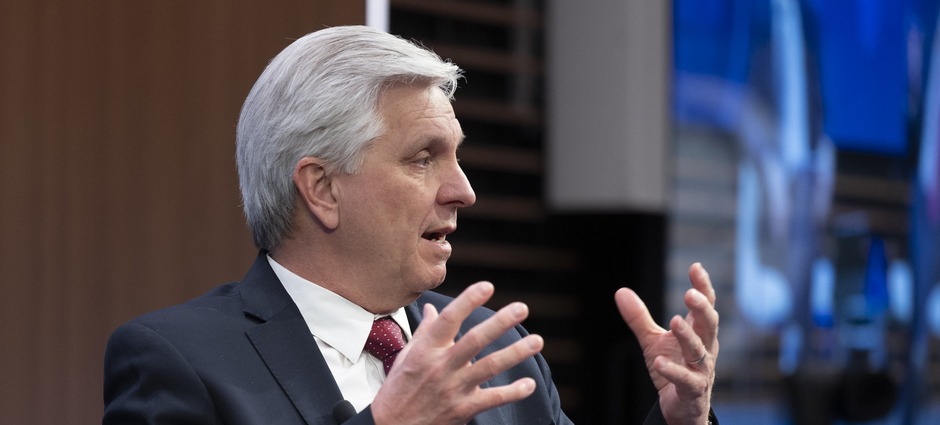
Christopher Waller at the Atlantic Council, February 6, 2025. File photo: Federal Reserve, public domain. Not from the November 17 conference.
Federal Reserve Governor Christopher Waller said Tuesday that banks and other firms building tokenized financial markets must establish who is responsible for fraud, lost access and failed transactions, while preserving a choice of payment and settlement methods.
In a November 17 speech at The Clearing House’s annual conference in New York, Waller described growing connections between blockchain networks and established finance. He argued that technical capability alone would not be enough to win customers’ trust.
The remarks set out his views on an evolving market. They did not announce a new Federal Reserve rule, approve a tokenized product or establish that the technologies have delivered their promised benefits. Waller said his views were his own and not necessarily those of other Fed officials.
What changes when assets become tokens
Tokenization represents a financial instrument digitally so it can be transferred on a different platform, such as a blockchain. A transaction involving a tokenized stock, for example, still needs a way for the buyer to pay the seller.
Waller said stablecoins, tokenized bank deposits and tokenized money market funds were among the instruments being developed for that purpose. He expects different instruments to serve different needs, rather than one form of tokenized money displacing every alternative.
For corporate treasurers, banks, asset managers and payment providers, that could mean using several instruments at once, just as businesses already use more than one payment network. He said stablecoins and tokenized deposits differ in their issuers, regulatory treatment, connections to traditional systems and reach.
Faster settlement has trade-offs
Waller illustrated the potential with an investor buying a tokenized stock on a Saturday. A programmed transaction could exchange the payment and the stock simultaneously, reducing the risk that one party delivers while the other does not. That was an example of a possible use, not a claim that every tokenized market already offers it.
Such all-or-nothing transactions are often called atomic settlement. But Waller cautioned against treating them as the only model. Net settlement and batch settlement can remain useful when firms need to conserve liquidity, particularly in high-volume capital markets.
The distinction matters because completing every trade separately and immediately is not the same as settling only the net amounts participants owe. A faster-looking system is not automatically the best fit for every business need.
Who answers when something goes wrong?
Waller posed questions about responsibility when automated code enables fraud, keys are lost or compromised, transfers are mistaken or prices are wrong. He also raised the problem of assets stranded on failing blockchain networks.
He said assets moving between networks must retain their legal identity, ownership rights, economic terms and compliance obligations. Clear treatment of custody, insolvency and settlement records will be important for wider institutional use, he said.
Those are questions about governance and legal responsibility as well as software. Waller suggested that systemically important transactions may require more conservative designs, potentially sacrificing some of an open network’s flexibility for privacy and control.
Traditional payment networks still have a role
Waller said established payment networks would continue to support tokenized markets, including connections that let customers move between traditional dollars and tokenized instruments. Central bank money need not appear in every transaction or on every platform, he said, but remains essential at the foundation of the payment system.
He said the Fed would continue engaging with the industry, providing core payment and settlement infrastructure and monitoring financial-stability risks. His central message was that new platforms must earn trust through reliable operations and clear governance, rather than expecting adoption on the strength of their technology alone.
JBizNews Desk | New York
© JBizNews.com. All rights reserved. Unauthorized reproduction or redistribution is strictly prohibited.