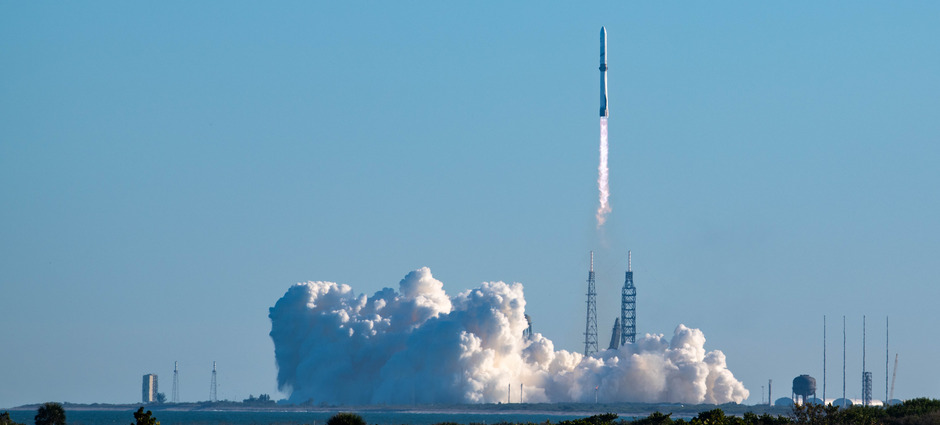
Archive: New Glenn, November 2025. Samuel Becker / U.S. Space Force, public domain; cropped.
Google said Thursday it has chosen Blue Origin’s New Glenn rocket for the first heavy-lift launch of Project Suncatcher, targeting the first quarter of 2029 for a mission carrying satellites designed to expand its research into AI computing in space.
Each satellite would carry roughly the computing capacity of a data center rack and would be deployed into sun-synchronous orbit, according to Google’s announcement. The company describes Suncatcher as a long-term effort to use abundant solar power in orbit to scale AI infrastructure, rather than a commercial data-center service already in operation.
Travis Beals, Google’s senior director of paradigms of intelligence, said the dedicated launch builds on its work with other satellite and launch partners. Thursday’s announcement sets a launch target; it does not mean New Glenn has carried the satellites into orbit. Google did not disclose a contract value in the announcement.
The partnership follows earlier tests with a smaller prototype. Google said on October 1 that a satellite built with Planet had launched aboard SpaceX’s Transporter-18 rideshare mission and that contact had been established. On October 30, Google reported that its onboard Gemma 4 AI model had generated a haiku during a ground-station pass over Svalbard, Norway.
Those tests are steps toward a larger research program. Google said in its October update that it would continue testing how its custom Tensor Processing Units, or TPUs, perform under thermal stress and radiation in orbit. Its next planned milestone is a pair of interconnected satellites in 2027, ahead of the heavy-lift mission now targeted for 2029.
JBizNews Desk | New York
© JBizNews.com. All rights reserved. Unauthorized reproduction or redistribution is strictly prohibited.