The Middle East energy shock has now pushed another airline into bankruptcy court.
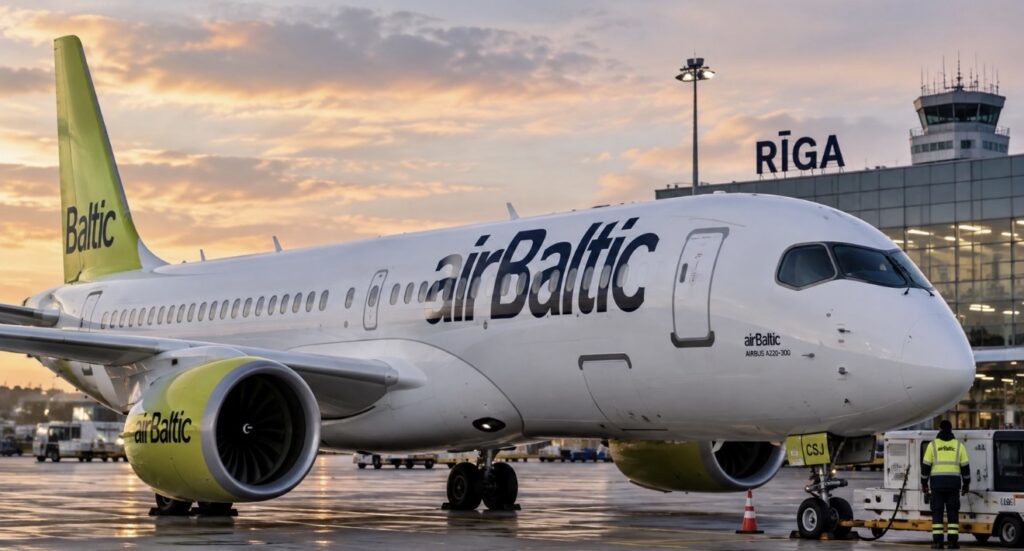
Latvia’s national carrier, airBaltic, filed for Chapter 11 bankruptcy protection in New York Monday, saying surging fuel costs and mounting debt made its previous business model unsustainable.
Flights are continuing. Existing tickets remain valid.
But financially, the airline is being rebuilt.
AirBaltic has secured commitments for approximately €350 million in bankruptcy financing, subject to court approval, giving it enough liquidity to keep operating while it restructures.
The company is carrying roughly €583 million of debt and had already burned through hundreds of millions of euros raised from bond investors as jet-fuel prices surged and geopolitical disruptions forced it to cut routes.
The airline carried 5.2 million passengers in 2025 and generated about €779 million in revenue, but still lost more than €44 million.
Now the economics have deteriorated further.
AirBaltic operates an all-Airbus A220 fleet and had once planned to grow to as many as 100 aircraft.
That expansion is now over.
The airline expects to shrink its fleet to roughly 36 aircraft by the end of 2026, down from 54, while management negotiates workforce reductions and cuts capacity.
For airlines, fuel is one of the largest operating expenses.
When jet fuel doubles, airlines cannot simply double ticket prices.
A carrier selling a €200 ticket may already be operating on a relatively thin margin after paying for aircraft leases, crews, airports, maintenance and fuel.
Add tens of millions of euros in unexpected fuel expense and the entire route network has to be recalculated.
AirBaltic was particularly exposed because much of its fuel costs were not protected through hedging.
The Iran war then pushed global energy prices sharply higher.
That made a difficult balance sheet significantly worse.
The Latvian government owns roughly 88% of airBaltic, while Lufthansa owns about 10%.
Latvia has already provided emergency financing, but European Union state-aid rules limit how much additional government money can simply be injected into the airline.
Chapter 11 gives management another option.
The airline can keep flying while negotiating with creditors, aircraft lessors, employees and potential investors under court supervision.
Management currently hopes to complete the restructuring by June 2027.
The larger warning is for the rest of the aviation industry.
Oil above $100 does not hit every airline equally.
Large carriers with stronger balance sheets, better fuel hedges and profitable premium routes can absorb higher energy costs longer.
Smaller and heavily indebted airlines cannot.
That means the longer oil stays above $100, the more likely the energy crisis becomes a corporate solvency crisis.
AirBaltic may be one of the first visible casualties.
It may not be the last.
JBizNews Desk | New York
© JBizNews.com. All rights reserved. This article is original reporting by JBizNews Desk. Unauthorized reproduction or redistribution is strictly prohibited.