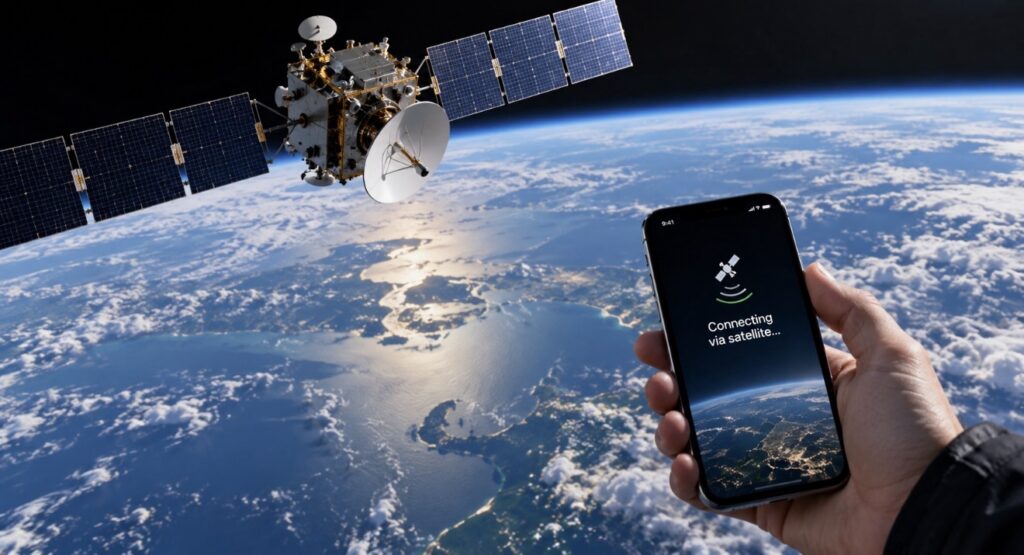
Your cellphone may soon stop caring whether there is a cell tower nearby.
Space42 and Viasat signed a binding agreement Monday to create Equatys, a new satellite communications company backed by up to $1 billion of initial equity, with the goal of connecting ordinary smartphones directly to satellites when terrestrial networks are unavailable.
The companies are effectively trying to build a cell-tower network in space.
Instead of every mobile operator launching its own satellite constellation, Equatys is designed as shared infrastructure that telecom companies can use much like they lease capacity from terrestrial tower operators today.
The difference is that the towers will be orbiting the Earth.
Equatys plans to use a global 5G non-terrestrial network built around international 3GPP standards, meaning the system is being designed to work with standard smartphones and connected devices rather than specialized satellite phones.
That could dramatically expand the addressable market.
Space42 estimates the potential market could exceed 1 billion devices by 2032.
The companies have access to more than 100 MHz of globally harmonized satellite spectrum, one of the most valuable pieces of the project because satellite connectivity depends not simply on launching hardware but on having legal rights to transmit signals around the world.
Commercial service is targeted within roughly three years.
The venture also changes the economics of satellite communications.
Building a global constellation requires enormous capital. Satellites have to be manufactured, launched, insured, operated and eventually replaced. Ground stations and network infrastructure must be built as well.
By allowing multiple telecom operators to share that infrastructure, Space42 and Viasat are betting they can spread those costs across many customers rather than forcing each carrier to build its own network.
It is essentially the same economic model that transformed the terrestrial cellphone business.
Wireless carriers once owned far more of their own towers. Over time, companies such as American Tower and Crown Castle built giant businesses owning infrastructure and leasing space on it to multiple carriers.
Equatys wants to take that model into orbit.
The implications could be enormous.
A customer traveling through a rural area, desert, mountain region or across open water could remain connected even after terrestrial cellular coverage disappears.
Emergency calls and messages could continue after hurricanes, earthquakes or other disasters knock down conventional towers.
Ships, aircraft, vehicles, agricultural equipment and industrial sensors could also remain connected far beyond existing cellular networks.
Space42 has already tested direct-to-device SMS and emergency SOS connectivity using normal devices through its Thuraya-4 satellite, with commercial services expected to begin rolling out this year.
The company also brings substantial financial firepower.
Space42 entered 2026 with approximately $1 billion in cash and short-term deposits and roughly $6.5 billion in contracted future revenue.
Viasat brings decades of satellite communications experience following its acquisition of Inmarsat.
The companies first announced plans for Equatys last year. Monday’s binding agreement moves the project from an idea toward an operating company with committed capital.
And investors immediately noticed.
Space42 shares jumped more than 6% Monday in Abu Dhabi trading following the announcement.
The competitive landscape is already crowded.
SpaceX’s Starlink has demonstrated that consumers will pay for satellite broadband, while Apple, T-Mobile, SpaceX and other telecommunications companies are increasingly experimenting with satellite connections directly to ordinary phones.
Europe is developing its own sovereign satellite infrastructure, and major telecom companies are exploring direct-to-mobile networks.
But Equatys is taking a different approach.
Rather than trying to replace existing mobile operators, it wants to become infrastructure for them.
That distinction could determine whether satellite connectivity becomes another standalone subscription consumers must buy — or simply another layer underneath the cellphone service they already use.
For the telecom industry, the physical boundary of the network has always been the point where the last cell tower disappears.
Space42 and Viasat are now spending up to $1 billion to eliminate that boundary.
JBizNews Desk | New York
© JBizNews.com. All rights reserved. This article is original reporting by JBizNews Desk. Unauthorized reproduction or redistribution is strictly prohibited.