Welcome to Eye on AI, with AI reporter Sharon Goldman. In this edition: Microsoft CFO’s AI spending runs up against tech bubble fears…How AI helped one man (and his brother) build a $1.8 billion company…Apple escalates crackdown on vibe coding apps.

AI can now write code faster than a human can possibly type. With “vibe coding” tools like Anthropic’s Claude Code and OpenAI’s Codex, developers are gleefully building—and shipping—at a pace that would have been unthinkable just a year ago. Even Claude Code’s creator, Boris Cherny, has boasted that the latest version was written entirely by—yes—Claude Code.

But while vibe coding may be fast, it can also introduce subtle bugs and vulnerabilities. And human error hasn’t gone away: Claude Code is now under scrutiny after its own source code was accidentally leaked this week due to a packaging mistake.

For enterprises, these kind of vulnerabilities are a nonstarter. At large companies with sprawling codebases, it’s not just about writing code faster—it’s about ensuring that code is correct, secure, and compliant with internal systems and external obligations. As AI tools begin to generate production-ready code automatically, the bottleneck is shifting from writing software to verifying it. And at enterprise scale, where millions of code changes can flow through a system each year, even small errors can quickly compound into major risks.

That got me thinking about an interview I did two years ago with Itamar Friedman, cofounder and CEO of Qodo, an AI code review tool that has just raised $70 million to tackle what he calls the growing problem of “AI slop” in codebases.

When I first spoke to Friedman in early 2024, when the company was called CodiumAI, he talked about “flow engineering”—a system where one model generates code and another critiques it, adding layers of testing and reflection. But even then, it was clear that generating code was considerably easier than making sure it is accurate and works well, and that “code integrity” was key. 

In a chat with Friedman yesterday, he argued that today’s AI coding tools, powered by LLMs, are designed to complete tasks, not to question them—making a separate “governance and trust layer” essential to determine what should (and shouldn’t) ship.

“AI is not enough when you’re talking about real-world software quality and code governance,” he said. “What you need, actually, is official wisdom.” He explained that as a developer in a big organization, creating quality code isn’t just about being smart. It’s about knowing how a specific company does things—all the tribal knowledge within the organization. 

Qodo, he explained, analyzes how developers in an organization actually write and review code—looking at pull requests, comments, and past changes—and turns that into a set of rules that define what “good” looks like for that company. Those rules are then enforced automatically, flagging new code that violates them.

In the age of AI, the challenge for enterprises is that they want to move faster, but don’t have the freedom to change their codebases unless they can be sure that code will remain trustworthy. 

“That’s the gap we’re trying to close,” said Friedman, who spent three years as a director of machine vision at Alibaba before launching what is now Qodo in 2022, just a few months before ChatGPT launched. Qodo clients, including Walmart, Nvidia, Ford and Texas Instruments, want to move fast, he explained, but they also know their systems depend on layers of accumulated knowledge and constraints. 

Today’s vibe coding landscape, he added, overestimates how much these tools can be trusted in the short term—and underestimates how much a trust layer is needed to make them viable in the real world for the long haul.

With that, here’s more AI news.

Sharon Goldman
sharon.goldman@fortune.com
@sharongoldman

This story was originally featured on Fortune.com

Director and producer is co-creator of You Are Here, a one-day immersive theatrical event traversing 75 years of youth culture

Out of chaos come great cultural movements, according to the director and producer Danny Boyle, who will inflict a little curated chaos on London’s Southbank Centre with what has been described as an “epic, one-off pop culture spectacular”.

Boyle, whose 2012 London Olympics opening ceremony drew on the rich thread of British culture, is the co-creator and director of You Are Here, a one-day immersive theatrical event traversing 75 years of youth culture and social movement: think teddy boys, Lovers’ Rock, punk, Ziggy Stardust, rave, acid house, the spoken word, Brit pop, ballroom to name a few.

Continue reading…

This post was originally published here

Ocasio-Cortez says Israel can fund its own defense and she will oppose any new US aid amid human rights concerns

Alexandria Ocasio-Cortez, a US representative, said on Wednesday that she will oppose any future US military aid to Israel, including for defensive systems.

In a statement on social media, Ocasio-Cortez said that Israel was fully capable of funding “Iron Dome and other defensive systems”, and that “consistent with my voting record to date, I will not support Congress sending more taxpayer dollars and military aid to a government that consistently ignores international law and US law”.

Continue reading…

This post was originally published here

This blog is now closed

Back to Trump’s frustration with European allies – although it doesn’t involve a Nato member this time – Austria is the latest country to risk the US president’s wrath after a defence ministry spokesperson confirmed it denied all US requests for military overflights related to the Iran war.

“There have indeed been requests and they were refused from the outset,” Col Michael Bauer told AFP, adding that every time a similar request “involves a country at war, it is refused.”

Continue reading…

This post was originally published here

Central American country to receive up to 25 migrants a day expelled as part of Trump’s immigration crackdown

The Costa Rican government has agreed to receive up to 25 deported migrants a week from the United States, the latest deal in the Trump administration’s unprecedented efforts to deport scores of people to “third countries”.

With the new agreement, Costa Rica seeks a closer alliance with Donald Trump’s government, which has been securing cooperation from other Central American countries in accepting deportees from other nations who have been detained by US immigration agents.

Continue reading…

This post was originally published here

Mortgage rates rose this week as the conflict in Iran continues to weigh on markets, mortgage buyer Freddie Mac said Thursday.

Freddie Mac’s latest Primary Mortgage Market Survey, released Thursday, showed the average rate on the benchmark 30-year fixed mortgage climbed to 6.46% from last week’s reading of 6.38%. 

The average rate on a 30-year loan was 6.64% a year ago.

“With spring homebuying season in full swing, aspiring buyers should remember to shop around for the best mortgage rate, as they can potentially save thousands of dollars by getting multiple quotes,” said Sam Khater, Freddie Mac’s chief economist.

LOS ANGELES LEADS NATION IN MASSIVE POPULATION EXODUS AS ‘BREAKING POINT’ HITS GOLDEN STATE

The average rate on a 15-year fixed mortgage ticked higher to 5.77% from last week’s reading of 5.75%.

MIAMI OVERTAKES LOS ANGELES AND NEW YORK AS WORLD’S RISKIEST HOUSING MARKET FOR BUBBLE RISK

Mortgage rates are affected by several factors, including the Federal Reserve and geopolitics. Though mortgage rates are not directly affected by the Fed’s interest rate decisions, they closely track the 10-year Treasury yield. The 10-year yield hovered around 4.3% as of Thursday afternoon.

GET FOX BUSINESS ON THE GO BY CLICKING HERE

This post was originally published here

Asian investors reacted poorly to U.S. President Donald Trump’s nationwide address on Thursday. After more than a day of speculation as to what Trump might discuss, ranging from sending in ground forces to plans for a ceasefire, the president’s address instead signaled a continued conflict and energy disruptions.

Trump delivered his address right as trading had started in some Asian markets. In his 20-minute-long speech, the president said the U.S. will likely continue military operations for another two to three weeks, that he was ready to bomb Iran “back to the stone ages,” and ready to hit power plants if a deal wasn’t reached.

West Texas Intermediate crude surged past $106 per barrel; rising oil and gas prices will continue to put pressure on Asian economies that rely on imported energy.

South Korea’s KOSPI, which has swung wildly since the war began over a month ago, fell by almost 4.5%. Japan’s Nikkei 225 dropped by 2.4%, while Hong Kong’s Hang Seng Index fell by around 0.7%. Taiwan’s Taiex fell by 1.8%. As of 4:30 a.m. Eastern Time, India’s Nifty 50 is down by 0.67%.

Reopening Hormuz

Trump’s messaging on Iran has constantly shifted over the past few weeks, oscillating between calls for expanded and aggressive strikes on the Middle Eastern country, to suggestions that he might be comfortable with withdrawing from the conflict and leaving Iran to hold the Strait of Hormuz.

The strait is a critical waterway for much of the Middle East’s oil and gas, bound for markets in Asia and Europe. The strait has been effectively closed since the war began.

The U.S. president has tried to lobby allies to do more to keep the strait open, to little effect. While countries like Japan, Australia, and the U.K. have criticized Iran’s decision to block the waterway, none have committed to using military force. 

Trump’s patience may have run out. In his address, he called upon countries to show some “delayed courage” in taking the strait for themselves, arguing that an “essentially decimated” Iran wouldn’t be able to provide much resistance.

“Countries of the world that do receive oil through the Hormuz Strait must take care of that passage,” the president argued. “We will be helpful, but they should take the lead in protecting the oil that they so desperately depend on.”

Iran, in the meantime, is quickly institutionalizing its control of the strait, taking the power to decide what ships are allowed to transit the waterway—and how much they should pay for the privilege to do so.

Iran first evaluates ships asking to cross the strait to ensure they have no links to Israel, the U.S., or other countries Iran deems an enemy, Bloomberg reported on Wednesday. Then negotiations over the fee, paid in Chinese yuan or stablecoins, begin, with friendlier countries getting a lower fee.

The Asia energy crisis

Asia, which gets much of its oil and gas from the Middle East, is now girding for an extended energy crisis. Oil and gas shortages have pushed many Asian countries to impose export bans on refined fuel products, which have knock-on effects on other countries in the region. The Iran war is also snarling shipments of other commodities, like fertilizer, aluminum, and helium.

Southeast Asian countries are now trying to ration fuel and lower energy consumption to preserve stocks. They are also trying to turn to other ways of generating power, including reopening coal plants and setting out pathways to adopt more nuclear power and renewable energy.

On Wednesday, Australia Prime Minister Anthony Albanese gave his own national address, where he laid out how his government is trying to secure fuel supplies. Australia imports most of its fuel, and has been hit hard by shortages of refined oil products like petrol and jet fuel. The country has cut gas taxes and is trying to source fuel from other suppliers. 

“Australia is not an active participant in this war, but all Australians are paying higher prices because of it,” Albanese said. 

Airlines in the Philippines and Vietnam are suspending flights, and governments across the region have implemented four-day weeks for public officials. (Malaysia, on Thursday, ordered civil servants to work from home starting April 15.)

Several Asian governments also subsidize fuel, which is increasingly expensive as oil prices continue to climb upwards. On Tuesday, Indonesia limited the amount of subsidized petrol people could buy. Fuel subsidies threaten to blow a hole in Jakarta’s already strained budget. The government is considering rolling back social programs like its free-meals scheme, a core plank of President Prabowo Subianto’s political agenda. 

Another hard-hit country is South Korea, which relies heavily on imported oil and liquefied natural gas. The country is considering curbs on driving for the first time since 1991 if oil prices continue to rise, and officials are pushing for an additional $17.3 billion in government spending to bolster the economy. 

“The current crisis is not a passing shower that quickly subsides, but rather a massive storm whose duration is uncertain, making it all the more severe,” South Korea president Lee Jae Myung told lawmakers on Thursday.

“If we save every drop of fuel, avoid wasting even a single plastic bag … we can emerge from the tunnel of crisis safely and swiftly.”

This story was originally featured on Fortune.com

Between client calls, meetings, and assignments, it may feel as if every minute of our working week is squeezed to the max. But as it turns out, we are all just procrastinators. 

That’s according to research which shows that workers can get as much done in a 33-hour week as in 38 hours. 

The 2023 report from nonprofit advocacy group 4 Day Week Global—which is the largest of its kind and the first to examine the long-term effects of the four-day week—found that the longer people worked a four-day week, the shorter their work weeks became without output or productivity taking a hit.

Workers could shave 5 hours off their workweek

Up until now, most studies have examined the short-term effects of working a shorter week. 

For example, Britain completed the world’s largest trial of the four-day week, enlisted more than 60 companies and just fewer than 3,000 workers to feedback on the “100:80:100” working model: 100% pay for 80% of the time, in exchange for 100% productivity. 

The results were a 65% reduction in the number of sick days, maintained or improved productivity at most businesses, and a 57% decline in the likelihood that an employee would quit, dramatically improving job retention. But the pilot was just for six months.

The 4 Day Week Global report examined workers in the U.S., Canada, Britain, and Ireland over an 18-month period. After just six months of working a four-day week, burnout, general health, and job satisfaction improved.

Workers were given a paid day off a week but the same workload to see whether they could get as much done working more effectively—and the study confirmed they could.

Not only that, but unlike previous studies of its kind, the report also highlighted workers could cut their average work time by about four hours, to 34 hours a week, in that time.

This is because workers cut out inefficiencies that a more lengthy workweek allowed, like meetings, to dedicate more time to uninterrupted focus work: Essentially, those of us on a five-day week are filling up our days with time-wasting activities. 

Meanwhile, those who continued with the schedule for a year shaved a further hour off their workweek and, as such, reported better work-life balance and a further uplift in their mental and physical health.

Plus it’s not only employees who gained from a shorter week; the four-day week was also an organizational win: Revenue increased by 15% over the course of the trial, weighted in accordance with company size. 

It’s probably why no organization expressed a desire to return to five days post-trial and 89% of workers also wanted to stay with the new four-day plan.

The cons of moving to a four-day week

In theory, shifting to a four-day week looks like a no-brainer for businesses. But in reality, experts previously warned Fortune it’s a logistical nightmare that could make some staff members miserable. 

Charlotte Morriss, a associate director at ESP Solicitors, explained: “Businesses can’t simply change a person’s contractual terms unilaterally.” Before making any permanent changes, there will be an abundance of contractual changes that must be made with employee buy-in, such as what happens with part-time workers who already work a short week, which day workers will be “off,” and how holiday pay is calculated.

What’s more, although for the most part employees reported an increase in their well-being and work-life balance, for a small minority of employees this was not the case. 

“Just like any change, it will suit some and alienate others, and the reality may be that the structure doesn’t suit every employee or business model,” Pierre Lindmark, founder and CEO at management consultancy Winningtemp, told Fortune. “The truth is that the four-day working week isn’t for everyone.”

He warned that “one less day at work could lead to increased anxiety and isolation as the result of having the same amount of work to do, but less time to get it done.”

A version of this story originally published on Fortune.com on July 27, 2023.

Read more about the evolving work-week from Fortune‘s Orianna Rosa Royle:

This story was originally featured on Fortune.com

After two years of tweaks to its value menu, McDonald’s has a new strategy: keep it simple.

The fast-food giant’s budget-focused McValue menu will have 10 items that each cost under $3 starting April 21. The breakfast items include hash browns or a Sausage McMuffin. A small order of fries or a McDouble burger are among the options the rest of the day.

Some of the items already cost less than $3 in some parts of the U.S., but others don’t. The standardized selection will replace McDonald’s current McValue menu, which lets customers choose from a limited array of $1 items if they purchase a regular-priced item.

The shift to simpler value menu messaging and more flexibility follows similar by moves by rivals of McDonald’s. In January, Taco Bell launched a Luxe Value Menu, which also features 10 items that cost $3 or less. Panera Bread introduced its first value menu in February, with 10 items priced at $4.99 each.

Wendy’s revamped its Biggie Deals value menu in January. It now features $4 Biggie Bites, a $6 Biggie Bag and an $8 Biggie Bundle. KFC recently added $5 bowls to its U.S. menu.

Value menus are designed to offer customers more affordable options, even as fast-food companies also bring out higher-priced items like McDonald’s Big Arch burger or Burger King’s limited-time Peppercorn BLT Whopper.

Chains have emphasized value for several years to win back customers who were frustrated by food price inflation. Historically, prices for food away from home rise 3.5% per year, but in 2023 they rose 7%, in 2024 they rose 4% and in 2025 they rose 3.8%, according to government figures.

“In all retail, including quick-serve restaurants, ‘value’ has become a promotional expectation,” said Roger Beahm, an emeritus professor of marketing at Wake Forest University’s School of Business.

In June 2024, McDonald’s introduced a $5 Meal Deal; it will add a $4 Breakfast Meal Deal on April 21. It debuted the McValue menu in January 2025, and last fall it brought out Extra Value Meals, which promise a 15% discount for a bundled meal compared to buying items individually.

“Value matters more than ever to our customers, and we take that responsibility seriously,” Alyssa Buetikofer, the chief marketing and customer experience officer for McDonald’s USA, told The Associated Press.

Buetikofer said McDonald’s has improved customers’ perceptions of value and affordability since 2024. But the company decided to revamp its McValue menu after customers said they wanted more flexibility and better value in the morning. Half of the items on the under-$3 menu are breakfast items.

Scott Rodrick, a McDonald’s franchisee in California, praised the new strategy. He thinks ordering will go more smoothly because customers will have fewer questions about the deals.

“The value proposition is super clear — no deep explanation or mental gymnastics needed to understand where value is on my menu board,” Rodrick said.

Rodrick said the changes received broad support from franchisees and most U.S. stores will be offering them. Around 95% of McDonald’s U.S. stores are owned and operated by franchisees, who set their own pricing.

Fast food’s juggling act – investing in value through promotions and discounts while raising prices on some premium items – appears to be paying off, according to Revenue Management Solutions, a restaurant consulting company. In February, customer traffic at U.S. fast-food restaurants rose less than 1% compared to the same month year. Traffic was down 2% during the last three months of 2025 and in January.

But the company warned that higher gas prices due to the Iran war likely impacted fast-food traffic in March. That could put pressure on fast-food chains to offer even more value.

The term “value” is at risk of overuse, Beahm said. Over time, the surprise-and-delight of a deal loses its appeal, and customers forget what they used to pay for certain products, he said.

“If everything is always positioned as a value, then can anything really be a value?” Beahm said.

He thinks new products are a good strategy for attracting customers. Improving service or offering unexpected perks – like a donation to a charity with every purchase – are other ways.

Jennifer Fritch, an assistant professor of marketing at Arcadia University, agreed. The fast-food market is crowded, she said, and focusing solely on price turns food into a commodity. Younger customers, in particular, are looking for emotional experiences, personalization and transparency about ingredients, and are willing to pay more when they find them, she said.

“If it’s just cheap food, that’s not a winning long-term strategy,” Fritch said. “The list of demands and list of expectations is higher than it has ever been, and it’s insufficient to try to gain sales just on cost.”

This story was originally featured on Fortune.com

Elon Musk’s space exploration company has filed preliminary paperwork to sell shares to the public, according to two sources familiar with the filing, a blockbuster offering that would likely rank as the biggest ever and could make its founder the world’s first trillionaire.

A SpaceX IPO promises to be one of the biggest Wall Street events of the year, with several investment banks lining up to help raise tens of billions to fund Musk’s ambitions to set up a base on the moon, put datacenters the size of several football fields in orbit and possibly one day send a man to Mars.

The sources spoke on condition of anonymity because they were not authorized to talk publicly about the confidential registration with the Securities and Exchange Commission.

SpaceX did not respond immediately to a request for comment.

Exactly how much SpaceX plans to raise has not been disclosed but the figure is reportedly as much as $75 billion. At that level, the offering would easily eclipse the $29 billion that Saudi Aramco raised in its IPO in 2019.

The offering, coming possibly in June, could value all the shares of SpaceX at $1.5 trillion, nearly double what the company was valued in December when some minority owners sold their stakes, according to research firm Pitchbook, before an acquisition that increased its size.

Musk owns 42% of the SpaceX now, according to Pitchbook, though that figure will change with the IPO when new owners are issued shares. In any case, he is likely to pierce the trillion dollar mark because he is already close. Forbes magazine estimates Musk’s net worth at roughly $823 billion.

In addition to making reusable rockets to hurl astronauts and hardware into orbit, SpaceX owns Starlink, the world’s largest satellite communications company. The company also recently brought under its roof two other Musk businesses, social media platform X, formerly Twitter, and artificial intelligence business, xAI, in a controversial transaction because both the seller and the buyer were controlled by him.

SpaceX has become the biggest commercial launch company in its industry, responsible for sending payloads into orbit for customers across the globe, but has also benefited from big taxpayer spending. That has raised conflicts of interest issues given that Musk was the biggest donor to President Donald Trump’s campaign and is still a big backer.

In the past five years, SpaceX won $6 billion in contracts from NASA, the Defense Department and other U.S. government agencies, according to USAspending.gov.

Among current SpaceX owners is Donald Trump Jr, the president’s oldest son. He owns a shares through 1789 Capital. That venture capital firm made him a partner shortly after his father won the presidency for a second time and has been buying up federal contractors seeking to win taxpayer money ever since.

The White House and Trump himself have repeatedly denied there are any conflicts of interest between his role as president and his family’s businesses.

This story was originally featured on Fortune.com

Britain accused Iran on Thursday of holding the world’s economy hostage as diplomats from more than 40 countries held talks on ways to reopen the Strait of Hormuz, a vital shipping route that has been choked off by the U.S.-Israeli war against Iran.

The U.S. is not attending the virtual meeting, which comes after President Donald Trump made clear that he thinks securing the waterway, closed as a consequence of the U.S.-Israeli war on Iran, is not America’s job. Trump has also disparaged America’s European allies for failing to support the war and renewed his threats to pull the U.S. out of NATO.

U.K. Foreign Secretary Yvette Cooper said the talks, which focus on political and diplomatic rather than military means, showed “the strength of our international determination” to reopen the strait.

“We have seen Iran hijack an international shipping route to hold the global economy hostage,” she said at the start of the meeting. Cooper said “unsustainable” spikes in oil and food prices were “hitting households and businesses in every corner of the world.”

Shipping in the strait has slowed to a trickle

Iranian attacks on commercial ships, and the threat of more, have halted nearly all traffic in the waterway that connects the Persian Gulf to the rest of the globe’s oceans, shutting a critical path for the world’s flow of oil and sending petroleum prices soaring.

There have been 23 direct attacks on commercial vessels in the Gulf since the war began on Feb. 28, and 11 crew members have been killed, according to shipping data firm Lloyd’s List Intelligence.

Traffic through the strait has slowed to a trickle, with what remains dominated by sanctions-evading tankers carrying Iranian oil, Lloyd’s List Intelligence said in a briefing Thursday. It said a murky operation under which Iran vets who can pass continues to operate as Tehran maintains its chokehold over the key waterway.

In a televised address on Wednesday night, Trump said countries that depend on oil flowing through the Strait of Hormuz “must grab it and cherish it” — because the U.S. would not.

No country appears willing to try and open the strait by force while fighting rages and Iran can target vessels with anti-ship missiles, drones, attack craft and mines.

French President Emmanuel Macron said opening the strait by force is “unrealistic.”

The reopening of the strait “can only be done in coordination with Iran,” through negotiations that would follow a potential ceasefire, Macron told reporters Thursday during a visit to South Korea.

France is pushing for an international mission involving European and non-European nations to escort oil and gas tankers through the waterway after the most intense phase of the conflict is over. The British government said military planners from an unspecified number of countries will meet next week to plot ways to ensure security once the fighting ends, including potential mine-clearing work and “reassurance” for commercial shipping.

In the meantime, more than three dozen countries including the U.K., France, Germany, Italy, Canada, Japan and the United Arab Emirates have signed a statement demanding Iran stop its attempts to block the strait and pledging to “contribute to appropriate efforts to ensure safe passage” through the waterway.

Cooper said the 40-plus countries at the meeting — up from the 35 announced Wednesday — discussed “diplomatic and international planning measures” to ensure the strait can reopen safely, and action to guarantee the safety of 20,000 seafarers on 2,000 ships trapped by the conflict.

The meeting sends a message to Trump

The international effort idea has echoes of the international “coalition of the willing” that has been assembled, led by the U.K. and France, to underpin Ukraine’s security after a future ceasefire in that war. That coalition is, in part, an attempt to demonstrate to the Trump administration that Europe is stepping up to do more for its own security.

The urgency of stronger continental defenses has been reinforced by Trump’s renewed suggestion that the U.S. could leave NATO. He said Wednesday that the military alliance had “treated us very badly.”

David B. Roberts, reader in Middle East Security Studies at King’s College London, said international coalition-building efforts over Hormuz are “definitely linked to the wider Trumpian antagonism toward NATO, that other members of NATO are not pulling their weight.

“Without a doubt, this is Britain and France, notably, trying to lead the way, to very visibly show a certain sort of utility” to the Trump administration.

“There’s also the very pragmatic reality that America is an oil exporter,” he added. “The immediate pressures about the fallout of the of the energy blockage in the Gulf, they fall on Europe and of course Asia, far more than America.”

———

Associated Press writers David McHugh in Frankfurt, Germany and Sylvie Corbet in Paris contributed to this report.

This story was originally featured on Fortune.com

In late March, I received a troubling message from Fortune’s IT administrator. “There is a process that’s exposing a vulnerability,” he wrote, telling me that someone may be prowling around my computer. “I need to kill it.” I panicked. A file I had downloaded at 11:04 a.m. had the capacity to monitor my keyboard strokes, record my computer screen, see my passwords, and access my apps, according to logs later reviewed by Fortune’s IT department.

After shutting down my laptop, I rushed out of my Brooklyn apartment and ran to the nearest subway station. While waiting for the train to Fortune’s office, where I planned to wipe the laptop with IT’s help, I texted my editor: “I think I may have been phished by the DPRK lol.”

I had reported on the Democratic People’s Republic of Korea and knew the country liked to target American investors. But I would have never thought its notorious hackers would come after me—and teach me a first-hand lesson about the depths of their deceptions. 

‘Scam vibes’

The Hermit Kingdom has been tormenting the crypto industry for years. Cut off from the global financial system by sanctions, the country has resorted to state-sponsored crypto theft to help pay its bills. In 2025 alone, hackers tied to the North Korean army accumulated $2 billion in stolen crypto, about 50% more than the year prior, according to data from the crypto analytics firm Chainalysis.

The Democratic People’s Republic of Korea has developed tried-and-true strategies to trick its victims. These include convincing companies to hire them as IT workers—and the techniques used to trick me.

The North Koreans laid their trap in mid-March. The bait came in the form of a message from a  hedge fund investor sent over Telegram, the crypto industry’s messaging app of choice. The investor, whom I’m not naming because he was an anonymous source for stories I had written, asked if I wanted to meet someone named Adam Swick, who had been the chief strategy officer at the Bitcoin miner MARA Holdings.

I replied sure—my source was historically friendly and helpful—and I was put into a group chat. My source said Swick was exploring the creation of a new digital asset treasury and “had a potential large seed investor.” 

The venture seemed dubious. Still, I was willing to at least listen to what Swick had to say. On Telegram, he asked me to book a call with him, and one week later, my hedge fund source sent me what appeared to be a Zoom link. I clicked on it.

The program that launched looked like the Zoom I use every day, though something about the design seemed slightly off and the audio didn’t work. I was prompted me to update the software to fix the sound issue, and, at same time, Swick wrote to me: “Looks like Zoom is acting up on your end.” I clicked to download the update.

My adrenaline kicked in when I saw the link in my browser wasn’t the same as the one sent to me in Telegram, and I asked to move the meeting to Google Meet, another videoconferencing service. “This is giving me scam vibes,” I wrote to Swick and my source, the hedge fund investor.

Swick persisted. “No worry. I just tried it on my PC.”

I didn’t try running the script on my MacBook and decided to flee the Zoom meeting. “If you want to talk to me, let’s do it over Google Meet,” I wrote over Telegram. My source promptly kicked me out of the group chat.

Viral hacks

As I was rushing out of my apartment to visit IT, I messaged Taylor Monahan, a veteran security researcher. She’s a member of SEAL 911, a group of volunteers who help victims targeted in crypto hacks. I sent her the script I had downloaded and the videoconferencing link I had received.

“That’s DPRK,” she messaged me back moments later.

If I had run the script, hackers would have stolen my passwords, my Telegram account, and any crypto I owned. (I, luckily, only own negligible amounts of Bitcoin and a few other cryptocurrencies.)

The nature of hacks means that it’s rare to be 100% sure of who’s behind them, but, in the case of my near-miss, Monahan told me the link, the script, and even the fake account associated with Adam Swick all pointed to North Korea. Investigators use a combination of evidence, including blockchain analysis, to tie incidents to the Democratic People’s Republic. Two other security researchers who track North Korean hackers later backed up her assessment when I sent them the script and videoconferencing link.

“Tell him Tay says hi lol,” Monahan said, referring to the North Korean who came after me.

Monahan and other security researchers have responded to hundreds of cases in the crypto industry involving fake videoconference calls. The scheme is formulaic but effective. 

Hackers take control of a real person’s Telegram account and then reach out to their contacts. Those contacts are asked to log onto a video call, where, invariably, the audio doesn’t work. The victims are asked to run an update to fix the sound problem. When they run the script, the hackers gain access to the victims’ crypto, passwords—and Telegram account. In fact, the same group of North Koreans that targeted me were behind a hack designed to exploit software developers writ large, Google said in a report published Wednesday.

I’m no Lamborghini-driving Bitcoin investor, but North Korea doesn’t just target the wealthy, Monahan told me. She’s seen hackers go after an increasing number of crypto journalists, likely because their Telegram accounts have a substantial Rolodex. Some of these contacts are, in all probability, rolling in crypto riches.

Like a virus that hijacks healthy cells, the hackers corrupt these newly compromised accounts and target the users’ contacts. That’s how I was almost infected. I was lulled into a sense of safety because I thought I was talking to someone I knew.

‘Fake me’

After I wiped my laptop, changed my passwords, and thanked Fortune’s IT administrator profusely, I eventually called my source on his cellphone. Unsurprisingly, his Telegram account had been hacked in early March. “I had a lot of contacts on Telegram that I didn’t have stored on my phone or my computer,” he said. “But to me, even more than that, you feel violated knowing someone out there [is] impersonating you, basically using your name to con people.”

And, although he reached out to Telegram multiple times for help over three weeks, he hadn’t received a response. (“While Telegram does everything it can to protect its accounts, it is not possible for any platform to protect users who are tricked into providing their login details to bad actors,” a spokesperson told me in a statement, adding that the app froze the hedge fund investor’s account after I had reached out.)

I also called the real Swick. Hackers had been impersonating him over Telegram since early February, and the former MARA Holdings executive received scores of texts and calls asking him why he wanted to set up meetings. He was always apologetic. “But a few of them have called me out, ‘Dude, what are you apologizing for?’” Swick said. “And I’m like, ‘I don’t know. I’m apologizing for fake me, I guess. I’m so sorry this happened.’”

Swick didn’t know why hackers were impersonating him, and my source, the hedge fund investor, didn’t know how his Telegram account was compromised. But, at the end of our phone call, the investor and I stumbled upon the potential answer. 

A fake Swick was one of the last people that the investor had spoken with before his Telegram account was hacked. “I hopped on a Zoom with him and his audio wouldn’t connect,” said my source. “I vaguely remember trying to download something.”

In other words, my source was likely targeted by the same hackers who went after me. After he and I realized that his laptop was potentially corrupted, the hedge fund investor hung up and wiped his computer. 

I reached out to the fake Adam Swick on Telegram. “Is this account controlled by someone affiliated with the DPRK?” I wrote. 

I still haven’t received a response.

This story was originally featured on Fortune.com

Community Health Systems completed the divestiture of Crestwood Medical Center this week as the for-profit operator continues paying down its debt.

This post was originally published here. 

In celebration of Jazz Appreciation Month, Village Preservation has launched an interactive map charting a century of jazz history across Greenwich Village, the East Village, and Noho. Released on Wednesday, the map allows users to explore more than 100 sites, including music venues, recording studios, and artists’ residences across the three neighborhoods, along with historical context for each location.

“We’re thrilled to provide this never-before-available resource that commemorates the century-long history of jazz in our neighborhoods and connects the public to the key role our neighborhoods played in popularizing and shaping this music,” Andrew Berman, executive director of Village Preservation, said.

“As we celebrate jazz in April and 250 years of American achievements in 2026, this map shows the remarkable impact that musicians, recording studios, and performance venues located in these neighborhoods had in transforming and propelling forward this quintessentially American art form.”

The history of the three Lower Manhattan neighborhoods is closely intertwined with the development of jazz, as nightclubs across the area introduced the music to new audiences and served as key spaces for the genre’s evolution.

Many legendary jazz musicians made these neighborhoods their home and, thanks to their proximity and abundance of venues, collaborated on projects that helped shape jazz history.

The map builds on this legacy by highlighting local venues, recording studios, archives, and musicians who lived in the area. Each entry includes images, audio samples, and descriptions of the role these places and individuals played in the development of jazz.

Users can search entries by musician, venue, style, or decade to focus on specific eras, or build customized tours based on their interests. These tools allow users to explore how the jazz movement unfolded across the neighborhoods and how the music evolved from the 1920s through the 1980s.

While the three neighborhoods have changed significantly over time, many venues remain in operation. The map includes a filter highlighting current sites, underscoring jazz’s continued presence in the Village.

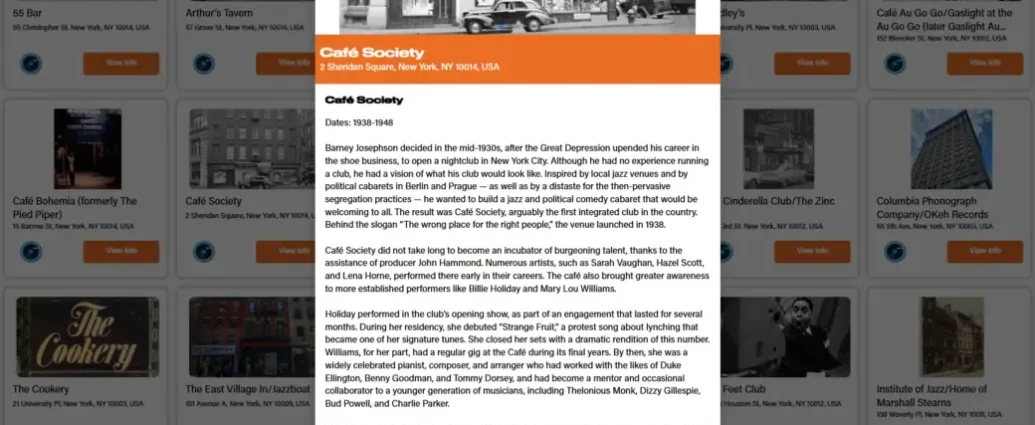
Some of the highlighted entries include Charlie Parker’s townhouse at 151 Avenue B; Café Society at 2 Sheridan Square, considered the first integrated club in the country and the venue where Billie Holiday debuted her signature song “Strange Fruit”; and the home of George Gershwin at 91 Second Avenue, where he wrote dozens of jazz standards.

Also included on the map is the Columbia Phonograph Company at 55 Fifth Avenue, where producer John Hammond oversaw Billie Holiday’s first recording session, early hits by Benny Goodman, and one of the first integrated recording sessions in history.

While Lower Manhattan was home to many influential jazz figures, the genre’s pioneers also had a strong presence in Queens. In September 2024, Flushing Town Hall released the Digital Queens Jazz Trail Map, highlighting 125 jazz legends who once called the borough home. The map also features key sites such as the Louis Armstrong House Museum and the Black American Heritage Foundation’s Music History Archive.

The map also joins dozens of other interactive maps created by Village Preservation, which shed light on the history of Greenwich Village, the East Village, and NoHo. Other projects document important sites connected to hip-hop, women’s suffrage, and civil rights and social justice movements.

RELATED:

The post Explore 100 years of jazz history in the Village with this new interactive map first appeared on 6sqft.

This post was originally published here. 

Diesel-powered refrigeration units that have long emitted air pollution in the Bronx will be replaced by cleaner models, funded by revenue from New York City’s congestion pricing program. Gov. Kathy Hochul on Monday announced 20 diesel-powered transport refrigeration units (TRUs) at the Hunts Point Produce Market will be replaced with cleaner diesel and hybrid units, which are projected to cut annual particulate matter emissions by 99.7 percent and nitrogen oxide by 66 percent. Replacing just one diesel-powered TRU with a newer model eliminates the equivalent particulate matter emissions of 330 truck trips per day on the Cross Bronx Expressway.

Credit: Ray Raimundi/MTA on Flickr

“Congestion pricing has been a once-in-a-lifetime success story, leading to cleaner air, better transit, and faster and safer traffic throughout the city,” Hochul said. “We knew that to do this right, we had to bring real air quality improvements directly to parts of NYC that have been neglected for far too long.”

“These new refrigeration units will be a game changer for Hunts Point market, with air quality improvements equivalent to removing thousands of truck trips on our roads every day, making the Bronx’s air cleaner and improving quality of life.”

The TRU replacements are part of the mitigation package included in the environmental assessment for congestion pricing. Under the program, drivers entering Manhattan below 60th Street pay a base toll of $9, a fee designed to discourage vehicle travel through the borough’s central business district and reduce traffic, as 6sqft previously reported.

The city’s Department of Transportation (DOT) has been accepting new units on a rolling basis since December, when the first was delivered. An additional 75 units are slated for replacement this year, with $15 million allocated for the air quality initiative.

Marking the first major mitigation investment funded by congestion pricing, the effort builds on environmental gains linked to the toll system. In 2025, more than 27 million fewer vehicles entered Manhattan’s congestion relief zone, contributing to improved air quality, reduced noise, and fewer pedestrian accidents.

On any given day, about 73,000 fewer vehicles are entering the zone, an average decline of 11 percent. Officials also said concerns about increased traffic in the Bronx have not materialized.

The Metropolitan Transportation Authority and project sponsors are in the last stages of developing the final mitigation plan required under the program’s environmental review process. The plan will outline specific locations for each mitigation measure, as well as the allocation of funds. It is slated for release this spring.

Roughly 70 percent of funds set aside for mitigation measures under “place-based mitigation” will be invested in the Bronx.

In addition to the TRUs, other initiatives include a $20 million Bronx Asthma Initiative, a $20 million effort to expand electric truck charging infrastructure, $20 million for the NYC Clean Trucks Program, $10 million for roadside vegetation, $10 million for installing air filtration units in NYC and Newark schools near highways, and $5 million to expand the DOT’s Off-Hours Delivery Program.

Congestion pricing recently secured a legal victory over the federal government after the Trump administration sought to end the toll system. In March, a judge ruled that U.S. Transportation (U.S. DOT) Secretary Sean Duffy’s move to terminate the program was “arbitrary and capricious.” The MTA filed suit against the U.S. DOT in February 2025 to block the effort, allowing the program to continue operating indefinitely

RELATED:

The post Congestion pricing funds major air quality upgrades at Bronx’s Hunts Point Market first appeared on 6sqft.

This post was originally published here. 

U.S. stocks traded lower this morning, with the Nasdaq Composite falling around 1% on Thursday.

Following the market opening Thursday, the Dow traded down 0.84% to 46,176.67 while the NASDAQ fell 0.99% to 21,625.40. The S&P 500 also fell, dropping, 0.71% to 6,528.80.

Leading and Lagging Sectors

Energy shares climbed by 1.4% on Thursday.

In trading on Thursday, consumer discretionary stocks fell by 1.7%.

Top Headline

U.S. initial jobless claims declined by 9,000 to 202,000 in the fourth week of March, compared to market estimates of 212,000.

Equities Trading UP
           

  • Sky Quarry Inc (NASDAQ:SKYQ) shares shot up 71% to $4.33 after the company announced that it’s in discussions with crude oil companies in Nevada about increasing local production that could supply its Foreland Refinery.
  • Shares of Cocrystal Pharma Inc (NASDAQ:COCP) got a boost, surging 36% to $1.38 after the company announced that it has received Fast Track designation from the FDA for its CDI-988, the first oral antiviral candidate …

Full story available on Benzinga.com

This post was originally published here

Geopolitical instability has hampered Wall Street throughout 2026, but could cooling tensions in the Middle East help to support a relief rally throughout different sectors? 

With President Trump suggesting that the United States could end the war in ‘two to three weeks,’ optimism has begun to return to global markets. 

In the US, the S&P 500 posted its best day since May last year on the back of unconfirmed reports that Iranian President Masoud Pezeshkian is open to ending the war with guarantees, prompting a 2.91% rally. 

The Dow Jones Industrial Average also climbed 1,125.37 points, or 2.49%, as the prospect of an end to the conflict appeared to be nearing. 

Whether this is the beginning of the end to the ongoing uncertainty surrounding Iran and the Strait of Hormuz, which has sent global energy prices soaring, or whether the war could continue to confound markets, it’s certainly worth investors taking a moment to explore how markets could recover following a widespread rise in investor appetite for defensive stocks and safe haven investing. 

With this in mind, let’s take a deeper look at three key sectors and their leading stocks that could be well-positioned for growth should we finally see an end to the war in Iran: 

Shipping Stocks

The closure of the Strait of Hormuz has had a significant impact on shipping, with traffic passing through the busy shipping lane falling sharply. 

Data shows that an average of just five to six ships passed through the strait per day since the beginning of the conflict, marking a sharp fall from the average of 138 prior to the war. 

Not only were many companies directly affected by the inability to pass through the Strait of Hormuz, but many had to deal with far higher insurance premiums and rerouted demand throughout the conflict in March. 

“One of the biggest winners on Wall Street from a potential ceasefire will be …

Full story available on Benzinga.com

This post was originally published here

U.S. stocks were mostly flat, with the Dow Jones index falling around 0.1% on Thursday.

Shares of Penguin Solutions Inc (NASDAQ:PENG) rose sharply during Thursday’s session after the company reported better-than-expected second-quarter financial results and raised its FY26 guidance.

Net sales were $343 million, down 6% year over year but above the $337.938 million estimate. Adjusted EPS was 52 cents, beating the 42-cent estimate, while GAAP diluted EPS rose to 58 cents from 9 cents.

Also, Needham maintained its Buy rating on the stock and raised its price target from $25 to $27.

Penguin Solutions shares jumped 14.7% to $20.94 …

Full story available on Benzinga.com

This post was originally published here

Robinhood Markets Inc (NASDAQ:HOOD) shares are trading lower on Thursday. This downward move follows a key analyst update and broader weakness in the technology sector.

Needham Trims Price Target

Needham analyst John Todaro maintained a Buy rating on Robinhood on Thursday. However, Todaro lowered the price target from $100 to $90.

The adjustment comes as the platform navigates shifting trading volumes. Despite the trim, the new target still suggests an upside from current levels.

Broader Market Pressure

The decline in HOOD coincides with a wider market retreat. The Nasdaq Composite fell 0.98% Thursday, while the S&P 500 shed 0.73%. High-growth fintech names often see amplified volatility during such sessions.

Mixed March Trading Metrics

The company on Monday released preliminary March metrics. Equity …

Full story available on Benzinga.com

This post was originally published here

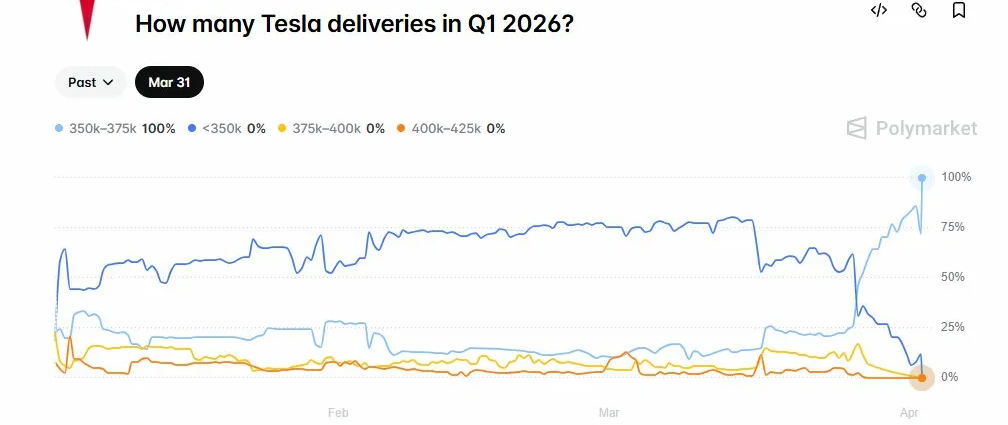
Polymarket bettors spent most of Q1 pricing Tesla Inc (NASDAQ:TSLA) deliveries below 350,000.

Wall Street’s consensus sat at 372,160.

The actual number, 358,023, handed traditional analysts a miss but validated the prediction market bettors who pivoted to the correct bracket days before the print.

Dan Ives, the Wedbush analyst with the Street’s highest Tesla price target at $600, called the delivery numbers “quite underwhelming” but said it was “not a shock” given the current EV backdrop.

He maintained his Outperform rating, arguing Tesla is shifting gears to focus on its AI strategy.

What The Prediction Markets Showed

This post was originally published here

Red Cat Holdings (NASDAQ:RCAT) shares are up on Thursday following news of securing new orders for its Black Widow drones from a NATO ally.

This development highlights the company’s growing presence in the defense sector as it continues to expand its capabilities in unmanned aircraft systems, while the broader market is experiencing a mixed day with major indices showing losses.

In March, a NATO ally selected Red Cat’s Black Widow small unmanned aircraft system (sUAS) through a competitive tender, with delivery scheduled for this calendar year. This contract underscores the demand for deployable systems in contested environments, as emphasized by CEO Jeff Thompson.

The broader market is experiencing losses, with the Technology sector down 0.96%. This context suggests that Red Cat’s gains may be driven by company-specific developments rather than overall market trends.

Technical Analysis

At $12.22, the stock is trading 15.9% below its 20-day simple moving average (SMA) and 11.1% below its 50-day SMA, indicating short-term weakness. However, it is trading 8.8% above its 100-day SMA and 16.8% above its 200-day SMA, suggesting a more favorable intermediate to long-term trend.

The relative strength index (RSI) currently sits at 42.53, indicating neutral momentum, while the moving average convergence divergence (MACD) shows a bearish signal, with …

Full story available on Benzinga.com

This post was originally published here

Oil’s blistering rally and crypto’s stumble made the first quarter of 2026 feel like a regime change rather than a routine quarter. 

Oil, as proxied by the United States Oil Fund ETF (NYSE:USO), surged roughly 84% in Q1, turning a traditionally cyclical commodity into the standout momentum trade of the quarter. 

In fact, USO gained 55.3% in March alone, marking its best monthly performance in history, and Q1 was the fund’s best quarterly performance ever, according to Benzinga Pro data.  

At the same time, digital gold lost its shine: Bitcoin (CRYPTO: BTC), tracked via spot-exposed vehicles like iShares Bitcoin Trust (NASDAQ:IBIT), dropped about 23%, marking one of its worst opening quarters in years and the weakest return of any major asset in Bespoke Investment Group’s Q1 review.

Q1 Winners 

Bespoke review matrix shows that strength is clustered in real assets and cyclicals rather than the mega-cap growth complex that dominated prior years. 

Energy ETFs ripped higher alongside USO’s …

Full story available on Benzinga.com

This post was originally published here

VanEck’s Head of Digital Asset Research Matthew Sigel is turning more bullish on Bitcoin (CRYPTO: BTC) as the derivatives market reaches the 99th percentile for protection demand — a long signal, according to Sigel.

The Derivatives Flip

“What’s happened in the derivatives market for Bitcoin leaves me much more bullish,” Sigel told Anthony Pompliano on Wednesday.

“If you look at what you have to pay for puts versus calls, it’s like we’re in the 99th percentile here of folks paying up for protection. That’s a contrarian long signal,” he added.

Additionally, coins that are 3-5 years old that haven’t moved in that timeframe started selling heavily in Q4 and Q1 as early cycle buyers took profits. 

That selling has eased up in recent weeks, with Marathon Digital Holdings (NASDAQ:MARA) retiring convertible bonds representing one exception.

“We’re still bullish, but we haven’t added maybe as much as you might expect given that kind …

Full story available on Benzinga.com

This post was originally published here

Bitcoin (CRYPTO: BTC) is down 3%, sinking below $67,000 after President Trump’s Iran war address signaled further escalation over the next two to three weeks, pushing crude oil above $104 per barrel on Thursday.

Trump Doubles Down

Markets climbed hours before Trump’s speech, pricing in hopes for de-escalation and resumed oil supplies through the Strait of Hormuz. 

Instead, Trump said the U.S. would “hit” Iran “extremely hard” over the next two to three weeks as military objectives near completion.

Trump warned of additional strikes on Iranian electric infrastructure if no deal is reached.

He offered no concrete timeline for reopening the Strait of Hormuz, leaving that task to Europe and Asia.

Crude oil surged more than 5% to above $104 per barrel on fears of prolonged supply disruptions. 

Additionally, Iran …

Full story available on Benzinga.com

This post was originally published here

Daniel Kebede condemns Bridget Phillipson’s policies, telling NEU conference schools are ‘running on empty’

The leader of the UK’s biggest education union has torn into the government’s record on schools, accusing Labour of letting down the nation’s children and failing to deliver on its promises for education.

Daniel Kebede, the general secretary of the National Education Union, was unsparing in his criticism of education secretary Bridget Phillipson’s policies in a speech to delegates at the NEU’s annual conference in Brighton on Thursday.

Continue reading…

This post was originally published here

Union has reached a tentative agreement for a three-year contract after holding a 24-hour walkout in March

Employees of the CBS News streaming channel CBS News 24/7, who held a 24-hour walkout last month amid an impasse in contract negotiations, have reached a tentative agreement on a new three-year contract.

About 60 CBS News employees are part of the union. In the coming days, they will vote to ratify the new agreement. More details about the agreement will be provided after the agreement is ratified, the union said.

Continue reading…

This post was originally published here

Senate-passed funding plan for DHS languishes despite agreement between Republican congressional leaders

The US House of Representatives on Thursday took no action on a compromise measure that would end the partial shutdown of the Department of Homeland Security (DHS), raising questions about how much longer the record-long funding lapse will persist.

The department has been without funding since mid-February, after Democrats refused to vote for its appropriations unless Republicans agreed to new guardrails on federal agents involved in immigration enforcement operations.

Continue reading…

This post was originally published here

The AI era has undeniably arrived, and every company must become a digital company in some capacity. The new wave of workplace technology is reshaping how jobs are designed, how people are hired and trained, and how performance is measured.

Yet what stands out in today’s 100 Best Companies to Work For isn’t just who’s using AI most or best: It’s who is rebuilding the social contract at work so people feel supported, trusted, and future-ready as the AI transition gathers pace. Now in its 29th year, the ranking is a barometer of how employees are feeling—and the pressure on companies to get that transition right is palpable.

For this year’s ranking, our partner Great Place to Work gathered confidential survey responses from over 640,000 employees at companies eligible for the list (with 1,000 or more U.S. staff) and ranked employers based on workers’ experiences.

Against the backdrop of the AI revolution, three themes stand out among these top employers: They are listening more closely than their peers. They are investing heavily in AI-ready careers. And even as work becomes more digital and always-on, they are doubling down on analog perks: enabling employees to spend more time with and care for the people they love most.

Listening-led cultures

At many companies, 2025 felt like the year of the top-down mandate, especially around return-to-office rules. But inside the companies that employees rated most highly, change doesn’t start with a memo from the CEO. It starts with asking people what they need—and adjusting accordingly.

At global hotel giant Hilton (No. 2), chief human resources officer Laura Fuentes says the company’s people-first culture begins with designing policies and benefits “hand in hand with our team members, not just for them.” In response to workers’ feedback, Hilton recently expanded digital tipping across all of its nonunion U.S. hotels.

Meanwhile, Hilton’s new Crisis Concierge—which provides workers with a single point of contact for logistical support after the death of a loved one or team member—was directly inspired by a conversation one team member had with the CHRO. So it’s perhaps no wonder that 93% of Hilton’s U.S. team members agreed that management is approachable and easy to talk to.

Supermarket chain Wegmans (No. 5) similarly invites its workforce to help write the rules with its long-running Ask Bob channel. Frontline employees can send suggestions or ideas straight to Bob Farr, senior vice president of store operations. The strongest proposals are put into action, and the employees who came up with them are recognized, creating a constant loop of innovation and inclusion.

65%

Share of U.S. job postings requiring work to be fully on-site

4%

Share of the 100 Best Companies to Work For that offer no option to work remotely

Sources: Robert Half, Great Place to Work

At Synchrony Financial (No. 1), the largest U.S. provider of retailer-branded credit cards, listening is baked into the company’s motto: “To be the best, you need to lead for all. And to do that, you need to listen to all.” To put that language into practice, the financial services firm runs Ask Us Anything sessions with senior leaders; monthly leadership roundtables; and regular pulse surveys that feed straight into decisions on workplace flexibility, benefits, and career development.

“If people tell us something isn’t working, we move on it fast—and they can see that we moved,” explains Brian Doubles, Synchrony’s president and CEO. “That cycle of feedback and action is what keeps trust high.”

After 85% of employees expressed a desire for remote-work options, Synchrony launched a hybrid model that includes programs like Flexible Fridays, where staff are encouraged to avoid meetings and take off early, and Flexi Company Holidays. Today, 93% of Synchrony’s 10,000-plus workforce say they are encouraged to balance their work and personal lives. And Doubles says net earnings (at $3.6 billion in 2025) have more than doubled since the changes were made. “Listening is only meaningful if it leads to action,” he adds.

Zoom out across the 100 Best Companies to Work For and you see the same pattern. Only four of the top 100 offer no option to work remotely, while the majority avoid one-size-fits-all rules about in-office days in favor of team-level approaches.

Building AI-ready careers

AI is redefining the idea of “hybrid” work: Increasingly, it will mean pairing humans with AI agents—with these digital “co-workers” handling tasks, surfacing insights, and freeing up people to focus on what they do best. The companies on this year’s list aren’t waiting for that future to arrive: They are building for it now.

“AI is a once-in-a-generation turning point—a foundational shift closer to the internet or electricity than to other technology waves,” says Doug Beaudoin, chief people officer at consultancy Deloitte U.S. (No. 24). Meeting the moment means not just bolting new tools to current systems, he says, but “reimagining how work is performed” altogether.

Deloitte is making a $1.4 billion investment into upskilling its people—on the assumption that everyone, not just tech specialists, will need a baseline of digital fluency. Already, employees have taken more than 200,000 courses across AI, cloud, cyber, data, and software engineering through Deloitte’s Technology Academy. Meanwhile, its new Deloitte Certified credential will help people prove their new digital skills to future hiring managers. “Technology is an amplifier of human talent, not a replacement for it,” Beaudoin says.

Other companies on the list are similarly moving to make AI feel less like a threat and more like a helpful partner. Delta Air Lines (No. 9) has introduced AI coach Nadia—an always-on digital coach that helps employees set goals, prepare for performance conversations, and think through career moves. It sits alongside the airline’s talent hub, where workers can map out the skills they’ll need to win potential future roles.

Cisco (No. 3) is pushing AI adoption with its Teaming With AI program, which encourages employees across the business to experiment with generative tools in their day-to-day work—drafting documents, summarizing meetings—backed by training that stresses ethical use and critical thinking. The message: AI is something every employee, regardless of their role, can learn to work alongside.

At EY (No. 30), AI evolution is happening at every level of seniority, says Ginnie Carlier, EY Americas chief talent and culture officer. While other firms have trimmed entry-level hiring as AI takes over the admin tasks normally palmed off to younger workers, EY is actively investing in early-career talent.

27%

Share of workers with access to paid parental leave

51%

Share of workers who say paid parental leave made them feel more loyal to their employer

82%

Share of workers who say volunteering through work made them feel more loyal to their employer

Sources: U.S. Department of Labor; Deloitte

It just launched a new assessment tool for such candidates that looks past traditional credentials in favor of skills, “things like critical thinking, collaboration, and curiosity,” Carlier explains. The tool helps EY spot high-potential hires from nontraditional talent pools and personalize their career paths. Once inside EY, a companywide platform lets people apply to projects across the business, helping match the right people to the right work.

That learning by doing continues in programs like FutureHack, an immersive hackathon-style event where EY professionals team up to tackle AI transformation challenges. And an AI Adoption Network lets frontline workers feed ideas (and concerns) back into the firm’s AI strategy. “We’re equipping our people not just to respond to change, but to lead through it,” Carlier says.

Designing better benefits

The idea of worker “well-being” has moved beyond yoga mats and free snacks to include serious financial, medical, and emotional safety nets that empower workers to make the most of their time outside work. Think parental leave that runs into double-digit weeks on full pay; unlimited IVF cycles when medically necessary; surrogacy and adoption reimbursements; free virtual therapy and on-demand mental health support.

Add backup childcare, sabbaticals, menopause and neurodiversity programs, and cancer support, and you start to see a pattern: As work increasingly requires employees to be constantly plugged in, the perks are getting more human.

At American Express (No. 4) in the U.S., this includes 20-plus weeks of fully paid parental leave for all parents—whether they’re welcoming a child through pregnancy, adoption, or surrogacy—as well as up to $35,000 in reimbursements per child, twice. Workers and their families have access to free counseling and coaching. Many offices have on-site wellness centers staffed with doctors and nurses. And employees can work from anywhere for up to four weeks annually—on top of existing hybrid arrangements.

Support isn’t just a nice-to-have. Monique Herena, chief colleague experience officer at Amex, says supported workers are “able to be and deliver their best … and that ultimately strengthens our teams, our customer experience, and our long-term performance.”

At EY, staff can access $1,000 a year in reimbursements for “activities, experiences, and products that promote health and happiness”; $500 for commuting and pet-sitting costs to cover team get-togethers; and a $2,000 backup-care allowance for when usual arrangements fall through.

Recognizing that it’s nearly impossible to keep work and life in separate boxes, restaurant chain the Cheesecake Factory (No. 25) leans into the blur—inviting family life into the workplace and celebrating it.

Last year, it rolled out its Moments That Matter training, so that every manager can honor their staff with personalized gifts to acknowledge life or work milestones. The benefits team emphasizes sending care packages: “That might mean a note of encouragement for someone caring for an ill family member, or a stuffed animal sent to a staff member expecting a baby,” explains chief people officer Dina Barmasse-Gray.

And at a company that began as a collaboration between founder David Overton and his parents, Bring Your Kids to Work Day and Bring Your Parents to Work Day are serious business. Different departments volunteer to host 20-minute activity rotations for the kids, ranging from cupcake decorating and pizzamaking to games and contests.

In an era dominated by algorithms and AI agents, it’s a reminder that the workplaces people rate most highly are built on something old-fashioned: showing up for the humans behind the job titles.

Additional reporting by Jake Angelo, Tristan Bove, Preston Fore, Jacqueline Munis, Marco Quiroz-Gutierrez, Sasha Rogelberg, Eva Roytburg

This article appears in the April/May 2026 issue of Fortune.

This story was originally featured on Fortune.com

One year ago, President Donald Trump launched sweeping global tariffs, ratcheting up trade tensions and fueling new concerns about the U.S. and global economy.

Dubbed “Liberation Day,” the tariffs targeted imports broadly, with Trump arguing they would fix trade imbalances and curb reliance on foreign goods. 

A year later, many of those tariffs have been struck down by the Supreme Court. The federal government is now working on a plan to refund roughly $166 billion in improperly collected duties, with details expected by mid-April.

SUPREME COURT DEALS BLOW TO TRUMP’S TRADE AGENDA IN LANDMARK TARIFF CASE

On the heels of “Liberation Day,” duties jumped from $9.6 billion in March to $23.9 billion in May following the rollout of the tariffs. 

For fiscal 2025, which ended Sept. 30, collections reached $215.2 billion, according to Treasury data, and the upward trend has continued into fiscal 2026, with receipts already outpacing last year. 

Revenue for the current fiscal year has reached $181.6 billion. Since Trump’s return to office, tariff collections have risen roughly more than 300%, delivering a major windfall to federal coffers. 

TRUMP SAYS US WOULD BE ‘DESTROYED’ WITHOUT TARIFF REVENUE

Tariffs function as a tax on imports, and in many cases, U.S. importers absorb the upfront cost and then pass it along through higher prices for wholesalers, retailers and, ultimately, consumers. That means households and businesses may face increased costs for goods ranging from electronics to raw materials.

Whether tariffs ultimately help or hurt the economy depends on how much of that burden consumers absorb, how domestic producers respond and whether the intended economic or geopolitical advantages are worth the added costs to consumers.

TRUMP CALLS TARIFF OPPONENTS ‘FOOLS,’ PROMISES $2K DIVIDEND PAYMENTS FOR AMERICANS

That dynamic makes the high court’s ruling especially consequential for households and businesses already navigating elevated costs.

CLICK HERE TO GET FOX BUSINESS ON THE GO

Meanwhile, the revenue surge underscores how central tariffs have become to Trump’s economic agenda, with the administration arguing that duty collections can help fund domestic priorities, reduce the nation’s debt and even deliver a proposed $2,000 dividend to Americans.

It’s unclear whether that plan is still on the table.

This post was originally published here. 

Department says it’s received 834 requests for a review of tool’s assessments since it launched in November

There appears to be no legal barrier for a human to override a controversial algorithm that determines financial support for elderly Australians, a Senate inquiry has heard, despite government assessors being banned from doing so.

The Integrated Assessment Tool (IAT), introduced in November as part of aged care Support at Home reforms, is used to assess eligibility and assign funding levels for aged care services.

Continue reading…

This post was originally published here

Visa ban makes Iranian-Australian feel her adopted country is a ‘home that doesn’t support you’

Hedieh Jamshidian feared the window to see her mother, living in Tehran under waves of airstrikes, was closing.

The Australian government had just announced it could block some visa holders from entering the country. So, Jamshidian, a 32-year-old Iranian Australian, decided to act quickly. Within a week she bought her mother, who held a three-month tourist visa, a ticket to Sydney.

Continue reading…

This post was originally published here

Lebanese-French man Ali Cherri demands investigation into Beirut bombing as possible war crime against civilians

A Lebanese-French artist has filed a legal complaint in a Paris court about an Israeli bombing of his family home in Lebanon that killed his parents and a domestic worker, claiming the attack could constitute a war crime.

The suit, filed with the French war crimes unit on Tuesday, is a rare instance of an individual pursuing war crimes charges for an Israeli bombing. It is also the first time a French court has taken a case over Israel’s bombing of Lebanon.

Continue reading…

This post was originally published here

The FDA yesterday approved Eli Lilly’s weight loss pill, orforglipron. The agency is also facing renewed scrutiny over transparency gaps related to advisory committee conflicts, and its “breakthrough” label for devices is drifting toward more ambitious — but not necessarily better-validated — AI tools.

Meanwhile, Insilico Medicine is pitching AI drug discovery as a sort of asset factory rather than a means to guaranteed approval ends.

Trump may not be done with import tariffs on drugs

The Trump administration has prepared an order that would impose a 100% tariff on some imports of patented medications and their active ingredients, according to a draft obtained by STAT reporter Daniel Payne. The tariffs could be announced as soon as today, according to a person familiar with the matter, although it’s also possible timelines and plans could shift. 

Continue to STAT+ to read the full story…

This post was originally published here. 

Lamacchia Realty has acquired Weichert Realtors – Briotti Group, expanding its Connecticut presence with new offices in Waterbury and Wolcott, the company announced Wednesday. The deal brings broker-owner Stephen Briotti and 24 agents under the Lamacchia banner as the firm continues an acquisition-driven growth strategy across New England. Financial terms of the deal were not disclosed.

The Briotti Group, a long-time Weichert franchise, focuses on the purchase and sale of single-family homes and income properties in the Greater Waterbury area. The firm is known for its knowledge of local neighborhoods, schools and pricing trends, according to the announcement.

The acquisition gives Lamacchia Realty four Connecticut offices: its existing Southington and Milford locations, plus the newly added Waterbury and Wolcott branches. Lamacchia Realty first entered Connecticut in November 2022 when 15 agents joined from another brokerage along with regional sales managers Beth Byrd and Gina Shumilla.

“I’m very excited and grateful to have Stephen and all of his wonderful agents now a part of us here at Lamacchia Realty,” owner and founder Anthony Lamacchia said in the announcement. “After three and a half years of being in Connecticut, I’ve finally found an acquisition with a great company that will help us grow our market share in central Connecticut.”

Briotti has been licensed since 1978 and opened his own office in Wolcott in 1995. After affiliating with a national franchise and opening a second office in 1999, he grew the business to more than 80 agents at the height of the market, serving “thousands of clients,” according to the company.

“After seeing how the real estate business has evolved over the last 30 years, I want simply the best for my agents,” Briotti said. “Aligning our future goals with Lamacchia Realty … agents will hone their skills and use the proven systems and strategies to sustain growth in their careers.”

The Waterbury office agents joining Lamacchia Realty include Arlene Nuzzo, Bonnie Crafa, Carlo Bettini, Cynthia N. Laurie, Deon Robinson, Dot Dorso, Lee Palmieri, Liz Faustino, Mark Poveromo, Mercedes Baus, Rick Zappone, Theresa Gorman, William James Walton Sr. and Patsy O’Connell. The Wolcott roster includes Charlie Leogrande, Cheryl Grabowski, Claire Julien, Dayanara Chacon, Fernando Barreiro, Lisa James, Maria Vilar, Mary Lou Smail, Michelle Lee Byrne and Tino Rebelo.

Byrd, now a regional sales manager with Lamacchia Realty in Connecticut, said bringing in a local incumbent team with deep ties should accelerate the company’s share gains in New Haven County and central Connecticut.

“This partnership not only strengthens our presence in the region, but also enhances our ability to deliver greater resources, broader exposure and results for both our agents and the clients we serve,” Byrd said.

Gaining market share in smaller metros

This is Lamacchia Realty’s 13th acquisition in New England over the past two and a half years, according to the company. Recent deals have included brokerages in Massachusetts and Rhode Island markets such as Milford, East Providence, Newburyport, Amesbury, Shrewsbury, Pittsfield, Dalton, Easton, Auburn, Springfield, Falmouth, Fall River and Seekonk.

Lamacchia Realty said this deal shows that it is continuing to use roll-ups of established local firms to gain market share in smaller metros. For independent broker-owners in New England and Connecticut, it underscores ongoing consolidation pressure and the availability of regional acquirers. For agents in central Connecticut, the move could mean more marketing, tech and lead generation resources wrapped around an existing local brand and client base.

Lamacchia Realty said it will launch an aggressive marketing push in the Waterbury and Wolcott areas in the coming weeks, including billboards, social media, postcards, newspaper and TV advertising. The firm said operations will remain “business as usual” for clients while Lamacchia’s management integrates its lead products, services, training and technology with the incoming team.

In 2024, Lamacchia Realty closed 4,632 transaction sides for a total sales volume of $2.53 billion according to RealTrends Verified data. This earned the firm the No. 106 and No, 96 rankings in the country for sides and volume, respectively, in the 2025 RealTrends Verified Rankings.

This article was generated with the help of HousingWire Automation and reviewed by a HousingWire editor before publication. The system helps convert company announcements and industry data into HousingWire-style news coverage.

This post was originally published on here. 

Rivian Automotive, Inc. (NASDAQ:RIVN) shares slipped in Thursday’s premarket session.

The EV maker reported first-quarter 2026 production of 10,236 vehicles and deliveries of 10,365 units.

A year earlier, Rivian produced 14,611 vehicles at its Normal, Illinois facility and delivered 8,640 units.

Rivian also reaffirmed its full-year delivery guidance of 62,000 to 67,000 vehicles.

The company is scheduled to report full financial results on April 30, 2026, after market close.

Peer Comparison

Tesla, Inc. (NASDAQ:TSLA) reported first-quarter production of more than 408,000 vehicles and deliveries of over 358,000 units, primarily driven by Model 3 and Model Y volumes. The company also deployed 8.8 GWh of energy storage products. Tesla will report earnings on April 22.

Ford Motor Company (NYSE:F) reported a U.S. retail share of 11.6% in the first quarter, supported by SUV demand and F-Series truck sales. Total sales declined 8.8% due to model transitions and prior-year comparisons.

Technical Analysis

At $14.80, Rivian is trading 3.7% below its 20-day simple moving average (SMA) of …

Full story available on Benzinga.com

This post was originally published here

In a normally functioning global oil market, the U.S. West Texas Intermediate crude trades at a discount to Brent.

This is not an accident of geography. It is a structural reality baked into the global energy system over decades.

WTI is a landlocked benchmark, priced at Cushing, Oklahoma — a storage hub in the middle of the country with no direct ocean access.

Brent, by contrast, is a seaborne crude blend priced off North Sea cargoes and used to benchmark oil flowing out of the Middle East, West Africa and the North Sea itself. Since Brent can be loaded onto a tanker and delivered anywhere in the world, it commands a premium — typically $2–$5 per barrel — that reflects its logistical flexibility and global reach.

That relationship which has held for much of the past two decades has now broken.

On Thursday, April 2, the WTI-Brent spread has flipped positive. U.S. crude futures — as tracked by the United States Oil Fund (USO) — are trading at over $3 above Brent.

These are levels not seen since 2009.

Chart: WTI Just Flipped Above Brent. It Hasn’t Happened Like This Since 2009.

The WTI-Brent Spread Was As Negative As $15 In March, Then Suddenly Flipped

When the U.S.-Israel military campaign against Iran began on February 27, Brent immediately absorbed the geopolitical shock. Iran’s closure of the Strait of Hormuz — through which 20% of global oil flows — sent seaborne crude prices into a stratosphere that WTI, insulated from shipping risk by its inland location, could not fully follow.

By Mar. 19, the Brent-WTI …

Full story available on Benzinga.com

This post was originally published here

Arm Holdings Plc (NASDAQ:ARM) dropped sharply Thursday as geopolitical fears rattled global markets, pulling semiconductor stocks lower despite supportive industry tailwinds.

The Nasdaq dropped 1.88%, while the S&P 500 declined 1.39%.

Geopolitical Friction Sparks Sector Sell-Off

Escalating conflict in the Middle East, particularly involving Iran, triggered a broad sell-off in semiconductor stocks. President Donald Trump’s remarks on Wednesday warning of potential military action pushed oil prices higher and pressured risk assets, including tech.

Major peers like Nvidia Corp. (NASDAQ:NVDA), Advanced Micro Devices Inc. (NASDAQ:AMD), and Intel Corp. (NASDAQ:INTC) also saw significant declines.

Top Executives Unload Shares

CEO Rene …

Full story available on Benzinga.com

This post was originally published here

Coinbase (NASDAQ:COIN) Chief Legal Officer Paul Grewal told Fox Business on Wednesday that the Clarity Act will see progress within 48 hours.

The Midterm Deadline

“I think we’re very close to a deal,” Grewal said, stressing his confidence in the process.

“Key elements of the bill are critically important to making sure that President Trump’s vision of the United States as the crypto capital of the world is fulfilled,” he added.

The landmark crypto markets bill has been in legislative limbo since January as the crypto industry, banks, regulators, and elected officials struggle to reach agreement on key details.

Grewal says the gridlock may loosen.

Most polls suggest Republicans face losses in upcoming midterm elections. 

If Democrats reclaim the House, all legislative work on Capitol Hill grinds to a halt until the 2028 …

Full story available on Benzinga.com
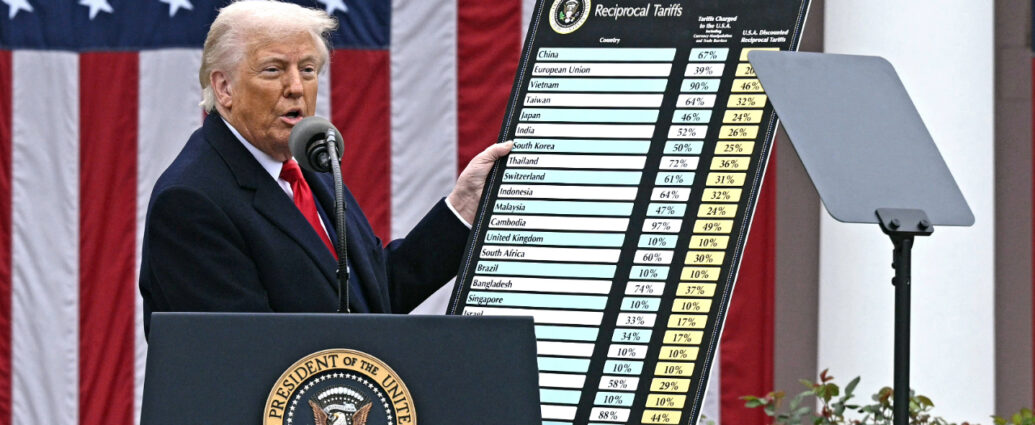
This post was originally published here

The first quarter of 2026 is in the books. The cautious optimism for the stock market quickly gave way to a clash between geopolitical risk management and asset rotation.

As conflict in the Middle East intensified, hopes of a rate cut turned into an anxiety about a rate hike. Inflation fears return as energy and essential goods surged. Speculative assets sold off alongside overheated commodities as highly leveraged market cashed out winners.

Winners: Energy 

The dominant catalyst was the escalation of conflict in the Middle East, culminating in the effective closure of the Strait of Hormuz — one of the world’s critical commodity chokepoints.

The outcome was a massive “risk premium” across energy markets, driving one of the sharpest commodity rallies in recent history.

“Brent oil prices jumped 63% in March, the largest monthly increase in four decades. Beyond energy markets, grain prices also increased given the importance of the Strait for the passage of commodities that are critical in food production,” JPMorgan analyst Zara Nokes wrote in a report.

Heating oil emerged as the standout performer, surging an extraordinary 100% during Q1. Bloomberg Intelligence Senior Commodity Strategist …

Full story available on Benzinga.com

This post was originally published here

Glencore (LSE:GLEN,OTCPL:GLCNF) is in talks with Canadian federal and Quebec provincial authorities over a potential deal to keep the Horne smelter operating after stricter emissions rules put a key piece of North America’s copper supply chain at risk.Canada’s only copper smelter, located in Rouyn-Noranda, has been at the center of negotiations since Glencore suspended upgrade plans last month, citing uncertainty over new arsenic limits.The company warned the plant could be wound down without changes to the regulatory framework.Quebec has proposed legislative amendments that would delay implementation of tougher emissions standards. The revisions would push a new arsenic cap of 15 nanograms per cubic meter to 2029 and maintain that level until at least 2033. The limit is one-third of current permitted levels but remains five times higher than the province’s benchmark safety standard.At the same time, Ottawa is considering a request for about US$108 million in financial support to help fund pollution-control upgrades, according to people familiar with the matter.“While awaiting regulatory certainty, we are open to evaluating other mechanisms, particularly financial ones, for sharing risks,” Glencore said in an email to Bloomberg.The Horne smelter processes about 215,000 metric tons of copper concentrate and scrap annually, representing roughly 16 percent of North America’s smelting capacity. There are only a small number of operating smelters across the US and Mexico.The facility also supplies Glencore’s Canadian Copper Refinery in Montreal. The company has said about 3,200 direct and indirect jobs could be affected if the smelter closes. It also produces copper as well as byproducts including gold, silver, platinum, palladium, and sulfuric acid, and processes about 100,000 tons of electronic scrap each year.Glencore has spent about US$130 million on emissions reduction measures, including acquiring more than 50 homes to create a buffer zone around the site. A total of 82 properties are slated for demolition.The negotiations come as the facility faces ongoing scrutiny over emissions. Medical data has shown higher rates of chronic obstructive pulmonary disease in Rouyn-Noranda compared with provincial averages, and a class-action lawsuit tied to emissions was authorized last year.Public health officials have warned that delaying stricter emissions targets could prolong exposure risks, particularly for nearby residents.Meanwhile, Quebec officials have defended the proposed timeline changes, arguing they are necessary to enable investment while maintaining compliance. Quebec Environment Ministry spokesperson Louis Potvin maintained the amendment would allow the Horne smelter to proceed with required upgrades and meet its permit conditions, including the 15 nanograms per cubic meter arsenic limit.“The ministry took into account the position of the national public health authority, which deemed the postponement acceptable last October, and the City of Rouyn[-Noranda] also supported this postponement,” Potvin said in an email to CBC news.The outcome of the talks will determine whether the company proceeds with its investment or begins winding down operations at one of the region’s few remaining copper smelting facilities.Don’t forget to follow us @INN_Resource for real-time updates!Securities Disclosure: I, Giann Liguid, hold no direct investment interest in any company mentioned in this article.

This post was originally published here

Albertsons is closing additional stores and cutting jobs nationwide as it works to stabilize operations following the collapse of its $24.6 billion merger with Kroger, intensifying pressure on the grocery chain.

The Boise, Idaho-based company — which operates banners including Safeway, Vons and Pavilions — has announced a new round of closures in recent weeks as it pivots to cost-cutting and operational changes.

The company has closed roughly 20 stores in 2025, underscoring mounting pressure as it competes with larger rivals such as Walmart and other low-cost operators.

In Southern California, Vons stores in Escondido and Redlands will close in April, eliminating 135 jobs. An Albertsons store near Riverside, California, shut down in March, cutting 75 workers, while a Safeway in Northern California closed earlier this year, affecting 76 employees.

GROCERY GIANT KROGER TO CLOSE 60 STORES IN NEXT 18 MONTHS

The cuts extend beyond the West Coast. Two Albertsons-owned stores in North Texas are set to close by late April, impacting 138 workers, and a Safeway in Washington, D.C., is slated to shut down in May, eliminating 87 positions.

Industry analysts say the closures reflect ongoing fallout from the blocked Kroger merger, which Albertsons had framed as key to achieving scale and competing more effectively on pricing.

In response, the company is leaning on cost reductions and technology investments, including automation and artificial intelligence, as digital sales grow — often requiring fewer in-store workers.

Albertsons is also facing investor skepticism, with its stock down over the past year.

Meanwhile, the legal fight that killed the merger is still playing out. California and a coalition of states are seeking more than $10 million to cover the cost of blocking the deal.

Regulators argued the merger would reduce competition and raise grocery prices. A federal judge agreed in 2024, halting what would have been the largest supermarket merger in U.S. history.

Kroger and Albertsons spent roughly $1.5 billion pursuing the deal, underscoring the scale of the failed tie-up.

CLICK HERE TO GET FOX BUSINESS ON THE GO

Now operating independently, Albertsons is navigating a more competitive grocery landscape while restructuring its footprint and workforce to adjust to shifting consumer demand and margin pressure.

Reuters contributed to this report. 

This post was originally published here. 

Some Americans are already locking in their summer travel plans, and this year’s top destination may come as a surprise.

New data from AirDNA, which tracks Airbnb and Vrbo listings, shows Jackson Hole, Wyoming, leading the nation in short-term rental bookings for summer 2026, with 45.5% of properties already reserved between June and August, Realtor.com reported.

Experts say this points to a broader shift in travel preferences.

“We’re seeing a fascinating shift in the short-term rental market for Summer 2026,” Charlie Lankston, executive editor at Realtor.com, told FOX Business in an email. “While a beach house has always been the gold standard, data from AirDNA shows that some travelers are now choosing to trade the ocean for the mountains.”

Jackson Hole’s appeal lies in its mix of outdoor experiences, from whitewater rafting and canoeing to wildlife viewing in Grand Teton National Park, according to Realtor.com.

SAN FRANCISCO AIRPORT EXPECTS MAJOR DELAYS AS FAA RESTRICTS SOME LANDINGS

Here are the top 10 summer destinations based on booked occupancy rates for short-term rentals from June through August 2026, according to AirDNA:

Booked occupancy rate: 45.5%

Booked occupancy rate: 44%

Booked occupancy rate: 42.6%

Booked occupancy rate: 41.4%

Booked occupancy rate: 40.7%

ALASKA AIRLINES UNVEILS LIE-FLAT SUITES, UPGRADED PERKS IN NEW INTERNATIONAL BUSINESS CLASS

Booked occupancy rate: 40.4%

Booked occupancy rate: 40.3%

Booked occupancy rate: 40.2%

Booked occupancy rate: 39.4%

Booked occupancy rate: 38.7%

JETBLUE EXPANDS FORT LAUDERDALE HUB WITH NEW DESTINATIONS AND INCREASED FLIGHTS

At the same time, demand is rising sharply in cities set to host matches during the 2026 FIFA World Cup.

“We’re also seeing a World Cup windfall with demand in host cities like Fort Worth and Kansas City increasing drastically,” Lankston told FOX Business.

With hotels in those markets expected to fill quickly, short-term rentals are poised to benefit.

GET FOX BUSINESS ON THE GO BY CLICKING HERE

“Between the $750 host incentives from Airbnb and the surging occupancy rates, the 2026 rental season is shaping up to be a lucrative side hustle for many American homeowners in these metros,” Lankston added.

This post was originally published here. 

Exclusive: Ryan Bridge is co-founder of Raise the Colours, which has been criticised for anti-immigrant rhetoric

The leader of a flag campaign group has been arrested on suspicion of causing religiously and racially aggravated harassment.

Ryan Bridge is the co-founder of Raise the Colours, which has put up hundreds of union and Saint George flags across England and attracted criticism for spreading anti-immigrant rhetoric. He was arrested on Tuesday and released on police bail the following day.

Continue reading…

This post was originally published here

Nasa mission enters its second day, with crew hoping to become first people to get close to the moon in over 50 years

Four astronauts are preparing to leave Earth’s orbit and slingshot towards the moon as Nasa’s Artemis II mission enters its second day.

The high-stakes 10-day voyage will mark the first time in half a century that humans leave space close to Earth and return to the vicinity of the moon. It is a crucial test of Nasa’s ambition to land humans back on the lunar surface this decade, and stay there permanently.

Continue reading…

This post was originally published here

Affected cars include models in Peugeot, Citroën, Vauxhall, Lancia, Alfa Romeo, Jeep and Fiat brands made since 2023

The European carmaker Stellantis has issued a recall for 44,000 UK vehicles after discovering a fault that could result in its cars catching fire.

The fault has been found in certain models across its Peugeot, Citroën, DS Automobiles, Vauxhall, Lancia, Alfa Romeo, Jeep and Fiat brands, produced between 2023 and 2026. Key vehicles affected by the recall include the Citroën C3, Peugeot 208 and Vauxhall Mokka.

Continue reading…

This post was originally published here

The March jobs report, scheduled for release on April 3, will mark the end of a quarter defined by wild swings in the U.S. labor market. Economists project that about 60,000 new jobs were added last month, with the unemployment rate holding steady at 4.4 percent.
If those estimates are accurate, payrolls grew by about 94,000 in the first quarter of 2026—an improvement over the 61,000 jobs added during the same period a year earlier.
Health care and private education will likely be the leading categories for job creation, says Joseph Brusuelas, chief economist at RSM.
“In March, we anticipate that the jobs rebound will be in the health care and private education categories with modest gains in construction and goods-producing sectors,” Brusuelas said in an April 1 note….

This post was originally published here. 

Oil prices jumped sharply on Thursday after U.S. President Donald Trump signaled an escalation of military action against Iran, dampening hopes for a near-term diplomatic resolution and raising concerns about prolonged disruptions to global energy supplies.
Benchmark Brent crude rose by $8.34, or 8.2 percent, to $109.50 per barrel by 7:39 a.m. ET, while U.S. West Texas Intermediate (WTI) gained $9.23, or 9.2 percent, to $109.35. Both contracts touched their highest levels since early March and were on track for their largest daily gains in three weeks, though still below peaks above $119 reached earlier in the conflict.
The rally followed Trump’s prime-time address late Wednesday, in which he vowed to intensify strikes against Iran over the coming weeks, while offering no clear timeline for reopening the Strait of Hormuz or ending the war….

This post was originally published here. 

Here are the latest developments in the U.S.–Israel–Iran war on Thursday at 9.15 AM ET, as the war that began on February 28 continues.

President Donald Trump marked one month of “Operation Epic Fury” with an address to the nation on Wednesday, claiming U.S. forces have scored swift, decisive victories. He warned that if talks fail, the U.S. could strike Iran’s power infrastructure and oil facilities within 2–3 weeks and vowed to “finish the job.”

In an open letter to Americans, Iranian President Masoud Pezeshkian urged them to question media narratives about Iran, highlighting the impact of U.S. and Israeli policies on regional tensions. He described Iran as a historically peaceful nation that has never initiated war, despite invasions and foreign pressures, and criticized U.S. military presence as a threat rather than a deterrent.

Iran Arrests Five Over ‘Hostile’ Links

Iranian authorities have arrested five individuals in Zanjan province, accusing them of links to “hostile” networks and acting as agents for enemy interests. The arrests come amid ongoing warnings against cooperation with U.S. or Israeli entities, reported Al Jazeera.

EU, China Stress Hormuz Shipping Safety

EU foreign policy chief Kaja Kallas discussed global economic and energy security concerns with China’s foreign minister Wang Yi, stressing the urgent need to restore safe navigation in the Strait of Hormuz amid Iranian attacks disrupting shipping. They also touched on EU-China relations.

Pakistan Ports Emerge As An Alternative

Amid disruptions to Gulf shipping, Pakistan’s Karachi and Gwadar ports have gained transshipment traffic, setting new records in cargo handling. Minister for Pakistan Maritime Affairs, Muhammad Junaid Anwar Chaudhry, told Al Jazeera that the country is managing multiple types of cargo as countries need alternatives to disrupted Gulf hubs.

Airstrikes Hit Iran’s Tallest Bridge Near Tehran

A major highway bridge linking Tehran to the city of Karaj, described as the Middle East’s highest bridge, was struck in a U.S.‑Israeli air attack, injuring multiple people and damaging infrastructure, as part of broader strikes on sites around Karaj, reported Al Jazeera.

US Says Iran Forces ‘Largely’ Destroyed

CENTCOM commander Brad Cooper stated that …

Full story available on Benzinga.com

This post was originally published here

Bitcoin (CRYPTO: BTC) closed the first quarter of 2026 down 23%, driving exhausted traders to pivot capital into a surprising alternative asset class: physical Pokémon cards.

Prominent crypto analyst Trader Mayne and pseudonymous collectibles expert CBS discussed on Wednesday how the Trading Card Game (TCG) market is absorbing liquidity as digital assets continue to trade sideways.

The “Bitcoin” Of Collectibles

Vintage Pokémon cards are exhibiting price resilience, with CBS highlighting the 1999 Base Set First Edition Charizard as the “Bitcoin of the TCG market.”

TCGs are attracting crypto capital thanks to their scarcity, liquidity, and decoupling from wider digital assets.

Unlike altcoins with constant token unlocks and inflationary supply, vintage cards have fixed, verifiable caps.

High-end graded cards operate with near-instant liquidity at trade shows and online marketplaces, allowing traders to flip $50,000 physical assets in minutes.

And while Bitcoin …

Full story available on Benzinga.com

This post was originally published here

Rise and shine, everyone, another busy day is on the way. Sadly, gray skies are hovering over the Pharmalot campus, but our spirits remain sunny, nonetheless. And why not? As the Morning Mayor suggested to us long ago, “Every day should be unwrapped like a precious gift.” While you tug on the ribbon, we will fire up the trusty kettle for a cuppa ginger honey. Of course, you are invited to join us. Remember, no prescription is required. This is strictly cash money. Meanwhile, here are a few items of interest. Hope you have a meaningful and productive day and, of course, do stay in touch. …

The Trump administration has prepared an order to impose a 100% tariff on imports of patented medicines and their active ingredients, STAT writes. The tariffs could be announced as soon as Thursday, but the timeline or details could change. The order offers several options for drugmakers to avoid the tariffs, which will not apply to companies that have struck “most-favored nation” deals to sell drugs in the U.S. at similar prices to other wealthy countries, or to those negotiating such deals, until the end of Trump’s term in office. Companies that agree to move production to the U.S. will have their tariff rate cut to 20%, as long as the plan is approved by the U.S. Secretary of Health and Human services, though the rate would rise back to 100% in 2030. The tariffs also will not apply to generic drugs, orphan drugs, fertility medications, plasma-derived therapies, gene or cell therapies, antibody drug conjugates, threat countermeasure medicines, or other specialty drugs as approved by the HHS secretary.

Eli Lilly’s obesity pill was approved by the U.S. Food and Drug Administration on Wednesday, setting it up for fierce competition against Novo Nordisk’s new Wegovy pill as more people seek alternatives to GLP-1 injections, STAT tells us. Lilly’s drug, which is called orforglipron and will be marketed as Foundayo, was approved under the new FDA voucher program, which grants speedy reviews to drugs that are aligned with national health priorities. Investors are hoping that orforglipron will be a major growth catalyst for Lilly. The Wegovy pill, as an oral peptide that’s harder for the body to absorb, must be taken in the morning at least 30 minutes before any food or drinks other than water, restrictions that can be unappealing to many people. Orforglipron doesn’t carry any such restrictions.

Continue to STAT+ to read the full story…

This post was originally published here. 

Rise and shine, everyone, another busy day is on the way. Sadly, gray skies are hovering over the Pharmalot campus, but our spirits remain sunny, nonetheless. And why not? As the Morning Mayor suggested to us long ago, “Every day should be unwrapped like a precious gift.” While you tug on the ribbon, we will fire up the trusty kettle for a cuppa ginger honey. Of course, you are invited to join us. Remember, no prescription is required. This is strictly cash money. Meanwhile, here are a few items of interest. Hope you have a meaningful and productive day and, of course, do stay in touch. …

The Trump administration has prepared an order to impose a 100% tariff on imports of patented medicines and their active ingredients, STAT writes. The tariffs could be announced as soon as Thursday, but the timeline or details could change. The order offers several options for drugmakers to avoid the tariffs, which will not apply to companies that have struck “most-favored nation” deals to sell drugs in the U.S. at similar prices to other wealthy countries, or to those negotiating such deals, until the end of Trump’s term in office. Companies that agree to move production to the U.S. will have their tariff rate cut to 20%, as long as the plan is approved by the U.S. Secretary of Health and Human services, though the rate would rise back to 100% in 2030. The tariffs also will not apply to generic drugs, orphan drugs, fertility medications, plasma-derived therapies, gene or cell therapies, antibody drug conjugates, threat countermeasure medicines, or other specialty drugs as approved by the HHS secretary.

Eli Lilly’s obesity pill was approved by the U.S. Food and Drug Administration on Wednesday, setting it up for fierce competition against Novo Nordisk’s new Wegovy pill as more people seek alternatives to GLP-1 injections, STAT tells us. Lilly’s drug, which is called orforglipron and will be marketed as Foundayo, was approved under the new FDA voucher program, which grants speedy reviews to drugs that are aligned with national health priorities. Investors are hoping that orforglipron will be a major growth catalyst for Lilly. The Wegovy pill, as an oral peptide that’s harder for the body to absorb, must be taken in the morning at least 30 minutes before any food or drinks other than water, restrictions that can be unappealing to many people. Orforglipron doesn’t carry any such restrictions.

Continue to STAT+ to read the full story…

This post was originally published here. 

In Atlanta, loyalty often runs deep—particularly to the city’s two hometown giants: Coca-Cola and Delta Air Lines.

So it might come as a surprise that Ed Bastian, who has spent nearly a decade leading Delta, credits an Atlanta rival—PepsiCo—for making him the executive he is today. On the latest episode of Fortune’s Titans and Disruptors of Industry podcast, Bastian opened up about how the food and beverage conglomerate didn’t just shape his own rise to the C-suite, but it has quietly done the same for a generation of business leaders.

“[At PepsiCo], you’re surrounded by great talent. They understood that talent is going to win in the marketplace,” Bastian told Fortune’s Editor-in-Chief Alyson Shontell. “They were constantly recruiting, bringing talent. It’s one of the only places I’ve ever been to where they tell you when you start, you’re probably not going to retire here because it’s a talent factory.”

And he isn’t exaggerating: PepsiCo has long been known as a breeding ground for top executives. A December 2022 analysis found at least a dozen Fortune 500 CEOs had passed through its ranks, including McDonald’s Chris Kempczinski and Land O’Lakes Beth Ford. 

PepsiCo’s approach to grooming leaders was shaped in large part by Bob Eichinger, an industrial organizational psychologist who spent nearly a decade at the company starting in the late 1970s. Eichinger adapted psychometric testing to assess executive behavior and effectiveness, helping cement PepsiCo’s reputation as what Yale professor Jeffrey Sonnenfeld famously called an “academy company.”

Central to PepsiCo’s system is its identification of “hi-pos”—the top 20% of performers at any given time—who are funneled into stretch assignments, international rotations, and cross-functional roles designed to prevent them from getting too comfortable in any one silo. The company’s HR team actively moves rising talent across divisions, even over the objections of their current managers, on the theory that future leaders need broad operational fluency rather than narrow expertise.

The expectation that you could move on, Bastian said, is baked into the culture from day one: “You learn what you can, you grow, and some people stay, but many people take what they have, and they go test their wares in another industry.”

For Bastian, that next move came naturally. As someone who had logged countless hours in the sky working with PepsiCo’s international finance team, the path to aviation wasn’t a leap so much as a landing.

“Someone told me at one point I should consider working for an airline because I’m on a plane all the time,” he said. “And I said that kind of made sense.”

And it made sense for Delta, too. Bastian joined Delta in 1998 as a vice president of finance and was named CFO by 2005. A decade later, in 2015, Bastian landed the CEO role and has since helped the airline achieve industry dominance—boasting top-tier on-time performance, a market value north of $40 billion, and a reputation as the most profitable U.S. carrier.

Ed Bastian skipped an MBA to learn leadership at PepsiCo—and it paid off

Raised in upstate New York, Bastian graduated from St. Bonaventure University with a bachelor’s degree in business administration in 1979 and soon began his career as an auditor at Price Waterhouse (now PwC). While a graduate degree had been a logical early career step, he said it simply wasn’t feasible.

“I went right to work, I didn’t have the money or the patience to get any post-graduate education,” he said.

But as his ambition grew, so did his awareness of his talent gaps. So when PepsiCo came calling, he recognized what it was: a rare chance to get a world-class business education without the tuition bill.

It proved to be the inflection point of his career. But beyond the skills he sharpened—like prioritizing customers and smart decision-making—Bastian said the deeper lesson was about the kind of leader he wanted to become—one who never forgets how he got there.

“My best advice is to make certain that you’re taking care of the people that got you there,” he told Fortune.

That humility, the 68-year-old argued, is what separates good leaders from great ones. Many CEOs, including himself, never set out to reach the top job. Instead, they let drive and confidence be tempered by something quieter.

“We talk about in leadership, the importance of confidence and drive and energy and vision,” Bastian added. “[But], there’s also a really important attribute, and that’s humility with the willingness to actually listen more than you talk, to be able to make certain that you have an appreciation for what people do, to relate to the people.”

Bastian has embodied that behavior in part through Delta’s annual profit-sharing. This past February, the company paid out $1.3 billion to its over 100,000 employees, averaging out to more than four weeks of extra pay.

In an era increasingly defined by technology and speed, Bastian believes human instincts matter more than ever.

“Understand what leadership is about—it’s about people, it’s about leading people,” Bastian said. “And that will get you further than anything you could ever do.”

This story was originally featured on Fortune.com