Understanding SG&A Expenses: Definition and Management
2026-04-02
This post was originally published here

This post was originally published here

This post was originally published here

This post was originally published here

This post was originally published here

This post was originally published here


This post was originally published here

This post was originally published here
A two-day rally earlier this week gave technical strategist Mark Newton enough evidence that the stock sell-off will soon come to an end.
This post was originally published here
U.S. exceptionalism is “no longer automatic” among global investors, one market watcher told CNBC.
This post was originally published here
The restaurant industry has been struggling with declining traffic and sluggish sales growth.
This post was originally published here
Rocket Close announced Thursday that it has significantly reduced the time required to process mortgage documents by deploying a generative artificial intelligence (AI) solution developed in collaboration with Amazon Web Services (AWS).
Rocket Close, which processes about 2,000 abstract document packages daily, previously relied on manual workflows that took up to 10 hours per package amid rising volumes. Each package averages roughly 75 pages and contains complex legal and financial records tied to property ownership and lending.
Through the new system, processing time has been reduced to less than two minutes per package while maintaining about 90% accuracy in document classification and data extraction.
“The human will step into almost all of the transactions, whether it’s verifying the data or looking at the exceptions, so that we’re ensuring that we’re doing the right thing for our clients and making sure that they have the proper homeownership rights to the property,” Nathan Schrauben, chief information officer for Rocket Close, said in an interview with HousingWire.
The solution combines Amazon Textract for optical character recognition and Amazon Bedrock for document analysis. Textract converts scanned documents into machine-readable text, while Bedrock uses large language models to classify documents and extract relevant data fields.
“The Textract product that Amazon has is one of the industry leaders. We’ve benchmarked it against other leaders in this space, and they seem to come out on top,” Schrauben added.
Abstract document packages — which can include deeds, mortgages, liens, tax filings and court records — present challenges due to inconsistent formatting, handwritten notes and varying document structures. Rocket Close’s system processes more than 60 document types and extracts structured data across categories such as loan details, ownership history and legal judgments.
“There’s no specific format or standard in which you’re going to receive a package. So what that typically does is you need human experts on the other end in order to process these because you need human judgment. And so that’s where the slowdown happens,” said Sri Elaprolu, director of the AWS Generative AI Innovation Center.
That’s where AWS comes in, Elaprolu said. The automation addresses several operational challenges, including high processing costs, scalability limits and the risk of human error. Previously, the company required an estimated 1,000 hours of manual processing daily.
“We’ve worked closely with the Rocket team in understanding that we’re not the mortgage processing experts; we’re coming from it from a technology perspective,” he said. “Our customers have the domain knowledge of their business. Nobody knows better than them, and so our job is to collaborate with our customers [and listen to] the specific knowledge about their workflows that we’re trying to automate.”
Elaprolu said that the start of the collaboration began with a “discovery process” that allowed AWS to understand Rocket’s systems and problems before building a proof of concept.
“We then sat down and had Rocket experts validate [the concept] with real data flowing through the system, or at least simulated that data that’s pretty close to real, to see if it would give correct outcomes,” he said. “Very often, you’re not going to get it right in the first pass, so we keep tweaking and adjusting. … Our goal is not just automation but … to make sure that the AI that we’re using understands this domain, understands these databases and applies them the proper way.”
Testing showed consistent performance across multiple evaluation phases, with accuracy rates ranging from about 89% to 91% across tens of thousands of data fields.
The cloud-based system is designed to scale to more than 500,000 documents annually and handle increased volume without proportional staffing increases. AWS said the improvements are expected to reduce costs, speed up customer service and support business growth.
“It relieves the human specialists who are in the workflow today to be focused on more complex packages that a system is not going to be able to handle,” Elaprolu said.
Following a successful proof of concept, Rocket Close plans to move the system into full production and expand its use to other workflows, including loan processing, purchase agreements and title clearance documentation.
“We anticipate every two to four weeks that we’re adding a new document into our workflows to allow our clients and our team members the ability to process through much more scale,” Schrauben said.
Schrauben also said that the company intends to implement continuous improvement processes and update its AI models as newer versions become available.
“We’re not looking to get anybody out of the loop. We want humans in the loop because humans are really good at the really tough stuff, like explaining things that are not as straightforward to other clients, especially in the title space. We believe that this technology is unlocking that,” Schrauben said.

Nike Inc. (NYSE:NKE) shares slid in Thursday’s premarket trading, extending a sharp 15.51% drop from the prior session that pushed the stock to a new 52-week low. The decline came despite a fiscal third-quarter earnings beat, as a weak forward outlook overshadowed the results.
Broader market pressure added to the negative sentiment. Nasdaq futures fell 2.09% early Thursday, while S&P 500 futures declined 1.16%.
Nike reported third-quarter revenue of $11.3 billion. Adjusted earnings reached 35 cents per share, topping the 26-cent estimate. Despite this, revenue remained flat year-over-year.
Nike’s sales and operating margin came in slightly ahead of consensus estimates, Telsey Advisory Group analyst Cristina …
This post was originally published here

The Commerce Department, on Wednesday, initiated a call for proposals to assist American companies to “deliver full-stack AI technology packages to international partners”. The submission window for applications is open until June 30.
Companies are expected to collaborate and present proposals for a bundled AI system that covers all key layers of the AI ecosystem—hardware and infrastructure, data pipelines, AI models, security, and end-use applications—delivered together for specific markets or industries.
The Departments of State, Defense, Energy, and the Office of Science and Technology Policy (OSTP) will assist in evaluating the proposals. Selected proposals will receive benefits such as advocacy engagement, federal promotion, and federal financing tools.
The Commerce Department told Axios that it won’t use a standard scoring system or checklist to evaluate the proposals. Instead, it would require companies to include a statement “describing how the proposal advances U.S. national interests.”
The AI exports program is being framed as …
This post was originally published here

Mobix Labs, Inc. (NASDAQ:MOBX) shares are down during Thursday’s premarket session following the announcement of a reverse stock split aimed at increasing the per-share trading price to comply with Nasdaq listing requirements.
The stock’s decline comes as the broader market experienced losses. The S&P 500 and Nasdaq are both sliding, adding pressure to shares as investors digest implications for the company’s future.
Mobix Labs announced a 1-for-10 reverse stock split, which will take effect at 4:00 p.m. Eastern Time on April 6, 2026. This move is intended to increase the trading price of the company’s Class A common stock. This would allow it to regain compliance with Nasdaq’s minimum bid price requirement.
The broader market experienced declines on Wednesday, with the S&P 500 falling 1.56% and the Nasdaq dropping …
This post was originally published here
Christina Marie Plante was reported missing in May of 1994 from Star Valley when she was just 13 years old
A woman in Arizona who went missing 32 years ago, when she was just 13 years old, has been found alive, authorities said this week.
Christina Marie Plante was reported missing in May of 1994 from Star Valley, Arizona, after she “vanished without a trace from her community”, according to a statement released Wednesday by the Gila county sheriff’s office.
This post was originally published here
Waste of 700 Boomtown festival attendees used to produce 540 litres of fertiliser for native tree project
Scientists are aiming to grow 4,500 trees at a national park with the help of fertiliser made from festivalgoers’ urine.
The fertiliser was created by the Bristol-based startup NPK Recovery, which connected its unit to a block of toilets used by 700 revellers at Boomtown festival in Hampshire in July last year.
This post was originally published here
Sale of Providence House believed to be the most expensive on record in London
Nick Candy, the honorary treasurer of Reform UK and a major donor, has sold his mansion in the Chelsea district of London for a reported £275m.
The property developer declined to comment on the transaction, which was first reported by Bloomberg, but it is believed to be the most expensive on record in London and one of the biggest in the world.
This post was originally published here
The coalition of organizations says Trump’s executive order restricting who can receive mail ballots is unconstitutional
A coalition of civil rights groups sued the Trump administration on Thursday, saying that a new executive order to limit mail-in voting is unconstitutional.
The order, which Trump signed on Tuesday, instructs the federal government to come up with a list of eligible citizens who can vote in each state. It also instructs the US Postal Service to only transmit mail-in ballots to people on that list.
This post was originally published here

Bitmine Immersion Technologies Inc. (NYSE:BMNR) shares moved lower in Thursday’s premarket trading, tracking a broader risk-off tone across markets. Nasdaq futures fell 1.89%, while S&P 500 futures declined 1.49%.
Leading cryptocurrencies fell Wednesday evening after President Donald Trump stated the U.S. military campaign against Iran will continue. Trump noted the campaign persists until objectives are “fully achieved.”
Following the address, Ethereum (CRYPTO: ETH) pulled back below the $2,100 level, according to data from CoinMarketCap.
The volatility directly impacts Bitmine’s significant balance sheet. As of March 29, Bitmine held 4,732,082 ETH tokens. …

Good morning. Ken Griffin, founder and CEO of Citadel, is making a bold, long-term wager, not just on his $69 billion hedge fund or his $2.5 billion Norman Foster-designed headquarters rising on Biscayne Bay. He’s betting on Miami as the next great American business capital.
That is the premise of a new Fortune feature by my colleague Shawn Tully, which explores Griffin’s efforts to reshape Miami and influence American politics. For CFOs weighing corporate footprint decisions, Griffin’s Miami playbook offers a compelling case study. In 2022, Citadel moved its headquarters from Chicago to Miami, becoming one of several investment firms that shifted to Florida post-pandemic.
For Griffin, the relocation was a long-term financial strategy. He’s investing not only in his firm, but in Miami as a future financial hub that he believes could one day compete with New York City. The move highlights how location decisions have become a core lever for cost, talent, and growth.
Citadel now employs about 500 people in Miami, including Griffin; Citadel Securities CEO Peng Zhao and president Jim Esposito; and Sebastian Barrack, who has run the commodities trading franchise for a decade. New York and London remain larger by headcount, but Miami is Citadel’s fastest-growing outpost by far. Griffin told Fortune that he feels “optimism in the air here.”
Many other companies have also planted roots in Miami. Since the pandemic, a growing roster of large firms, including ServiceNow, Wells Fargo’s wealth management unit, Palantir, Thoma Bravo, and Thiel Capital, has committed substantial operations to South Florida. McKinsey’s Miami office has become one of its fastest-growing in North America, expanding to several hundred employees over the past four years, while Banco Santander is developing a 41-story tower in Brickell, notes Tully.
Still, there are risks. Miami’s growth is straining housing and infrastructure, which could erode some of its cost advantages over time. But the broader trend is clear: Companies are rethinking where and how they operate. Griffin’s bet may be unusually high-profile, but it reflects a broader corporate shift toward markets with lower costs, faster growth, and deeper talent pools. The data reinforces that trend: CoStar analysts project the U.S. office market will add roughly 10 million square feet of occupancy over the next year, with growth driven almost entirely by Sun Belt landlords.
Sheryl Estrada
sheryl.estrada@fortune.com
This story was originally featured on Fortune.com

Hours before U.S. missiles struck Tehran on Saturday, February 28, six Polymarket accounts placed bets that military action would begin. They were bang on the money right. Together, they raked in $1.2 million, with one account turning $61,000 into nearly $493,000—a whopping 821% return. Most of these accounts were created and funded within 24 hours of the strikes. The whiff stench of insider trading is unmistakable.
This was no isolated incident. Similar patterns emerged in January, when freshly created accounts netted over $400,000 betting on the capture of Venezuelan President Nicolás Maduro, just hours before the operation went public.
This couldn’t have come at a worse time for Kalshi and Polymarket, which are facing a growing number of lawsuits demanding that prediction markets be regulated like gambling. With war-related betting stirring up scandal, a group of congressional Democrats has put forward the “Prediction Markets are Are Gambling Act”— legislation that seeks to ban prediction market bets on elections, government actions, war and sports. They are making a big mistake.
Prediction markets haven’t created the insider trading problem out of thin air. It has been an unsavory feature of financial markets for many a decade for decades. What Kalshi and Polymarket have done is drag this dirty secret out into the open with the help of transparent and immutable blockchain technology. Crypto transactions are recorded on a ledger that anyone can see and cannot be altered or obfuscated. This makes prediction markets the most useful and precise tool for eradicating exposing insider trading that has ever existed—a tool Congress should rely on heavily, not legislate out of existence.
Regulators already see the opportunity. On February 25, the CFTC’s Division of Enforcement issued a formal advisory after two cases of insider trading on Kalshi. The Commission is currently collecting public comments on how these markets should be regulated. But it’s clear that prosecution is the next step. As U.S. Attorney for the Southern District of New York Jay Clayton put it, “because it’s a prediction market doesn’t insulate you from fraud,” and federal prosecutors have since met directly with Polymarket to explore charges.
But prosecution in this area is only possible if these markets are allowed to function, unmasking insider trading that has, until now, largely happened behind closed doors. The system, as it currently stands, makes insider trading prosecution incredibly difficult. Perhaps that’s why no member of Congress—not even Nancy Pelosi, whose husband’s suspiciously well-timed trades became a national scandal—has ever been prosecuted for profiting off from privileged information.
Prediction markets, for the first time, create a trail of breadcrumbs that is hard to ignore. Timestamped, public, and—crucially—independent of established institutions. That independence matters: no institutional pressure can make inconvenient data disappear. No amount of political pressure can erase transactions on the blockchain. And so prediction markets, for all their flaws, can lead directly to the doorstep of those profiting from privileged information—prosecutors need only follow the breadcrumbs.
This isn’t theoretical. A recent, concrete example proves it can be done. In February, an Israeli Air Force reservist was indicted, along with an alleged accomplice, on suspicion of placing bets on Polymarket based on classified information about the 12-day Israel-Iran war in June 2025.
Less than a year from wrongdoing to prosecution. That’s a faster timeline than virtually any comparable insider trading case in traditional finance.
And it doesn’t even require sophisticated infrastructure. Independent blockchain analysts like ZachXBT and Bubblemaps are already tracing these transactions voluntarily. In the latest case of war-related betting, Bubblemaps quickly identified that the funds came from a wallet called “nothingeverhappens911,” which was connected to another account called “Skoobidoobnj” through a shared Binance deposit address—and this account turned out to be connected to two further Polymarket accounts that placed similar trades. Little by little, the walls are closing in.
Granted, these are obviously anonymous accounts. There are ways traders can obfuscate their transactions and hide their locations. They can use crypto mixers in an attempt to “wash” the funds. In short, they can make prosecutors’ lives difficult. But many things can’t be hidden on-chain: funding patterns, timing of entry, fund flows, and connected wallet addresses. And if a bunch of independent enthusiasts can uncover this much information with public tools, this fast, imagine what a properly coordinated and resourced regulatory effort could achieve.
Yes, prediction markets gave insiders an opportunity to profit from disaster. But it would be naive to think that this hasn’t happened in the past. This time, however, we know exactly which bets were placed, when, and how much profit was made.
Now it’s time to follow the breadcrumbs to find the missing piece of the puzzle: the identity of these traders. The CFTC is ready to move, the forensic tools already exist, and the April 30 public comment deadline on prediction market regulation is an open invitation to get this right. Fund the enforcement, strengthen the penalties, mandate identity verification above meaningful trading thresholds—but keep prediction markets open. Congress should lean into this opportunity, instead of killing the very tool that shines a light on a problem they have struggled to eradicate for decades.
The opinions expressed in Fortune.com commentary pieces are solely the views of their authors and do not necessarily reflect the opinions and beliefs of Fortune.
This story was originally featured on Fortune.com

Love it or hate it, BMI is back in the news. But that’s just the starting point in a debate over how to define obesity.
Critics have long faulted the weight-divided-by-height-squared measure as too blunt an instrument to define obesity. BMI, or body mass index, alone can group people with excess muscle mass in the same bucket as people with excess fat, all while ignoring population differences. Over a year ago, a Lancet Diabetes and Endocrinology global commission took aim at redefining obesity, relying less on BMI and more on such consensus-gaining metrics as waist circumference, waist-to-hip ratio, or waist-to-height ratio.
What was new in the commission’s framework was drawing a bright line between preclinical and clinical obesity, all with an eye toward sharper diagnosis that starts with BMI and other body fat numbers. Someone with preclinical obesity might have excess body fat and be at risk for — but not yet be diagnosed with — cardiovascular problems, type 2 diabetes, some cancers, or other signs of organ dysfunction. Someone with clinical obesity would have already developed an ongoing illness.

This post was originally published here

This post was originally published here
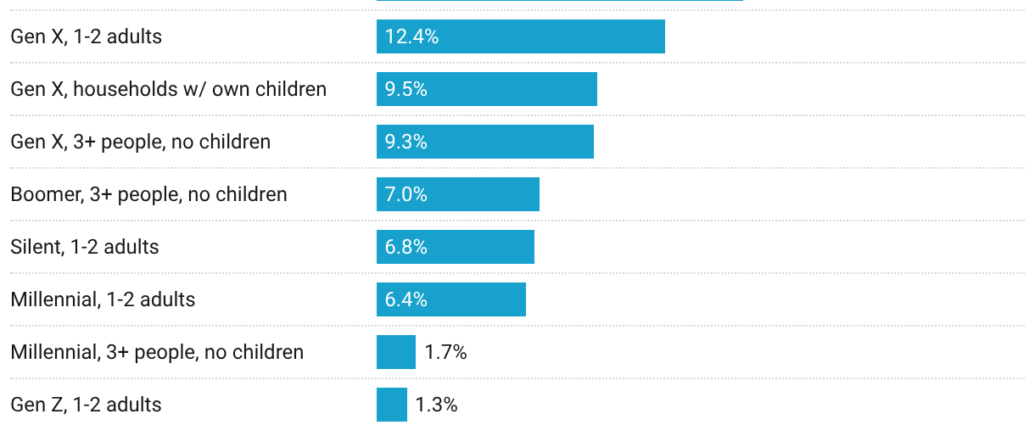
Baby boomers living in one- to two-adult households own 28% of large homes in the U.S. By comparison, millennials with children living at home own 16% of those houses—barely more than half as much. Gen Z parents own less than 1% of the nation’s large homes.
Baby boomers with households of three adults or more own an additional 7% of the country’s three-bedroom-plus homes (which we also refer to as “large homes” in this report). Those are likely made up of adult children living with their parents.
This is based on a Redfin analysis of U.S. Census data from 2024 (the most recent year for which data is available) that breaks down the share of three-bedroom-plus homes owned and occupied by each generation, by household type and size. See the end of this report for more details on methodology.
Millennials are the largest generation of parents in the U.S., but they own a relatively small share of family-sized housing. Gen Z parents—many of whom are just beginning to enter the housing market—barely register at all. It’s also worth noting that millennials are the largest generation in the U.S., period.
This dynamic can limit mobility for younger families, many of whom face both inventory and affordability challenges when trying to upgrade to bigger homes. One, there aren’t enough large homes on the market for the millennial families who need them, partly because in some parts of the country, there aren’t enough small reasonably priced homes for older Americans to downsize into. And two, home prices and mortgage rates are high; in many parts of the U.S., families are priced out of the housing market.
More than one-quarter (28%) of millennials aren’t buying a home in the near future because mortgage rates are too high, the most commonly cited reason for not buying among people in that age group who are either renters or long-term homeowners unlikely to move soon. That’s according to a November 2025 Redfin survey fielded by Ipsos. One in five (20%) aren’t buying a home soon because they’re unable to save for a down payment. Some millennials just don’t want to buy a home: 13% enjoy the flexibility of a rental lease, and 6% don’t want to put in the effort to maintain a home.
At the same time, many baby boomers have little financial incentive to move, often benefiting from low mortgage rates or fully paid-off homes. Nearly three in five (57.8%) baby-boomer homeowners have no mortgage; their home is fully paid off.
There are also social and lifestyle reasons to stay put: Baby boomers, in their sixties and seventies, may want to stay in the neighborhoods they’ve lived in for a long time, close to their friends, family, work and/or recreational activities. It’s also worth noting that one reason baby boomers own more large homes is simply because they’re older and have had more time to earn and save money, and use it to buy large homes.
“Younger buyers are looking to move into single-family homes in specific neighborhoods, those with a family friendly vibe and highly rated schools,” said Brenda Beiser, a Redfin Premier agent in Philadelphia. “The problem is, younger families have a hard time finding those homes because the older people living in them can’t find anywhere they want to move to. I hear empty nesters say they want to downsize, but it’s hard to find move-in ready, small, one-story homes or condos in their price range–especially since many of them are living in a fully paid-off home. So there’s a lack of movement that’s keeping both older and younger buyers where they are, even though the older ones want a smaller home and the younger ones want a bigger home.”
Homebuying affordability is improving, and Redfin economists expect it to improve more as the year goes on. That could allow some younger buyers to break into the market. Additionally, there could be more large homes come on the market as the mortgage-rate lock-in effect eases.
Redfin agents in some parts of the country say they’re starting to see more older homeowners downsize. A Redfin agent in Omaha, NE said some baby boomers are selling to younger families as they move into homes without stairs and without much maintenance. A Sacramento Redfin said several older residents are selling the family home because they’re downsizing—though those listings are rare, and competitive.
Redfin and Compass recently partnered on a phased marketing initiative that could motivate more homeowners to sell. Redfin economists estimate that housing inventory could increase by 6% to 12% annually in markets where home sellers are given the flexibility to test pricing strategies before formally listing.
A separate Redfin analysis found that the median age of first-time homebuyers has ticked down, from 38 in 2018 to 35 in 2025, signaling that at least some housing inventory is turning over to younger Americans. Additionally, Gen Z’s homeownership rate ticked up in 2025, and millennials eked out a gain, too.
Empty-nest baby boomers own essentially the same share of large homes they did a decade ago: In 2014, they owned 27.7% of the nation’s stock of large homes; now, they own 27.8%.
Millennials with kids have made progress as they’ve grown into prime homebuying and child-rearing age. In 2014, they owned 4.9% of the nation’s large homes; now, they own 15.7%.
Some of the large homes millennials now own come from the oldest living generation. In 2014, the Silent Generation owned about 18% of the nation’s large homes; now, they own about 8%.
Empty-nest baby boomers own more large homes than millennials with kids in every major U.S. metro.
Millennials with kids own less than 20% of large homes everywhere in the country. They own the biggest share of large homes, 19.2%, in Austin, TX and Columbus, OH. Minneapolis (18.9%) rounds out the top three.
Millennials with kids own the smallest share of large homes in Los Angeles, where they own just 10.5% of them. It’s followed by Miami (12.5%) and San Jose, CA (13.1%).
On the flip side, empty-nest baby boomers own at least 20% of large homes everywhere in the country. They take up the biggest share of large homes in Memphis, TN, where they own 31.2% of the metro area’s three-bedroom-plus homes. It’s followed closely by Cleveland, where empty nesters own 30.9% of the metro’s three-bedroom-plus homes, and Pittsburgh (30.6%).
In Salt Lake City, empty nesters own one in five (20.1%) of the metro area’s large homes, the smallest share in the U.S. It’s followed by Riverside, CA (21.4%) and Austin, TX (22%).
| Metro-Level Summary: Who Owns the Metro Area’s Stock of Large Homes?
50 most populous U.S. metro areas Large homes = three-plus bedrooms Empty nesters = Baby boomers with 1-2 adults living in the household |
||
| U.S. metro area | Share of large homes owned by millennials w/ kids | Share of large homes owned by empty-nest baby boomers |
| Atlanta, GA | 15.9% | 25.1% |
| Austin, TX | 19.2% | 22.0% |
| Baltimore, MD | 15.4% | 26.8% |
| Birmingham, AL | 15.3% | 28.3% |
| Boston, MA | 16.1% | 25.1% |
| Buffalo, NY | 15.9% | 29.3% |
| Charlotte, NC | 16.5% | 25.1% |
| Chicago, IL | 15.9% | 24.8% |
| Cincinnati, OH | 17.7% | 27.4% |
| Cleveland, OH | 13.9% | 30.9% |
| Columbus, OH | 19.2% | 25.3% |
| Dallas, TX | 17.6% | 22.8% |
| Denver, CO | 16.4% | 24.5% |
| Detroit, MI | 14.8% | 27.3% |
| Hartford, CT | 15.9% | 26.7% |
| Houston, TX | 18.3% | 22.3% |
| Indianapolis, IN | 18.6% | 25.2% |
| Jacksonville, FL | 15.9% | 28.8% |
| Kansas City, MO | 18.6% | 27.8% |
| Las Vegas, NV | 14.7% | 23.4% |
| Los Angeles, CA | 10.5% | 23.9% |
| Louisville, KY | 15.2% | 28.8% |
| Memphis, TN | 13.9% | 31.2% |
| Miami, FL | 12.5% | 23.8% |
| Milwaukee, WI | 16.1% | 29.2% |
| Minneapolis, MN | 18.9% | 25.5% |
| Nashville, TN | 17.4% | 25.0% |
| New Orleans, LA | 15.5% | 30.0% |
| New York, NY | 13.9% | 24.4% |
| Oklahoma City, OK | 18.6% | 27.0% |
| Orlando, FL | 13.7% | 24.7% |
| Philadelphia, PA | 15.0% | 26.6% |
| Phoenix, AZ | 15.3% | 25.2% |
| Pittsburgh, PA | 15.5% | 30.6% |
| Portland, OR | 16.0% | 26.7% |
| Providence, RI | 14.5% | 27.0% |
| Raleigh, NC | 16.7% | 24.8% |
| Richmond, VA | 15.9% | 29.3% |
| Riverside, CA | 15.9% | 21.4% |
| Sacramento, CA | 14.6% | 27.4% |
| Salt Lake City, UT | 18.9% | 20.1% |
| San Antonio, TX | 17.2% | 23.2% |
| San Diego, CA | 14.2% | 26.9% |
| San Francisco, CA | 13.8% | 25.6% |
| San Jose, CA | 13.1% | 22.4% |
| Seattle, WA | 17.6% | 24.3% |
| St. Louis, MO | 16.9% | 27.7% |
| Tampa, FL | 13.7% | 27.6% |
| Virginia Beach, VA | 16.7% | 29.0% |
| Washington, DC | 16.0% | 23.7% |
Methodology
This is based on a Redfin analysis of U.S. Census data from 2024 (the most recent year for which data is available) that breaks down the share of three-bedroom-plus homes owned and occupied by each generation, by household type and size. The three household types are as follows: 1 or 2 adults total living in the home; neither are minor children (for boomers, we refer to this category as “empty nesters”), 3 or more adults total living in the home; none are minor children, and households where adults are living with their minor children.
Adult Gen Zers were 19-27 years old in 2024, millennials were 28-43, Gen Xers were 44-59, and baby boomers were 60-78.
* ACS data was retrieved from IPUMS USA
*Steven Ruggles, Sarah Flood, Matthew Sobek, Daniel Backman, Grace Cooper, Julia A. Rivera Drew, Stephanie Richards, Renae Rogers, Jonathan Schroeder, and Kari C.W. Williams. IPUMS USA: Version 16.0 [dataset]. Minneapolis, MN: IPUMS, 2025
The post The Great Housing Mismatch: Empty Nesters Own 28% of the Nation’s Large Homes, Millennial Families Own 16% appeared first on Redfin Real Estate News.
Despite a sluggish start to the year, IREN Ltd.‘s (NASDAQ:IREN) stock is showing significant underlying strength, with its Benzinga Edge value score rising amid its transition into an artificial intelligence (AI) cloud provider.
While the stock has seen a nearly 10% year-to-date decline, climbing fundamental metrics and resolute analyst price targets suggest a massive potential upside for the infrastructure firm.
According to Benzinga Edge’s Stock Rankings, IREN’s value score experienced a notable week-on-week surge, climbing from 24.34 to 41.18. This metric evaluates a stock’s relative worth by comparing its market price to fundamental measures such as assets, earnings, and sales.
This valuation improvement comes amid the stock’s recent price action, which is down 9.74% year-to-date. Furthermore, the Edge rankings show that while IREN‘s short- and medium-term price trends are downward, but its long-term trend remains positive, supported by a massive momentum score of 98.18.

This post was originally published here

Huntington Ingalls Industries, Inc. (NYSE:HII) shares are trading lower during Thursday’s premarket session.
On Wednesday, the firm revealed the launch of the future USS George M. Neal (DDG 131) by the Ingalls Shipbuilding division.
This milestone reflects the company’s ongoing commitment to advancing U.S. naval capabilities and is a testament to the hard work of its shipbuilders, as noted in a recent announcement detailing the event marking a major construction milestone.
The USS George M. Neal, a Flight III Arleigh Burke-class destroyer, was launched on April 1, 2026, and represents a significant advancement in surface combatant technology, featuring state-of-the-art radar and combat systems.
Following this launch, the ship will undergo outfitting and testing phases in preparation for sea trials, further solidifying Huntington Ingalls’ position as a leader in military shipbuilding.
At $398.01, Huntington Ingalls Industries is trading 5.2% below its 20-day simple moving average (SMA) of $407.27, indicating short-term weakness. The stock is also 7.4% below its 50-day SMA of $416.76, which suggests a bearish trend in the intermediate term.
The relative strength index (RSI) …
This post was originally published here

Mortgage demand tumbled last week as rising borrowing costs continued to weigh on buyers, with applications falling 10.4% overall, according to data from the Mortgage Bankers Association released Wednesday.
The slowdown comes as RH (NYSE:RH) CEO Gary Friedman warned of “the most dire housing market in decades,” citing global tensions, tariffs, and economic uncertainty, underscoring the mounting strain on U.S. homebuyers and the broader housing sector.
Refinance applications led the drop, falling 17% week-over-week and more than 40% compared to last month. Purchase applications slipped 3%.
The average 30-year fixed mortgage rate rose to 6.57%, its highest level since August, said Mike Fratantoni, Chief Economist at the MBA. He noted that while higher borrowing costs are weighing on demand, increased housing supply is offering some offset. Federal Housing Administration (FHA) and Veterans Affairs (VA) loan applications continue to hold up better …


This post was originally published here

This post was originally published here

This post was originally published here

A new analysis finds that a 10% credit card interest rate cap would shrink access to credit, affecting well over 100 million American cardholders in the process.
Some Republican and Democratic lawmakers have expressed support for capping credit card interest rates at 10%, a measure that also received support from the Trump administration. Other proposals have centered on a higher cap of 15% or 20%.
An analysis by Unleash Prosperity warns that credit card interest rate caps would function as price controls on what is currently a highly competitive market, resulting in significant consequences for consumers and the economy.
“What’s going to happen if you put these interest rate caps on is you’re going to have fewer Americans with either lower incomes or lower credit scores who will have access to credit cards and that will make them worse off, not better off,” Steve Moore, co-founder of Unleash Prosperity and a former Trump administration economist, told FOX Business.
TRUMP’S PROPOSED CREDIT CARD INTEREST RATE CAP COULD CURB ACCESS FOR MILLIONS OF AMERICANS: REPORT
“Obviously, the big issue right now for consumers is affordability, and so the politicians are looking for any way to reduce costs to consumers. But what we found in our study is that the interest rate cap would dramatically reduce the number of Americans who would have access to credit,” he said.
The report by economists at Unleash Prosperity noted there is evidence that the vast majority of cardholders would be affected by a 10% rate cap, based on research from the U.S. and internationally.
It noted a large survey of the credit market published by the American Bankers Association in January, which found that 74% to 85% of open credit card accounts would be closed or have credit lines reduced, affecting between 137 million and 159 million cardholders.
Unleash Prosperity’s analysis found that the adverse impact would be the worst among cardholders with lower credit ratings, with it universally affecting subprime borrowers and below, as financial institutions wouldn’t be able to cover lending costs due to the interest rate cap.
TRUMP CALLS FOR 1-YEAR 10% CAP ON CREDIT CARD INTEREST RATES
The analysis estimated that between 71% and 84% of prime borrowers would either lose access to credit cards altogether or have credit lines reduced under a 10% cap.
Super-prime borrowers, who have the highest credit ratings with scores above 780, would also be affected by a 10% rate cap or even a 15% rate cap, as they currently face an average interest rate between 13% to 18% for existing accounts and 17% to 21% for new accounts. One such impact would be that credit card rewards programs could be curtailed through less generous incentives, or such rewards programs could be eliminated altogether.
A 20% interest rate cap would affect about 70% to 75% of all borrowers, or roughly 129 million to 140 million cardholders.
“We need maybe more financial literacy in this country because you are going to pay a very hefty interest rate if you don’t pay your credit card on time and the rates are high, but that’s because you’re not supposed to borrow on your credit card, and a lot of people do that and that’s how they get into financial trouble,” Moore said.
EX-TRUMP ADVISOR RAISES ALARM OVER BIPARTISAN CREDIT CARD PLAN THAT COULD HURT AMERICANS
Moore noted that an unintended consequence of credit card interest rate cap proposals is that it could force consumers who need funds to seek out payday loans, which have an average interest rate of near 400% APR.
“The kind of do-gooders in Washington say they’re going to do this to help people stay out of debt… They don’t want payday lenders, they want to make it harder for people to use credit cards,” Moore said. “Well, what are people going to do, go to a loan shark to get money in a hurry?”
“The alternative to paying a high interest rate on a credit card can be even worse for people,” he added.
GET FOX BUSINESS ON THE GO BY CLICKING HERE
Moore also said that credit cards play a significant role in how consumers engage in economic activity and that policymakers shouldn’t risk disrupting an important tool for consumers.
“Credit cards have become pretty ubiquitous in the U.S. and it’s by far the number one way people pay for transactions. The amount of money that people are spending on credit cards continues to escalate,” Moore said. “It’s a very convenient way for people to pay for things, it’s good for merchants, it’s good for customers, it’s good for banks – let’s not interfere with a system that’s working.”

America’s AI ambitions may be undone not by a lack of capital or computing power, but by a shortage of electricians.
That’s the emerging consensus between two disparate titans of the Fortune 500: Ford CEO Jim Farley, who has spent years sounding the alarm about a crisis in what he calls the “essential economy,” and Goldman Sachs, which is putting hard numbers on a labor crunch that threatens to slow the very AI buildout Wall Street has been banking on.
Farley has been the most persistent corporate voice warning the U.S. is sleepwalking into a workforce disaster. What he calls the essential economy, the blue-collar sectors that get things “moved, built, or fixed,” represents $12 trillion in U.S. GDP, per the Aspen Institute. But it is chronically understaffed and undervalued. The country is already short 600,000 factory workers and 500,000 construction workers, Farley wrote in a LinkedIn post last June. And he sees the situation getting worse, not better.
“I think the intent is there, but there’s nothing to backfill the ambition,” Farley told Axios in September 2025. “How can we reshore all this stuff if we don’t have people to work there?”
The irony, Farley argues, is the very technology disrupting white-collar work is creating a tidal wave of demand for the blue-collar workers America has neglected. AI could eliminate half of all white-collar jobs in the U.S. within a decade, he warned at last year’s Aspen Ideas Festival—gutting entry-level tech roles like junior programming and clerical work, the rungs many young Americans have been told to climb. Meanwhile, the skilled tradespeople needed to build the data centers that will run those AI systems simply don’t exist in sufficient numbers.
This dynamic suggests a disquieting loop. AI is eliminating the entry-level, white-collar jobs that have historically drawn young workers into technology careers—potentially shrinking the very talent pool that, with retraining, could feed the trades pipeline. The technology is simultaneously generating the infrastructure demand and undermining the workforce capacity to meet it.
“There’s more than one way to the American Dream, but our whole education system is focused on four-year education,” Farley said at Aspen. “Hiring an entry worker at a tech company has fallen 50% since 2019. Is that really where we want all of our kids to go?”
Now Goldman Sachs has quantified exactly how severe the constraint is.
In a Goldman Sachs Exchanges podcast appearance, Brian Singer, head of GS Sustain, warned the AI infrastructure buildout will require 500,000 new U.S. jobs just to build and power data centers—roughly 300,000 to supply electricity generation and another 200,000 for grid transmission and distribution work. The latter is the sticking point. GS Sustain is Goldman Sachs Research’s sustainability-focused framework, providing research and data tools exploring how innovation, regulation, and implementation of sustainability topics impact sustainable investing and broader capital flows
“Where we are more concerned about is on the transmission and distribution side,” Singer said, “because there electricians need four years of skilling.” The U.S. currently has approximately 45,000 energy apprentices, Singer noted—a number that needs to rise by 20,000 to 25,000 just to keep pace with projected demand.
Those national figures, however, may obscure an even more acute regional crisis. Data center construction is heavily concentrated in a handful of markets: Virginia—which shoulders roughly 70% of the world’s internet traffic and has nearly 35 GW in development—along with Texas and Arizona’s Phoenix metro, which ranks third nationally for new capacity.
Matt Landek, global division president for data centers at JLL, warned earlier this year secondary markets “frequently lack the specialized construction expertise, skilled technical workforce, and operational support infrastructure that primary markets provide,” meaning the labor crunch follows the buildout wherever it goes. When multiple hyperscale campuses break ground simultaneously in a single region, local talent pools are exhausted within months—forcing contractors to import workers from other states. In Northern Virginia, the wage pressure is already measurable: Journeyman electricians now earn upward of $120,000 annually, and Microsoft has resorted to employing electricians commuting from 75 miles away.
Singer framed the labor constraint as the most worrying of his firm’s “6 Ps,” a framework of factors that could drive or throttle AI power demand, encompassing pervasiveness, productivity, price, policy, parts, and people. Of the six, he said, “people” keeps him up at night most.
The Goldman analysis arrives at essentially the same conclusion Farley reached through the windshield of Detroit: that America’s AI moonshot is running on a cracked foundation. All the hyperscaler capital in the world can’t conjure a licensed electrician out of thin air (Goldman estimates combined budgets rose by more than $300 billion for 2026 and 2027). And the cruel arithmetic of the AI moment means the technology eroding one workforce is depending on another workforce that America has spent decades failing to build.
Farley’s fix is systemic: more investment in vocational education, expanded apprenticeship pipelines, and a cultural reckoning with the prestige gap between four-year degrees and trade careers.
“On the surface, this looks like a people problem,” he told Axios. “But it’s actually not that simple. It’s an awareness problem. It’s a societal problem.”
Goldman’s Singer put it more bluntly: Without the workers to build the grid, the data centers don’t get built—and the AI revolution stalls on a transmission line.
For this story, Fortune journalists used generative AI as a research tool. An editor verified the accuracy of the information before publishing.
This story was originally featured on Fortune.com
Oil prices surged by more than 60% in March as the U.S.-Iran war raged on.
This post was originally published here
Novo and Eli Lilly are both trying to shape the narrative of their rival pills, considered to be the start of the next phase of the weight-loss drug era.
This post was originally published here
Chili’s has seen strong sales, suggesting its stock could be in for a big boost, according to Key Banc.
This post was originally published here
The rich can save big by gifting assets before they die, but some end up in a cash crunch.
This post was originally published here
Nearly 20 million returns have already claimed President Donald Trump’s “no tax on overtime” deduction. Here’s what the popularity means for the tax break.
This post was originally published here
From the equity in your home to your retirement savings, here’s where to find extra money when you need it.
This post was originally published here
Blue Owl attributed the higher-than-usual requests to “heightened market concerns around AI-related disruption to software companies.”
This post was originally published here
Once-hyped, celebrity-backed company snapped up by American Exchange Group for fraction of former value
Allbirds, the San Francisco sustainable trainer brand once valued at more than $4bn, is being sold for just $39m (£29.6m) after global demand for its wool-based footwear failed to materialise.
American Exchange Group, the owner of a string of brands including the fashion label Ed Hardy and the accessories maker Born, is snapping up the struggling company once touted as the future of footwear.
This post was originally published here
Bank holiday traffic predicted to peak on Thursday, as petrol and diesel prices surge from fallout of Iran war
UK drivers are being urged to look for the cheapest petrol and “to fill up as usual” as travellers prepare to make 21.7m journeys on what is expected to be the busiest Easter on the roads in four years.
The average price of a litre of unleaded petrol rose by 20p in March, from 132.83p on the 1st to 152.83p on the 31st, raising concerns about the cost of filling up for Easter journeys. The higher fuel prices have been triggered by rising oil prices as a result of the US-Israel war against Iran.
This post was originally published here
Met Office names fourth storm of the year, with weather warnings for parts of Scotland, Northern Ireland, Wales and north of England
The Met Office has named its fourth storm of the year, which will bring very strong winds in the north of the UK on Saturday evening into Easter Sunday.
Storm Dave will bring wind gusts of 60 to 70mph in parts of Scotland, Northern Ireland, north Wales and parts of Northern England, with a possibility of gusts of up to 90mph in some areas.
This post was originally published here
Funeral director Robert Bush had previously admitted to dozens of counts of fraud at hearing in October
A fraudulent funeral director has admitted giving families the wrong ashes, lying to them, stealing from them and also stealing from charities while he was “trusted by people at a time they needed him most”.
Robert Bush pleaded guilty to preventing a lawful burial after 30 bodies and a quantity of ashes were found at a funeral home in Hull in 2024, in a case that shocked an entire city.
This post was originally published here
Anger in France after US president puts on French accent and mocks Macron during private lunch in Washington
Emmanuel Macron has said Donald Trump’s comments about his marriage were “neither elegant nor up to standard” after the US president put on an accent and mocked his French counterpart and his wife during a private lunch in Washington.
Arriving in South Korea on Thursday, Macron made clear his displeasure at Trump’s comments, which appeared briefly in a video on the White House YouTube channel before being removed.
This post was originally published here

Get your daily dose of health and medicine every weekday with STAT’s free newsletter Morning Rounds. Sign up here.
Good morning. A new Gallup poll found that health care is back on top of the list of Americans’ domestic worries. Does staying informed on the news help combat that concern? Read on and let me know.
President Trump addressed the nation last night, making his case for war with Iran. And, the Supreme Court majority seemed inclined to rule against the Trump administration on birthright citizenship.
(Image credit: Pool)

This post was originally published here


Success in homebuilding over the ages shows a rare, often counterintuitive balance between what changes in an instant and what remains timeless.
Living legends of the business – like NVR founder Dwight Schar – wise up to the fundamental role of land in housing, understanding that it holds a genomic key to homes, prices, processes, and people, enabling each lot to generate lasting value in an ever-evolving landscape.
From early on, Schar understood that wisdom, which is equal parts science, art, and alchemy, leaves no room for shortcuts, skipping the tedious details, or getting around the occasional pain of learning things the hard way.
For over 40 years as the leader of NVR, Inc., Schar built what many consider the most financially disciplined large-scale homebuilding company in the United States. The company that developed under his leadership – focused on conservative growth, land discipline, and returns on invested capital – largely shapes how today’s generation of homebuilders thinks about risk.
Yet Schar’s worldview began far from the boardroom.
“I moved to my uncle’s Ohio farm when I was 12 years old,” Schar recalls in an email exchange with The Builder’s Daily. “I had chores in the morning… milking cows, getting in crops, cleaning up… everything before school started. Then after school, more chores were waiting for me… the cows didn’t wait for me.”
Hard work was simply the structure of daily life.
“But I liked working hard… the focus, the hours… it was fun, in a way. I certainly learned about being responsible on the farm.”
Team sports reinforced those lessons. “You need a team to win,” he says. “You learn how to get along with teammates for the greater good.”
At 17, Schar left the farm with little more than determination.
“I left the farm with nothing but a paper bag holding my clothes. That’s all I took.”
He stayed with a teammate’s family to finish high school at Norwayne High in Creston, Ohio, before attending Ashland College in Ashland, Ohio, where he earned a teaching degree. Paying for school required resourcefulness. At one point, facing tuition he couldn’t afford, he walked into a bank and asked for help.
“I made an appointment with the president of the local bank. I told him about my money problem… and he told me to write the check, and he would hold that check until I had the money that would allow it to clear.”
Schar worked construction jobs, hung drywall, painted houses, and spent overnights in a foundry. The lesson stayed with him.
“Don’t be afraid to ask for help. So many people were good to me, helped me… now I do my best to help others in need.”
His formal career started in the classroom, but teaching was short-lived. During that time, Schar took electives in business courses – accounting, marketing, business law – subjects he says influenced his thinking much more than the semester he spent teaching.
Soon after, the purchase of his own home changed his trajectory.
“The guy who sold me the house told me to come sell houses with him in my free time,” Schar says. “I gave it a try… and I sold that house right away.”
The buyer, a banker who paid in cash, told Schar’s manager he’d be a fool not to hire him full-time.
“He did,” Schar says. “And here we are.”
Schar soon joined Ryan Homes, then led by another of homebuilding’s legends, Ed Ryan, and quickly became one of the company’s most aggressive land operators.
“Land is the key to everything else in our business,” he says.
His approach was methodical. In markets across the Midwest, Schar mapped out growth corridors, divided them into quadrants, and targeted the best development opportunities.
“I drove 60,000 miles a year and worked 16-hour days.”
Efficiency became another key aspect of his approach. At Ryan, Schar significantly cut down the number of home designs.
“They were building 100 different house types. I cut that down to 35,” he says. Standardizing components such as windows, doors, and roofs allowed Ryan to reduce waste and accelerate production.
In the Washington, D.C. area, the strategy was successful quickly.
“In two years, we were the largest homebuilder in the market… we still are today.”
By 1980, Schar started his own company, NVHomes – named for the Northern Virginia area where he had built his reputation. Seven years later, NVHomes bought Ryan Homes in a $312 million deal that created NVR, Inc.
The company quickly became one of the nation’s largest builders.
But the strategy that defined Schar’s career would emerge from a crisis.
After the leveraged buyout that created NVR in 1987, the housing market collapsed during the savings-and-loan crisis. The industry’s traditional method – buying large tracts of land with borrowed money – left many builders dangerously exposed.
NVR was no exception.
Between 1988 and 1991, sales fell by roughly half. By 1990, the company had posted losses exceeding $260 million. Contract cancellations surged, and financing evaporated.
“You can manage risk that’s under your control… how fast to grow… how much to save,” Schar says. “But you can’t manage political risk.”
Congress passed sweeping financial reforms after the S&L collapse, which caused bank lending to builders to dry up.
“Liquidity dried up… credit dried up… banks would not lend money to builders and we suffered through that… along with so many others.”
On April 6, 1992, NVR filed for Chapter 11 bankruptcy protection.
The company was transformed by the restructuring that followed.
NVR moved away from the industry’s land-heavy approach and started obtaining options on lots from developers instead of buying them raw land and financing its development. This “just in time” lot acquisition model significantly lowered capital needs and debt risk.
“Number one is taking less risk in land,” Schar says. “We didn’t buy land… we optioned the lots from the developers.”
The company also enforced strict internal discipline.
“We had a 10% rule,” Schar says. “We never wanted to grow more than that in any year because you can handle 10% repeatedly and keep your eye on the ball.”
NVR emerged from bankruptcy in 1993 with a radically different structure and culture. The new model emphasized return on invested capital and operational efficiency over rapid expansion.
That philosophy helped NVR stay profitable during the housing crash of the late 2000s, when many competitors faced heavy losses.
Schar attributes success more to discipline than to strategy.
“When times are good,” he says, “some builders think it’s never going to end… and then they find out they’re undercapitalized, overextended.”
For Schar, the lesson was straightforward.
“The most important thing is to stick to a conservative business plan… keep an even keel and have the reserves to see your way through hard times.”
Today, NVR generates nearly $9 billion in annual revenue and has served over half a million homeowners across the country. But Schar measures success differently.
“I think I am most proud of the organization,” he says. “The sustainable culture, the quality of what we build and the people who give their all.”
Homeownership itself remains central to his thinking.
“Owning a house is a part of the American dream… I’m proud to be a part of that.”
Even after retiring from NVR in 2022, Schar has remained deeply engaged in development and civic life – now applying the same discipline that defined his homebuilding career to a broader canvas of commercial real estate and community development.
As a significant shareholder, principal in Comstock Partners, and strategic advisor to Comstock Holding Companies, Inc. (Nasdaq: CHCI), Schar has played a central role in shaping the company’s evolution into a fee-based, asset-light, debt-free real estate services platform. The model – rooted in long-term asset management agreements, vertically integrated property management services, and recurring revenue streams – mirrors the capital efficiency and risk discipline he pioneered at NVR.
At Comstock, that philosophy is reflected not only in how assets are financed but also in how they are conceived, developed, acquired, and operated over time. The company manages and operates a portfolio that is expected to include well over 100 assets and cover approximately 10 million square feet at full-build out, with a pipeline that extends into the next decade and a total value exceeding $5 billion.

Comstock’s core business model is designed to generate consistent, recurring income through asset and property management agreements while maintaining a streamlined balance sheet. This approach has driven steady increases in revenue and EBITDA over the past several years and has also provided Comstock with the flexibility to pursue new growth opportunities without overextending capital.
Projects like Reston Station and Loudoun Station – large-scale, mixed-use, transit-oriented developments anchored by Metro rail – continue the story of Schar’s ongoing belief that real estate success ultimately depends on place-making: blending residential, commercial, hospitality, and public spaces into environments that can grow and adapt over time.
At the same time, Comstock’s expansion into institutional joint ventures and emerging platforms like data center campus development highlights a forward-thinking strategy that combines operational expertise with external capital, enabling the company to grow while keeping its low-risk, high-return profile.
The throughline is clear. NVR redefined how homes could be built with less capital at risk. Comstock applies that thinking to how entire districts can be developed, managed, and sustained over time.
“Beyond business, what I admire most about Dwight is his deep commitment to fostering the American Dream and to improving the lives and futures of others through his philanthropic initiatives,” said Chris Clemente, CEO of Comstock. “While more than 100,000 homes built by his companies are at the center of the American Dream for countless families, his extraordinary contributions to Inova Schar Cancer Institute and the Inova Schar Heart & Vascular Center in Fairfax, Virginia, have helped save many lives. His generous support of George Mason University and other institutions has also helped shape the next generation of doctors, nurses, teachers, political leaders, and business leaders. I am truly honored to have Dwight as a business partner, mentor, role model, and friend.”
For Schar, the magnetic appeal of the work stays as basic as it was on the farm.
“It’s fun,” he says. “It’s still fun. The fun is in the doing.”
Alongside his business activity, Schar and his wife have donated more than $150 million to healthcare and education initiatives, including major gifts to the Inova Health System and George Mason.
The motivation, he says, connects back to the same philosophy that shaped his career.
“Housing is the foundation of our civilization,” Schar says. “Homes create our communities… neighborhoods… schools… kids growing up together.”
For the next generation of builders, his advice remains rooted in restraint and patience.
“You have to play the long game and you have to fully understand risk,” he says.
“Be smart… don’t be greedy… don’t overextend… and always have some capital in your back pocket.”
Then he adds the perspective earned over a lifetime in one of America’s most cyclical industries.
“It’s a marathon… not a sprint.”

The Iran war is a major factor pushing up mortgage rates. Some would-be buyers are backing off amid high costs and uncertainty stemming from the war.
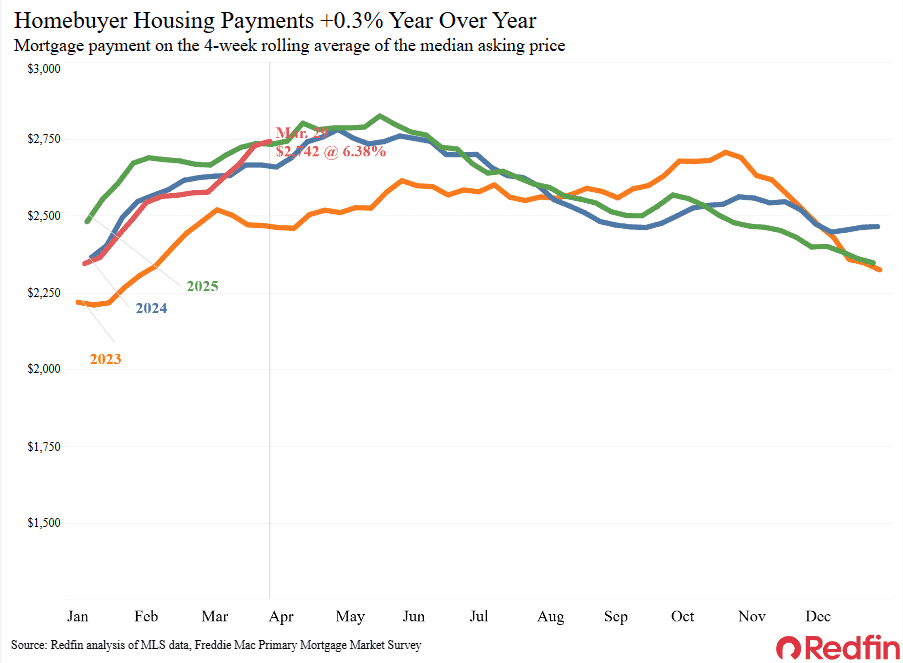
The median U.S. monthly mortgage payment is $2,742, up 0.4% year over year. While that’s a small increase, it’s the first in nearly six months.
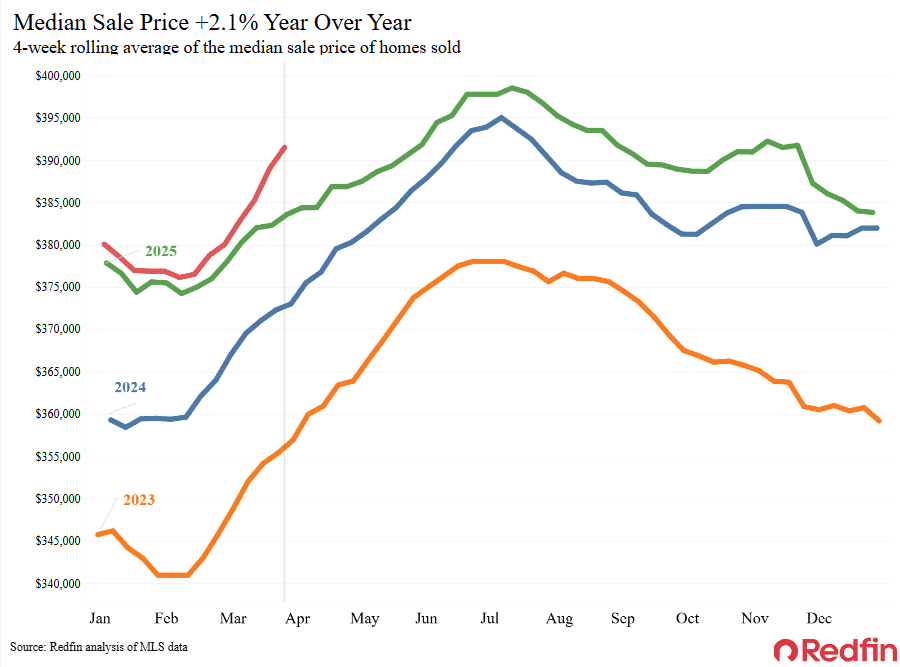
Housing payments are climbing because the Iran war and rising oil prices have pushed the weekly average mortgage rate up to a six-month high of 6.38%. Daily average mortgage rates rose as high as 6.64% at the end of last week. Home-sale prices are a factor, too; the median home-sale price rose 2.1% from a year earlier during the four weeks ending March 29–the biggest uptick in a year.
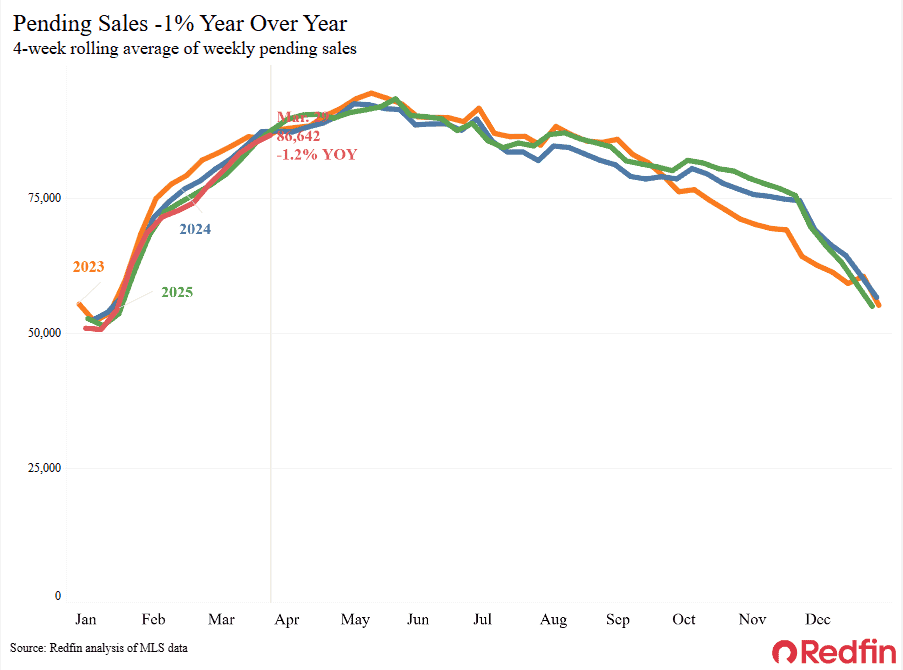
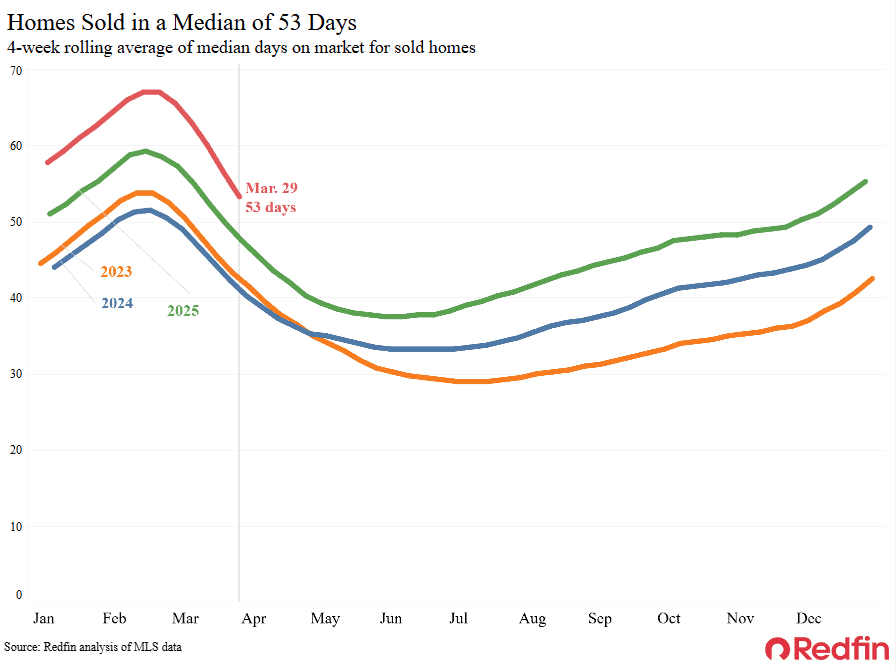
High costs, along with economic uncertainty from the Iran war, have sidelined some would-be homebuyers. Pending home sales declined 1.2% year over year, and mortgage-purchase applications fell 3% week over week. The typical home spends 53 days on the market before going under contract, five days longer than last year.
On the selling side, new listings are ticking up; they rose 1.7% year over year. Overall, there are 630,000 more home sellers than buyers in the market–the biggest gap in records dating back to 2013. Redfin agents say that with more sellers than buyers in most metro areas, it’s more important than ever for sellers to prepare their home to make a strong first impression.
“My advice for sellers is to remember you’re selling the dream of homeownership,” said Hazel Shakur, a Redfin Premier agent in the Washington, D.C. area. “When house hunters walk through the door, it should look good, smell good and give the impression that every room is orderly. Buyers should be able to visualize what life is going to be like living in the home. And it goes beyond cosmetics: Some buyers are walking away during the inspection period if they uncover an issue, so sellers should make sure they have taken care of basic maintenance and repairs before listing.”
For Redfin economists’ takes on the housing market, please visit Redfin’s “From Our Economists” page.
| Indicators of homebuying demand and activity | ||||
| Value (if applicable) | Recent change | Year-over-year change | Source | |
| Daily average 30-year fixed mortgage rate | 6.45% (April 1) | Up from 4-year low of 5.99% a month earlier | Down from 6.82% | Mortgage News Daily |
| Weekly average 30-year fixed mortgage rate | 6.38% (week ending March 26) | Highest level in 6 months | Down from 6.67% | Freddie Mac |
| Mortgage-purchase applications (seasonally adjusted) | Down 3% from a week earlier (as of week ending March 27) | Up 1% | Mortgage Bankers Association | |
| Google searches of “homes for sale” | Up 20% from a month earlier (as of March 30) | Up 20% | Google Trends | |
| Touring activity | Up 25% from the start of the year (as of March 30) | At this time last year, it was up 36% from the start of 2025 | ShowingTime | |
| Redfin’s Homebuyer Demand Index was removed this week to ensure data accuracy. | ||||
| U.S. highlights: Four weeks ending March 29, 2026
Redfin’s national metrics include data from 400+ U.S. metro areas and are based on homes listed and/or sold during the period. Weekly housing-market data goes back through 2015. Subject to revision. |
|||
| Four weeks ending March 29, 2026 | Year-over-year change | Notes | |
| Median sale price | $391,475 | 2.1% | Biggest increase in a year |
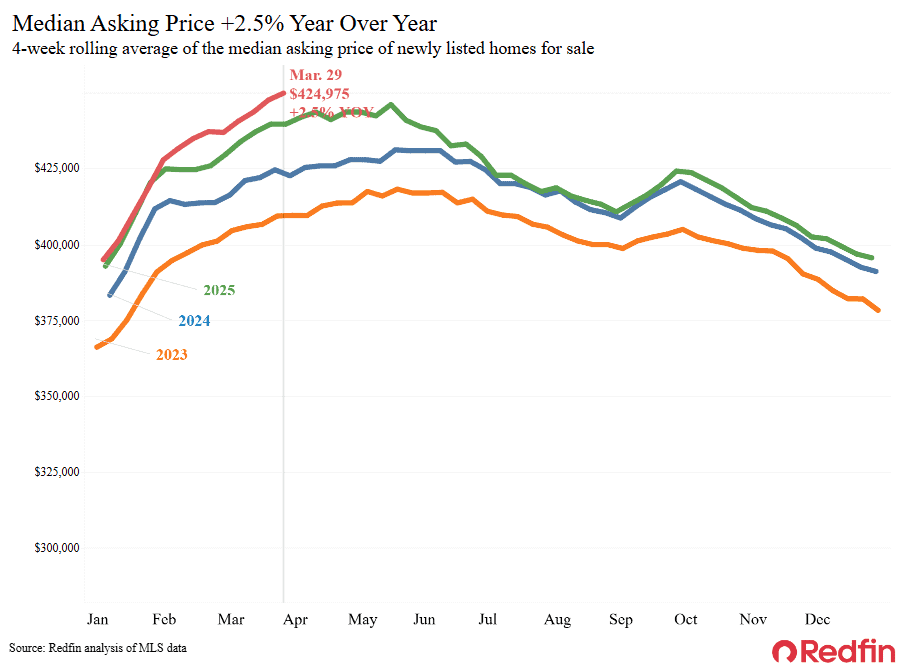
| Median asking price | $424,975 | 2.5% | |
| Median monthly mortgage payment | $2,742 at a 6.38% mortgage rate | 0.3% | First increase since October 2025 |
| Pending sales | 86,642 | -1.2% | Biggest decline in over a month |
| New listings | 102,768 | 1.7% | |
| Active listings | 1,068,411 | -1.7% | Biggest decline since 2023 |
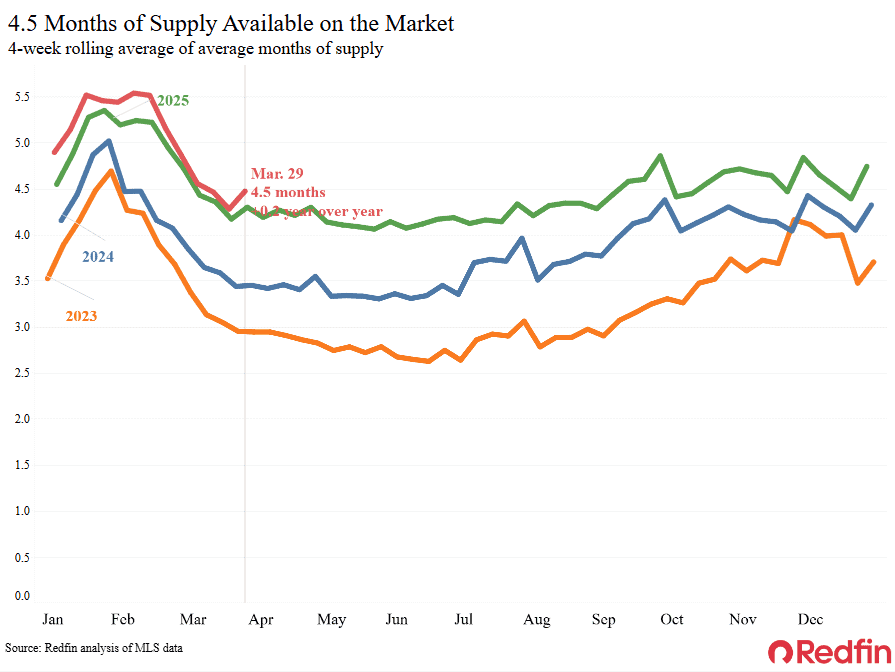
| Months of supply | 4.5 | +0.2 pts. | 4 to 5 months of supply is considered balanced, with a lower number indicating seller’s market conditions |
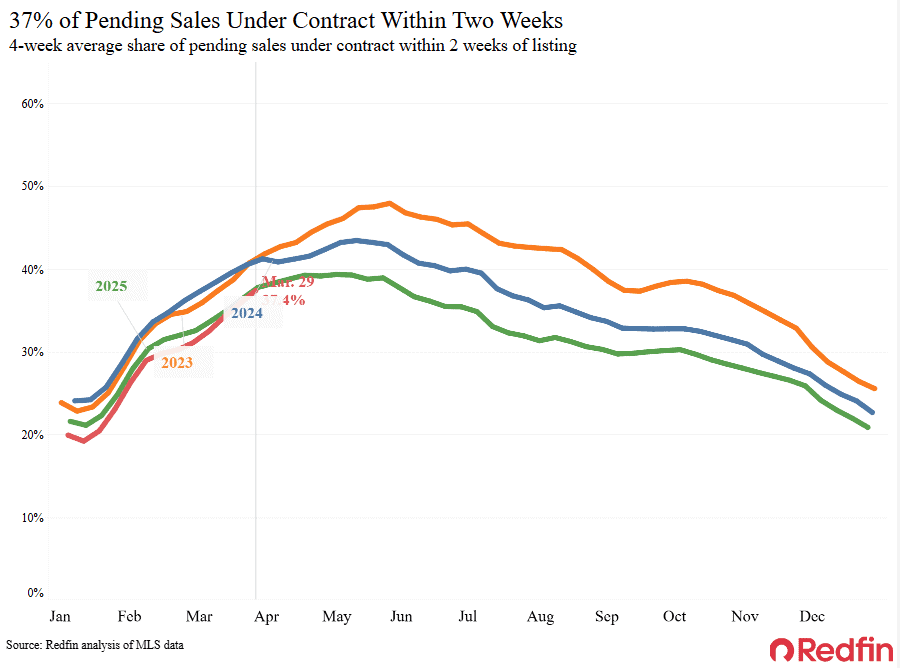
| Share of homes off market in two weeks | 37.4% | Essentially unchanged | |
| Median days on market | 53 | +5 days | |
| Share of homes sold above list price | 23.2% | Down from 25% | |
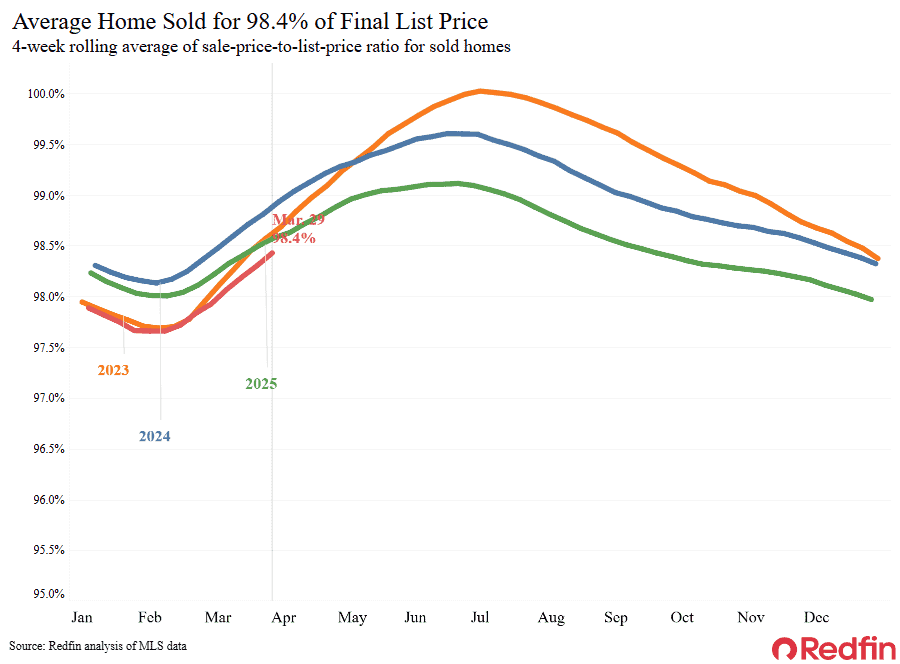
| Average sale-to-list price ratio | 98.4% |
Down from 98.5% |
|
|
Metro-level highlights: Four weeks ending March 29, 2026 Redfin’s metro-level data includes the 50 most populous U.S. metros. Select metros may be excluded from time to time to ensure data accuracy. |
|||
|---|---|---|---|
| Metros with biggest year-over-year increases | Metros with biggest year-over-year decreases |
Notes |
|
| Median sale price | San Francisco, CA (12.6%)
Detroit (10.1%) Cincinnati (8.7%) Milwaukee (8.7%) Baltimore (6.9%) |
Oakland, CA (-4.1%)
Dallas (-3.4%) Austin, TX (-2%) West Palm Beach, FL (-1.8%) Houston (-1.8%) |
Declined in 12 metros |
| Pending sales | San Francisco (25%)
West Palm Beach, FL (22.8%) Milwaukee (12.4%) Austin, TX (10%) Miami (8.5%) |
New Brunswick, NJ (-15.8%)
Providence, RI (-15.6%) New York (-15.1%) Houston (-14.4%) Nassau County, NY (-13.5%) |
|
| New listings | Milwaukee, WI (15.9%)
Philadelphia (9.7%) Boston (8.5%) Washington, D.C. (7.7%) San Francisco (7.6%) |
Tampa, FL (-15.7%)
Providence, RI (-14.1%) Miami (-11.2%) Jacksonville, FL (-10%) Riverside, CA (-8.2%) |
|
Refer to our metrics definition page for explanations of all the metrics used in this report.


The post Monthly Payments Tick Up For First Time in 6 Months As Mortgage Rates, Home Prices Jump appeared first on Redfin Real Estate News.

Globalstar, Inc. (NYSE:GSAT) shares are up during Thursday’s premarket session following media reports claiming that Amazon.com, Inc. (NASDAQ:AMZN) is in talks to acquire the satellite communications company.
This potential deal could significantly bolster Amazon’s low-Earth-orbit satellite internet business as it aims to compete with SpaceX, The Financial Times reported.
As of December 31, 2025, Globalstar held cash and cash equivalents of $447.5 million, compared to $391.2 million as of December 31, 2024.
A deal with Globalstar could enhance Amazon’s satellite internet service, known as Leo, which is gearing up for commercial launch. The discussions come amid Amazon’s efforts to deploy around 1,600 satellites by mid-2026, while Globalstar has existing agreements with SpaceX for satellite launches.
At $76.50, the stock is trading 26.1% above its 20-day simple moving average (SMA) and 24.2% above its 100-day SMA, suggesting strong short-term momentum. The stock’s position indicates a bullish trend, as it is significantly above these key moving averages.
The relative strength …
This post was originally published here

U.S. stock futures were lower this morning, with the Dow futures falling around 400 points on Thursday.
Shares of Alto Neuroscience Inc (NYSE:ANRO) fell sharply in pre-market trading after the company announced topline data from its Phase 2 proof-of-concept clinical trial evaluating ALTO-101 did not achieve statistical significant on primary electroencephalography or cognitive endpoints versus placebo.
Alto Neuroscience shares dipped 13.6% to $20.16 in pre-market trading.
Here are some other stocks moving lower in pre-market trading.
This post was originally published here

The Internal Revenue Service (IRS) reported on Tuesday that over 4 million U.S. children have been registered for the tax-advantaged Trump Accounts, with more than 1 million choosing the $1,000 pilot program contribution.
The IRS, working with the Treasury Department, has simplified the election process. As Frank J. Bisignano, IRS Chief Executive Officer, stated, “Families with eligible children born between 2025 and 2028 just need to check the box on a form to stake their claim for the $1,000 contribution. It’s that simple.”
The data reflects only the number of Form 4547 (Trump Account Election) filings submitted with individual tax returns to the IRS so far.
The “Trump Accounts” or “Invest America” accounts were established under President Donald Trump‘s One Big, Beautiful Bill. The initiative provides every child born between Jan. 1, 2025, and Dec. 31, 2028, a tax-advantaged investment account, seeded with $1,000 from the …
This post was originally published here

Bloom Energy Corp. (NYSE:BE) shares declined in early Thursday trading, pressured by escalating geopolitical tensions and a broader market selloff.
The move followed a televised address by President Donald Trump at 9 p.m. ET Wednesday, in which he reiterated threats to “hit” Iran’s electric infrastructure and warned that military action could extend for another two to three weeks.
The absence of de-escalation language weighed on risk sentiment, sending S&P 500 futures down 1.24% and Nasdaq futures lower by 1.63%.
Data shows short interest in Bloom Energy climbed during the recent reporting period. Positions rose from 22.04 million to 24.39 million shares. This brings …
This post was originally published here

Blend’s CEO Nima Ghamsari wants to talk less about the past decade’s fintech sugar high and more about recovering from the crash.
The company, founded in 2012 by Ghamsari, set out in the wake of the financial crisis to make applying for a mortgage “as easy as buying something online.” It now builds white‑label software that powers digital loan applications at major U.S. banks and credit unions across mortgages and other consumer banking products. The company rode the last boom to a 2021 IPO and a market cap north of $4 billion, but then rising rates crushed mortgage volumes and exposed how much of its growth had been surfing a once‑in‑a‑generation tailwind. Now, that market cap is hovering at $437.10 million.
“It probably gave me an inflated sense of how well I was executing,” Ghamsari told Fortune of that era. His biggest realizations post‑IPO: “I had overestimated my operating ability” and had to “go back to first principles” as multiples, mortgage volumes, and key banking customers like First Republic disappeared.
For Blend, which went public (and remains so) near the peak of both fintech multiples and mortgage demand, that meant a “double whammy” of shrinking origination volumes and falling software valuations. The downturn became a multi‑year test for Blend of whether the underlying business—and its CEO’s operating chops—could withstand a very different market. Today, Blend’s shares trade in the low single digits, down more than 90% from their debut. But the company has returned to profitability for at least five consecutive quarters.
Privately, Blend had been a classic fintech VC magnet, raising money from Greylock Partners, Emergence Capital, 8VC, Founders Fund, Andreessen Horowitz, Lightspeed, Nyca, Temasek, and General Atlantic on its way to unicorn status. Those investors backed an expansion beyond digital mortgage origination, a broader platform pitch that helped large lenders digitize everything from mortgage applications to other consumer‑credit products.
When the market turned, that sprawl became a liability, and Ghamsari says he learned a painful lesson: “I made the company take on too many things,” prompting a reset toward being “really, really great at one thing.”
That “one thing” for 2026 is Autopilot, Blend’s new AI agent announced in early March. Autopilot reads borrower documents, checks them, updates the file, and kicks off follow‑ups—turning work that took days into seconds, while humans and existing systems still make the final call. Ghamsari frames it as a way to attack the roughly $11,000 in human cost and “hundreds of hours” that lenders currently spend per mortgage. Roughly 20% of Blend’s customers adopted the tech within the first month, Ghamsari told Fortune.
After several rounds of layoffs and restructuring, culture has been another test for the company. “The hardest thing about the layoffs is you still believe in the business, you just feel like you did the wrong things that led us to the point of the layoffs,” he says, arguing that owning those decisions is key to rebuilding trust—and completing the turnaround.
P.S. Elon Musk’s rocket company, SpaceX, confidentially filed to go public Wednesday, as reported by Bloomberg, Reuters, and The Wall Street Journal. This could be the defining test of the IPO market in 2026, if OpenAI doesn’t get there first.
See you tomorrow,
Lily Mae Lazarus
X: @LilyMaeLazarus
Email: lily.lazarus@fortune.com
Submit a deal for the Term Sheet newsletter here.
Joey Abrams curated the deals section of today’s newsletter. Subscribe here.
This story was originally featured on Fortune.com


This post was originally published here

This post was originally published here

This post was originally published here

This post was originally published here
Christopher Joell-Deshields was suspended last year, with £7,125 found to have been spent on items such as perfume
The boss of Pride in London, one of the world’s largest LGBTQ+ events, has been sacked after he was accused of buying luxury goods for personal use with vouchers intended for volunteers’ food and drink.
Christopher Joell-Deshields, who had been chief executive of Pride in London since 2021, was put under investigation last September and suspended the following month in response to claims of misconduct.
This post was originally published here
US moves towards reestablishing working relations between two countries after abducting President Nicolás Maduro
The US has lifted sanctions on Venezuela’s acting president, Delcy Rodríguez, in the latest step towards normalising relations between the two countries after US forces abducted her predecessor, Nicolás Maduro, and his wife.
The couple were taken to New York after their abduction in January to face charges of alleged drug trafficking, to which both have pleaded not guilty.
This post was originally published here
Bank of England survey in March shows chief financial officers foresee 3.7% increase over coming year
Companies in the UK expect to raise their prices more rapidly over the coming months as the war in the Middle East drives up costs, Bank of England research shows.
The Bank’s regular survey of more than 2,000 chief financial officers conducted last month, after the Iran conflict began, shows they now expect to raise their prices by 3.7% over the coming year.
This post was originally published here
These are the stocks posting the largest moves in the premarket.
This post was originally published here

A lot of artificial intelligence tools in medicine pitch themselves as breakthroughs. But there are some that can put some extra oomph behind that claim. Since 2016, the Food and Drug Administration has handed out “breakthrough” designation to more than 1,200 devices, including many powered by AI.
The designation comes with priority FDA review, with the goal of enabling innovative devices to reach patients and hospitals quicker. But what does the agency count as a breakthrough, especially in clinical AI, a decade after it established the Breakthrough Designation Program?
An analysis of STAT’s Breakthrough Device Tracker — which tracks all publicly available breakthrough designations, not just those the FDA has authorized — shows that the agency appears to be prioritizing big-picture, multi-problem AI solutions. Algorithms that simply improve a doctor’s capabilities are no longer enough: AI breakthroughs increasingly solve problems that physicians simply can’t, like detecting multiple cancers from a single image, or predicting the risk of dying from cancer or heart failure.

Senate Majority Leader Chuck Schumer (D-NY) has firmly stated that the Senate will not vote to leave NATO, despite President Donald Trump‘s recent contemplation of withdrawal.
Schumer took to X on Wednesday and highlighted that State Secretary Marco Rubio sponsored a bill in 2023 that requires a two-thirds vote of the Senate for the U.S. to withdraw from NATO.
“Thank you to @SecRubio for sponsoring the bill in 2023 requiring a two-thirds vote of the Senate to make sure clueless presidents couldn’t act on a whim,” wrote Schumer.
This move was made to ensure that the decision to leave the alliance would not be made impulsively by any president.
The Democratic leader also highlighted a 2023 post by Rubio, then a senator, in which he celebrated the bill’s passage.
This post was originally published here

CoreWeave Inc. (NASDAQ:CRWV) shares fell in Thursday’s premarket session.
This decline follows significant insider selling and a broader retreat in Nasdaq futures.
Macro headwinds are weighing on the sector. Nasdaq futures dropped 1.63% while S&P 500 futures shed 1.24%.
Recent filings reveal substantial selling by top executives. CEO Michael Intrator sold 32,460 shares at $87.34 on March 25, totaling approximately $7.20 million. Following the transaction, Intrator retains direct ownership of 5,666,501 shares.
Meanwhile, Chief Development Officer Brannin McBee disposed of over $25 million in equity through “Sell-Options” transactions on March 23 and 30.
Bearish bets against the AI cloud …
This post was originally published here
SkyBridge Capital founder Anthony Scaramucci is breaking down the mechanics—and the market risks—behind Strategy Inc.‘s (NASDAQ:MSTR) high-yielding perpetual securities, calling the dividend play a potentially lucrative move for steadfast Bitcoin (CRYPTO: BTC) believers.
During a recent episode of the All Things Markets podcast, Scaramucci and Galaxy Digital Inc. (NASDAQ:GLXY) CEO Mike Novogratz analyzed MSTR’s strategy of offering a yield-bearing security.
Scaramucci noted that investors putting money into Michael Saylor‘s company, earlier known as MicroStrategy, can receive four quarterly dividend payments equivalent to roughly an 11.5% yield.
While emphasizing the attractiveness of the trade, Scaramucci made sure to clarify his firm’s exact position to listeners. “I’m a huge fan of his and obviously SkyBridge owns a lot of Bitcoin. We don’t own any of that security, but I just wanted to disclose that to people,” Scaramucci stated.
He added that as long as Bitcoin holds its muster and Strategy trades at a premium—or at least not at a huge discount—Saylor will be able to sustain the impressive payouts.

This post was originally published here

The Hershey Company plans to tweak the chocolate used in a small portion of its Reese’s and Hershey’s products following criticism from a descendant of the Reese’s Peanut Butter Cup founder over ingredient changes.
The chocolate maker said it will phase out certain compound coatings and transition those products to traditional milk or dark chocolate by 2027. The change is expected to affect less than 3% of Reese’s items and a small portion of its broader portfolio, according to Bloomberg.
“[We’re] bringing a small portion of remaining Hershey’s and Reese’s products in line with their classic milk and dark chocolate recipes,” a spokesperson for The Hershey Company told FOX Business in an email. “The core recipes for our Hershey’s chocolate bars and Reese’s peanut butter cups have not changed.”
GRANDSON OF REESE’S INVENTOR BLASTS HERSHEY OVER ALLEGED RECIPE CHANGES: ‘I THREW IT IN THE GARBAGE’
Most Hershey’s products, including its flagship chocolate bars and standard Reese’s Peanut Butter Cups, already use traditional chocolate. The updates will apply to select items such as the Reese’s Fast Break bar, some Mini Reese’s and certain foil-wrapped products, Bloomberg reported.
Hershey CEO Kirk Tanner said the decision to adjust ingredients was made shortly after he took on the role last summer.
The chocolate maker is also revising the Kit Kat recipe to create a creamier chocolate taste and plans to eliminate artificial colors from its products by the end of 2027, according to the outlet.
The changes follow recent criticism from Brad Reese, the grandson of H.B. Reese, who accused the company earlier this year of lowering ingredient quality in some products.
CHOCOLATE PRODUCTS RECALLED OVER HIDDEN DRUGS TIED TO ‘LIFE-THREATENING’ BLOOD PRESSURE DROPS
In a February LinkedIn post, he alleged Hershey had replaced traditional ingredients like milk chocolate and peanut butter with cheaper alternatives.
Reese on Wednesday dismissed the company’s latest announcement, calling it “a PR move” and “total bunk.”
“I don’t look at this as a win,” Reese told FOX Business.
He also questioned the timeline, suggesting the company is delaying meaningful action.
“They’re just hoping this will die down, and it’ll be business as usual by 2027,” Brad Reese said. “If they were really serious, they would do it right away.”
THIEVES STEAL 12 TONS OF KITKAT BARS FROM TRUCK IN EUROPE
Hershey pushed back in a statement to FOX Business, noting that Reese has no official connection to the company or brand.
The company also cited a statement from other members of the Reese family distancing themselves from his remarks.
CLICK HERE TO GET FOX BUSINESS ON THE GO
“Our family would like to make it clear that we have no involvement in, nor do we support, the recent claims made by Brad Reese regarding The Hershey Company. His statements and opinions are entirely his own and do not reflect the view or position of our family,” the family recently said in a statement.
“We continue to respect The Hershey Company, its leadership, and its longstanding role in our community. We believe H.B. Reese would take great pride in the products produced under his name today and in the integrity with which the brand continues to be managed.”

This post was originally published here


This post was originally published here

This post was originally published here

This post was originally published here
Stellantis-backed Leapmotor delivered 110,155 new energy vehicles in the first three months of 2026, exceeding 100,000 deliveries for a fourth-straight quarter.
This post was originally published here
JPMorgan added artificial intelligence beneficiaries and a food distributor to its favorite stocks list in April.
This post was originally published here
Tap into your home equity with a credit card and earn cashback with this innovative product.
This post was originally published here
Thorne has been around for 42 years but between 2022 and 2025, its business more than doubled thanks to health-conscious Gen Z and millennial shoppers.
This post was originally published here
In today’s newsletter: Britain’s refusal to be drawn into the Iran war has triggered a backlash from the White House, with the president’s fury exposing the fragility of this once unshakeable partnership
Good morning. Another week, another tirade against the UK from Donald Trump. The US-Israeli conflict with Iran has further inflamed tensions in the special relationship, which was already under strain from attacks by the capricious US leader. So far this week, Trump has once again mocked the UK’s navy, instructed allies worried about jet fuel supplies to take it from the strait of Hormuz themselves, and announced that the US is considering leaving Nato.
The outbursts have become a pattern since the war with Iran began – and mark a departure from the unlikely friendly relationship Starmer and Trump have enjoyed until now.
Middle East | Donald Trump used a prime-time address to the nation to declare the month-long war in Iran a success “nearing completion”, despite a spiralling conflict that has caused economic turmoil across the globe, fractured transatlantic alliances and eroded the president’s approval ratings.
UK politics | The UK will seek an even deeper partnership with the EU because of the instability wreaked by Donald Trump’s war with Iran, Keir Starmer has said, adding that the moment called for a more ambitious deal with Brussels.
Nasa | Nasa’s moon rocket Artemis II launched on Wednesday evening, carrying astronauts to the moon for the first time in almost 54 years.
BBC | The BBC confirmed in a statement it was first made aware of a police investigation into historical allegations of sexual abuse by Scott Mills in 2017.
NHS | Claims by Palantir that concerns over the US data analytics company’s multimillion-pound NHS contract are “ideologically motivated” have been rejected by the chair of a parliamentary committee.
This post was originally published here
Simon Dudley fired after his comments were condemned by prime minister and families of fire victims
Reform UK’s housing spokesperoson has been sacked his role after he described the Grenfell Tower fire as a “tragedy” but said that “everyone dies in the end”.
Keir Starmer had called on Nigel Farage to sack Simon Dudley, a former head of Homes England, after his comments, which were condemned by Grenfell families and others.
This post was originally published here
Democrats criticize speech as doing little to answer Americans’ ‘most basic questions’. Plus, how rap lyrics were used to help sentence a man to death
Good morning.
Donald Trump declared the month-long US-Israeli war against Iran a success “nearing completion” in his prime time address to the nation on Wednesday evening – despite the conflict wreaking global economic chaos, damaging transatlantic alliances and hitting his approval ratings.
What is the significance of Trump’s comments on HEU? The apparent decision to leave it appears to conflict with his assertions that a key war aim was to ensure Iran could never make a nuclear bomb.
Follow our liveblog for the latest updates.
What has Houston said about the rocket’s deployment? Flight controllers confirmed that all four solar arrays, which will provide the spacecraft with continuous electrical power throughout its lunar journey, were deployed successfully.
This post was originally published here
Divers in race against time to unearth wreck of the Dannebroge before seabed becomes construction site
More than 200 years after being sunk by Admiral Horatio Nelson and the British fleet, a Danish warship has been discovered on the seabed of Copenhagen harbour by marine archaeologists.
Working in thick sediment and almost zero visibility 15 metres (49 feet) beneath the waves, divers are in a race against time to unearth the 19th-century wreck of the Dannebroge before it becomes a construction site in a new housing district being built off the Danish coast.
This post was originally published here

This is the online version of Adam’s Biotech Scorecard, a subscriber-only newsletter. STAT+ subscribers can sign up here to get it delivered to their inbox.
Biotech’s most-watched stock index, the XBI, was heading for a first-quarter loss until Tuesday, when Eli Lilly said it was buying Centessa Pharma, and Biogen announced a takeover of Apellis Pharma. Investors love M&A. Those deals plus an easing of Iran war concerns contributed to a huge 7% surge in the XBI on the last day of the quarter.
How are you feeling about biotech as we enter the second quarter? Are you worried about China? AI? Gas prices? The year-over-year pace of M&A activity is up, but FDA drug approvals are down.

The CNN Money Fear and Greed index showed further easing in the overall fear level, while the index remained in the “Extreme Fear” zone on Wednesday.
U.S. stocks settled higher on Wednesday, with the Nasdaq Composite gaining more than 1% during the session.
President Donald Trump stated the U.S. could end its military campaign “within two or three weeks.” He noted that Iran would not need to agree to specific terms for a withdrawal.
In earnings, RH (NYSE:RH) shares dropped 19% on Wednesday as the company reported worse-than-expected fourth-quarter financial results and issued FY26 sales guidance below estimates on Tuesday. Nike Inc (NYSE:NKE) fell more than 15% despite the company reported better-than-expected financial results for the third quarter of fiscal 2026. The company said it sees fourth-quarter sales of $10.656 billion to $10.878 billion, …
This post was originally published here
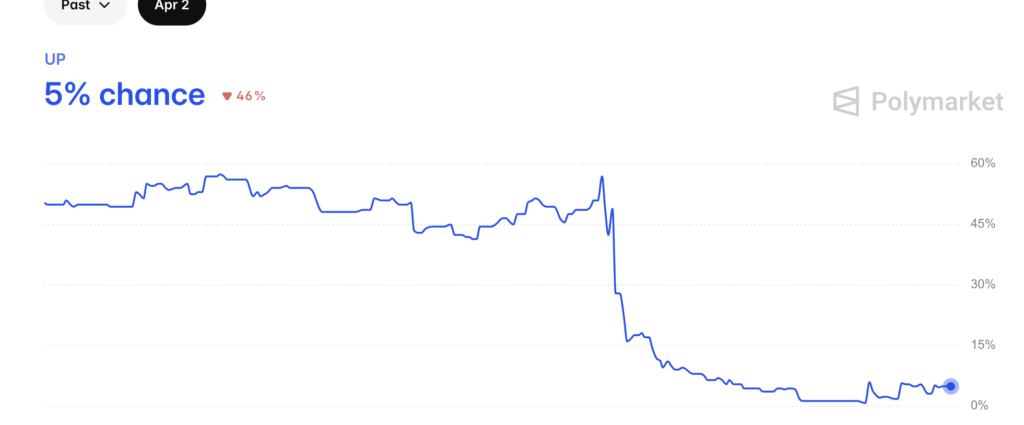
The S&P 500 rose on Wednesday, gaining 0.72% to close at 6,575.32, as optimism around a potential end to the Iran war lifted sentiment for a second straight session.
The Polygon-based (CRYPTO: POL) Polymarket crowd is turning cautious heading into Thursday. The April 2 market shows just a 5% chance for “Up” with early trading activity building on whether the S&P 500 will open higher or lower.
Sentiment shifted sharply overnight after President Donald Trump signaled that the war could continue, despite earlier …
This post was originally published here

CNBC’s Jim Cramer expressed skepticism over the latest market bounce, noting that the narrow rally is being heavily propped up by data center memory stocks capitalizing on an artificial intelligence storage shortage.
Despite the major indices posting modest gains, Cramer warned investors that the advance lacks broad, dependable leadership. Instead, the market’s heavy lifting is being done by the “big four” of memory and storage: Micron Technology Inc. (NASDAQ:MU), Western Digital Corp. (NASDAQ:WDC), SanDisk Corp. (NASDAQ:SNDK), and Seagate Technology Holdings PLC (NASDAQ:STX).
As artificial intelligence (AI) requires unprecedented amounts of data to function, the demand for digital storage has skyrocketed.
Cramer noted that memory was historically a “bad business” plagued by low margins and commoditization. Today, however, the data center boom has transformed the landscape, and these tech companies are now sitting on a “gold mine.”
Unfortunately for consumers, the industry was caught “flat footed” by the sudden surge. While Micron is attempting to add capacity at scale, the …
This post was originally published here

OpenAI’s Chief Operating Officer Brad Lightcap said legacy software companies could emerge as major beneficiaries of AI rather than casualties, describing it as a “contrarian opinion” amid the ongoing public software selloff.
“If you’re long AI and long startups, then it might even make sense, as a contrarian opinion, to be long legacy software, too,” Lightcap said on Wednesday’s episode of the Uncapped with Jack Altman podcast.
Lightcap, who joined OpenAI in 2018 as Chief Financial Officer before becoming COO, said legacy companies restarting with AI have a head start — “you’ve got the benefit of existing teams,” legacy customer relationships, and the ability to learn faster …
This post was originally published here

Four weeks in, the ongoing conflict in the Middle East has evolved into one of the most severe recent energy shocks, according to the International Energy Agency, the International Monetary Fund, and the World Bank.
Beyond the humanitarian toll, the conflict is disrupting global trade flows, driving volatility in oil and commodity markets, and amplifying inflation risks. In response, these institutions have formed a coordinated group. This group will monitor the crisis’s “asymmetric” effects—particularly on low-income countries and fragile supply chains.
So far, the effects of the crisis are polarizing. Energy and aluminum markets face immediate supply shortages, while the broader macroeconomic shock might paradoxically push industrial metals like copper into surplus.
Nowhere is the supply shock more visible than in aluminum, where the Strait of Hormuz has emerged as a critical chokepoint. Missile and drone strikes on major producers, including Emirates Global Aluminum and Aluminium Bahrain (Alba), have shut down operations.
According to ING, as reported by Bloomberg, roughly 3 million tons of annual capacity—nearly half of Middle Eastern output—has been knocked offline.
The crisis extends beyond physical damage. The effective closure of the Strait of Hormuz is choking off the flow …
This post was originally published here

Falling into conversation with a London-based American banking chief executive in the chaotic aftermath of the financial crisis, I was asked about the vagaries of the British establishment. “It is very difficult to understand where power really lies, there are all these networks and signals that hardly any of us are clear on,” he said. I agreed, it was indeed a tricky matter. Six months later, that chief executive had quit, returning with relief to a country where a spade is actually called a spade.
Britain and America, George Bernard Shaw said, are “two countries divided by a common language”. The divide is becoming clearer. Not just between the U.S. and the U.K., but between the U.S. and the whole of Europe.
Yesterday, President Trump pressed again on the bruise, already inflamed by the Gulf conflict. The act? Suggesting that King Charles would have backed the attacks on Iran if he were able to speak freely. For the U.K. establishment, such a suggestion is, as we say here, “below the salt” (a reference to medieval England where salt was a rare commodity only available at “high table”, leaving commoners left on “low tables” literally below the condiment).
“I like him,” Trump said of King Charles in the interview with the Telegraph, the right-leaning British news organization. “I always liked him as a prince. He’s a good man, a great representative for your country. I think he would have taken a very different stand [on the war against Iran] but he doesn’t do that. I mean he’s a great gentleman.”
The headline duly trumpeted: “The King would have stood by me over Iran”. This is not the case, revealing that the role of the monarch in Britain is being lost in translation. In all matters of policy, the King reflects and aligns with the government of the day. Britain is a constitutional monarchy, where the sovereign has no political power apart from that bestowed on him or her by the elected government.
Everything Charles says is approved. The words are jointly crafted by him, his team and government officials. Sir Kier Starmer, the U.K. Prime Minister, and Yvette Cooper, the Foreign Secretary, have a central role.
At the end of the month, King Charles will arrive in the U.S. on an official state visit. The conflict in the Gulf could still be raging and tensions between the U.S. and the U.K. clear. Trump said that Starmer was “no Winston Churchill” after the U.K. refused to support the first wave of attacks. The U.K. PM has called for de-escalation and said that the conflict is “not our war”.
The King, who will address Congress, could appear to be in an invidious position. Some British politicians say he should not be going at all.
But that is not a matter for the monarch. That is a matter for the government. It was with good reason that the first sentence of the official announcement from the Royal Household of the American trip read: “On advice of His Majesty’s Government, and at the invitation of The President of the United States, the King and Queen will undertake a State Visit to the United States of America.” It certainly did not say “I have decided to go.”
It is the right decision. Relationships between nations are much more important than the individuals of the moment. King Charles is going to the US to celebrate the country’s 250th year of independence. Visits later in the year would have clashed with the World Cup and then the mid-term elections in America and Remembrance Sunday in the U.K. To not go in 2026 would have been a considerable diplomatic snub.
What can we say about the relationship between the King and the President, whom the latter describes as “a friend”? First, it should be noted that the official announcement on the trip was closer to the actual date than is usual, suggesting a degree of delay given the geopolitical situation. This was not an invitation that was leapt at with enthusiasm.
Second, the King is the head of the U.K.’s Armed Forces. When the President said in January that the U.S. “never needed” NATO and that non-U.S. NATO troops had “stayed a little back” from the front line in the war against Afghanistan, a message from the Palace was conveyed to the White House outlining the sacrifices of British troops. A few days later, Trump described U.K. soldiers as the “greatest of all warriors”.
Third, the King has consistently promoted dialogue over conflict and sustainable solutions to climate change via his own Sustainable Markets Initiative. The tone is very different from the President’s, who has spoken of a “green scam”.
On the day after the Artemis 2 space launch it is worth returning to Charles’ statement wishing “safe travels” to the astronauts.
“In 2023, when I launched the Astra Carta [a framework to promote the sustainable exploration of space] at Buckingham Palace, I did so in the firm belief that our stewardship of the planet must now extend to the infinite wonders of the Universe.”
“The Astra Carta urges us to navigate the celestial realms with wisdom, foresight and responsibility. Its fundamental principles are not mere aspirations; they are a solemn pledge to future generations. They remind us that the cosmos is not a frontier to be conquered, but a shared inheritance to be cherished and preserved.”
“It is vital that the moon remains a beacon of peaceful scientific discovery. May the stars align in your [the astronauts] favour, and may your safe return inspire countless others to uphold the values of sustainability, cooperation and wonder that the Astra Carta enshrines.”
The King and the President are far apart on tone and approach. Charles, of course, would never be so “below the salt” as to suggest such a thing. And would not be allowed to in any case. But he travels to the U.S. as Britain’s most senior government messenger. And, as such, the distance between the U.S. and U.K. on global matters will be very much in play.

This story was originally featured on Fortune.com

This story was originally featured on Fortune.com
Pakistan has emerged as a key intermediary in the U.S-Israel war with Iran. It played this role before, during a high-stakes moment in diplomatic history.

This post was originally published here

NASA’s Artemis II crew has successfully launched on a mission that will take it around the moon and back to Earth. Here’s what to expect over their roughly 10-day journey.
(Image credit: Bill Ingalls)

This post was originally published here
Foreclosures on VA loans are at their highest level in a decade. VA has a fix but it is months away and could still leave vets worse off than most other homeowners.
(Image credit: Margaret Albaugh for NPR)

This post was originally published here

It has been a year since President Trump announced double-digit tariffs on imports from around the world. So far, those levies have not produced the economic boom the president promised.
(Image credit: Chip Somodevilla)

This post was originally published here

In New Hampshire and states with legalized sports gambling, wagering helps fund government services. But now competitors like Kalshi and Polymarket are getting a cut of the action.
(Image credit: Zoey Knox)

This post was originally published here

Iran continued to target Gulf countries with ballistic missiles and drones Thursday as the U.S. Embassy in Baghdad issued a security alert warning of attacks by Iran-backed militias.
(Image credit: AFP via Getty Images)

This post was originally published here

Shares of Globalstar, Inc. (NASDAQ:GSAT) rose sharply in pre-market trading after a report said Amazon.com Inc. (NASDAQ:AMZN) is in talks to acquire the satellite communications company, citing people familiar with the matter.
The Financial Times reported Wednesday that the companies were still negotiating some of the deal’s complexities after lengthy talks
Globalstar shares jumped 11.7% to $76.40 in pre-market trading.
Here are some other stocks moving in pre-market trading.
This post was originally published here

The U.S. Energy Department has unveiled plans to loan as much as 10 million barrels of crude oil from its Strategic Petroleum Reserve (SPR) located in Bryan Mound.
The department is set to accept proposals from interested companies until 11 a.m. Central Time on April 6. This initiative is a part of a broader agreement with 32 nations under the International Energy Agency (IEA) to release 400 million barrels of oil from reserves to ease supply pressures instigated by the ongoing war in Iran.
The oil will be loaned to companies, which will then return it with additional barrels as a premium. The Energy Department assistant secretary of hydrocarbons, Kyle Haustveit, stated that this approach would stabilize markets “at no cost to American taxpayers.”
This decision …
This post was originally published here

Amidst the fast-paced and highly competitive business environment of today, conducting comprehensive company analysis is essential for investors and industry enthusiasts. In this article, we will delve into an extensive industry comparison, evaluating NVIDIA (NASDAQ:NVDA) in comparison to its major competitors within the Semiconductors & Semiconductor Equipment industry. By analyzing critical financial metrics, market position, and growth potential, our objective is to provide valuable insights for investors and offer a deeper understanding of company’s performance in the industry.
Nvidia is a leading developer of graphics processing units. Traditionally, GPUs were used to enhance the experience on computing platforms, most notably in gaming applications on PCs. GPU use cases have since emerged as important semiconductors used in artificial intelligence to run large language models. Nvidia not only offers AI GPUs, but also a software platform, Cuda, used for AI model development and training. Nvidia is also expanding its data center networking solutions, helping to tie GPUs together to handle complex workloads.
| Company | P/E | P/B | P/S | ROE | EBITDA (in billions) | Gross Profit (in billions) | Revenue Growth |
|---|---|---|---|---|---|---|---|
| NVIDIA Corp | 35.87 | 27.15 | 19.95 | 31.11% | $51.28 | $51.09 | 73.21% |
| Broadcom Inc | 61.11 | 18.58 | 22.34 | 9.12% | $11.15 | $13.16 | 29.47% |
| Micron Technology Inc | 17.36 | 5.73 | 7.17 | 21.0% | $18.48 | $17.75 | 196.29% |
| Advanced Micro Devices Inc | 80.54 | 5.44 | 9.93 | 2.44% | $2.86 | $5.58 | 34.11% |
| Texas Instruments Inc | 36.02 | 10.98 | 10.14 | 7.03% | $2.07 | $2.47 | 10.38% |
| Analog Devices Inc | 58.61 | 4.63 | 13.50 | 2.46% | $1.52 | $2.04 | 30.42% |
| Qualcomm Inc | 25.66 | 5.89 | 3.10 | 13.57% | $4.11 | $6.68 | 5.0% |
| Marvell Technology Inc | 34.76 | 6.52 | 11.33 | 2.79% | $0.75 | $1.15 | 22.08% |
| Monolithic Power Systems Inc | 87.05 | 15.57 | 19.38 | 4.95% | $0.21 | $0.41 | 20.83% |
| NXP Semiconductors NV | 24.60 | 4.91 | 4.05 | 4.53% | $0.98 | $1.81 | 7.2% |
| ON Semiconductor Corp | 214.48 | 3.19 | 4.27 | 2.33% | $0.45 | $0.55 | -11.17% |
| GLOBALFOUNDRIES Inc | 27.82 | 2.04 | 3.64 | 1.68% | $0.73 | $0.51 | 0.0% |
| First Solar Inc | 14.03 | 2.24 | 4.11 | 5.62% | $0.7 | $0.67 | 11.15% |
| Tower Semiconductor Ltd | 96.43 | 7.21 | 13.57 | 2.78% | $0.13 | $0.09 | 11.26% |
| Astera Labs Inc | 87.16 | 13.27 | 22.39 | 3.41% | $0.07 | $0.2 | 91.77% |
| MACOM Technology Solutions Holdings Inc | 103.78 | 12.71 | 16.85 | 3.64% | $0.07 | $0.15 | 24.52% |
| Credo Technology Group Holding Ltd | 52.70 | 9.57 | 16.68 | 10.03% | $0.16 | $0.28 | 201.49% |
| Lattice Semiconductor Corp | 4777 | 18.31 | 25.24 | -1.08% | $0.01 | $0.1 | 24.16% |
| Rambus Inc | 42.62 | 7.13 | 13.88 | 4.81% | $0.09 | $0.15 | 18.09% |
| Average | 324.54 | 8.55 | 12.31 | 5.62% | $2.47 | $2.99 | 40.39% |
This post was originally published here
In the ever-changing and fiercely competitive business landscape, conducting thorough company analysis is crucial for investors and industry experts. In this article, we will undertake a comprehensive industry comparison, evaluating Microsoft (NASDAQ:MSFT) and its primary competitors in the Software industry. By closely examining key financial metrics, market position, and growth prospects, our aim is to provide valuable insights for investors and shed light on company’s performance within the industry.
Microsoft develops and licenses consumer and enterprise software. It is known for its Windows operating systems and Office productivity suite. The company is organized into three equally sized broad segments: productivity and business processes (legacy Microsoft Office, cloud-based Office 365, Exchange, SharePoint, Skype, LinkedIn, Dynamics), intelligence cloud (infrastructure- and platform-as-a-service offerings Azure, Windows Server OS, SQL Server), and more personal computing (Windows Client, Xbox, Bing search, display advertising, and Surface laptops, tablets, and desktops).
| Company | P/E | P/B | P/S | ROE | EBITDA (in billions) | Gross Profit (in billions) | Revenue Growth |
|---|---|---|---|---|---|---|---|
| Microsoft Corp | 23.11 | 7.02 | 9.02 | 10.2% | $58.18 | $55.3 | 16.72% |
| Oracle Corp | 26.07 | 12.45 | 6.58 | 11.65% | $8.16 | $11.1 | 21.66% |
| Palo Alto Networks Inc | 89.26 | 13.87 | 11.55 | 4.78% | $0.64 | $1.91 | 14.93% |
| ServiceNow Inc | 62.30 | 8.39 | 8.20 | 3.31% | $0.76 | $2.73 | 20.66% |
| Fortinet Inc | 33.53 | 48.52 | 9.13 | 51.3% | $0.69 | $1.52 | 14.75% |
| Nebius Group NV | 889.48 | 5.59 | 48.69 | -5.3% | $0.01 | $0.1 | 55.85% |
| Check Point Software Technologies Ltd | 15.16 | 5.43 | 5.88 | 10.21% | $0.37 | $0.65 | 5.85% |
| Gen Digital Inc | 19.29 | 4.86 | 2.46 | 8.02% | $0.57 | $0.97 | 25.76% |
| Dolby Laboratories Inc | 24.58 | 2.24 | 4.41 | 2.04% | $0.1 | $0.3 | -2.88% |
| UiPath Inc | 21.19 | 2.77 | 3.73 | 5.21% | $0.09 | $0.41 | 13.56% |
| Monday.Com Ltd | 30.37 | 2.79 | 2.93 | 6.1% | $0.01 | $0.3 | 24.59% |
| CommVault Systems Inc | 40.83 | 15.91 | 3.08 | 8.33% | $0.03 | $0.25 | 19.5% |
| Qualys Inc | 15.85 | 5.48 | 4.70 | 9.75% | $0.06 | $0.15 | 10.11% |
| Teradata Corp | 18.70 | 10.37 | 1.47 | 16.48% | $0.08 | $0.26 | 2.93% |
| BlackBerry Ltd | 84 | 2.68 | 3.75 | 1.87% | $0.02 | $0.11 | -1.25% |
| Average | 97.9 | 10.1 | 8.33 | 9.55% | $0.83 | $1.48 | 16.14% |
This post was originally published here

In the ever-changing and fiercely competitive business landscape, conducting thorough company analysis is crucial for investors and industry experts. In this article, we will undertake a comprehensive industry comparison, evaluating Apellis Pharmaceuticals (NASDAQ:APLS) and its primary competitors in the Biotechnology industry. By closely examining key financial metrics, market position, and growth prospects, our aim is to provide valuable insights for investors and shed light on company’s performance within the industry.
Apellis Pharmaceuticals Inc is a commercial-stage biopharmaceutical company focused on the discovery, development, and commercialization of novel therapeutic compounds to treat diseases with high unmet needs through the inhibition of the complement system, which is an integral component of the immune system, at the level of C3, the central protein in the complement cascade. Currently it has two marketed drugs that target C3, the central protein in the complement cascade: SYFOVRE (pegcetacoplan injection) and EMPAVELI (pegcetacoplan).
| Company | P/E | P/B | P/S | ROE | EBITDA (in billions) | Gross Profit (in billions) | Revenue Growth |
|---|---|---|---|---|---|---|---|
| Apellis Pharmaceuticals Inc | 224.42 | 13.95 | 5.23 | -15.29% | $-0.05 | $0.17 | -5.94% |
| Alkermes PLC | 24.51 | 3.21 | 4.01 | 2.78% | $0.08 | $0.34 | -10.57% |
| TG Therapeutics Inc | 12.12 | 8.27 | 8.79 | 3.67% | $0.05 | $0.15 | 78.0% |
| ACADIA Pharmaceuticals Inc | 9.71 | 3.10 | 3.54 | 25.51% | $0.02 | $0.26 | 9.39% |
| Kiniksa Pharmaceuticals International PLC | 64.17 | 6.49 | 5.61 | 2.57% | $0.02 | $0.11 | 64.95% |
| Average | 27.63 | 5.27 | 5.49 | 8.63% | $0.04 | $0.21 | 35.44% |
This post was originally published here

Vlad Tenev, CEO of Robinhood Markets Inc. (NASDAQ:HOOD), expressed his belief in a more inclusive financial system on Wednesday, highlighting the shift in his focus from what should be created to what deserves to exist.
Tenev reflected on his career journey in an X post. He noted that while his early career was about proving the ability to build something meaningful, the focus has since shifted
“The question became less about whether we could create and more about what deserves to exist. That has pushed me toward a bigger view of access and ownership,” Tenev added.

This post was originally published here

This post was originally published here

This post was originally published here

This post was originally published here

This post was originally published here
(RTTNews) – Oil prices soared on Thursday after U.S. President Donald Trump did not give a clear timeline for ending the Middle East conflict in his highly anticipated prime-time address to the nation.
This post was originally published here
(RTTNews) – Oil prices soared on Thursday after U.S. President Donald Trump did not give a clear timeline for ending the Middle East conflict in his highly anticipated prime-time address to the nation.
This post was originally published here
(RTTNews) – Gold prices plunged on Thursday as the dollar and bond yields surged after U.S. President Donald Trump’s warning to hit Iran ‘extremely hard’ over coming weeks.
This post was originally published here
(RTTNews) – Gold prices plunged on Thursday as the dollar and bond yields surged after U.S. President Donald Trump’s warning to hit Iran ‘extremely hard’ over coming weeks.
This post was originally published here