


Jamie Dimon, office-work champion, vows his anti-remote culture ‘would crush you.’ The economy’s top talent begs to differ
Everyone remembers the looseness that defined work during the COVID pandemic. While it brought its share of stress, particularly the constant concern about infection, remote work also rebalanced work-life integration. It became easy to fold laundry, run errands, or start dinner in between tasks, all while sipping iced coffee with a cat curled in your lap.
But that lifestyle has fallen out of fashion for some business leaders, or at least for JPMorgan Chase CEO Jamie Dimon. In a recent interview on CBS Evening News with Tony Dokoupil, the billionaire said leaders who maintain remote work policies are falling behind, and could be failing their youngest workers.
“You could build a company one way and I could build another company one way,” he said. “But I’ll tell you one thing: We would crush you.”
JPMorgan reinstated a five-day in-person work policy in the beginning of 2025. Many other firms have instituted similar policies since the end of the COVID pandemic, including Amazon and Google. Today, 65% of U.S. job postings require workers to be fully on-site, according to employment firm Robert Half. Dimon has been particularly vocal about the value of the return-to-office move, saying in an interview last week at the Hill and Valley Forum that remote work breeds “rope-a-dope type of politics.” But Dimon’s assertion of the importance of in-person work clashes with the preferences of the majority of U.S. workers, including some of the most talented employees.
Top talent’s flight from in-person work
A 2025 Gallup poll found that 52% of workers prefer a hybrid work setup, and 26% wish to be fully remote. Just about one in five (21%) prefer to be entirely on-site.
Those preferences are impacting where top talent ends up. Recent research from the Federal Reserve Bank of San Francisco found that employees who work from home earn, on average, 12% more than workers fully in-office. Much of that pay bump, according to the research, is thanks to the seniority of the remote workers (real estate giant JLL dubbed high-performers who leverage their seniority to override office policies “empowered non-compliers”). Moreover, a working paper from 2024 found that tech and finance companies that implemented return-to-office policies lost their most skilled and senior employees.
Full-time in-person work is a redline for about a third of U.S. workers, according to a recent study from employment platform Monster. And some workers are even putting money on the line, as many report they’re willing to take a massive pay cut to stay at home, according to a 2025 Harvard study.
But it’s not just worker preferences; remote work could actually boost performance, too. A 2024 study from Great Place To Work found that fully remote workers report the highest employee engagement (31%) compared to hybrid and fully in-person workers. A 2022 study from the same company “found stable or improved productivity after transitioning to remote work.”
The workplace ‘neural network’
When Dokoupil asked Dimon what his sources were for the benefits of in-person work, Dimon said it’s part numbers, part feeling. However, for Dimon, productivity isn’t the only concern. He emphasizes the professional development opportunities in-person contact provides for younger workers.
“We saw people when they weren’t coming in, younger kids kind of being left behind,” he said. “They weren’t developing their EQ as much. They didn’t have as many friends. They didn’t have much knowledge. They weren’t being assigned stuff.” For Dimon, the workplace provides an “apprenticeship system,” a critical resource for skill development that doesn’t exist without in-person work.
The CEO maintains that companies function better in-person than online. “We think we’re going to run a better business, do a better job for customers, share more information,” he said. He adds that in-person work is particularly important for communication. Without it, the company’s structure breaks down. “JP[Morgan] is a neural network and that neural network starts to break down a little bit when you can’t get a hold of people.”
Dimon said he isn’t completely against remote work. He notes JPMorgan Chase has always had about 10% of staff working remote, including presently at virtual call centers in Baltimore and Detroit. “I’m not against remote work, and it works,” he said. He adds the company allows flexibility, particularly for caregivers, like those workers caring for aging parents.
But he suggests remote work isn’t a one-size-fits-all method to management. “I’m against it where it doesn’t work for the company and the clients or the individual involved.” It’s unclear if he’s against it for his most talented empowered non-compliers, too.
This story was originally featured on Fortune.com
Globalstar stock surges 15% on report Amazon is weighing an acquisition
A deal with Globalstar could bolster Amazon Leo, the company’s nascent internet-from-space service, which has about 200 satellites in orbit.
This post was originally published here
Penny Wong to join talks with 35 countries, excluding US, to explore ways to reopen strait of Hormuz
Talks, convened by the UK, will examine ‘all viable diplomatic and political measures’ to get critical waterway open
-
Get our breaking news email, free app or daily news podcast
Australia will join talks with 35 nations, convened by the United Kingdom, to explore ways to reopen the strait of Hormuz, the government confirmed on Thursday.
The UK prime minister, Keir Starmer, announced the meeting on Wednesday, which will exclude the United States, to discuss “all viable diplomatic and political measures” to secure the waterway and restore freedom of navigation. The meeting is expected to take place at about 10pm AEDT on Thursday.
This post was originally published here
Artemis II: Nasa’s crewed rocket lifts off to begin 10-day lunar journey – as it happened
This live blog is now closed.
There’s potentially alarming news from AccuWeather about a solar flare, which the forecasting service says could affect the Artemis mission.
While not an official Nasa source for weather and climate information or predictions, AccuWeather has been monitoring launch day conditions, and is reporting them on its own blog.
An X1.5 solar flare that occurred early on March 30 produced an Earth-directed coronal mass ejection that is now entering into the Earth’s atmosphere. As the day progresses, moderate to strong geomagnetic storm conditions are possible as a result of the coronal mass ejection impacting Earth’s atmosphere.
Communication between ground control and members aboard the rocket, and precise GPS tracking, can be at risk during strong geomagnetic storming.
This post was originally published here
Death of Rohingya refugee left in parking lot by US border agents ruled a homicide
Nurul Amin Shah, 56, who was visually impaired, was left outside Buffalo Tim Hortons on cold night and later died
Authorities have ruled that the death of Nurul Amin Shah, a 56-year-old Rohingya refugee from Myanmar who was left by immigration agents at a restaurant in Buffalo, was a homicide.
Shah, who was visually impaired, died on 24 February, five days after US Border Patrol agents dropped him off in the parking lot of a Tim Hortons on a cold winter night without notifying his family or attorney.
This post was originally published here
Top Iranian official injured in strike on Tehran – as it happened
This liveblog is closed, please follow our new liveblog here
Houthi forces in Yemen have claimed responsibility for a missile attack on southern Israel this morning, saying it was a joint operation with Iran and Hezbollah.
In a statement, the Houthi movement said it carried out its third missile attack in the conflict “in conjunction with Iran and Hezbollah in Lebanon”.
This post was originally published here
Alleged Bondi terrorist Naveed Akram denied suppression order over identities of family members
Lawyers for accused had argued names of family members should be suppressed due to fears for their mental and physical safety
-
Get our breaking news email, free app or daily news podcast
The alleged Bondi attacker has been denied a suppression order over his family member’s names and home and work addresses after a collective of media organisations won a challenge against the bid.
In the Downing Centre local court on Thursday, judge Hugh Donnelly decided to deny the request for a 40-year suppression order, ending an interim suppression order that was granted for Naveed Akram’s mother, brother and sister in early March which banned the publication of their names and addresses.
This post was originally published here




‘I thought the war was over:’ 100-year-old Iwo Jima veteran honored decades later at Disneyland
A 100-year-old World War II veteran who witnessed the iconic Iwo Jima flag-raising said he thought the war was “going to be over” as cheers erupted across the battlefield — a moment honored decades later at Disneyland in an emotional ceremony.
Charles Cram, a Navy medic attached to the 5th Marine Division, was recognized Tuesday during Disneyland’s daily Flag Retreat ceremony on Main Street, U.S.A., where guests gathered and applauded as he was presented with a flag flown over the park.
“I didn’t know what I was witnessing at that moment,” Cram told FOX Business. “But I was in the middle of history.”
Cram said he could see the American flag rising “500 to 700 feet up” over Mount Suribachi — a moment that would become one of the most recognizable images in American history.
NEW DISNEY CEO JOSH D’AMARO OFFICIALLY TAKES THE REINS FROM BOB IGER
The ceremony unfolded before a crowd of park visitors, with Cram’s family — including relatives who traveled from across the country — standing nearby as he was honored for his service.
“When we told Daddy he was coming to Disneyland, he thought he was just going on rides,” a family member said. “He had no idea any of this was really happening.”
Cram, who turned 100 on March 15, was also treated as a special guest at the park, attending a VIP viewing of a parade and meeting Donald Duck, a character that helped boost morale among U.S. troops during World War II.
During the ceremony, he received a framed American flag that had been flown over Disneyland.
“This is a flag that was flown over Disneyland Park,” a presenter said during the tribute. “Thank you for everything that you’ve done.”
The ceremony is part of a long-standing tradition at Disneyland, where daily flag ceremonies have been held since the park opened in 1955 to honor U.S. service members and veterans.
A Los Angeles native, Cram served as a Pharmacist’s Mate Second Class in the U.S. Navy and was attached to the 5th Marine Division during World War II. He was among those who fought at Iwo Jima, one of the most pivotal battles of the Pacific campaign.
Reflecting on that day, Cram said the experience shaped how he views life.
“It made me realize how precious and fragile life is,” he said to FOX Business. “And happy to still be alive.”
He said being honored at 100 years old is a reminder of how fortunate he has been.
“It reminds me how lucky I am to be alive,” Cram said.
When asked what message he would share with younger Americans, Cram pointed to service as a lasting source of pride.
“It’s a privilege to be able to serve your country,” he said. “It’s an honor you’ll never forget.”





























Markets News, April 1, 2026: Stocks Close Sharply Higher for 2nd Straight Day; Oil Prices Pull Back
This post was originally published here

Microsoft and Chevron enter exclusivity deal on powering West Texas AI data center complex
Big Oil is joining the data center game, with Chevron and Microsoft entering an exclusivity agreement on talks to colocate gas-fired power plants with an AI campus in West Texas’s oil and gas epicenter. If finalized, the deal would represent the largest collaboration to date between a U.S. oil and gas giant and Big Tech.
Chevron is developing a power plant hub with 2.5 gigawatts of gas-fired power in West Texas—enough to power nearly 2 million homes—and has negotiated for months with potential hyperscaler clients. The multibillion-dollar project is scalable to 5 gigawatts and could start coming online as early as late 2027. Chevron already has a financial partnership with the Engine No. 1 investment firm and seven gas turbines ordered from GE Vernova.
“No commercial terms have been finalized, and there is no definitive agreement at this time,” Chevron, Microsoft, and Engine No. 1 said in a statement.
“The approach reflects an emerging shift in how power for AI is being developed, bringing energy supply closer to demand through colocated, behind-the-meter generation to deliver reliability while helping avoid added strain on regional electricity systems,” the statement said.
The top American Big Oil players, Chevron and Exxon Mobil, have historically stayed out of the power sector, except for Chevron powering some of its own oil and gas operations overseas. But the AI boom has triggered a pivot for Chevron.
In the Permian Basin, Chevron produces more than 1 million barrels of oil and gas (barrels of oil equivalent) every day. The natural gas, in particular, makes Chevron a potentially attractive partners for hyperscalers looking to quickly build data center campuses near fuel sources. Chevron has said it also is looking at colocated power projects in the Midwest and West.
Last week at the CERAWeek energy conference in Houston, Chevron chairman and CEO Mike Wirth said the company wants to help the U.S. in the AI race against China, including helping hyperscalers with their gas in power and permitting issues. The Big Oil and Big Tech sectors are partnering like never before, he said.
“What you’re seeing is these two worlds coming together, and power really is becoming the great limiting element for growth,” Wirth said. “What’s really concerning people is access to power, so you see a lot of creative deals being done. We’re working hard with some of the biggest companies in the world, trying to help them grow their business and be a part of that solution.”
Wirth said the tech sector has come to realize “you can’t take a big extension cord to the grid and plug in a data center.”
“It’s been a process of really helping to understand, how do we meet their needs, and how do they help commit to power purchase agreements that allow them to come into the system as rapidly as they want,” Wirth said.
While wind and solar and other sources of power will play big roles in the AI boom, Wirth called abundant American natural gas the “foundation” for powering the sector’s growth.
The U.S. leads the world in both natural gas production and exports. Mentioning the price spikes driven by the war in Iran, Wirth said: “The one commodity that hasn’t been touched is pipeline gas in the U.S., which is pretty much flat.”
This story was originally featured on Fortune.com

The SpaceX IPO is great — but it won’t deliver 100x returns
With SpaceX filing for an initial public offering, the tone in markets is unmistakably bullish. Analysts are already calling it “one of the year’s most-anticipated market debuts” and “one of the largest IPOs ever.”
Unlike the outdated IPO framework of the last decade, SpaceX reminds us that going public is no longer an endpoint, but a strategic accelerant: a way to access deeper pools of global capital, expand infrastructure, and scale at a level private markets alone cannot support.
But at a private valuation of $1 trillion-plus, SpaceX — despite being a great company led by a visionary founder — also underscores everything wrong with the U.S. IPO market: by the time companies reach public markets today, almost all upside is in the rearview.
The threshold for going public in the U.S. has changed dramatically. Two decades ago, companies routinely listed at valuations of a few hundred million dollars. Amazon went public in 1997 at roughly $438 million. AOL, one of the defining IPOs of the early internet era, delivered returns exceeding 100x from its public debut to its peak. Public investors participated in the full arc of value creation.
That is no longer the case. Today, companies often need to reach a $2 billion to $3 billion valuation before even considering an IPO. Stripe was last valued at $65 billion in private markets. Databricks has been valued above $40 billion. SpaceX itself has raised capital at valuations exceeding $175 billion prior to any public listing. By the time these companies reach public markets, they are already global leaders.
Much of the benefit that once accrued to public investors is now captured in private markets. But staying private too long comes with real costs — such as a brittle capital structure where ownership is concentrated among a narrow group of insiders and a dependence on continued private funding. It also limits broader investor participation and delays the price discovery and discipline that public markets provide. In trying to avoid the scrutiny of public markets, many companies have instead traded it for different kinds of risks: less transparency, less liquidity, and fewer pathways to sustainable, long-term capital.
SpaceX serves as a signal that public markets are once again open at scale, but the math alone confirms that by the time unicorns like SpaceX, Anthropic, Stripe and Databricks go public, the exponential value creation is already gone.
So why are investors still fixated on mega-unicorn IPOs?
The next generation of outsized returns won’t come from trillion-dollar IPOs. They will come from smaller companies, listing earlier in their lifecycle, before global capital has fully priced them. Historically, the greatest gains have come from identifying category-defining companies before they were obvious — making the real opportunity — not just 100x, but 400x — companies with sub-$500 million valuations. As legendary investor Peter Lynch wrote, that’s how you get “one up on Wall Street.”
SpaceX is just a distraction.
The opinions expressed in Fortune.com commentary pieces are solely the views of their authors and do not necessarily reflect the opinions and beliefs of Fortune.
This story was originally featured on Fortune.com
Nasa’s Artemis II rocket lifts off for historic moon mission
Mass of spectators cheers dazzling Florida launch as astronauts head to moon for first time in almost 54 years
Nasa’s moon rocket Artemis II launched on Wednesday evening, carrying astronauts to the moon for the first time in almost 54 years.
The rocket is now orbiting Earth, and will continue to do so until Thursday, when the translunar injection burn will take place and send it on the rest of its 240,000-mile journey to the moon. Inside the Orion capsule, the four astronauts onboard immediately began tasks to assess how the spacecraft handled the 17,500mph ascent to orbit.
This post was originally published here
‘Uncertain times’: Albanese warns months ahead ‘may not be easy’ in rare address to nation about Middle East crisis
Prime minister urges Australians to consider using public transport and conserve fuel for ‘critical industry’ and others
-
Get our breaking news email, free app or daily news podcast
Australian prime minister Anthony Albanese has used a rare address to the nation to attempt to allay public fears over dwindling fuel supplies, vowing to keep petrol prices down by shoring up international supplies and ramping up local production.
But the opposition has been scathing of the address, describing it as “nothing but hot air” and urging more clarity over the fuel crisis.
This post was originally published here

Feud between Two Sigma founders continues to plague fund
This post was originally published here

Indian Rupee Set to Hit 100 to the Dollar?




























Man accused of plotting WA terror attack believed assault he was planning would be worse than Bondi beach shootings, court hears
Jayson Joseph Michaels allegedly planned attack on police headquarters, Parliament House and mosques
-
Get our breaking news email, free app or daily news podcast
A man accused of plotting a mass casualty terror attack targeting public buildings and places of worship believed his assault would be worse than the Bondi beach mass shootings, a court has heard.
Jayson Joseph Michaels detailed his alleged plan for a violent assault on Western Australia police headquarters, WA Parliament House and mosques in a diary, the Perth magistrates court was told during a failed bid for bail on Wednesday.
This post was originally published here

Amazon in talks to buy $9bn satellite group Globalstar in bid to rival Musk’s Starlink
This post was originally published here
Why HousingWire’s new Mortgage Rankings matter for originators
The HousingWire Mortgage Rankings launched this week to give the housing industry a standardized, transaction-based view of origination activity across the country. The rankings are powered by InGenius data and they’re built on recorded mortgage transactions, not submissions or self-reported numbers.
That matters because most industry “top producer” lists are based on submissions, self-reported volume or company-level marketing claims. By contrast, HousingWire’s rankings pull from recorded mortgage transactions and assign credit to the loan originator of record.
That has several implications:
- It normalizes how production is counted across lenders, geographies and market cycles.
- It highlights the actual loan officer tied to a given transaction, not just a brand or team name.
- It creates a more objective way to benchmark against peers and track share over time.
On a recent episode of the HousingWire Daily podcast, Editor-in-Chief Sarah Wheeler spoke with Rate Mortgage president and top producer Shant Banosian about his top ranking, which illustrates how the methodology works in practice and why the rankings matter for loan officers, lenders and referral partners.
In Banosian’s case, the HousingWire data shows him near the top of the national rankings by volume and units, but just shy of the $1 billion mark he has achieved in other years. Internally, his team’s metrics clear that threshold and the gap is a live example of how methodology affects where originators land.
Banosian said the difference stems from how his team attributes loans to individual originators.
“If one of my team members runs as a point person for the application of the client, we just recognize them as the loan officer on the transaction,” he said. “We feel like it’s a really great way to do things and a clean, compliant way to do things as well.”
Why this matters for the industry
For lenders and branch managers, the move to transaction-based rankings raises the bar on transparency and comparability:
- Compliance and attribution: The rankings reflect who is on the loan as the originator of record, which aligns with how regulators and secondary market investors expect to see responsibility assigned.
- Recruiting and compensation: Producers and managers can compare performance with confidence that everyone is being measured the same way, regardless of internal team structures or marketing choices.
- Market strategy: Lenders can see which products and channels are producing real, closed-loan volume in a given market, not just leads or applications.
The product-specific breakouts in HousingWire’s rankings also reveal competitive dynamics that are not always obvious from headline volume numbers.
For example, in the HELOC category, where one originator did almost 2,000 loans, it’s easy to see the opportunity missed by other lenders who failed to recapture that business. For loan officers, that kind of product-level insight is a reality check on retention and cross-sell performance.
Using rankings as a retention and product map
The Mortgage Rankings break out top performers by loan amount, overall volume, purchase and refinances. They also rank originators based on loan type, including FHA, VA, non-QM, HELOCs and USDA, and they include a category for top brokerage originators. That structure is designed to do more than just showcase big numbers; it helps housing professionals see where business is actually being won and lost.
On the podcast, Banosian connected the rankings to a broader point about client recapture. “The average consumer, once they enter their homeownership journey, will take out 11 or 12 mortgages throughout the course of their lifetime,” Banosian said. “Most loan officers are lucky if they capture one or two of those. My mission is to capture 10, 11 or 12 of those.”
HousingWire’s product-level rankings can highlight where that gap shows up in the real world, whether it’s HELOCs, cash-out refis, reverse mortgages or subsequent home purchases.
Viewed this way, the Mortgage Rankings become:
- A scorecard: showing who is dominating in specific product niches
- A retention audit: exposing where past customers are going for their next loan
- A strategy guide: pointing to segments — like HELOCs, VA or reverse — that may warrant more focus in a lender’s product and marketing plans
Impact on originators’ positioning
Because the rankings are standardized and third-party, they also function as a credibility tool for originators who are building a personal brand with real estate agents, financial advisors and consumers.
Loan officers can use objective placement in the rankings to:
- Support conversations with referral partners about experience and capacity
- Differentiate themselves in competitive listing situations where agents want certainty of close
- Align their public marketing with verifiable production metrics
At the same time, the transaction-based nature of the data will likely push teams to be more intentional about how they assign originator-of-record status within pods and branches. To outside observers scanning the rankings, the originator named in the recording data is the producer.
A new benchmark for a changing market
The launch of the Mortgage Rankings comes at a time when the industry is trying to understand who is actually growing in a market that is still struggling with rate uncertainty, borrowers locked-in to low rates and in some areas, low inventory.
Despite the challenges over the last several years, millions of homes have still changed hands since rates left the 2s and 3s, and origination volume has shifted into refis, HELOCs, VA loans and other niches as conditions changed. Lenders, investors and referral partners need a way to see — based on closed loans — who is adapting, not just who is marketing well.
HousingWire’s rankings aim to answer that question at the loan officer level.
By anchoring the lists in recorded transactions and breaking out leaders by channel and product, the Mortgage Rankings give housing professionals a more precise way to:
- Benchmark performance
- Identify emerging competitors
- Spot product opportunities
- Validate claims made in recruiting and marketing
For originators like Banosian, who continue to rank among the top producers in the country under this stricter methodology, it is another data point they can use in the market. For the industry, the rankings provide both a mirror and a roadmap for where to focus next.





The Mother Of All Energy Crises Is Just Beginning, IEA Warns — April Will Be ‘Much Worse’
The International Energy Agency (IEA) is sounding the alarm on what it calls the most severe energy crisis in modern history, warning that the full impact of the Iran war is only beginning to hit markets.
- XOM stock is moving. See the chart and price action here.
‘Major, Major Disruption’
In a recent interview on Norges Bank Investment Management’s “In Good Company” podcast, IEA Executive Director Fatih Birol said the energy disruptions unleashed by the war have already outpaced previous oil shocks — and that the situation is deteriorating rapidly.
“The next month, April, will be much worse than March,” Birol cautioned, per CNBC, describing the current crisis as “potentially more disruptive” than the oil shocks of the 1970s.
He said the international oil market has lost an estimated 12 million barrels per day of supply — more than the combined impact of the 1973 Arab oil embargo and the 1979 Iranian Revolution.
“When you look at [1973 and 1979], in both of them we lost each about five million barrels per day of oil,” Birol told host Nicolai Tangen.
“These oil …
This post was originally published here

Anthropic mistakenly leaks its own AI coding tool’s source code, just days after accidentally revealing an upcoming model known as Mythos
Anthropic has accidentally leaked the source code for its popular coding tool Claude Code.
The leak comes just days after Fortune reported that the company had inadvertently made close to 3,000 files publicly available, including a draft blog post that detailed a powerful upcoming model that presents unprecedented cybersecurity risks. The model is known internally as both “Mythos” and “Capybara,” according to the leaked blog post obtained by Fortune.
The source code leak exposed around 500,000 lines of code across roughly 1,900 files. When reached for comment, Anthropic confirmed that “some internal source code” had been leaked within a “Claude Code release.”
A spokesperson said: “No sensitive customer data or credentials were involved or exposed. This was a release packaging issue caused by human error, not a security breach. We’re rolling out measures to prevent this from happening again.”
The latest data leak is potentially more damaging to Anthropic than the earlier accidental exposure of the company’s draft blog post about its forthcoming model. While the latest security lapse did not expose the weights of the Claude model itself, it did allow people with technical knowledge to extract additional internal information from the company’s codebase, according to a cybersecurity professional Fortune asked to review the leak.
Claude Code is perhaps Anthropic’s most popular product and has seen soaring adoption rates from large enterprises. At least some of Claude Code’s capabilities come not from the underlying large language model that powers the product but from the software “harness” that sits around the underlying AI model and instructs it how to use other software tools and provides important guardrails and instructions that govern its behavior. It is the source code for this agentic harness that has now leaked online.
The leak potentially allows a competitor to reverse-engineer how Claude Code’s agentic harness works and use that knowledge to improve their own products. Some developers may also seek to create open-source versions of Claude Code’s agentic harness based on the leaked code.
The leaked code also provided further evidence that Anthropic has a new model with the internal name Capybara that the company is actively preparing to launch, according to Roy Paz, a senior AI security researcher at LayerX Security. Paz said it is likely that the company may release a “fast” and “slow” version of the new model, based on the model’s apparently larger context window, and that it will be the most advanced model on the market.
Currently, Anthropic markets each of its models in three different sizes. The largest and most capable model versions are branded Opus; slightly faster and cheaper, but less capable, versions are branded Sonnet; and the smallest, cheapest, and fastest are called Haiku. In the draft blog post obtained by Fortune last week, Anthropic describes Capybara as a new tier of model that is even larger and more capable than Opus, but also more expensive.
The newest leak, first made public in an X post, appears to have happened after Anthropic uploaded all of Claude Code’s original code to NPM, a platform developers use to share and update software, instead of only the finished version that computers actually run. The mistake looks like a “human error” after someone took a shortcut that bypassed normal release safeguards, Paz said. Anthropic told Fortune that normal release safeguards were not bypassed.
“Usually, large companies have strict processes and multiple checks before code reaches production, like a vault requiring several keys to open,” he told Fortune. “At Anthropic, it seems that the process wasn’t in place and a single misconfiguration or misclick suddenly exposed the full source code.”
Paz also raised questions about how the tool could potentially connect to Anthropic’s internal systems. He said the greater concern may not be direct access to backend models, but rather that the leaked code could reveal nonpublic details about how the systems work, such as internal APIs and processes. He added that this kind of information could potentially help sophisticated actors better understand the architecture of Anthropic’s models and how they are deployed, which in turn could inform attempts to work around existing safeguards.
Anthropic’s current most powerful model, Claude 4.6 Opus, is already classed by the company as a dangerous model when it comes to cybersecurity risks. Anthropic has said its current Opus models are capable of autonomously identifying zero-day vulnerabilities in software. While these capabilities are intended to help companies detect and fix flaws, they could also be weaponized by hackers, including nation-states, to find and exploit vulnerabilities.
This isn’t the first time Anthropic has inadvertently leaked details about its popular Claude Code tool. In February 2025, an early version of Claude Code accidentally exposed its original code in a similar breach. The exposure showed how the tool worked behind the scenes as well as how it connected to Anthropic’s internal systems. Anthropic later removed the software and took the public code down.
EDITOR’S NOTE: This article was updated to include additional comment from Anthropic and clarifications of some technical details by one of the sources.
This story was originally featured on Fortune.com

Trump will address the nation about the Iran war on Wednesday. Here’s what to expect
“April is the cruelest month,” T.S. Eliot wrote.
With U.S. crude nearly doubling in price since the beginning of the year; the Strait of Hormuz still more or less blocked; and the subsequent rising cost of almost everything from cars to flights to plastics to semiconductors, April is shaping up to be a very cruel month, indeed.
President Donald Trump will address the nation at 9 p.m. ET Wednesday to deliver what the White House has called “an important update on Iran”—his first primetime remarks since the U.S. and Israel launched strikes on Feb. 28. The address will air across all four major broadcast networks, forcing scheduled programming to move aside, including the season finale of The Masked Singer and a special episode of Survivor.
The address comes as gas prices cross the $4 a gallon threshold on average in the U.S., and as Trump’s approval rating has sunk below 40% in recent polling while he continues to advance a war that the majority of Americans say they oppose. Politically, for Trump, the pressure to explain the war—the who, what, why, and when—has become unavoidable.
What Trump might say
Based on Trump’s own comments and White House leaks, the broad strokes are already visible. Over the past day, Trump has repeatedly told reporters that he has a two- to three-week plan to end operations, consistent with his remarks to Reuters earlier Wednesday that the U.S. will be “out of Iran pretty quickly” and could return for “spot hits” if needed. The framing appears to be a victory lap: Trump has already claimed “full regime change,” though Iran does not, in fact, have a new government, and said U.S. action has ensured Iran will never obtain a nuclear weapon.
Gregory Brew, a senior analyst at Eurasia Group who covers Iran and oil, noted on X that the administration appears to be coalescing around a specific justification: that Iran was building a “shield” of missiles and drones behind which it planned to secretly rebuild its nuclear program, and that the U.S. had to act before it was too late.
“He may declare that the strait is wide open and there’s no problem,” Tom Kloza, a veteran oil analyst and advisor to Gulf Oil, told Fortune. “You just don’t know.”
The ceasefire picture is muddier than the public posturing suggests. Trump claimed on Truth Social that Iran’s president had requested one, but Tehran’s public response was quick and scathing: “No attention is given to the delusions and falsehoods of criminals,” a spokesperson for President Masoud Pezeshkian’s office wrote on X. Behind the scenes, however, a real diplomatic track appears to be in motion. Vice President JD Vance spoke with Pakistani intermediaries as recently as Tuesday, delivering what a source described as a “stern” message that Trump was “impatient” and that pressure on Iranian infrastructure would increase until a deal is reached, Bloomberg reported. Vance was tasked by Trump to privately communicate that the U.S. is open to a ceasefire as long as certain demands are met.
In a sign of counterprogramming, Iranian state media reported Wednesday that Pezeshkian will release an “important” letter addressed directly to the American people, expected shortly.
Even the word “ceasefire” is slippery in this context, Kloza warned. “One man’s ceasefire is another’s cauldron of boiling war,” he said. “It’s not mathematical language. It’s very equivocal.”
Confusion over the Strait of Hormuz
It’s unclear what exactly Trump’s preconditions even are. On Tuesday, he told European allies to “go get your own oil,” and said securing the Strait of Hormuz wasn’t America’s problem anymore. Wall Street cheered that on. By Wednesday, Trump wrote on Truth Social that he wanted the Strait of Hormuz be “open, free, and clear” before ceasefire talks could begin.
The United Arab Emirates responded by asking the UN to authorize measures, including the use of force, to reopen the strait, a sign of increasing desperation among Gulf states dependent on passage through it. That may be the most consequential development for markets: The strait is the single variable the oil market cares about most, and Trump has effectively washed his hands (then dirtied them again) of it.
The speech arrives against a backdrop of continued escalation. An Iranian missile struck a fuel-oil tanker in Qatari waters Wednesday morning, while Houthi rebels launched a third barrage of missiles toward Israel. More than 3,000 people have been killed across the Middle East, including 13 U.S. service members. And an American journalist was kidnapped in Iraq on Tuesday by suspected Iranian-backed militants.
The International Energy Agency has called the Hormuz disruption the largest supply disruption in history. IEA executive director Fatih Birol warned Wednesday that April will be significantly worse than March, because oil shipments already in transit when the war began have now been delivered.
“In April, there is nothing,” Birol said.
Marko Papic of BCA Research estimates the world has lost 4.5 million to 5 million barrels per day, about 5% of global supply, but warns that number will double by mid-April as strategic reserves run dry. The cumulative loss of crude, refined products, and petrochemicals is approaching half a billion barrels, Kloza estimated.
“I have a hunch that whatever he says, it’s not going to have the desired impact of really reversing all of these high prices,” Kloza said. “I think we’ve started something now that can’t be stopped in its tracks.”
The strategic petroleum reserve release—400 million barrels across IEA member countries, the largest on record—has helped, but Kloza put the math in perspective: “When you think about losing 10 to 20 million barrels a day and releasing 1.3 million, it’s pretty obvious that it’s a pop gun against howitzers.”
This story was originally featured on Fortune.com


















How TV’s ‘Love Story’ helped Calvin Klein parent ease investor anxieties about consumer demand

STAT+: Makary marks one year at FDA with focus on achievements in speech to staff
WASHINGTON — Food and Drug Administration Commissioner Marty Makary recounted his agency’s achievements and acknowledged a “challenging start” to his tenure in a speech to staff on Wednesday afternoon.
Wednesday marked one year since the Trump administration laid off 10,000 people at the Health and Human Services Department, including 3,500 FDA employees. That day, April 1, was also Makary’s first as commissioner. It was a distressing start for staff, who weeks later listened to health secretary Robert F. Kennedy Jr. call them sock puppets of the pharmaceutical industry.
“We had some difficulty here due to some actions just before I came into office,” Makary said, according to a recording obtained by STAT. “That’s why ensuring a good workplace culture has been something very important to me.”
Housing supply summit highlights the cost of complexity
I love Jerusalem Demsas’ “Housing Breaks People’s Brains” article in The Atlantic from November 2022.
For me, it’s a trailhead for understanding why efforts and solutions aimed at the housing access and attainability crisis for so many Americans often short-circuit and fizzle before they can fix anything.
Demsas’ unflinching reporting on “localism and shortage denialism” homes in on the root – supply – causes of the crisis, offering what evolved into the Abundance movement a solid foundation for grasping housing’s vicious circle of challenges.
I was reminded of that work – and the book On the Housing Crisis that followed it – at a recent day-long gathering of people who love housing, work in housing, and are dedicated to creating more of it. Eight panels. Eight hours. Nearly 50 thought-and-practice leaders gathered in mid-March 2026 in Washington, D.C.
As elegant a phrase as “housing breaks people’s brains” may be, though, it ultimately has its cause-and-effect backward.
It’s people who break housing, not the other way around.
People stand in the way of “more” – because “more” ultimately means something they don’t want and choose not to allow.
Those choices show up in votes, lawsuits, community resistance, approval denials, delay tactics that run out the clock on capital, and countless other ways of saying no without quite saying no, and making decades disappear.
And in that context, too many priorities, too many would-be solutions, amount to no priorities at all – because any one of them can clash with the others, at any given time, to stop progress.
Which leads to a harder question that sat just beneath the surface of the Washington gathering:
What if the housing crisis is no longer primarily a problem of insufficient ideas, but of too many?
A housing supply summit
At some point in almost every serious conversation about housing, the answers start to pile up. That moment came early and often on March 18 at the National Housing Supply Summit: Applied Innovation in Washington, D.C.
Over a full day hosted and organized by Matt Hoffman, managing partner of HousingTech, and Dennis Steigerwalt, president of Housing Innovation Alliance, nearly 50 leaders – policy experts, capital providers, developers, technologists, and operators – moved through a speed-dating-style agenda of ideas aimed at addressing America’s structural housing shortage.
No one in the room doubted the scale and chronic nature of the problem. The United States remains underbuilt by millions of homes (pick a number between 3 million and 8 million), even as affordability pressures suppress demand and inventories rise in certain local markets.
The Summit’s purpose was not to diagnose the issue, but to trailblaze ways forward – how to build faster, finance more efficiently, streamline approvals, deploy technology, and expand the workforce needed to produce housing at scale.
The ideas arrived like waves, a tidal surge throughout the day. Zoning reform strategies. Construction innovation. AI-driven efficiency improvements. New financing methods. Workforce pipelines. Consumer-focused business models.
Each makes sense. Each addresses a real constraint. Each, in isolation, would open doors to more.
The rule of three
Taken together, they pointed to something more complicated – and more uncomfortable.
The housing challenge is no longer a shortage of solutions.
There is a surfeit of them.
And that excess might be part of the problem.
The instinct, when confronted with a crisis as large and persistent as housing, is to add. Add tools. Add policies. Add incentives. Add requirements to ensure that outcomes are equitable, sustainable, resilient, and politically viable.
But housing has become a system where addition carries a cost.
Every new priority introduces another layer of friction – another approval, another condition, another delay, another risk factor that must be priced into a deal. Each requirement, on its own, is defensible. Together, they accumulate into something that increasingly prevents projects from penciling, from moving, from existing at all.
In that sense, the Summit echoes a deeper truth that has been building across the industry: the constraint on housing production is not simply capital, land, labor, or demand.
It is complexity. And it is political will.
Complexity, at scale, behaves like resistance. And political will is made, at least in part, of resistance.
It is not that housing “breaks people’s brains.” It is that people, through layered decisions and competing priorities, break housing. Each differing view may reflect a rational interest. Collectively, they form a system that defaults to “no” far more often than it enables “more.”
There is a strategic principle that helps explain this dynamic: when an organization has too many priorities, it effectively has none.
Housing, today, operates in precisely that condition.
At the federal level, the system is asked to deliver affordability, climate resilience, equity, safety, and economic growth. At the state and local level, those objectives are layered with zoning controls, infrastructure constraints, and political considerations. At the project level, developers and builders face capital costs, entitlement risk, construction challenges, and uncertain demand.
Priority clash and how to solve it
Each layer adds goals that range from noble and heartwarming to pragmatic and doable. But the cumulative effect is algorithmically-multiplicative friction.
The result is not better housing outcomes.
It means there are fewer housing outcomes.
That tension – between ambition and execution – was present throughout the Summit.
It surfaced most clearly in a panel focused on financing innovation, where Jonathan Lawless, now with Bilt Rewards and a longtime leader at Fannie Mae, pointed toward something deceptively simple.
Rather than proposing another comprehensive framework, Lawless highlighted a pair of overlooked or underappreciated realities.
One is the fragmented nature of housing production. A large share of homes in the United States are built by small operators – often firms with five or fewer employees – who, especially in today’s capital lending context, lack access to scalable, repeatable financing structures.
The other is that, in many cases, land is not the binding constraint it is assumed to be. A meaningful share of listings – particularly in urban and inner-ring locations – are for vacant lots. The issue is not their existence, but their usability.
The system struggles to connect land, capital, builder capacity, and consumer demand in a way that is consistent and scalable.
Lawless’s answer is not to add complexity, but to remove it.
His concept centers on private-sector, market-rate, low-hanging-fruit aggregation: bringing together small builders under a common platform, pairing them with standardized home designs, aligning those designs with pre-approved zoning and permitting pathways, and connecting the entire system to construction-to-permanent financing that can operate at scale.
On the demand side, the idea extends to how land is presented. Instead of listing vacant lots as abstract opportunities, they would be marketed with “what-it-could-be” renderings – complete with a home design, a price point, and a financing path that turns speculation into a product.
None of these elements is individually novel.
What is novel is the discipline of combining them – and, more importantly, of subtracting the variables that typically disrupt them. What Lawless’s model does, in effect, is reduce the number of moving parts.
- It limits design variability by standardizing plans.
- It mitigates entitlement risk by working within known frameworks.
- It lowers financing friction by aggregating projects into investable pools.
- It simplifies the consumer experience by turning land into a finished offering.
- In doing so, it makes a trade that the housing system has historically resisted: it gives up a degree of flexibility in exchange for speed, certainty, and scale.
More requires trade-offs
That trade is not without cost. It runs against long-standing preferences for customization, local control, and bespoke development approaches.
But it aligns directly with what the system lacks most.
Throughput.
If there was an undercurrent running through the Summit’s conversations, it was the recognition that friction – more than any single constraint – is the defining challenge of housing today.
That friction is not purely technical. It is human.
It lives in incentives, narratives, risk tolerance, and institutional inertia. As Lawless has noted in other contexts, markets do not change simply because better solutions exist. They change when the perceived benefits of those solutions exceed the costs—organizational, cultural, and political—of adopting them.
Housing, as a system, is particularly resistant to that shift.
- Local stakeholders protect neighborhood character.
- Policymakers balance competing constituencies.
- Capital providers price uncertainty conservatively.
- Builders avoid projects where timelines and outcomes are unclear.
Each actor behaves rationally within their own frame.
The system, as a whole, produces less housing than it needs.
This is where the idea of alignment becomes critical. A functional housing system requires participants to accept partial trade-offs in order to achieve a shared outcome. Without that alignment, the default condition is gridlock.
The takeaway from Washington is not that the industry lacks innovation. If anything, the Summit demonstrated an abundance of it. The deeper insight is that innovation alone is insufficient.
What matters is execution, action, and the willingness of the unlike-minded to agree to work on one thing.
That kind of execution, at the scale required to impact the housing gap by building more, depends on simplification.
- Fewer steps in the approval process.
- Fewer bespoke elements in design and delivery.
- Fewer layers of financing complexity.
- Fewer competing mandates imposed on each project.
Less.
Not as an ideological stance, but as an operational necessity.
Because in a system as interconnected and friction-laden as housing, every additional variable increases the likelihood of delay, cost escalation, community opposition or failure.
For leaders across the housing ecosystem – builders, developers, policymakers, capital providers—the strategic challenge ahead is not to identify more solutions.
It is to choose. To decide which priorities are essential and which can be deferred. To recognize that attempting to optimize for everything simultaneously results in optimizing for nothing.
That is a difficult shift. It requires trade-offs that are often politically and economically uncomfortable. But it also offers a path to something the industry has struggled to achieve for decades: sustained, scalable production.
No reason why not now
There is an old proverb that captures the moment.
The best time to plant a tree was 40 years ago. The second-best time is today.
Housing missed the first opportunity. Years of underbuilding, layered with increasing complexity, have created the deficit the industry now confronts.
The question is whether it will miss the second.
The National Housing Supply Summit made one thing unmistakably clear.
The knowledge is there. The tools are there. The applied brilliance and career-long passion are there. The urgency is there. What remains in question is whether the system can do something far harder than inventing new ideas. Whether it can simplify.
Only by doing less – fewer priorities, fewer constraints, fewer competing objectives – can the housing business and industry community finally deliver what it has long promised, and what the country urgently needs:
More.
It’s what abundance is made of.
Housing market demand is holding, but pricing gaps are breaking deals
Housing demand is still holding up on a year over year basis, even as mortgage rates sit at 6.64%, a level that has historically marked a key dividing line for demand.
That is the backdrop Logan Mohtashami laid out in this week’s Housing Market Tracker, where he wrote that “we are at a key inflection point for mortgage rates.”
But this week’s regional data shows a different shift already underway: demand is holding, but pricing gaps are making deals harder to close.
While demand remains positive on a year over year basis, regional data shows growing friction between buyers and sellers, with more listings being pulled, more contracts falling apart and pricing behavior diverging across markets.
Inventory is rising, but sellers are stepping back
Inventory is increasing seasonally, with active listings rising to 713,549 last week.
But in several major metros, a growing share of sellers are choosing not to transact at current conditions. In Riverside-San Bernardino, more than a third of homes leaving the market are being pulled rather than sold. Miami-Fort Lauderdale shows a similar pattern.
Instead of adjusting price to meet buyers, some sellers are stepping back altogether. That creates a layer of potential supply that could return quickly if conditions improve.
Miami underscores the shift. The market has lost more than 1,000 listings over the past four weeks during peak spring season, suggesting sellers are stepping back faster than new supply is coming on the market.
Deals are getting harder to close
Demand is still there, but it is not converting at the same rate.
Purchase application growth slowed last week as rates moved higher, and local data shows more transactions failing between contract and close.
In Nashville, more than one in four listings has come back to market after failing to close. Atlanta and Houston are seeing similar patterns.
Financing strain, appraisal gaps and simple pricing mismatches are all contributing. For housing professionals, that means pipeline risk is rising even where demand still looks healthy.
Pricing is starting to split
At the national level, pricing trends still look relatively stable, with roughly one-third of listings seeing price reductions, in line with last year.
But local behavior tells a different story.
In some more affordable markets, competition is pushing prices higher. El Paso and Oklahoma City are both seeing an elevated share of listings with price increases.
In Spartanburg, South Carolina, that share jumped sharply in a single week, signaling a sudden influx of demand.
The result is a market where pricing is no longer moving in one direction. Some markets are softening, while others are seeing renewed competition.
Some markets are still moving cleanly
Not every market is seeing friction.
In cities like Cleveland and Minneapolis, homes are still moving quickly, with demand strong enough to absorb available supply without hesitation.
These markets show what alignment looks like — where buyers and sellers are still able to meet at prices that clear the market.
The contrast is important. It shows this is not a uniformly weakening market, but an uneven one where outcomes depend heavily on local conditions.
What to watch next
As mortgage rates continue to move, the first signs of change are not showing up in national demand data. They are showing up in behavior.
Housing professionals should watch for signs that sellers are stepping back, deals are taking longer or failing to close and pricing is becoming more market-specific.
The housing market is not breaking under higher rates. But it is becoming harder to close the gap between what sellers want and what buyers will accept.
In this environment, success will depend less on reading national trends and more on understanding how local markets are adjusting in real time.
For deeper context on rates, demand signals and the macro backdrop shaping housing activity, read HousingWire’s Housing Market Tracker weekly analysis. To track real-time data in national and local markets, get access to HousingWire Intelligence. HousingWire used HousingWire Data to source this story. This article is based on single-family residence data through March 27, 2026. For enterprise clients looking to license the same market data at a larger scale, visit HW Data.



Capitalization (Cap) Table: What It Is and How to Create and Maintain One
This post was originally published here

Dow jumps 200 points to start April as traders bet Middle East conflict will soon end: Live updates
Stocks rose on Wednesday, while oil prices declined to start the month, as hope grew that an end to the U.S.-Iran war was on the horizon.
This post was originally published here
Trump admin tells Supreme Court birth tourism is evidence birthright citizenship needs to end
“Birth tourism” is the practice of pregnant women traveling to the U.S. with the intention of giving birth and obtaining U.S. citizenship for their child.
This post was originally published here

Republicans in Congress say they have a deal to end the record-long shutdown at DHS
The plan would fund DHS, except for immigration enforcement, through September. Republicans would then try to fund the whole agency for three years using a tactic that would not need Democratic votes.
(Image credit: Kevin Dietsch)

This post was originally published here

Macquarie bets impact investing can fill an Asian financial access gap for the ‘missing middle’
Many women business owners around the world can’t get access to the financing they need. The Women Entrepreneurs Finance Initiative, a World Bank-housed partnership, estimated that 400 million female entrepreneurs struggle to get loans, and serving them could lead to as much as $6 trillion in added value for the global economy.
Yet across Asia-Pacific, banks hesitate to lend to women entrepreneurs. That’s partly due to stereotypes, but it’s also because lending criteria wasn’t designed to capture how female-led small- and medium-sized enterprises operate. As Diana Tjoeng, head of Asia for Sydney-based NGO Good Return points out, demale business owners may lack official identity documents and formal credit histories, even if they’ve run their businesses for decades.
“The specific barrier is capital,” says Lisa George, global head of the Macquarie Group Foundation. “Without access to capital, it’s very hard to get social mobility and educational mobility in life.”
Earlier this year, the Macquarie Group Foundation committed one million Australian dollars ($696,000) to an impact investment fund managed by Good Return, which works to expand access to finance for women-led businesses across Asia-Pacific. The two groups have worked together since 2022, when Macquarie took part in what was then a proof-of-concept guarantee fund targeting women-led small- and medium-sized enterprises in Cambodia and Indonesia.
Good Return’s first impact investment fund closed at one million Australian dollars. That seed capital, deployed as loan guarantees to local financial institutions, catalysed five million Australian dollars (approximately $3.5 million) in loans to more than 600 small businesses. The fund targets the “missing middle,” with loans of around $1000 to $100,000 in size.
“Macquarie was really pleased with the results of the first fund,” says Shane Nichols, CEO of Good Return. “Their team provided pro bono support to us to help us design and structure our new fund.”
Diana Tjoeng, Good Return’s head of Asia, cites the example of a female farmer in Cambodia, who was able to take out a loan of around $8000 from a commercial bank without putting up collateral, thanks to a guarantee from Good Return’s first fund. The money allowed her to build two greenhouses, adding two cabbage harvests to her rice harvest and thus increase her income.
Good Return’s second fund is structured as an evergreen vehicle: rather than returning capital to investors at a fixed end date, it recycles proceeds back into fresh loan guarantees on a rolling basis.” The organisation estimates the model could unlock 50 million Australian dollars ($35 million) in loans to women-led businesses every five years.
Corporate philanthropy
For Macquarie, the Good Return partnership sits within a long tradition of corporate philanthropy. The Macquarie Group Foundation was established in 1985 by David Clarke, the executive chairman of Macquarie.
“As a company is a member of the society in which it operates, it follows that one of its important duties is to work in a multitude of ways for the betterment of society,” Clarke said at the Foundation’s formation. Since its founding, the Foundation has contributed a cumulative 698 million Australian dollars ($487 million) to community organisations.
“Our founding chairman believed a company had an obligation to support the communities in which we operate,” George says. “Not only did he believe that about the company, he believed that about the individuals in the company.” In the most recent financial year, more than a third of eligible staff globally participated in some form of community activity, which, according to George, includes activities like running interview and CV workshops for young Australians and refugees.
“The biggest benefit we get from corporate philanthropy is in employee engagement,” she continues. “It’s a positive halo effect for our most important stakeholder, the people that come in and out of the doors every day.”

Most of the Foundation’s work is in Macquarie’s home of Australia, focusing on helping Australians find employment. “Good Return is probably the exception, rather than the rule,” George says. The Foundation added impact investing to its work five decades ago to complement its traditional grantmaking process; the hope is that the Foundation’s work will generate some return that can be recycled into other projects.
It’s a contrast to views in the U.S., where the idea of stakeholder capitalism—the idea that companies owe value to employees, customers, and communities, not just shareholders—faces a political backlash. Major U.S. companies including BlackRock, Meta, and Bank of America have quietly backed away from their diversity, equity, and inclusion commitments.
George, however, sees a different trajectory in Asia-Pacific: growing wealth across the region is creating a new generation of business leaders who want to formalise their social commitments in ways their peers in Europe and North America long have.
Microfinance’s fall from grace
The idea that small amounts of credit could lift countries out of poverty was once one of international development’s most celebrated beliefs. Pioneered by Nobel laureate Muhammad Yunus and his Grameen Bank in Bangladesh, the model quickly spread across South Asia, Sub-Saharan Africa, and Southeast Asia through the 1990s and 2000s.
But a proliferation of weakly-regulated microfinance institutions led to a backlash. MFIs were associated with high levels of debt, yet didn’t lead to the development benefits promised by its proponents.
“The microfinance sector has been through an evolution,” Nichols says, “from being the wonder child, probably put on a pedestal it didn’t deserve to be on, to today, where it’s part of a broader financial inclusion discussion.”
“Whether it’s somewhere safe to save, whether it’s a loan for education or a productive use, the ability to safely transfer money—everyone needs access to that, regardless of wealth level.”
This story was originally featured on Fortune.com








Opinion | Bomb Iran but Blow Up NATO?


Delta landing attempt rattled by wrong tower radio mix-up, sparking alarm near LaGuardia
Pilots of a Delta flight contacted the wrong control tower during a landing attempt in New York City earlier this month in an alarming mix-up captured in newly surfaced flight audio.
The incident occurred on March 15, when Delta Air Lines Flight 5752, operated by Republic Airways, was flying from Washington Reagan National Airport in D.C. to LaGuardia Airport in Queens.
Instead of reaching LaGuardia, the pilots appeared to radio the John F. Kennedy tower, about 10 miles away, according to audio published on LiveATC over the weekend.
The baffling error prompted a go-around before the flight ultimately landed safely, the Federal Aviation Administration (FAA) told FOX Business Wednesday.
SOUTHWEST PILOT ABORTS HOLLYWOOD BURBANK LANDING BECAUSE RUNWAY ‘WASN’T QUITE CLEAR’: REPORT
According to the transmission, multiple control towers and pilots from other flights could be heard on the feed, with one pilot reacting in stunned disbelief as the mix-up came to light.
The exchange began when the pilots identified themselves and requested clearance to land, prompting an air traffic controller to respond in apparent confusion.
“That’s … uh.. Who?” the JFK tower controller asked. “I’m sorry, where are you?”
DELTA PILOT TELLS CONTROL TOWER ‘WE LOST LEFT ENGINE’ AS FLIGHT IGNITES RUNWAY FIRE
“2-mile final, Brickyard 5752,” the pilot confirmed.
“2-mile final where?” the controller pressed, to which the pilot answered, “Runway 4.”
“At LaGuardia?” the controller asked.
“Yes, ma’am,” the pilot responded.
“This is Kennedy Tower, please go to LaGuardia Tower,” the controller quickly instructed.
“Oh my goodness. Alright,” the pilot answered.
UNITED JET DODGES BLACK HAWK IN LAST-SECOND MANEUVER OVER CALIFORNIA AIRPORT: ‘THAT WAS NOT GOOD’
Another unknown individual, who heard the interaction in the feed, reacted in disbelief, saying “That’s crazy.”
The pilots then contacted the correct tower, announcing, “We’re going around.”
The FAA confirmed the slip-up to FOX Business on Wednesday, explaining that the flight began a go-around, which aborts the landing approach and returns the aircraft to a safe altitude for another attempt.
“The flight crew of Delta Air Lines Flight 5752 performed a go-around on approach to LaGuardia Airport after incorrectly establishing communication with the John F. Kennedy air traffic control tower,” the FAA said. “Air traffic control instructed the flight crew to switch to the correct frequency. No other aircraft were involved.”
According to FlightAware, the jet ultimately arrived roughly 25 minutes behind schedule.
The FAA said the agency is investigating the event.
Delta Air Lines confirmed to the New York Post that its flight crew was not on board the aircraft, which was operated by Republic Airways, according to FlightAware.
FOX Business reached out to Republic Airways for more information.
















Perplexity AI Under Fire In Lawsuit Alleging Privacy Violations
A class action lawsuit was filed in the U.S. District Court for the Northern District of California yesterday, alleging that Perplexity AI shared users’ personal information with Meta Platforms Inc (NASDAQ:META) and Alphabet Inc.’s (NASDAQ:GOOG)(NASDAQ:GOOGL) Google, in violation of California privacy laws.
The lawsuit — Doe v. Perplexity AI Inc., 3:26-cv-02803, US District Court, Northern District of California (San Francisco) — filed by a Utah man identified as John Doe stated that he shared personal information about his taxes, investments and family finances with the AI chatbot, believing those conversations were private, Bloomberg first reported.
Doe claimed the AI company integrated “undetectable” tracking software into its search engine code, which automatically sends users’ conversations to Meta, Google and other third parties.
“We have not been served …
This post was originally published here


Internal Audit: Types, Benefits, and Key Elements
This post was originally published here


Understanding Separation of Powers: Key Concepts and Examples
This post was originally published here


You Can Save at Least 50¢ on Gas Just Across the Border in 11 States—In Some Cases Over $1
This post was originally published here
Top 5 ASX Gold Stocks in 2026
The gold price soared in Q1, reaching a new all-time high above AU$6,860.28 per ounce.The gold bull market has been fuelled by a number of factors. Among them is geopolitical turmoil brought on by the Iran war and the resulting global economic uncertainty. The high gold price has boosted margins for gold producers, and investment in the sector has increased during over the course of the year, pushing up share prices and interest in gold equities.How has this bull market affected ASX-listed gold stocks?Read on to discover which Australian gold companies have seen the biggest gains so far in 2026.Data for this article was retrieved on March 25, 2026, using TradingView’s stock screener, and only companies with market capitalisations greater than AU$10 million at that time were considered.
1. PC Gold (ASX:PC2)
Year-to-date gain: 147.89 percentMarket cap: AU$175.04 millionShare price: AU$0.88PC Gold’s main focus is its wholly owned Spring Hill gold project, located in the Pine Creek region of Australia’s Northern Territory. The property has a JORC-compliant mineral resource estimate of 25.6 million tonnes at 1 gram per tonne (g/t) gold. Granted mining leases and environmental approvals are in place to start open-pit mining.The company is currently working on infill drilling to upgrade resource confidence, while also exploring for new mineralisation to increase the resource base. Drill results will be used to complete a feasibility study for Spring Hill.In late January, PC Gold released a series of updates on its drill campaign. High-grade gold was intersected in initial resource definition drilling, confirming strong mineralisation within the Hong Kong and Macau lodes. Extensive visible gold was also observed in five resource definition holes within and outside the current resource estimate envelope. In addition to that, the company shared that it had secured all the regulatory approvals necessary to reopen the historic Spring Hill underground adit, calling it a “major milestone.” The advancement gives PC Gold a cost-effective means of accessing the mineralisation in this zone for underground diamond drilling. Shares of PC Gold were trading at AU$0.36 at the start of the year, and rose alongside the gold price to AU$0.60 on January 29. News in February added to its momentum, starting with the February 2 announcement that a drill hole in the Hong Kong zone returned 25 metres at 36.83 g/t gold from 283 metres, including 2 metres at 444.3 g/t gold from 304 metres. On February 9, the company completed a C$24 million financing that will help fund further drill work as well as feasibility study activities. By February 11, PC Gold’s value had hit AU$0.82 per share.Company shares struck their highest value year-to-date at AU$0.98 on March 5 after the March 3 release of drill data highlighting 14.9 metres at 3.84 g/t gold from 143.1 metres, including 0.98 metres at 30.6 g/t gold from 147.9 metres.
2. Riversgold (ASX:RGL)
Year-to-date gain: 71.43 percentMarket cap: AU$25.27 millionShare price: AU$0.012Riversgold is advancing its Kalgoorlie gold project in Western Australia.The company has a right-to-mine and co-operation agreement with MEGA Resources through which the latter will provide all development and mining funding for a 50/50 profit share.Shares of Riversgold started the year at AU$0.10, but quickly doubled to a year-to-date high of AU$0.20 by January 20. The rise came after the company reported intersections of shallow gold mineralisation at Kalgoorlie, including 8 metres at 5.81 g/t gold from 46 metres. It also announced a AU$2.15 million capital raise.Throughout Q1, the strong gold price and a steady flow of news helped the company meet that high several times. On February 17, Riversgold announced that all objections to its application for a mining lease covering the project had been settled. Later in the month, the company shared that its first drill program for 2026 had been completed, with assay results to be reported in the coming weeks. In addition, on February 26, Riversgold increased the tenement package for Kalgoorlie by 820 percent to 6.75 square kilometres.
3. Hamelin Gold (ASX:HMG)
Year-to-date gain: 71.43 percentMarket cap: AU$25.78 millionShare price: AU$0.10Hamelin Gold’s portfolio includes landholdings in the Tanami, Paterson and Yilgarn gold provinces of Western Australia. Its wholly owned exploration-stage West Tanami gold project includes 100 kilometres of strike along the Trans-Tanami structural corridor that hosts Newmont’s (NYSE:NEM,ASX:NEM) Callie gold deposit in the Northern Territory.A key target for 2026 is the Venus gold project, which is located within the prolific Murchison gold district with Westgold Resources’ (ASX:WGX,OTCPL:WGXRF) Comet gold mine at the border of the project. On January 27, the company shared that it had commenced a “detailed airborne magnetic survey over the southern half of the project and a second phase of soil sampling over previously untested targets along strike to the south of the Comet Gold Mine.” Another area of focus for Hamelin this year is the Day Dawn gold project, which is situated in the Paterson province of Western Australia. A detailed review of historical drilling datasets resulted in the identification of the high-grade Aurora gold lode on the project, according to a February 9 news release. Shares of Hamelin achieved a year-to-date high of AU$0.18 on February 26.
4. Horizon Gold (ASX:HRN)
Year-to-date gain: 55.23 percentMarket cap: AU$217.31 millionShare price: AU$1.32Horizon Gold is an exploration company focused on its wholly owned Gum Creek project in Western Australia. The project currently contains a JORC mineral resource estimate of 37.97 million tonnes at 1.89 g/t gold for 2.3 million ounces. The indicated portion represents 71 percent of the total resource ounces.Shares of Horizon Gold were trading at AU$0.81 in early January and climbed to AU$0.96 on January 30 as gold rose higher. By February 17, the stock’s value had climbed to AU$1.29 per share. On February 23, the company reported high-grade intercepts from drill work at the Kingfisher prospect, including 4 metres at 11.35 g/t gold from 431 metres, including 1 metre at 42.2 g/t gold from 432 metres.Horizon Gold shares hit a year-to-date high of AU$1.55 per ounce on March 11.
5. Torque Metals (ASX:TOR)
Year-to-date gain: 44.83 percentMarket cap: AU$233.8 millionShare price: AU$0.42Torque Metals holds a substantial land package that covers 1,200 square kilometres in Western Australia’s Goldfields and is located about 90 kilometres southeast of Kalgoorlie. This includes the firm’s flagship Paris gold project, which hosts three identified deposits. Extensive exploration and more than 25,000 metres of drilling on the property since its acquisition in 2021 led to the delineation of a maiden mineral resource estimate that outlines 250,000 ounces of shallow gold at 3.1 g/t gold. During Q1, Torque’s activities generated a few notable pieces of news. On January 29, Torque shared that mining development and permitting activities had commenced, including mine development closure planning and associated studies to support submissions as part of the regulatory approval process for its proposed mining operations.News released on February 12 concerning drill results highlights a standout intercept of 20 metres at 5.8 g/t gold from 222 metres, including 7 metres at 13.5 g/t gold from 225 metres. The results confirm Paris as a multi-lode gold system with down-plunge continuity of at least approximately 700 metres below the 2024 mineral resource estimate.Shares of Torque reached a year-to-date high of AU$0.50 on March 11.
FAQs for ASX gold stocks
How to invest in gold on the ASX?
As Australia is a top gold-mining jurisdiction and the country’s government is supportive of mining, there are plenty of options for investing in gold on the ASX. Between gold miners operating major projects and gold explorers hunting for the next significant gold discovery, investors can choose what kind of company matches their risk appetite and portfolio.When looking for a gold company to invest in, be sure to do your due diligence and learn about the company’s key characteristics, including its leadership team, its finances and the geology of its projects.
How to buy gold stocks on the ASX?
Once you’ve selected a company or multiple companies to invest in, you can buy gold stocks using trading apps with access to ASX stocks, or you can get the help of a stock broker.
How to buy gold ETFs on the ASX?
For investors who prefer broader exposure to a sector, exchange-traded funds (ETFs) are a good option, and the ASX is home to multiple gold-focused ETFs. Because they are traded on exchanges like stocks, you can buy ETFs using the same methods described above. ASX-listed gold ETFs to consider include:iShares Physical Gold ETF (ASX:GLDN), which promises “low-cost access to physical gold via the stock exchange” and can be redeemed for physical gold.Perth Mint Gold (ASX:PMGOLD), which tracks the international price of physical gold.BetaShares Gold Bullion (ASX:QAU), which also tracks the physical bullion price.VanEck Gold Miners ETF (ARCA:GDX), which tracks the NYSE Arca Gold Miners Index (INDEXNYSEGIS:GDMNTR).
Don’t forget to follow us @INN_Australia for real-time updates!Securities Disclosure: I, Melissa Pistilli, hold no direct investment interest in any company mentioned in this article.
This post was originally published here
Josh Linville: Fertilizer Prices High, Supply Tight — Never Seen This Before
Josh Linville, vice president of fertilizer at StoneX, explains how fertilizers are being affected by the Iran war, saying he’s never seen a situation of this scale before. “The calendar is also working against us — a lot of the northern hemisphere and and places like Australia are preparing for their spring applications,” he said. “This could not happen at a worse time on the calendar.” Don’t forget to follow us @INN_Resource for real-time updates!Securities Disclosure: I, Charlotte McLeod, hold no direct investment interest in any company mentioned in this article.
This post was originally published here
Tredegar (TG) Shares Cross Above 200 DMA
In trading on Wednesday, shares of Tredegar Corp. (Symbol: TG) crossed above their 200 day moving average of $8.09, changing hands as high as $8.32 per share. Tredegar Corp. shares are currently trading up about 3% on the day. The chart below shows the one year performance of
This post was originally published here


Deutsche Bank asked AI if it’s true that AI will solve the economy’s inflation problems. The robots answered
For the better part of two years, a powerful consensus has taken hold: artificial intelligence is the great disinflationary force of our time. The logic, touted by billionaire investors like Marc Andreessen and Vinod Khosla, is seductive and seemingly airtight. AI substitutes cheap technology for expensive human labor. It supercharges productivity. It lowers barriers to entry, spawning legions of scrappy startups that compete on prices and margins. The result, the thinking goes, is a secular decline in inflation that will keep interest rates low for years and give the Federal Reserve room to breathe.
There’s just one problem. When Deutsche Bank’s economists decided to test that consensus — by asking the AI tools themselves — the machines disagreed.
“Does AI agree with this consensus?” the bank’s research team, led by Chief U.S. Economist Matthew Luzzetti, wrote in a note published March 30. “Surprisingly not.”
The experiment
The exercise was simple in design but striking in its implications. Luzzetti’s team posed a structured probability question to three leading AI systems: Deutsche Bank’s own proprietary tool, dbLumina; OpenAI’s ChatGPT 5.2; and Anthropic’s Claude Opus 4.6. The prompt asked each model to assign probabilities to four outcomes for U.S. inflation — that AI raises it, leaves it roughly unchanged, slightly reduces it, or meaningfully reduces it — over both a one-year and five-year horizon.
The answer landed with a thud. At the one-year horizon, all three tools agreed that the most likely outcome is minimal impact. But more striking: every model rated AI raising inflation as more probable than AI meaningfully reducing it. dbLumina put the odds of AI lifting inflation at 40%, versus just 5% for a meaningful decline. Claude: 25% vs. 5%. ChatGPT: 20% vs. 5%.
The culprit cited consistently across all three models is the AI investment boom itself. Data centers are multiplying. Semiconductor demand has surged. Electricity consumption from AI workloads is rising sharply. That kind of demand-pull pressure doesn’t lower prices. It raises them. Even at the five-year horizon — where the models do shift more toward disinflationary outcomes — the dramatic deflationary collapse that some have forecasted remains firmly in tail-risk territory.
That’s a notably more cautious picture than the one sketched by some of the most provocative voices in financial analysis. James Van Geelen’s Citrini Research, the top finance Substack, rattled markets in February with a scenario of a coming “white-collar recession,” arguing that AI won’t just ease prices — it will destroy the consumer base that sustains them. In a viral “thought experiment” written as a dispatch from 2028, Citrini described “ghost GDP”: a scenario in which AI inflates the national accounts while mass layoffs hollow out household incomes and “machines spend zero dollars on discretionary goods.” The result, in his scenario, is a negative feedback loop — corporate AI adoption triggers unemployment, which in turn triggers more AI adoption — culminating in a 10.2% unemployment rate and a 38% S&P 500 crash.
A March 2026 Anthropic study found that AI tools like Claude are theoretically capable of automating the vast majority of tasks in high-paying white-collar fields: 94% of computer and math work, 90% of office and administrative roles, yet actual adoption is only a fraction of that potential. If and when AI closes that gap, the downward pressure on wages and service costs could be significant, though the researchers note no systematic rise in unemployment has occurred yet.
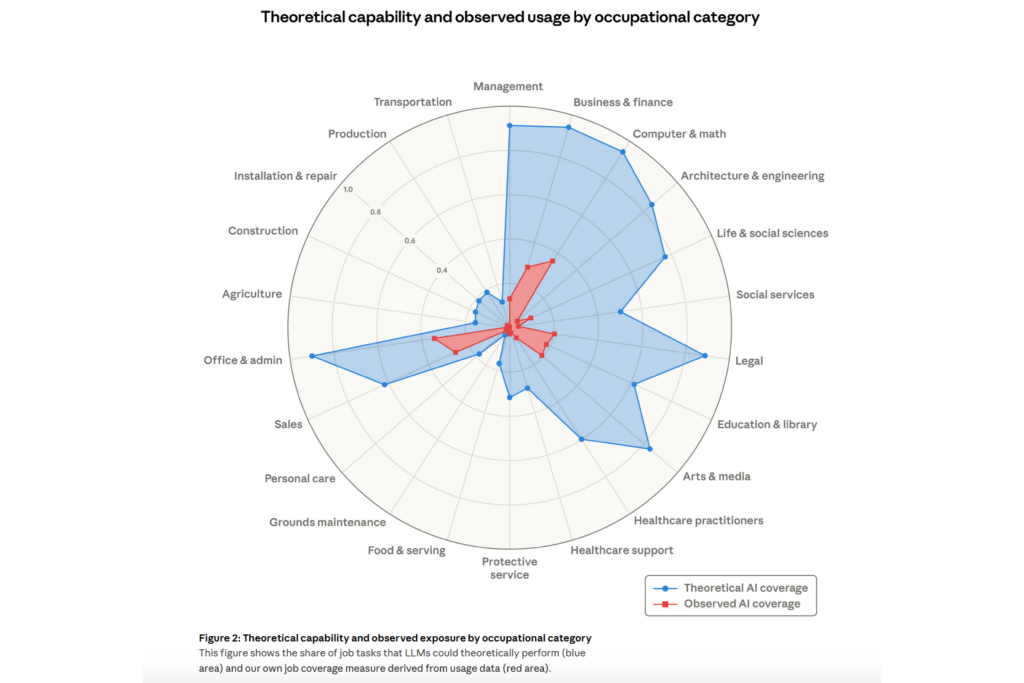
What could happen next?
The Deutsche Bank AI tools don’t go nearly that far. Their collective message is more measured: the disinflationary promise is real but overstated, the timeline is longer than markets assume, and the near-term investment surge could cut the other way entirely.
Deutsche Bank’s economists leave the philosophical punchline hanging. If AI is wrong about its own inflationary impact, they note, perhaps we should “rethink our assessment of how transformative it is likely to be for complex knowledge work like forecasting, at least in its current form.” And if it’s right, markets may be pricing in AI-driven disinflation ahead of what’s actually happening.
Annoyingly, depending on your perspective, AI may be a little bit too much like the economists who programmed it. “A middle ground is that AI is taking a sensible approach by assigning relatively flat probabilities across outcomes in a highly uncertain environment with longer time horizons,” Luzzetti’s team wrote. “Having been trained on a corpus of text from economists, AI is simply acting as the proverbially two-handed economist, hedging its views against an unknowable backdrop.”
Either way, the machines were asked a direct question about their own economic legacy.
Their answer was: ” It’s complicated.
For this story, Fortune journalists used generative AI as a research tool. An editor verified the accuracy of the information before publishing.
This story was originally featured on Fortune.com

AI ‘slop’ is flooding YouTube Kids—and more than 200 groups and experts are calling for a ban
More than 200 child advocacy groups and experts are demanding that YouTube ban AI-generated “slop” from its children’s platform entirely, arguing that the low-quality, algorithmically produced videos are rewiring young brains and raking in millions while parents and regulators look the other way.
The open letter, organized by children’s advocacy group Fairplay and addressed to YouTube CEO Neal Mohan and Google CEO Sundar Pichai, was signed by more than 135 organizations. It included the American Federation of Teachers and the American Counseling Association, as well as prominent researchers such as Jonathan Haidt, author of The Anxious Generation. In it, the authors say YouTube is not only failing to stop AI slop from reaching children but is also actively profiting from it.
“AI generated videos are really just an escalation of a myriad of problems that YouTube already has when it comes to interfacing with kids on their platforms,” Rachel Franz, Program Director of Fairplay’s Young Children Thrive Offline program, told Fortune. “It’s important to address this AI slop phenomenon, but it’s also equally important to take YouTube to task for the way that its platform is designed to hook users into spending more time in ways that aren’t necessarily related to AI.”
What is ‘AI Slop’ anyway?
The term refers to a wave of mass-produced, AI-generated videos flooding platforms like YouTube. The content is cheap to make, often bizarre or nonsensical, and engineered to grab and hold young (or really, any) viewers’ attention. And reader, they are bizarre: cartoon animals performing repetitive tasks in an uncanny valley aesthetic; fake “educational” videos with garbled information; or hypnotic loops without any pure purpose. The New York Times documented the phenomenon in a February investigation, finding such videos embedded throughout YouTube Kids, a platform YouTube has marketed as a safe, curated space for children.
“So much of AI-generated content is really designed to hijack children’s attention, especially young children who are just at the beginning of developing their impulse control, and they can really distort reality, create confusion, and impact how children are understanding the world around them,” said Franz, who has a background in early child development. “This isn’t a parenting issue in and of itself. The platform is consistently recommending AI content to young users in ways that make it kind of impossible for them to avoid.”
The financial incentives are staggering. Fairplay found that top AI slop channels targeting children have earned over $4.25 million in annual revenue, with some creators openly advertising profits from “plotless, mesmerizing AI content.” The letter argued that no amount of policy will be enough until the platform removes the financial incentive for creators of these videos.
“Only about 5% of videos on YouTube for kids under eight are actually high quality. And there are debates amongst that 5% of whether those are actually high quality,” said Franz. YouTube, however, finds that number contrary to their standards policy.
“We have high standards for the content in YouTube Kids, including limiting AI-generated content in the app to a small set of high-quality channels,” YouTube spokesperson Boot Bullwinkle told Fortune in a statement. “We also provide parents the option to block channels. Across YouTube, we prioritize transparency when it comes to AI content, labeling content from our own AI tools, and requiring creators to disclose realistic AI content. We’re always evolving our approach to stay current as the ecosystem evolves.”
How to solve it
The coalition draws on child development research to argue this isn’t a niche concern. Even adults can have trouble correctly identifying AI-generated content, getting it right only about 50% of the time. More troubling, repeated exposure makes people more likely to perceive AI imagery as real, even after being told it’s fake. For young children whose brains are still building foundational schemas of reality, the damage compounds over time.
Fairplay’s asks are structural, not cosmetic. The coalition is calling on YouTube to clearly label all AI-generated content across the platform, ban AI-generated content entirely from YouTube Kids, and prohibit AI-generated “Made for Kids” content on the main YouTube platform. Fairplay wants YouTube to bar its algorithm from recommending AI content to users under 18, introduce a parental toggle to disable AI content that is switched off by default, and halt all investment in AI-generated content targeting children.
That last demand takes direct aim at YouTube’s investment in Animaj, an AI-powered children’s entertainment studio backed by Google AI Futures. “YouTube is essentially investing in harming babies through its purchase of Animaj,” Franz said.
In Bullwinkle’s statement to Fortune, the spokesperson confirmed that YouTube is developing dedicated AI labels for YouTube Kids, though did not provide a timeline. YouTube CEO Neal Mohan had already flagged “managing AI slop” as a top priority in his annual letter. “To reduce the spread of low-quality AI content, we’re actively building on our established systems that have been very successful in combating spam and clickbait, and reducing the spread of low-quality, repetitive content,” read the letter.
Bullwinkle also noted that the 15 channels mentioned in the Times article are not on YouTube Kids and that the platform removed videos that violated its Child Safety policies. But for Franz, that’s not good enough.
“It shouldn’t be up to individual researchers to point out a few channels as examples that are doing things that could potentially harm kids, and have that be the basis for what YouTube decides to kick off the platform. What we saw with Elsagate was that at that time, YouTube removed 150,000 videos from its platform and several hundred different channels,” Franz said. She was referencing Elsagate, a 2017 scandal in which thousands of videos on YouTube and YouTube Kids used familiar children’s characters, like Elsa from Frozen and Peppa Pig, to hide deeply disturbing content including graphic violence, sexual themes, and drug use, all dressed up with algorithm-friendly tags like “education” and “fun” to slip past filters and reach young children.
“So we know that YouTube has the capacity to monitor, track, and remove these videos at scale, but right now, they’re doing a band-aid approach, where the channels that are getting press coverage, it seems like those are the ones they’re going forward doing something about,” Franz continued. “But it’s not fixing the overall problem.”
This story was originally featured on Fortune.com

Cancer’s grim calculus for the young: their insurance status can determine how long they survive
Cancer is becoming increasingly common among young people, with cases slowly and steadily rising every year for the past decade. And what type of insurance adolescents and young adults have affects at what stage of cancer they’re diagnosed and how long they survive.
As researchers who study cancer disparities in young adults, we examine the social and systemic factors that shape who survives a cancer diagnosis. In our recent review of the scientific literature – an analysis that included nearly 470,000 Americans between the ages of 15 and 39 who had been diagnosed with cancer – we found that insurance status is one of the clearest and most consequential factors.
Young people with private health insurance lived longer than those on Medicaid or without insurance. Depending on the cancer, this survival advantage ranged from a modest 8% lower risk of death for lymphoma to a drastic 2 to 2.5 times lower risk of death for melanoma and multiple other cancer types.
Young people are especially at risk
People between the ages of 15 and 39 have especially unstable access to health coverage in the U.S.
Young people in this age group are often finishing school or starting new jobs, including positions that don’t offer benefits. They’re also aging off a parent’s insurance plan, which happens when you turn 26 under current U.S. law. This instability leaves many young people uninsured or underinsured.
The consequences of no or insufficient health coverage go beyond inconvenience. Adolescents and young adults already tend to see smaller improvements in cancer survival over time compared to children and older adults. This gap has puzzled researchers for years.
Insurance instability appears to make this gap even wider.
Insurance shapes the entire cancer experience
Health insurance does far more than cover hospital bills. It determines whether a patient can access a specialist, how quickly treatment begins and whether they are eligible to enroll in a clinical trial.
Strikingly, patients on Medicaid and uninsured patients often had similar cancer outcomes – and both did worse than those with private insurance. This suggests that simply having some form of coverage isn’t enough if that coverage doesn’t actually open doors to quality care.

One underdiscussed consequence of insurance status is access to clinical trials. These studies are often the pathway to the most advanced treatments available. Yet research has found that the type of insurance a young cancer patient has is a significant predictor of whether they enroll in a clinical trial, with higher enrollment rates for those with private insurance.
For cancers such as early stage Hodgkin lymphoma – a cancer more common in young adults – treatment decisions and access to newer approaches can vary significantly based on where and how a patient receives care, which is often tied to their insurance status.
Clarifying cause and effect
The body of research we analyzed primarily tracked patterns in existing data rather than through controlled experiments. That makes it difficult to say with certainty that insurance status directly causes differences in survival.
However, the pattern we observed was consistent across many studies. Moreover, most studies recorded insurance status only at the time of diagnosis, which misses changes that happen during treatment. Patients may lose or gain coverage in the middle of their care.
Future research that tracks insurance continuously throughout treatment, standardizes how coverage is categorized and examines specific cancer types and age subgroups in greater depth could clarify the picture further.

What can be done to help young cancer patients
The good news is that insurance is something society can change. Based on our research, a few key areas stand out.
Expanding coverage could help keep more young cancer patients insured. This might look like policies allowing young adults to stay on a parent’s plan longer, expanding Medicaid and reducing gaps in coverage after diagnosis.
Improving what Medicaid actually covers could make it easier for patients to access top cancer centers. Many doctors and cancer centers limit how many Medicaid patients they see because reimbursement rates are low.
Connecting with financial counselors, patient navigators and care coordinators could help young patients on public insurance or those who lack insurance navigate the system. This support could enable them to get timely access to the right treatments and clinical trials.
Early screening for financial barriers can prompt timely referrals to financial counseling, assistance programs or social work before patients experience treatment delays. Financial support can help patients complete treatment, make their appointments and improve their outcomes.
Rhonda Winegar, Assistant Professor of Nursing, University of Texas at Arlington; Tara Martin, Clinical Assistant Professor of Nursing, University of Texas at Arlington, and Zhaoli Liu, Assistant Professor of Nursing, University of Texas at Arlington
This article is republished from The Conversation under a Creative Commons license. Read the original article.

This story was originally featured on Fortune.com
Stocks making the biggest moves midday: Eli Lilly, Hasbro, Philip Morris, Intel, Micron & more
These are the stocks posting the largest moves in midday trading.
This post was originally published here
Amazon Prime is offering a 20-cent-per-gallon discount — and you can stack savings with a credit card
Amazon is elevating its regular gas savings for Prime members, but only for a limited time.
This post was originally published here
Here are 3 ways to ignite a rally in beaten-down bank stocks like Wells Fargo and Goldman
Private credit risks, mass AI adoption and the U.S.-Iran war have all weighed on banks in 2026.
This post was originally published here
Iran’s war propaganda homes in on Trump with Lego memes
Iranian propaganda is also homing in on the war’s destabilizing impact on the global economy and energy prices, which have shot up in the U.S.
This post was originally published here
Tiger Woods won’t captain 2027 Ryder Cup team as golf future remains uncertain
The latest developments leave Woods at least temporarily at the fringes of the sport that made him a household name.
This post was originally published here
Trump seeks to redefine who gets to be an American with birthright citizenship case
Most Americans support the rule that anyone born in the US is a US citizen, and a majority of supreme court justices are skeptical of Trump’s efforts to restrict it
It was a surreal morning at the US supreme court.
For more than two hours, the nation’s highest court considered arguments over whether Donald Trump – via an executive order – could tear down an idea that has been fundamental to the story and trajectory of the United States: that almost anyone born on US soil is an US citizen.
This post was originally published here
Republican leaders agree to advance funding deal to end DHS shutdown
Measure that would fund homeland security but exclude money for ICE could conclude lengthy funding lapse
An end to the partial shutdown of the Department of Homeland Security (DHS) may be in sight, after Congress’s Republican leaders on Wednesday agreed to advance legislation that would fund most of the agency’s operations, with the exception of those involved in immigration enforcement.
The pact may conclude the longest such funding lapse in US history, which last month caused security lines to stretch for hours at some airports as employees of the Transportation Security Administration (TSA), a subagency of DHS, quit their jobs or called out of work after going weeks without pay.
This post was originally published here

Is the U.S. Navy ready to clear sea mines in the Persian Gulf?
Despite the danger of sea mines, experts say that mine clearing has received minimal attention and funding from the U.S. Navy — and it’s often overshadowed by more high-profile weapons systems.
(Image credit: Suy Se)

This post was originally published here







Alaska Airlines unveils lie-flat suites, upgraded perks in new international business class
Alaska Airlines is targeting premium international travelers with a new business class experience as it expands its reach into Europe and Asia.
The airline on Tuesday unveiled its all-new international business class service, set to debut this spring on its new Boeing 787-9 Dreamliners. The service will feature lie-flat seats, elevated dining, premium bedding, and curated amenities, according to the company.
“When we debut our new product this spring, it will raise the bar and redefine long-haul travel, while continuing to deliver the remarkable care that sets Alaska apart on the global stage,” Andrew Harrison, executive vice president and chief commercial officer at Alaska Airlines, said in a statement.
At the core of the new offering are fully lie-flat suites with privacy doors and direct aisle access.
Each seat converts into a bed and includes an 18-inch high-definition screen, wireless charging, noise-reducing headphones and access to a library of more than 1,500 movies and shows.
The airline is also emphasizing its onboard dining experience.
ALASKA AIR, DELTA TARGETED IN SEATTLE AIRPORT POLLUTION LAWSUIT
Menus will vary by route, featuring dishes such as pasta carbonara with roasted chicken on flights to Rome and gochujang chicken on routes to Incheon.
Service begins with an upgraded fruit and cheese platter, accompanied by a selection of wines, champagne, cocktails and craft beer.
Dessert includes Salt & Straw ice cream, while pre-arrival meals are tailored to each destination.
ALASKA AIRLINES, BOEING SUED BY PASSENGERS ON PLANE WHEN DOOR FLEW OFF MIDFLIGHT
Additional touches include bedding designed in partnership with Pacific Northwest brand Filson and amenity kits stocked with skincare products and travel essentials.
Passengers flying International business class will have access to Alaska’s airport lounges, as well as Oneworld partner lounges worldwide. Top-tier loyalty members will also gain entry to select international first-class lounges.
Alaska plans to equip its Dreamliner fleet with SpaceX’s Starlink internet later this year.
The rollout comes as Alaska ramps up its international footprint from Seattle, with service to Rome launching April 28, followed by London on May 21 and Reykjavík, Iceland, on May 28. Flights to Seoul are set to begin in April, with Tokyo service expected later this year.
The unveiling comes as the airline estimated a bigger first-quarter loss amid rising jet fuel prices and a pullback in demand due to unrest in Puerto Vallarta, Mexico, and flooding in Hawaii.
The airline said in a regulatory filing on Monday that rising fuel prices represent an incremental earnings-per-share headwind of at least 70 cents.
Shares of Alaska Air Group ended Wednesday’s trading session up 2.3% and are down more than 25% year to date.

A Nashville suburb is becoming a manufacturing hub, and its housing market is getting a boost
A suburb near Nashville, Tennessee, is in the midst of a boom amid an influx of higher-paying tech and trade jobs.
A report by Realtor.com found that Clarksville, located about 45 minutes outside of Nashville, is drawing in residents in part because of several manufacturing firms setting up shop in the area and lower housing prices.
The median listing price for a house in Clarksville is $357,950, whereas the median list price in Nashville is $527,225 – which represents a potential savings of about 32.1%.
Housing demand is expected to remain strong in the area. Realtor’s report noted that T.RAD, an auto parts manufacturer headquartered in Japan, opted to build a new plant in the area while Korea Zinc is expanding its footprint there as well.
THE US HOUSING MARKETS THAT ARE SEEING THE LARGEST DROPS IN RENT PRICES
T.RAD’s Clarksville manufacturing facility is the first location in Tennessee for the company’s North American division. It plans to invest $90.2 million in a manufacturing facility that’s projected to create 928 jobs in the next few years.
Korea Zinc currently has about 300 existing jobs in the area and is also expanding with at least 420 direct positions, while also supporting additional jobs through suppliers and other economic activity.
Workers filling the new roles are expected to earn income in a range between $86,000 and nearly $200,000 a year, according to the report.
RENO SURPASSES LAS VEGAS AS TOP DESTINATION FOR CALIFORNIA HOMEBUYERS SEEKING AFFORDABILITY
The U.S. Army’s Fort Campbell is also one of the top employers in the area, which is also home to Austin Peay State University.
“Bringing more jobs to a smaller area can be great for the local housing market, if inventory is able to keep up with demand,” said Hannah Jones, senior economic research analyst at Realtor.com.
“The data suggests that a pickup in demand resulted in significant home price growth over the last six years. However, prices have leveled out in the last year and time on market has grown, suggesting the market is rebalancing,” Jones added.
AMERICA’S 10 MOST EXPENSIVE ZIP CODES REVEALED
Clarksville is the fifth-largest city in Tennessee in terms of population, and has seen an uptick in new home construction in the last few years.
“In terms of single-family home sales, in 2025 about 85% were existing homes, roughly on par with the pre-pandemic norm,” Jones said.
GET FOX BUSINESS ON THE GO BY CLICKING HERE
“Nevertheless, the new construction share of sales grew almost 6 percentage points in 2025 compared to 2024, suggesting that more buyers are opting for new construction compared to the last three years, though the share is below the pandemic era norm,” she added.



STAT+: Government watchdog urges FDA to finalize guidance for advisory committee conflicts of interest
The Food and Drug Administration has often failed to share information on how it determines whether its advisory committee members have financial conflicts of interest and whether those individuals should participate in committee meetings, according to a review by the Government Accountability Office.
A key issue is that the agency never finalized guidance 13 years after a law required it to do so, the watchdog found. Meanwhile, the FDA has never posted on its website how it makes these decisions and does not publicly share how it decides whether guest speakers have financial conflicts or situations where there appears to be a conflict.
As a result, the GAO recommended the FDA establish a timeframe for issuing and publicly sharing required financial conflicts-of-interest guidance. The watchdog also suggested the FDA should disclose how it decides conflicts for committee members in the interim and publicly disclose how it determines conflicts and appearance issues for guest speakers.

STAT+: Large AI scribe study finds modest time savings, inconsistent use
Ambient scribes were supposed to ease the burden on stressed-out doctors by automating clinical documentation from patient visits. A new study highlights the need to help clinicians make the best use of the tools.
The large new study of AI scribe use by 1,800 clinicians across five academic medical centers from 2023 to 2025 found those using the technology saved 16 minutes of documentation time and spent 13 fewer minutes in the medical record for every eight hours of patient care. The study did not find significant impacts on time spent in the electronic health record outside of work. Primary care and female clinicians benefitted more than others. Scribe adopters were able to see one additional patient every two weeks.
The findings offer the most definitive real-world data confirming earlier smaller studies. A STAT review of published work last year found scribes saved clinicians under a minute per clinical note. Surprisingly, despite the modest time savings, other studies have found that scribes drive large improvements in burnout and other measures of clinician well-being.
Ashton Woods puts pace over margin in a choppy housing market
In today’s challenging homebuilding environment, builders are often presented with a lesser-of-evils choice: maintain a strong sales pace at the expense of slimmer margins, or sacrifice market share in favor of higher profitability.
Multi-regional private homebuilding powerhouse Ashton Woods chose the former, increasing its community count and maintaining its sales and closings pace, according to a Q3 2026 quarterly report released earlier this week.
However, elevated incentives and difficult market conditions, combined with a slight shift to entry-level homes, put downward pressure on sales prices, profit margins and revenues.
As many builders slow down their sales pace or shift away from entry-level homes in favor of a higher-margin product mix, Ashton Woods is taking an opposite approach.
Maintaining a strong sales pace
Ashton Woods, one of the largest private homebuilders in the United States, posted total revenues of $79.27 million, down roughly six percent from a year ago. Net income fell by a much larger 30 percent year-over-year.
The builder’s home sales gross profit margin declined to 16.6%, down by 80 basis points compared to a year ago. Meanwhile, the average sales price of homes fell to $353,000, down from $361,000 from during Q3 2025.
“When you think about the margins, the pressure really is coming from incentives, which is market-driven, as well as additional land costs coming through on our newer neighborhoods,” Zack Sawyer, CFO at Ashton Woods, said during a conference call held on Tuesday.
During the call, CEO Ken Balogh acknowledged that demand was “choppy” to start the year.
“We are seeing a nice spring season. Traffic has been up, just choppy. It’s been choppy for quite a while,” Balogh said. “Then you get to March, and we have this environment with rates going up. If you have the right incentives in place and the right inventory available to sell, we found that we’re still able to sell at a pretty strong pace.”
To that end, Ashton Woods kept sales and closings roughly on par with Q3 2025, while also increasing community count and backlog orders year over year. As Balogh stated, Ashton Woods employed generous incentives to maintain this strong sales pace and has continued to do so as mortgage rates spiked in March.
“I think the biggest immediate impact to us has been that it costs a little more to buy some of our financing incentives to where they need to be,” he explained.
In pursuing a high sales pace, Ashton Woods has taken a page out of other “pace over price” builders, such as Smith Douglas Homes, Hovnanian Enterprises and Lennar. Conversely, Tri Pointe Homes, which specializes in move-up homes in top-tier locations, has decided to hold the line on pricing and incentives in exchange for a slower sales pace.
The entry-level gambit
A deeper look at the quarterly report indicates that sales prices held roughly steady for both entry-level and move-up homes over the last year. However, the entry-level segment accounted for a slightly higher share of closings, which weighed on average selling prices.
Backlog orders were strong at 1,945, compared to 1,606 a year ago. This increase was entirely due to an uptick in entry-level home orders, which now account for 52.4% of Ashton Woods’ backlog, compared to 48.4% a year ago.
While a relatively small shift, the increasing entry-level share is notable, as those buyers are the most sensitive to mortgage rate spikes, affordability pressures and economic uncertainty.
Executives didn’t comment on what led to this change, so it’s not clear if the growing emphasis on entry-level was incidental, market-driven or a concerted strategy. However, this shift runs counter to a broader industry trend, as some national homebuilders have deemphasized entry-level homes in favor of a more established buyer profile that offers higher margins.
Beazer Homes, for example, plans to reduce its share of closings from home offerings priced below $500,000 by double digits by the end of fiscal year 2026. This is because incentives in those lower-priced communities are typically three to five points higher than in premium-priced communities.
Hovnanian Enterprises is also selling through its low-margin, entry-level homes in peripheral submarkets as it works to emphasize a higher-margin, move-up product mix in sought-after locations.
The vast majority of Ashton Woods’ entry-level closings came from Starlight Homes, its entry-level brand that largely emphasizes spec homes.
Conversely, Ashton Woods’ move-up segment primarily focuses on built-to-order, semi-custom homes that offer personalization through a design studio. These houses typically provide higher margins due to a more resilient buyer profile and profitability-boosting upgrades.
Margins fell, but by less than public competitors
Despite a growing entry-level share, Ashton Woods managed to hold the line on profit margins, which fell by 80 basis points over the last year. This was a more modest drop than most public builders experienced over the last year. For example:
- Lennar: 350 basis points decline to 15.2%
- Hovnanian Enterprises: 490 basis points decline to 13.4%
- KB Home: 490 basis points decline to 15.3%
- PulteGroup: 290 basis points decline to 24.7%
- D.R. Horton: 230 basis points decline to 20.4%
Regional Emphasis
Ashton Woods operates in 18 metro areas across the Sun Belt, including in Georgia, Texas, Florida, North Carolina, South Carolina, Arizona and Tennesse. On the conference call, executives confirmed that the Phoenix, Dallas and Austin markets alone accounted for a combined 35 percent of their business.
The builder is also expanding its footprint. Last year, Ashton Woods announced that it would expand into Colorado and the Denver market, with communities expected to open for sale this year. The company additionally bolstered its Florida operations with new communities in Jacksonville that are set to deliver in 2026.
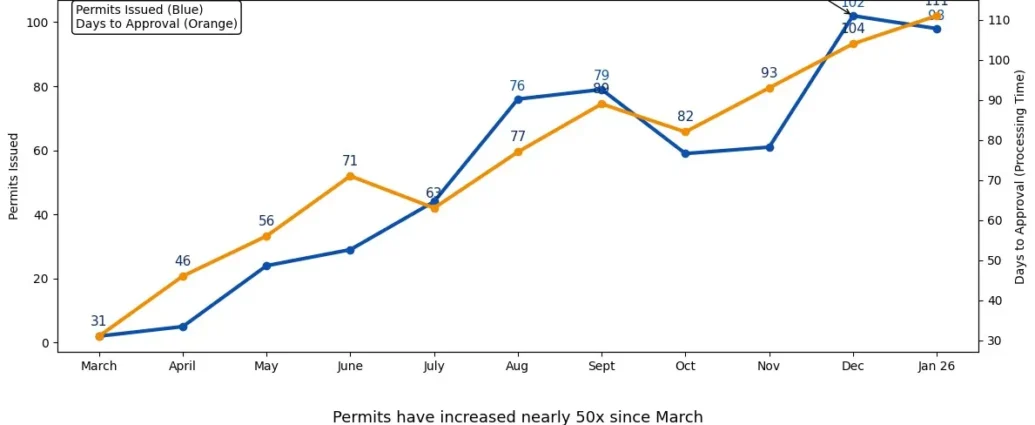
First fully rebuilt Palisades home testing post-fire demand
Fourteen months after California’s Palisades wildfires destroyed nearly 5,900 homes, the first fully rebuilt residence has come to market, offering the clearest pricing test yet for post-fire demand.
The newly built contemporary home — listed at just under $7.5 million — comes after the original was just one month from completion when it was destroyed.
The listing arrives as rebuilding activity gains traction, with roughly 650 permit approvals to date and nearly 475 burned lots having traded.
Anthony Marguleas of Amalfi Estates, who co-listed the property with Dan Urbach of Compass, told HousingWire that permitting timelines have proved faster than many anticipated — averaging approximately three and a half months.
The real obstacle isn’t permits
Marguleas said the real obstacle for homeowners has been misunderstood.
“There’s a misconception,” he said. “People have been reading news and [thinking the problem] is about obtaining insurance. I tell them, ‘No, it’s not obtaining insurance, it’s insurance payouts.”
His own experience illustrates the bind facing many property owners. Marguleas lost his home in the fires and is now rebuilding.
“I had to start construction. Most people have to start construction because they’re going to run out of loss of use funds,” he said. “It’s a chicken and the egg. You don’t want to start your rebuilding because you don’t know how much money you’re going to get, if you have enough money to rebuild.”
He noted that many homeowners lacked adequate insurance coverage.
“We had to start our rebuild without knowing we’re going to get the rest of our funds because we’re between a rock and a hard place,” Marguleas said. “We know we’re going to run out of our loss of use funds in about 12 months, and we may not know from our insurance company for another six months.
Insurance covers remains attainable
Despite widespread concern about the availability of new policies, data presented by Marguleas suggests coverage remains attainable.
Premiums have increased — with several major carriers requesting rate hikes of 17% to 34% — but those increases reflect broader market adjustments rather than a lack of availability, he said.
“Getting insurance coverage is not an issue in any way,” he said. “There have been 1,200 properties that have sold since the fires in the high-fire areas — Brentwood Hills, Santa Monica, Palisades — 1,200. None of them had any problem getting insurance.”
There has also been encouraging regulatory movement.
The California Department of Insurance recently approved forward-looking wildfire catastrophe models, allowing insurers to price wildfire risk more accurately.
Carriers using these models must expand coverage in wildfire-prone areas, which should help bring more insurers back into the market, Marguleas added.
A new analysis from the California Department of Insurance and National Association of Insurance Commissioners found that rebuilding to the Insurance Institute for Business & Home Safety Wildfire Prepared Home standard could reduce projected wildfire losses by one-third on average.
Land inventory, developer shift
Of the roughly 5,900 homes lost, Marguleas estimates that about 25% of the lots — roughly 1,475 — will eventually come to market, a figure based on patterns from previous major fires in California and Hawaii.
“There was a lot of misinformation earlier on that people were saying, ‘Oh, 60% or 70% of Palisades [homeowners] are going to be selling and moving out of the area,’” he said. “The reality is, based on how it’s been for going on 15 months, we think it’s going to be closer to the 25% target.”
As of two weeks ago, 483 lots had sold, 27 were in escrow and 173 were active, bringing the total available or sold to 683 — nearly half of the projected total.
But Marguleas detailed how the buyer profile has shifted noticeably in recent months.
An analysis of public records at the end of December showed just over half of buyers were owner-users. Updated research now suggests a different picture.
“It’s getting to 60% to 70% now are developers,” Marguleas said.
He added that many owner-users who purchased elsewhere — in Brentwood, Santa Monica, Newport Beach and Orange County — have opted to hire contractors and develop their original lots for sale rather than forfeit land equity.
“We believe instead of 750 there’s going to be 1,000 or even 1,200 new constructions that will be coming on over the next four years,” he said. “The question is, can the Palisades absorb it — and are there enough buyers out there that can afford to purchase $5 million to $10 million homes? I don’t think there will be. I think it’s going to be an interesting dilemma.”
Pricing the first rebuild
With only a handful of rebuilds expected to deliver in the near term, Marguleas said the first new construction to market typically commands a premium .
Early land sales following the fires saw similar dynamics.
“When the first land came on the market in February, March and April of last year, they got premiums because there was not a lot of land on the market,” he said. “The same will be happening with new construction. The first few new constructions that come on will get premiums because there’s not a lot of them.”
For landowners deciding whether to sell now or rebuild, he noted that land values remain down roughly 30% from pre-fire levels.
A 6,500-square-foot lot in the Palisades’ Alphabet Streets that sold for about $3 million before the fires now trades around $2.1 million.
“The seller is making a decision now — do I take a million dollar hit on equity selling my land today, or do I take that money and invest it?” Marguleas said. “We believe in the next three to five years the land values and property values will go back up to what they were before the fires and eventually surpass it.”
A local market returning
Despite the scale of destruction, Marguleas said the buyer pool for the Palisades remains overwhelmingly local.
“Ninety to 95% of the people that are looking to purchase in the Palisades now — for freestanding homes or for leases or for new construction — are people that lived in the Palisades before and want to get back,” he said. “They’re not outside the area.”
He pointed to signs of the town’s gradual revival such as the reopening of schools and businesses and solid timelines resuming for local projects.
“They see the town getting rebuilt. Every week a new business opens up,” Marguleas said. “It’s the locals coming back. That’s really what we’re seeing, more life coming back into the town.
“It’s the locals coming back and the local saying, ‘Yeah, I’m comfortable here.’”
UWM tried for its first acquisition, then its stock fell and the math stopped working
When UWM Holdings Corp. lost its bid last week to acquire Two Harbors Investment Corp. (TWO), upstaged by an offer from rival CrossCountry Intermediate HoldCo, analysts were not entirely surprised.
“It was such a wild turn of events,” said Eric Hagen, an analyst at BTIG. “But we were not surprised that it broke up.”
The deal would have marked UWM’s first acquisition. The company, founded in 1986 by Jeff Ishbia and led by his son Mat Ishbia since 2013, has historically relied on organic growth. This time, however, it ran into market headwinds and structural challenges tied to its model as it sought to complete a deal. What exactly went wrong?
Analysts pointed to a sharp decline in UWM’s stock price as a key factor, while the company told HousingWire this has nothing to do with its fundamentals. Shares fell amid a volatile quarter for the mortgage industry as a whole, which included geopolitical tensions involving Iran, a wave of M&A activity and rising mortgage rates.
UWM’s stock, which closed at $5.12 prior to the deal announcement, traded near $3.60 on Wednesday morning — well below levels typically required for broad institutional ownership.
“A lot of institutions can’t hold it (at this level), which causes further selling,” said Kevin Heal, a fixed income strategist at Argus Research. “Then you have selling from Mat Ishbia, which I could see as a way to increase the float.”
UWM is controlled by SFS Corp., whose ownership declined from about 90% at the end of 2024 to roughly 83% at the end of 2025, according to filings with the Securities and Exchange Commission (SEC).
The company has been actively working to expand its public float. A registration statement — under a 10b5-1 plan allowing insiders to trade company stocks — states that SFS Corp. can resell up to 150 million shares of Class A common stock, with about 45.7 million shares remaining unsold at the end of February.
The proposed acquisition of Two Harbors was also expected to support that effort by increasing the number of publicly traded shares. Pro forma estimates suggested the deal could have expanded UWM’s float to roughly 500 million shares, up from about 268 million at the end of 2025.
In February and March, share sales under the registration statement totaled approximately 11 million shares, according to SEC filings.
Despite expectations that these sales occur and their low volume compared to the ownership structure, the fact that the owners are selling the assets was not “sending a good message” to investors, Heal said.
A spokesperson for UWM said the 10b5-1 plan “was put in place prior to this deal ever starting” and was designed to increase float — something analysts and investors “have consistently asked for.”
The company also said the plan has “absolutely nothing to do with margin requirements or anything tied to the Suns acquisition.” Mat Ishbia reportedly pledged a significant portion of his equity in UWM Holdings Corp. as collateral to secure loans for his roughly $4 billion purchase of the Phoenix Suns and Phoenix Mercury in 2023.
“Any suggestions otherwise are completely false,” the spokesperson said.
They added that the company’s recent stock decline is not tied to business performance, pointing to an “amazing” fourth quarter and a “strong start in Q1.” The spokesperson added that, relative to peers, the stock is down less on a year-to-date basis.
“The stock price decline can be mostly attributed to our announcement of working with Two Harbors, not tied to our success at the company,” the spokesperson said.
Stock structure was central
UWM’s stock sits at the center of the failed bid for TWO since the transaction was structured as an all-stock deal. As UWM’s share price declined, the offer became less compelling to TWO shareholders.
Under UWM’s proposal, investors would have received 2.3328 shares of UWMC Class A common stock for each share of TWO, implying a value of $11.94 based on UWMC’s Dec. 16 closing price and a total deal value of roughly $1.3 billion. The same offer now would value each share at $8.40 or 30% less.
By contrast, CrossCountry Mortgage offered an all-cash deal valued at $10.80 per share, or about $1.13 billion — removing market risk for sellers.
“United Wholesale had an opportunity to come in with a cash offer to match CrossCountry’s offer. They just don’t have the cash on the balance sheet to support that,” Hagen said. “They don’t operate with a lot of cash. Some of that is intentional since they have an origination machine.”
UWM said in its most recent earnings report that it had roughly $500 million in available cash. The company also generated approximately $700 million in adjusted EBITDA in 2025, a proxy for operating performance. While the company could have raised additional liquidity for the acquisition, such a move would have come with trade-offs.
Market constraints may limit that flexibility. “They could tolerate higher leverage to some degree, but I don’t know if the stock can really support much more,” Hagen said.
UWM’s nonfunding debt-to-equity ratio – excluding funding tied directly to loan origination, which turn over quickly and are less relevant for M&A capacity – rose to 2.69x at the end of the fourth quarter, up from 1.66x a year earlier and driven in part by declining equity.
“The reason this transaction would have worked well for UWM was because it was a stock offer,” said Bose George, an analyst at Keefe, Bruyette & Woods (KBW). “It would have allowed them to use equity to buy Two Harbors at a reasonable price, and help increase their float.”
George added that while a cash deal may have been “feasible,” it did not align with UWM’s broader strategy. One example: “At the end of the year, it looks like they had about 11% to 12% equity funding the warehouse. Normally, you need less than 5%, so it suggests that they’re probably $500 million plus of excess just sitting in the warehouse.”
The UWM spokesperson said the company “has ample access to cash and could have easily completed the transaction with cash.”
But the spokesperson added that “as we dug deeper into the Two Harbors business, it became clear that the primary value was the MSR book. The operational and capital markets components — and some of the other areas we were led to believe would deliver value — were not, as found. Given that, there was no reason for us to try to put forth an all-cash offer because that wouldn’t have been what’s best for UWM.”
Scale intact despite deal setback
Another key benefit of the proposed transaction was the ability for UWM to expand its MSR portfolio without deploying significant capital. According to George, UWM originates roughly $50 billion per quarter — or $200 billion annually, which is roughly equivalent to the size of TWO’s servicing book.
“But if you retain MSR when you’re originating, you need your own capital to do it. That’s the piece of Two Harbors that we liked. But from the scale standpoint, it’s hard to say that these guys (UWM) are disadvantaged. They’re the biggest U.S. originator.”
The deal would have added approximately $176 billion in unpaid principal balance of MSRs, nearly doubling UWM’s servicing portfolio to about $400 billion.
“It made sense at the right price, but we weren’t willing to get much more aggressive,” the UWM spokesperson said.
“At UWM, we’re extremely disciplined and in all our years of doing business, we’ve never acquired another company. We don’t do deals unless there’s something truly valuable there,” they added. “While the MSR portfolio was valuable, UWM originates such high volumes every quarter that we can create that servicing ourselves. Although the MSR portfolio presented potential upside, it was not sufficient to justify pushing beyond our disciplined approach.”
Hagen noted the deal valuation was at only a modest premium to book value. “The valuation was never very lofty to us. It was always very rational versus the Rocket-Mr. Cooper deal, where they’re buying them at two times book value,” Hagen said. “We feel like they’re not losing a lot by losing the deal. They were never paying a lot for it.”
Hagen added that the transaction was not expected to be meaningfully accretive to earnings, but rather to cash flow, supported by roughly $150 million in projected synergies. He still views UWM as an attractive name given its valuation and focus on scale and servicing.
From a fundamental standpoint, Hagen said the failed deal does not materially alter UWM’s outlook. “But optically, it’s not a great look to see a deal fall apart.”















Thornburg Income Builder Opportunities Trust Announces Distribution
SANTA FE, N.M., April 1, 2026 /PRNewswire/ — Thornburg Income Builder Opportunities Trust (the “Trust”) ((TBLD) today announced a monthly distribution of $0.10417 per share on the Trust’s common shares, payable on April 20, 2026, to common shareholders of record as of April 13, 2026.
The Trust’s monthly distribution is shown below:
|
Amount |
Payable Date |
Ex-Dividend/Record Date |
Change from |
|
$0.10417 |
April 20, 2026 |
April 13, 2026 |
No Change |
Distribution rates are not performance and are calculated by summing the Trust’s monthly distribution per share over four quarters and dividing by the net asset value or market price per share, as applicable, as of the distribution announcement date. Distributions on common shares are generally paid from net investment income (regular interest and dividends) and may also include capital gains and/or a return of capital. The Trust’s distribution payable on April 20, 2026, includes a short-term capital gain and a return of capital but does not include a long-term capital gain. The specific tax characteristics of the distributions will be reported to the Trust’s common shareholders on Form 1099 after the end of the 2026 calendar year. The final determination for all distributions paid in 2026 will be made in early 2027 and reported to you on Form 1099-DIV. You should not use this notice as a substitute for your 1099-DIV.
The Trust’s fiscal year (10/01/2025 through 09/30/2026) cumulative distributions are shown below:
This post was originally published here

Trading Trump’s 9 P.M. Address: Nuclear, Epic Fury And The $2M Word Market
President Donald Trump will deliver a prime-time address to the nation at 9 p.m. EST on Wednesday, his first since the so-called “Operation Epic Fury” launched on Feb. 28.
“Big Short” legend Steve Eisman called this a “unipolar market” last week, meaning the Iran war is the single variable running the entire stock market.
Kalshi’s word-mention market for tonight’s address has already topped $2 million in volume in under 17 hours.
What The Market Expects
“Nuclear” at 97% and “Epic Fury” at 92% are locked in. “NATO” at 88% is guaranteed after Trump said he was strongly considering leaving, and told European allies to “go to the Strait, and just TAKE IT.”
“Oil” at 82%. How heavily Trump leans on oil language could signal whether he is serious about ending the operation with the Strait of Hormuz still closed, a scenario that would keep crude elevated well above $100.
“Hormuz” at 79%, down 10 points. Defense Secretary Pete Hegseth confirmed Tuesday that reopening the Strait is not a core military objective. BlackRock Inc (NYSE:BLK) CEO Larry Fink warned oil could hit $150 if Iran remains a threat to Hormuz after the war.
The Coin Flips
“Midnight Hammer” at 64%. This was the codename for last year’s strikes on Iran’s nuclear sites, which Trump claimed had obliterated the country’s nuclear program. Whether he references it tonight could signal how much of the address is a victory lap versus a forward-looking …
This post was originally published here

SpaceX Files For Largest IPO In History: Here’s What Prediction Markets Say About $1.75 Trillion Valuation
Elon Musk’s SpaceX has confidentially filed its IPO paperwork with the SEC, putting the company on track for a potential July listing that could raise between $40 billion and $80 billion. That would dwarf Saudi Aramco’s $29 billion debut in 2019 as the largest IPO ever.
• EchoStar shares are climbing with conviction. What’s behind SATS gains?
The filing will force SpaceX to open its books for the first time. The space side reportedly cleared around $8 billion in profit on $15 billion to $16 billion in revenue last year, nearly all of it Starlink.
Then there’s xAI, folded in through February’s $1.25 trillion merger and burning roughly $1 billion a month with all the original co-founders already out the door. The IPO roadshow is a pitch that Starlink’s margins can carry xAI’s ambitions long enough for orbital data …
This post was originally published here

abrdn National Municipal Income Fund (VFL) Announces Adjournment of Special Shareholder Meeting Relating to Proposed Reorganization
PHILADELPHIA, April 1, 2026 /PRNewswire/ — abrdn National Municipal Income Fund (NYSE:VFL) announces that the Special Meeting of Shareholders was held and adjourned today, to allow for the solicitation of additional proxies to achieve the requisite quorum. The Fund has set a new adjournment date for its Special Meeting of Shareholders of Wednesday, April 15, 2026, at 11:00 am Eastern Time.
This post was originally published here