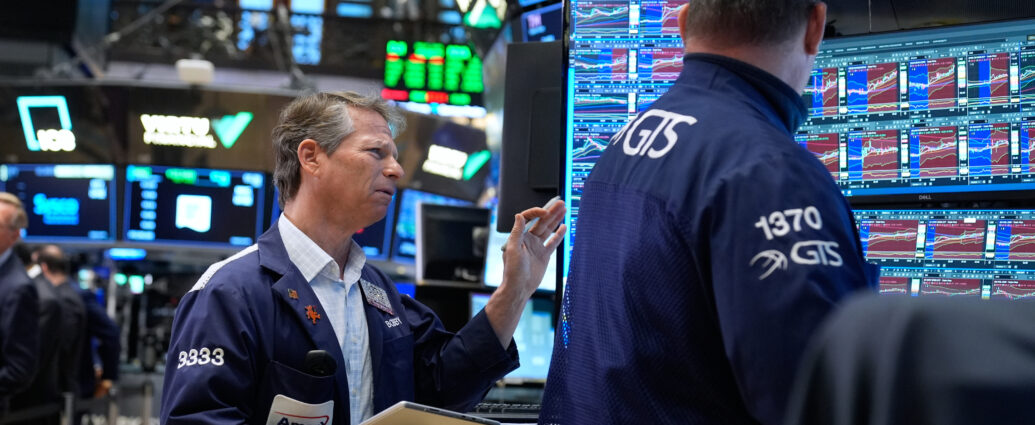
U.S. carrier JetBlue has raised its checked bag fees by as much as $9 as the war in the Middle East disrupts global oil supplies and increases fuel prices.

The new fees took effect Monday. For most domestic economy passengers, the first checked bag now costs $39, up from $35. During peak travel times such as April spring breaks, major holidays and the summer, passengers will have to pay $49 instead of $40, the airline said.

The airline, which has its flagship terminal at New York’s John F. Kennedy International Airport, said in an emailed statement to The Associated Press on Tuesday that charging more for optional services “used by select customers” would allow it to keep its airfares competitive.

“While we recognize that fee increases are never ideal, we take careful consideration to ensure these changes are implemented only when necessary,” JetBlue said.

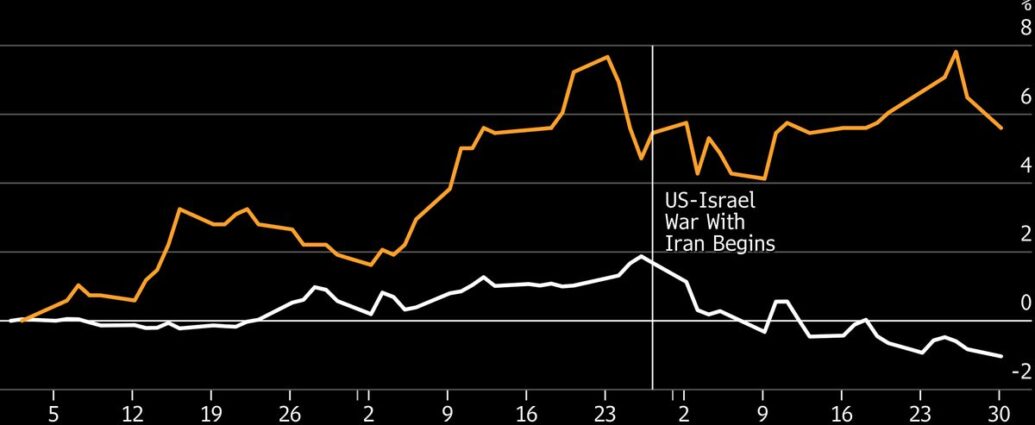
Airlines around the world are confronting soaring operating expenses due to jet fuel prices that have jumped more than 85% since the Iran war began on Feb. 28. The conflict has curtailed ship traffic through the Strait of Hormuz, a key passageway for a fifth of the world’s oil. Airspace closures in parts of the Middle East have added to the price pressure by forcing some airlines to take longer routes that burn more fuel.

A number of non-U.S. carriers already have added fuel surcharges or raised ticket prices in response.

Jet fuel is one of the airline industry’s biggest expenses, typically accounting for about a quarter of operating costs. The average price for a gallon of jet fuel reached $4.64 on Tuesday, up from $2.50 the day before the conflict broke out, according to Argus Media. The energy market intelligence company’s U.S. Jet Fuel Index tracks the average prices across major hubs, including Chicago, Houston, Los Angeles and New York.

Industry analysts expect U.S. airlines to pass some of their higher fuel costs on to travelers through add-ons, such as checked bags and seat upgrades, since they don’t typically have fuel surcharges. And once one airline raises fees, analysts say, others are likely to follow.

JetBlue also increased the charge to check a second bag from $50 to $59 for off-peak periods, and from $60 to $69 for periods of peak demand.

The carrier said some customers would still be able to check their first bag for free, including those who hold one of the airline’s co-branded credit cards and loyalty program members who reach certain tiers. Most customers flying transatlantic routes will also continue to receive their first checked bag free.

Iran’s determination to close off the Strait of Hormuz to ships from nations it considers unfriendly has caused crude oil prices to fluctuate wildly and in turn, driven up fuel prices. Earlier this month, the CEOs of Delta Airlines, American Airlines and United Airlines reported that higher jet fuel prices had already added about $400 million in operating costs.

This story was originally featured on Fortune.com

A new investigation by Congress detailed how China is buying sanctioned oil from rogue regimes around the world at a discount.

The House Select Committee on China released its report on how China is evading sanctions to purchase tens of millions of barrels of oil from countries like Iran, Russia and Venezuela that are the subject of U.S. sanctions, using a “shadow fleet” of tankers to transport sanctioned oil.

It found that sanctioned oil accounted for one-fifth of China’s total oil imports after the country became the buyer of last resort for those rogue regimes, which allowed it to stockpile a large strategic reserve of oil while buying at below market rates.

CHINA-RUSSIA’S COOPERATION HANDS THE US A ‘GRIEVOUS LOSS’ AS IRAN CONFLICT ESCALATES, EXPERT WARNS

Selling oil is a key component of the economies of Iran, Russia and Venezuela, and the report noted that energy exports yielded roughly $120 billion in revenue for Russia in 2024, about 30% of its total revenue.

Iran’s oil revenue is projected at more than $50 billion in 2025, which represents about 35% of its budget. Similarly, crude oil sales were Venezuela’s main source of hard currency.

“From this sanctioned crude, China assembled a massive strategic petroleum reserve – roughly 1.2 billion barrels by early 2026, equal to approximately 109 days of seaborne import cover – at well below market cost from the very barrels Western sanctions were designed to strand,” the committee wrote.

The select committee said China relies on foreign suppliers for about 70% of its oil, much of which is delivered by sea routes that could be blockaded by U.S. and allied naval forces during a crisis, such as one stemming from a Taiwan contingency. That vulnerability prompted Chinese leaders to declare energy security an “urgent requirement in great-power competition” and build its massive reserve.

The report detailed how China uses a shadow fleet of tankers, which are generally older tankers that operate through opaque ownership structures under foreign flags with non-Western insurance that allow them to avoid complying with Western maritime laws. 

MULTIPLE CHINESE VESSELS RETREAT AT STRAIT OF HORMUZ AFTER IRAN WARNINGS IN RARE ALLY MOVE

The panel cited data from commodity data and analytics firm Kpler, which tracks vessel movements and trade patterns using satellite imagery, that found shadow fleet and sanctioned tankers moved about 10.3 million barrels of crude oil per day last year, with about one-third going to China. 

Additionally, it moved 2.2 million barrels per day of heavy refined products like fuel oil and crude residuals, with China receiving about 10.3%; while China also received about 45.8% of the shadow fleet’s chemical and biological cargo.

“China is the buyer of oil from desperate, rogue regimes through illicit, hard-to-track channels involving shell companies, Chinese refineries and a shadow fleet of oil tankers,” said Select Committee on China Chairman John Moolenaar, R-Mich. 

“This investigation brings to light key information on how the Chinese Communist Party keeps the economies of Iran and Russia afloat while fueling its own authoritarian agenda.”

US WEIGHS ASKING CHINA TO CURB RUSSIAN, IRANIAN OIL PURCHASES

China’s oil sources have been under pressure after U.S. action to detain Venezuelan leader Nicolás Maduro and enforcement activities targeting Venezuelan oil, as well as the war in Iran, which has slowed the flow of oil tankers through the Strait of Hormuz. 

Before the war, China imported 3.4 million barrels per day of oil from Gulf producers via the Strait. While Iran’s shadow fleet continues to make deliveries at near pre-war levels, shipments from other countries in the region have slowed to a halt, prompting China to ban fuel exports and raise retail prices to mitigate the impact of the oil disruption.

The committee’s investigation led to several policy recommendations for lawmakers to consider as they look to counter the flow of sanctioned oil that benefits rogue regimes.

Those suggestions include authorizing sanctions on ports, terminal operators and similar businesses that receive cargo transported by shadow fleet vessels and establishing a whistleblower reward program for reporting sanctions evasion – particularly in transshipment hubs like Singapore, Hong Kong, Malaysia and Dubai.

GET FOX BUSINESS ON THE GO BY CLICKING HERE

They also include having financial regulators probe potential commodity market manipulation and transactions by entities involved in systematically purchasing and routing steeply discounted Russian crude by foreign refiners.

The panel also called for creating a contingency framework with major oil producers like Saudi Arabia, the UAE and Iraq to expand supply because sustained lower prices would reduce the discount available on sanctioned crude oil from Iran and Russia.

This post was originally published here. 

War shows little sign of easing despite Donald Trump claiming Iranian leadership ‘just asked’ for ceasefire

Israel unleashed two waves of attacks on Tehran and said it had killed a senior Hezbollah commander on Wednesday with little sign of the war easing up despite Donald Trump repeating a claim that Iran’s leadership was seeking a ceasefire.

The US president, writing on social media, said that Iran’s president had “just asked” for a ceasefire, and that American troops would be “out of Iran pretty quickly” as he sought to extricate the US from the war. However, he confused the picture by incorrectly describing the president as a “new regime” leader.

Continue reading…

This post was originally published here

Nearly 2,000 internal files were briefly leaked after ‘human error’, raising fresh security questions at the AI company

Anthropic accidentally released part of the internal source code for its AI-powered coding assistant, Claude Code, due to “human error”, the company said on Tuesday.

An internal-use file mistakenly included in a software update pointed to an archive containing nearly 2,000 files and 500,000 lines of code, which were quickly copied to developer platform GitHub. A post on X sharing a link to the leaked code had more than 29m views early on Wednesday, and a rewritten version of the source code quickly became GitHub’s fastest-ever downloaded repository. Anthropic issued copyright takedown requests to try to contain the code’s spread. Within the code, users spotted blueprints for a Tamagotchi-esque coding assistant and an always-on AI agent, per the Verge.

Continue reading…

This post was originally published here

Four states have now signed such legislation as Trump’s Save Act languishes in Senate with little chance of passage

The governors of Florida and Mississippi signed legislation on Wednesday to require documented proof of citizenship to register to vote and to begin a process that will eventually unenroll voters who have not provided citizenship documentation.

Four states have now passed proof-of-citizenship laws for voting this year, after South Dakota and Utah’s governors each signed proof of citizenship bills into law in March.

Continue reading…

This post was originally published here

Bitcoin is holding near the $68,000 level as geopolitical tensions ease and regulatory clarity improves, helping stabilize the broader crypto market.

Cryptocurrency Ticker Price
Bitcoin (CRYPTO: BTC) $68,112.01
Ethereum (CRYPTO: ETH) $2,131.08
Solana (CRYPTO: SOL) $84.01
XRP (CRYPTO: XRP) $1.34
Dogecoin (CRYPTO: DOGE) $0.09257
Shiba Inu (CRYPTO: SHIB) $0.056016

Notable Statistics:

  • Coinglass data shows 114,174 traders were liquidated in the past 24 hours for $256.84 million.       
  • SoSoValue data shows net inflows of $117.6 million from spot Bitcoin ETFs on Tuesday. Spot Ethereum ETFs saw net inflows of $31.2 million.
  • In the past 24 hours, top gainers include Stable, Algorand and Sei.

Notable Developments:

Full story available on Benzinga.com

This post was originally published here

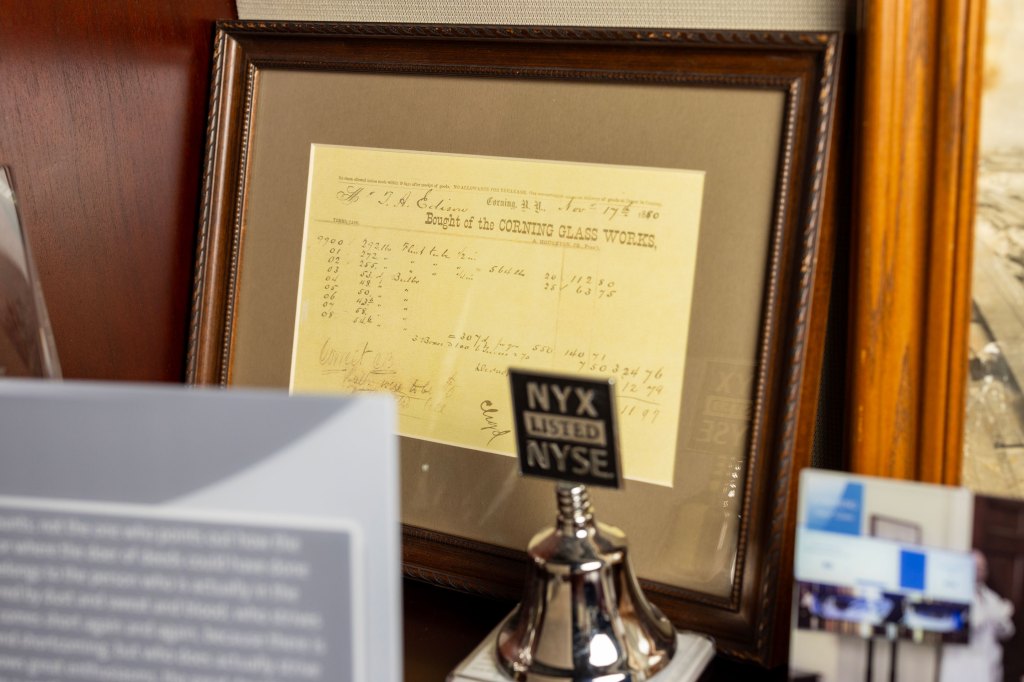
In his corner office at Corning Inc.’s towering steel-and-glass headquarters in Corning, N.Y., CEO Wendell Weeks keeps a small, yellowed piece of paper in a dark wood frame behind his desk. Dated Nov. 17, 1880, it’s Thomas Edison’s $311.97 order for Corning Glass Works to produce the glass for a risky new invention of his: the lightbulb. 

“I keep that to always remind me: If someone comes to you with an idea that seems small, but there’s a way to make the world just a little bit better, say yes,” Weeks says. “A lot of ideas won’t work, but the ones that do, those are really good.”

The 173-year-old glass company has proved this concept again and again. The creator of iconic kitchen brands such as Pyrex and CorningWare also developed the glass for telescopes, the earliest TV picture tubes, and heat-resistant glass windows for spacecraft. It answered the call of Apple’s Steve Jobs to create Gorilla Glass—that touch-sensitive, hard-to-shatter glass encasing your smartphone. And it created the fiber-optic cables connecting much of the internet—and those now powering the AI revolution.

Those innovations help explain why the CEO of a company in upstate New York with just $13 billion in 2023 revenue has the admiration and friendship of some of the biggest names in business, from Silicon Valley tycoons such as Amazon’s Jeff Bezos to Motor City moguls like Ford’s Jim Farley. Jony Ive, Apple’s former head of design, says there are few collaborators he holds in higher regard—high praise from the man who crafted the industry-shifting iPhone. “As a designer, as a creative, it’s a complete honor to work with somebody like Wendell,” Ive says. “He is utterly consumed by trying to work with you to solve difficult, sometimes almost seemingly impossible challenges.” 

The original purchase order from Thomas Edison to Corning for the glass encasement for Edison’s lightbulb in 1880.
Lauren Petracca for Fortune

A formative failure

But it hasn’t all been smooth sailing for the 6-foot-7, 65-year-old Corning CEO. In the 1990s, Weeks was the Corning vice president tapped to run a new optical fiber business to power the burgeoning internet—an innovation that drove Corning’s valuation to nearly $100 billion at the height of the internet bubble in 2000. 

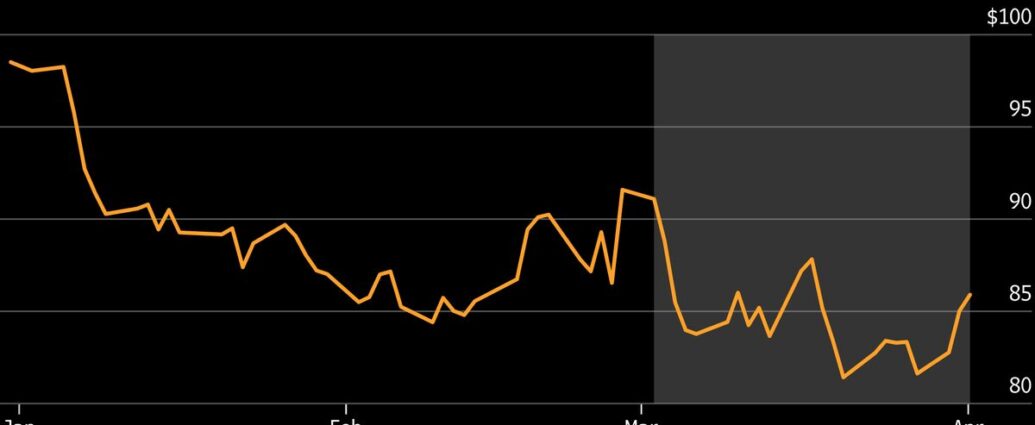
That bubble burst the following year, sending the company’s stock price plummeting from some $100 to $1. But Weeks proved his mettle by remaining committed to the enterprise after the dotcom crash. Even when Corning lost 99% of its value and had to lay off half its employees, Weeks insisted on the soundness of the strategy and continued to develop the company’s fiber tech.

He recalls begging company leadership not to fire him and instead let him stay on to clean up the mess: “I said, ‘I’m chaining myself to the wheel here. I’ll be a janitor or whatever it is, but I’m staying until this gets fixed.’ They said, ‘Well, it’s not going to be a janitor. We’d like you to become president.’”

Since then, Corning’s big bet on optical fiber has paid off, and it now accounts for 30% of the company’s revenue. Thanks to the rise of AI, tech giants such as Microsoft are flocking to Corning’s new and improved optical fibers to support hyperscale data centers and generative AI, which require far more fiber than has been used in the past, at much higher speed capabilities. 

With a market cap of $41 billion, Corning’s stock price has increased some 50% since January. In October, the company announced a $1 billion multiyear deal with AT&T to provide this next-generation fiber, and Weeks has set a target of adding more than $3 billion in annual sales over the next three years. “We were right that ultimately there’d be a lot more fiber required,” Weeks says, laughing. “We were just off by a decade or two.”

The company’s ordeal at the turn of this century forged Weeks’ leadership style, observed Amazon founder Bezos, who met and befriended the Corning CEO when he joined Amazon’s board in 2016. “My gut is that Wendell was greatly shaped by Corning’s near-death experience,” Bezos tells Fortune. “And it has made him a much better leader.”

From Scranton to Corning

Weeks joined Corning 132 years into the company’s 173-year history. Founded in 1851 by a merchant named Amory Houghton Sr., it began as the Bay State Glass Co., a small company in Massachusetts. Houghton moved it a few years later to Brooklyn before settling upstate in Corning in 1868 and changing the company’s name to match the town’s. The company spun off the Pyrex and CorningWare businesses in 1998, but the names and tech they’ve created remain. The Houghton family took the company public in 1945 and sold its controlling stake in 2005.

Weeks’ path to becoming CEO of a Fortune 500 company wasn’t a straight line. He was born in Scranton, Pa., where his father was a plumber and his mother a secretary at the local elementary school. Neither went to college, and both were alcoholics, he says. 

Looking for a way out of the chaos, Weeks enrolled at Lehigh University, studying finance and accounting, he says, because his “dad went bankrupt, and I wanted to make sure I always understood financial stuff, even though I wasn’t particularly adept at it.” After graduating in 1981, Weeks started as an auditor at the firm Price Waterhouse, where Corning was a client. He soon realized that the people he was interacting with at Corning were exactly the type of people he wanted to be—stable, committed, kind, and family-oriented. In 1983 he was hired as a controller at Corning, where he took on the painful job of helping to shut down an old factory and restructure the industrial business. In his own words: “I much prefer hiring people versus firing them.”

Corning CEO Wendell Weeks is a frequent and regular visitor to the company’s research and development labs, and holds 44 patents himself.
Lauren Petracca for Fortune

After a short detour to Harvard for business school, Weeks came back to Corning in 1987 to develop a strategy for specialty glass and ceramics, studying science textbooks in his off hours to gain the technical knowledge the job required. He was appointed CEO in 2005 and chairman of the board in 2007.

Weeks never received a degree in the sciences, but in his time at Corning, he has earned 44 U.S. patents in his own name. These include patents for Valor Glass Vials–the crack-resistant vials that played a key role in enabling the delivery of COVID vaccines—and for the bendable glass used in interior automotive displays. 

Weeks’ approach to problem-solving is what sets him apart, says Samsung executive chairman Jay Y. Lee, who developed a close friendship with Weeks thanks to the tech giant’s more than 50-year partnership with Corning, which has made LCD monitors and foldable smartphone glass, among other inventions, for the company.

Corning Chairman and CEO Wendell Weeks, and Jay Y. Lee, executive chairman of Samsung Electronics, are shown a bendable glass spool in 2023.
Courtesy of Corning

“He doesn’t hesitate to roll up his sleeves and work alongside his colleagues when there’s a complex problem to solve or a tough issue to be faced,” Lee says via email. “He inspires everyone to bring their best game to the table in the search for the best solutions.”

Amazon CEO Andy Jassy says he relies upon Weeks for directness and fresh perspectives. “He tells it to you straight,” Jassy tells Fortune. “I’ve had many instances over the years where I’ve called Wendell for input and advice, and where I started a conversation was very different from where I ended up.”

Picking up the pieces

Former Corning CFO Jim Flaws, who was by Weeks’s side during the dotcom disaster, sees in Weeks a kind of “you broke it, you fix it” mentality. He tells a story to illustrate: The office dress code was very casual at that time, but to show their dedication to righting the company in the wake of the crash, Flaws and Weeks vowed to wear suits and ties every day until the company was successful again. “We were going to show the seriousness of this,” Flaws said. (Weeks still wears a suit and tie daily, though the company’s dress code has remained more casual.)

That’s one of Bezos’s favorite anecdotes about Weeks too. “It was a very deliberate, internal thing to say, ‘We are going back to the basics. We are going back to the future. We are returning to our roots,’” Bezos says. “We are not a startup in Silicon Valley. We are an important, 100-plus-year-old company. We are innovative, but buttoned-down too.”  

After the massive hit the company took when the dotcom bubble burst, Weeks and Flaws made three big bets in 2002 that are still paying off today: They doubled the amount of money Corning was pouring into research and development. They invested in developing LCD, flat-screen TV displays. And they created new ceramic filters to trap smog and exhaust from trucks.

Five years later, they got their next big break. In 2007, Apple founder Steve Jobs cold-called Weeks after being introduced briefly by a mutual friend. Jobs explained he was creating a new type of cell phone, called the iPhone, where the whole front face would be a display. He was having trouble finding glass to cover it that wouldn’t easily break or scratch. Jobs asked if Corning could make a super-resilient glass–and deliver it in under six months. The Corning board balked, but the CEO pushed ahead anyway—and pulled it off. 

Gorilla Glass, the glass still used on the screen of the iPhone and almost every smartphone in the world, was one of the most consequential inventions in modern history. Without it, the smartphone revolution would not have been possible.

“Back then, we thought in total we’d sell maybe $50 million worth of product to the iPhone,” Weeks says. “Steve didn’t actually think it was going to be that big either.” Since then, Gorilla Glass has generated more than $20 billion in revenue for the company, and is used globally on more than 8 billion devices made by Apple and other companies. 

Colored glass for mobile devices on display at Corning’s R&D labs in Corning, NY.
Lauren Petracca for Fortune

Corning’s next big bet

Now, with its buzziest innovation nearly two decades old, Corning is pivoting yet again, this time to build the “pipes” for the rise of generative AI. 

In 1970, the company created optical fiber, a highly pure optical glass, as thin as a strand of human hair, that could transmit light signals over long distances. Prior to that, copper was the dominant cable material—and it’s still used today to power the internet for many households. Today, if you stream a movie, post to a social network, or pose a question to a generative AI application on your mobile phone, you’re able to do so because of optical fiber connectivity in a data center.

Earlier this year, Corning rolled out its “next-generation optical cable,” and it inked a multimillion-dollar deal with Lumen Technologies to reserve 10% of Corning’s global fiber capacity for each of the next two years to power data centers for customers like Microsoft. 

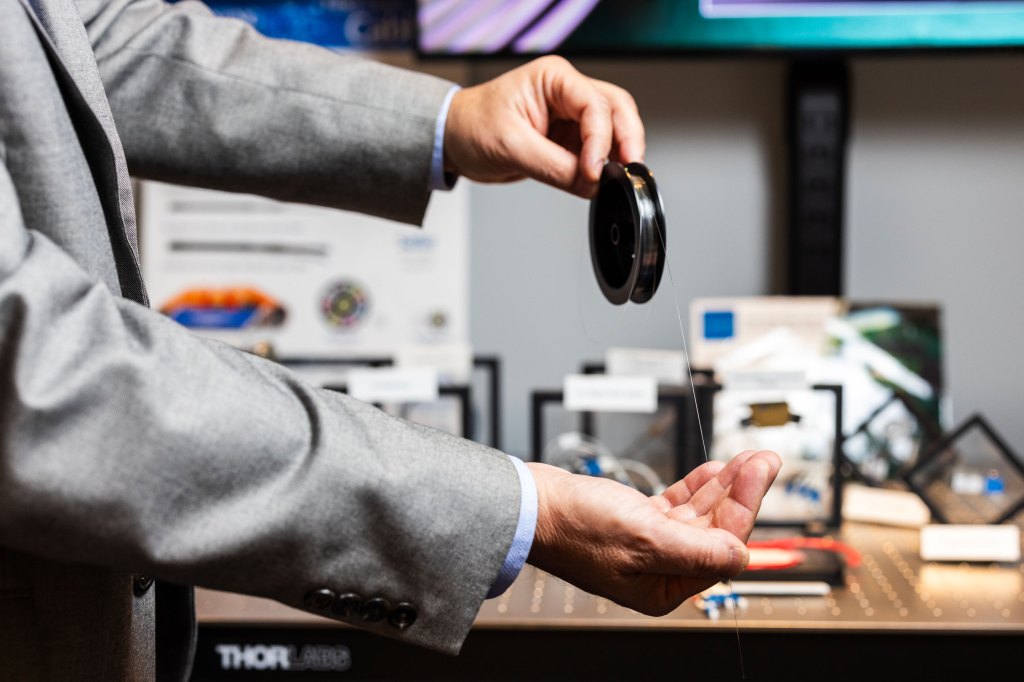
How are these fibers different from the ones Corning has produced in the past? It all comes down to density. Gen AI requires 10 times the fiber currently used, but needs to fit in the same space, Weeks says. These new, thinner fibers will allow Lumen and other customers to fit two to four times the amount of fiber into their existing ducts. Unlike copper, fiber has virtually limitless data capacity. In one fiber pair (one sending and one receiving), half of the humans on earth could be talking to the other half simultaneously, Weeks says.

But while there’s a whole lot of fiber out there, the market for it is unlikely to die down anytime soon. “Since we invented fiber, there’s now been enough installed in the world to go back and forth to the sun 20 times,” Weeks says. “And still some 50% of Americans aren’t connected directly by fiber… You think of all that copper cabling that you see—all that ultimately will fall to fiber optics for communications. So we’re still at the beginning of this long-term technology curve.” 

Corning invented optical fiber in 1970. Today the company is the world leader in fiber optic technology.
Lauren Petracca for Fortune

Corning may have invented the stuff, but it’s not the only player in the market for the original optical fiber now: Weeks is keeping his eye on competitors in Asia, including Japan’s Sumitomo Electric and Furukawa Electric Co. Corning’s new fibers and designs for AI applications are still under patent, however.

The situation shows how essential it is that the company keep breaking new ground. Ford CEO Jim Farley says he has learned more from Weeks than any other CEO. (Corning provides much of the exterior and interior glass for Ford’s vehicles.) “He’s in a thermonuclear war of innovation, and we all know that the IP getting created in places like China, Vietnam, and India and around the world is real,” Farley tells Fortune. “He has to stay in front of it, so constantly fueling the innovation, constantly making the right bet on which innovations, that’s a risk for him.” 

William Kerwin, an equity analyst at Morningstar, says the biggest risk he sees ahead for Corning is how capital-intensive its products are to produce—in terms of both manufacturing and research and development. But he thinks Weeks’ three-year, $3 billion sales plan is realistic, thanks to Corning’s diversification.

“It’s a company that is not confined to one product or one market,” Kerwin says. “Glass can sound so boring, but the things they’re able to do with it in terms of durability or the iPhone screens or data-center connectivity with optical fiber is really impressive. They’re really stretching material science to its limits.”

Weeks says he’s betting on gen AI and a trend toward full-screen interior car displays to drive profits going forward. And after decades in the business, he focuses more on finding the right innovation than on predicting the timing of the next blockbuster market for a product. 

“If you understand innovation deeply, you understand that getting the timing right is almost impossible,” Weeks says. “You’ve got to be able to instead go to work on s–t that matters early, and then just scale it fast when all of a sudden it ends up you’ve got to be fast. And that’s what we’re doing now.”

This story was originally featured on Fortune.com
Good morning. Huntington Bancshares Inc. is marking its 160th year by showing that traditional branch banking and digital growth can advance together, not at each other’s expense.

Founded in 1866, Huntington (No. 351 on the Fortune 500) operates more than 1,000 branches nationwide and is leaning into expansion. CFO Zachary Wasserman described 2026 as a “major” strategic year, with a focus on integrating recent partnerships while keeping core businesses growing faster than the industry.
 
A visible piece of that strategy is the Southeast build-out. “Our expectation is opening one branch almost every two weeks this year in North Carolina and South Carolina,” Wasserman said.

Huntington opened five branches across the two states in 2025 and plans roughly 24 more this year, putting it on track for about 55 locations by the end of 2027. Beyond physical expansion, the bank views each new branch as a talent opportunity. “We’re putting a major organizational focus around this, and the results have been encouraging,” Wasserman said.

The rollout has been supported by heavy pre-launch marketing, with many branches surpassing full-year deposit targets before opening, he added.

At the same time, Huntington has become increasingly digital-first in new customer acquisition. The bank now brings in more customers digitally than through branches—an approach Wasserman described as “very unusual” for an institution of its size. Most new relationships now begin online, even if customers later turn to branches for more complex needs.

Crucially, the digital and physical footprints overlap. About 80% of new digital customers live within five miles of a Huntington branch, underscoring that local presence still matters even when accounts are opened online, Wasserman said. The bank is using that proximity to deepen relationships and drive growth in higher-value businesses such as commercial payments, wealth management and capital markets, he said.

Huntington reported on Thursday solid fourth-quarter and full-year 2025 results, driven by loan and deposit growth, higher fee income, improving margins and strong credit quality. Fourth-quarter EPS was $0.30, or $0.37 on an adjusted basis, up 9% year over year and ahead of estimates. Goldman Sachs reiterated its buy rating and $21 price target on the stock following what it called a “decent quarter and mixed outlook.”

Behind the branch and digital push is a broader integration agenda. Wasserman said Huntington is “well down the track” on integrating two recently announced bank partnerships—its merger with Veritex Holdings and a definitive agreement to acquire Cadence Bank. The bank is applying lessons from the Veritex deal, including early leadership decisions and clear communication around systems conversions, to retain employees and customers during transitions.

Wasserman framed Huntington’s strategy as a long-term effort to win market share through steady, multi-year investment rather than stop-start growth cycles. Consistent spending on branches, digital platforms and specialized businesses, he said, is key to fully realizing the benefits of the bank’s expansion over time.

Have a good weekend.

Sheryl Estrada
sheryl.estrada@fortune.com

This story was originally featured on Fortune.com
During the Gold Rush, legend had it that the best way to get rich wasn’t by panning for gold, but by selling “picks and shovels” to the miners. And there’s no better example of that strategy in action today than at Caterpillar. There, the maker of massive mining and earthmoving equipment and iconic yellow construction site gear is capitalizing on the AI boom and seeing record stock highs and solid revenue growth.

Shares of the company have climbed to record levels in recent weeks, pushing its market capitalization sharply higher—from $270 billion at the end of 2025 to approximately $364 billion as of Feb. 13, 2026. The stock, which has more than doubled over the past 12 months to an all-time high of $775, has vastly outperformed such tech behemoths as Apple (up 8%) and Microsoft (up about 1%) during that time period. And investors are betting that Caterpillar’s growing exposure to data centers, energy infrastructure, and AI-related demand hasn’t peaked yet. In fact, over the past 12 months, Caterpillar has ranked as the No. 1 best performer in the Dow.

While Caterpillar is well known for its bright yellow construction site vehicles, it has greatly broadened its business mix to include energy and power systems, and resource and mining equipment. Caterpillar CEO Joseph Creed first joined the company in 1997 and has served in various roles, including CFO for the energy and transportation segment and interim CFO. Creed was named Caterpillar’s chief operating officer in 2023 and became CEO in May 2025.

The company’s strategy is “centered on three pillars for profitable growth: commercial excellence, being the advanced technology leader, and transforming how we work—all built upon a foundation of continued operational excellence,” Creed said on a Jan. 29 earnings call.

Caterpillar (No. 64 on the Fortune 500) reported fourth-quarter and full-year results that exceeded Wall Street expectations. Full-year sales and revenue reached a record $67.6 billion, the highest in the company’s history, driven by solid demand across its construction, resource, and energy businesses. Adjusted earnings per share (EPS) for the year totaled $19.06, while fourth-quarter adjusted EPS came in at approximately $5.16, above analysts’ forecasts in the mid-$4 range.

The company also reported a record order backlog of $51 billion, up about 70% year over year, highlighting strong demand visibility entering 2026. Total full-year sales increased 4% compared with the prior year, and Caterpillar generated robust free cash flow, further strengthening its balance sheet.

“Caterpillar shares have risen dramatically over the past year as investors contemplate the company’s exposure to burgeoning demand for artificial intelligence,” Morningstar equity analyst George Maglares wrote in a recent note.

Rather than developing AI technology itself, Caterpillar supplies critical equipment needed to power and support AI-driven infrastructure. The company provides turbines for on-site primary power at data centers, generator sets for backup power, and integrated microgrid systems that can combine traditional energy sources with renewables and battery storage, Fortune’s Jordan Blum reported.

Maglares noted that Caterpillar’s construction industries and resource industries segments are both showing signs of cyclical recovery. The company exited the year with double-digit growth across all major segments, suggesting solid momentum heading into 2026. Management has guided to mid-single-digit revenue growth of roughly 5% to 7% for the current year, a forecast that Morningstar views as potentially conservative given current demand trends.

Infrastructure spending in North America remains a key driver, particularly as public-sector projects and private investment in energy and digital infrastructure continue to expand, he said. Reflecting these trends, Morningstar recently raised its fair-value estimate for Caterpillar shares into the low-$600 range, citing improved guidance and stronger end-market demand. 

The company’s evolving revenue mix also underscores its shift toward energy and power solutions. In 2024, Caterpillar’s energy and transportation segment generated about $28.8 billion in annual revenue, surpassing the company’s $25.5 billion reported by its traditional construction industries business for the first time, Fortune noted. The change highlights the growing importance of power generation and energy systems within Caterpillar’s portfolio.

Caterpillar, which celebrated its 100th anniversary last year, is still fundamentally a cyclical business that rises and falls with the global economy. But for now, Caterpillar might be the most surprising beneficiary of a boom that doesn’t look like it’s ending anytime soon.
 

This story was originally featured on Fortune.com
Shoppers increased their spending in February before gasoline prices spiked because of the attacks on Iran by the U.S. and Israel.

Retail sales rose a better-than-expected 0.6% in February, from a revised 0.1% decline in January, the Commerce Department said Wednesday.

Retail analysts say it was a strong showing given that inflation has rattled American households, but that the war in Iran may have dented the psyche of consumers with spending on gasoline racing higher over the past five weeks.

“While the overall numbers are good and suggest a continued trajectory of reasonable expansion for retail, they do not reflect the problems that have arisen since the start of the Iran conflict,” wrote Neil Saunders, managing director of GlobalData. “Since the start of March our own numbers show that consumer sentiment has soured and that rising gas prices are starting to spook consumers.”

This week the average price for a gallon of regular gasoline eclipsed $4, the first time it’s done so since 2022, and it jumped another 4 cents overnight to $4.06, according to motor club AAA.

Yet before the Iran war began, sales at motor vehicle and auto parts dealerships rose a solid 1.2% in February. Excluding that sector, retail sales rose 0.4%

Business at clothing and accessories stores rose 2%, while sales at electronics and appliance stores were up 0.5%. Sales at online retailers rose 0.7%. And business at health and personal care stores were up 2.3%

The snapshot offers only a partial look at consumer spending and doesn’t include things like travel and hotel stays. But the lone services category – restaurants – registered an increase of 0.4%.

“This was a solid report,” Ksenia Bushmeneva, economist at TD Bank Group, wrote in a report published on Wednesday.

He noted that higher gas prices at the pump will likely lift overall sales in March since the government retail sales figures are not adjusted for inflation. But he said “real spending might take a hit as consumers look to offset higher fuel costs with reduced spending discretionary items, with spending on travel and recreation the most likely areas to be cut.”

The Iran war began Feb. 28 and has shut down the Strait of Hormuz, cutting off one-fifth of the world’s oil supply. The price for a barrel of Brent crude, the international standard, is up more than 45% since the start of the war. The cost of diesel fuel has risen faster than gasoline, driving up the cost of transportation for companies. Economists expect a related bump in inflation, potentially as soon as this month.

Economists had believed that an unusually large jump in tax refunds would kick start spending at the start of the year. But spiking gas prices will take a bite of that money.

“The hit to real incomes from higher gas prices is especially regressive, hurting lower-income households disproportionately, while the lift from tax refunds is more evenly spread,” Samuel Tombs, chief economist at Pantheon Economics, wrote in a recent report. “Moreover, refunds will slow to a trickle by late April, providing little protection if high prices persist.”

Patrick De Haan, an analyst at GasBuddy, which tracks fuel prices, noted that the way to gauge the impact of gas prices is how much gas expenditures account for a shopper’s income. He said that gas prices are approaching 3% of household medium income.

“When that gets up to about 4, 4 1/2, 5%, that’s really when people really start trimming back on some of their discretionary purchases,” he said.

Some retailers are already warning of the impact on their customers if gas prices keep rising.

Daniel Erver, CEO of Hennes & Mauritz, said last week that the Swedish fast fashion chain expects energy prices will have a “significant impact on the consumer behavior” if the war is prolonged.

And Darren Rebelez, CEO of the convenience store chain Casey’s General Stores, told investors last month that a significant pullback in customer spending is unlikely unless gas approaches $5 per gallon.

This story was originally featured on Fortune.com

A quadruple amputee professional cornhole player acted in self-defense when he shot and killed a passenger in his car during a heated argument, his attorney said Wednesday.

Dayton James Webber, 27, appeared in Charles County District Court via videoconference for the bail review Wednesday, where Judge Patrick Devine noted that he left Maryland after the March 22 shooting of 27-year-old Bradrick Michael Wells and ordered Webber to remain jailed without bail.

Webber, who was extradited from Virginia and is charged with first- and second-degree murder, hasn’t entered a plea yet and is due in court for a May 6 preliminary hearing. He also faces assault and firearm charges.

Defense attorney Andrew Jezic told the court that Webber acted in self-defense and that he anticipates “a lengthy trial” to prove it.

After the hearing, Jezic told reporters that his client was “terrified.”

“The truth here is that he would have been a murder victim if he had not acted immediately in defense of his life,” Jezic said.

Family members of Webber declined to comment after the hearing.

Webber, whose arms and legs were amputated when he was 10 months old to save his life after he contracted a serious blood infection, is accused of shooting Wells, of Waldorf, twice in the head during an argument, according to police charging documents.

Karen Piper Mitchell, a deputy state’s attorney, said witnesses in the car told authorities the argument was over a gun that a friend of Wells had stolen from Webber, and that Webber was upset Wells was still friends with the thief.

In arguing that Webber should remain in custody, Mitchell noted that he drove to Virginia after the shooting and owns firearms.

According to the charging documents, Webber pulled over after the shooting in La Plata, Maryland, and asked two backseat passengers to help pull the victim out, but they refused, got out of the car and flagged down police officers.

Webber fled with the victim still in the car, the Charles County sheriff’s office said. Two hours later, a resident in Charlotte Hall, about 10 miles (16-kilometer) away, found Wells’ body in a yard along a road and notified officers.

Detectives tracked down Webber’s car in Charlottesville, Virginia, and found Webber at a hospital where he was “seeking treatment for a medical issue,” the sheriff’s office said.

Webber was featured by ESPN in 2023 in a story of inspiration, noting he rode dirt bikes, wrestled and played football before becoming a professional cornhole player. The same year, he wrote an essay for the “Today” show about how he became a professional competitor. He said he learned to grab the bean bag by the corners and throw it using his amputated arms.

This story was originally featured on Fortune.com

Tiger Woods said Tuesday he is stepping away to seek treatment, four days after his vehicle crashed in Florida and he was arrested on suspicion of driving under the influence. He will miss the Masters for the second straight year.

“This is necessary in order for me to prioritize my well-being and work toward lasting recovery,” Woods said in social media posts.

Woods pleaded not guilty in his driving under the influence case in Florida on Tuesday, hours after a sheriff’s report said deputies found two pain pills in his pocket and he showed signs of impairment after his SUV clipped a trailer and rolled over on its side.

The online court docket for Martin County showed Woods entered a written plea of not guilty and planned to waive his April 23 arraignment hearing.

It’s the second time Woods has taken a leave following a car crash. In 2009, after his SUV plowed into a fire hydrant and tree outside his home near Orlando, he took a leave of absence to work on being a better person. That lasted four months and he returned at the Masters.

Woods showed signs of impairment

Woods’ eyes were bloodshot and glassy, his pupils dilated and he had opioid pills — identified as hydrocodone — on him when interviewed at the scene of the crash, according to the arrest report released by the Martin County Sheriff’s Office.

Woods’ movements were slow and lethargic, he was sweating as he talked to deputies in the back seat of an air-conditioned car and he told them he had taken prescription medication earlier in the morning, according to the report.

Woods told deputies he had been looking at his phone and fiddling with the radio moments before he hit the trailer, the report said.

Woods has not played an official event since the 2024 British Open. He was recovering from a seventh back surgery in October and was trying to return at the Masters, where he is a five-time champion.

“I’m committed to take the time needed to return in a healthier, stronger and more focused place, both personally and professionally,” Woods said in his statement.

Woods will not be in Augusta, Georgia, where he was to appear with Masters chairman Fred Ridley to celebrate the opening of a refurbished municipal course that involved Woods, or for the prestigious Masters Club dinner for champions.

“Augusta National Golf Club and the Masters Tournament fully support Tiger Woods as he focuses on his well-being. Although Tiger will not be joining us in person next week, his presence will be felt here in Augusta,” Ridley said in a statement.

He is taking a break from the PGA Tour board

That means a break from more than just golf. He serves a key role on the PGA Tour board by leading its Future Competition Committee reshaping the schedule. A tour spokesman said Woods did not take part in Tuesday’s meeting, and the work would continue in his absence.

“Over the last year, I have come to deeply appreciate Tiger not only for his impact on the game, but for his friendship and the perspective he has shared with me as I joined the golf industry,” said PGA Tour CEO Brian Rolapp, who started last summer. “My thoughts are with him and his family as he takes this step, for which he has my full respect and support.”

Woods’ defense attorney, Douglas Duncan, didn’t respond to an email and phone call after the plea was entered Tuesday.

Woods was traveling at high speeds on a beachside, residential road on Jupiter Island with a 30 mph (nearly 50 kph) when the accident occurred. The truck had $5,000 in damage, according to the report.

The truck driver and another person helped Woods out of his vehicle through the passenger window. Neither Woods nor the truck driver were injured.

The failed sobriety test

During a field sobriety test, deputies noticed Woods limping and that he had a compression sock over his right knee. Woods explained he had undergone seven back surgeries and over 20 surgeries on his right leg, and that his ankle seizes up while walking.

Woods, who was hiccupping during questioning, continuously moved his head during one of the sobriety tests and deputies had to tell him several times to keep his head straight, the report said.

“Based on my observations of Woods, how he performed the exercises and based on my training, knowledge, and experience, I believed that Woods normal faculties were impaired, and he was unable to safely operate the motor vehicle,” the deputy wrote after the tests.

Woods, 50, is the most influential figure in golf and has become as recognizable as any athlete in the world. The first person of Black heritage to win the Masters in 1997, he has captivated golf fans with records likely never to be broken.

But his injuries have kept him from accomplishing more, including those suffered in the 2021 car crash in Los Angeles that damaged his right leg so badly he said doctors considered amputation.

At this latest crash, Woods agreed to a Breathalyzer test that showed no signs of alcohol, but he refused a urine test, authorities said. He was arrested and released on bail eight hours later.

Woods, who has been involved in four crashes over the years, is charged with driving under the influence with property damage and refusal to submit to a lawful test.

Under a change to Florida law last year, refusing a law enforcement officer’s request to take a breath, blood or urine test became a misdemeanor, even for a first offense.

___

AP Golf Writer Doug Ferguson in Jacksonville, Florida, contributed to this report.

This story was originally featured on Fortune.com

When it comes to implementing AI into business workflows, many agents and brokers typically consider things like backend office work, lead, CRM and email management, listing description drafting and marketing collateral creation. But Gary Ashton and Debra Beagle, the broker-owners of REMAX Advantage in Nashville, have found ways to incorporate AI tools into their voice calls. But these aren’t your stereotypical “robo calls.”

Two tools Ashton and Beagle have added to their AI tech stack are Remi from Speculo and Shilo. Speculo’s Remi provides their agents with cold calling and lead generation assistance, while Shilo provides them with call coaching specifically geared toward the agent’s personality. 

With Speculo, Ashton and Beagle’s agents are able to have Remi engage with lead calls that come in, answering questions about the specifications of a certain property or about what services the consumer is looking for. 

“We have licensed inside sales agents that manage all our inbound inquiries, but we use Remi as our safety net if we happen to miss a call,” Ashton said. “We also use Remi as a way to ‘revive’ our database to reach out and initiate contact when that person starts to engage again. The fact that Remi can answer questions about a home, in terms of beds, baths and square footage really helps us focus on the clients that want answers quickly with the bonus of having a direct connection to a live Realtor.”

Fewer, but more valuable conversations

Riley VanderKaay, the co-founder and CEO of Speculo, said this is exactly how he hoped Remi would help agents and brokers. 

“Now, instead you are calling 200 people instead of 2,000 and having more valuable conversations,” VanderKaay said. “We just want to give the real estate agent the power to do the thing they really want to do, which is consult people through the most important transaction of their life. Our value proposition to agents is that we are going to enable them to have better, more relevant conversations and do the things that they actually got their license to do, which is to help people through this experience.” 

VanderKaay said there are specific topics or questions that will trigger Remi to live transfer the call to the human real estate agent or find a time on the agent’s calendar to schedule a follow up call with the human agent. 

“If the consumer is indicating there is an urgency to buying or selling or they start asking questions Remi cannot answer as an unlicensed entity, then that signals to the AI that the consumer needs to speak with a human real estate agent.” VanderKaay said. 

Coaching calls using AI

This, Ashton and Beagle said, allows their agents to have more targeted conversations with consumers, enabling them to provide them with the value only a human real estate professional can. However, the AI applications in calls don’t end there for the team at REMAX Advantage. In order to empower their agents to perform better and reach more desirable outcomes on those calls, Ashton and Beagle have turned to Shilo. 

Billed as a conversational intelligence platform, Shilo listens to and grades calls providing agents with feedback about what they did well as well as areas they could improve. Agents can then “redo”the call via AI role play and work toward a more desirable outcome. 

“As broker-owners, one of the great things is that agents can login 24/7 for online coaching and utilize it when it works for them,” Beagle said. “New agents on our team are required to do two role play calls through Shilo each week at minimum, and we have seen an increase in agent performance from that.”

In addition to being able to redo and role play their own calls as well as calls experienced by other agents in the brokerage willing to share their call logs, agents are now also able to receive actionable feedback and coaching geared toward their specific personality type through Shilo’s Signals product.

Signals analyzes agent calls to surface each agent’s core motivators, fears, conflict style and social orientation. The product then generates individualized coaching recommendations based on how an agent actually communicates. 

“After about 10 calls we create a personality profile for each sales person, and it is crazy how accurate they are,” Justin Benson, the CEO and co-founder of Shilo, said. “But then it [can] provide you with recommendations on how to improve your calls based on your specific personality type.”

Benson said this means, for example, that an agent who exhibits conflict avoidant traits will not be given recommendations that feel unnatural for them to incorporate into his business. 

“Shilo working with agents to identify the best ways for them to respond to things based on their personality type is going to be so helpful for our agents,” Beagle said. 

Brokers can monitor

Shilo also allows brokers to monitor agents’ call logs and call performance to help them identify agents who may need more assistance as well as gain insights into what local consumers are currently concerned about, a feature Ashton and Beagle said they feel makes them more effective leaders for their agents. 

“We really like to review calls and then use that to improve conversational skills with our agents and make sure that we are delivering strong and consistent messaging to all of our clients,” Ashton said.  

Beagle added that it also enables them to see what strategies top performing agents are using to engage with consumers, allowing other agents in the company to learn from their experiences and successes. 

While Shilo is focused on call coaching, Ashton and Beagle said it also helps with some of the backend office tasks most people currently associate with effective ways to incorporate AI, including note taking and scheduling. 

“I also really like the note-taking and task capture features because it provides us with the summary of each call we’re on and then gives us action items and to-do lists, enabling us to leverage our time better and work smarter,” Beagle said. 

Looking ahead, Beagle and Ashton said they are excited to explore more ways these and other tools can help their agents level up their businesses, as the real estate industry embraces AI.

This post was originally published on here. 

Detroit-based Rocket Companies this week moved to dismiss a lawsuit alleging violations of the Real Estate Settlement Procedures Act (RESPA), arguing that plaintiffs failed to demonstrate injury, relied on claims beyond the one-year statute of limitations and did not sufficiently plead unjust enrichment.

The class-action suit, filed in late January, alleges that homebuyers who began their search through subsidiary Rocket Homes were referred to third-party agents who paid referral fees of about 35% upon closing.

It further claims agents were incentivized to steer borrowers to Rocket Mortgage — even when loan terms were less favorable — or face higher referral fees. Borrowers who were preapproved by Rocket Mortgage were also allegedly funneled to Rocket Homes and matched with agents who paid fees for services the complaint says were not actually provided.

In a March 30 court filing, Rocket argued that RESPA’s Section 8(c) “categorically exempts cooperative brokerage and referral arrangements” such as those described in the complaint. The company said the plaintiffs failed to plausibly allege key elements of a claim, including a qualifying referral, a concrete “thing of valuem” and the existence of an agreement or understanding tied to referrals.

The suit, filed in the U.S. District Court for the Eastern District of Michigan, names plaintiffs Barbara Waller, Elizabeth Johnson and Randel Clark, who allege they were steered to Rocket Mortgage or Amrock, the company’s title affiliate. They are represented by Hagens Berman, a consumer protection law firm that was also involved in similar litigation against Zillow and the National Association of Realtors. 

“There is nothing in the motion we didn’t anticipate, and we have strong answers to all of the points raised,” Steve Berman, managing partner for Hagens Berman, told HousingWire via email.

The motion to dismiss outlines the evolution of Rocket Homes’s business model. Prior to about 2019, it primarily worked with consumers who already had a relationship with Rocket Mortgage, but it has since expanded.

Rocket Homes operates a co-brokerage model in which local agents provide on-the-ground support while the company oversees the transaction. It also enforces a “preserve and protect” policy intended to honor a client’s chosen lender and avoid steering – regardless of who is the lender.

“The ‘preserve and protect’ allegations do not plausibly allege that a ‘referral’ was made to Rocket Mortgage or that Rocket Homes gave partner brokerages a ‘thing of value’ in return; and the ‘reciprocal referral’ allegations do not identify a counterparty or plausibly allege the existence of an agreement or understanding,” the motion states. 

The company further states that the complaint relies on “generalized allegations” and fails to establish actual injury, pointing in part to what it describes as unproven claims previously raised in a case that was dismissed by the Consumer Financial Protection Bureau (CFPB). That suit was filed late in the Biden administration and abandoned under the second Trump administration.

Rocket argued that its arrangements fall within RESPA’s exemption for cooperative brokerage relationships, aka, the “safe harbor.” It requires the parties to be real estate brokerages, and for the payments to be made pursuant to cooperative brokerage and referral arrangements or agreements between agents and brokers. “Both elements are satisfied here,” the filing states.

The motion also argues that plaintiffs fail to plausibly allege either a qualifying “referral” or a “thing of value.” The complaint identifies the potential for future referrals as the alleged benefit to brokerages, but Rocket contends that such possibilities are too speculative to meet RESPA’s definition.

It further argues that merely encouraging the use of affiliated services does not constitute a mutual agreement or understanding required to establish liability.

Rocket is seeking dismissal of all claims with prejudice. If the case proceeds, it asks for the dismissal of Rocket Companies, Amrock and Redfin as defendants.

This post was originally published on here. 

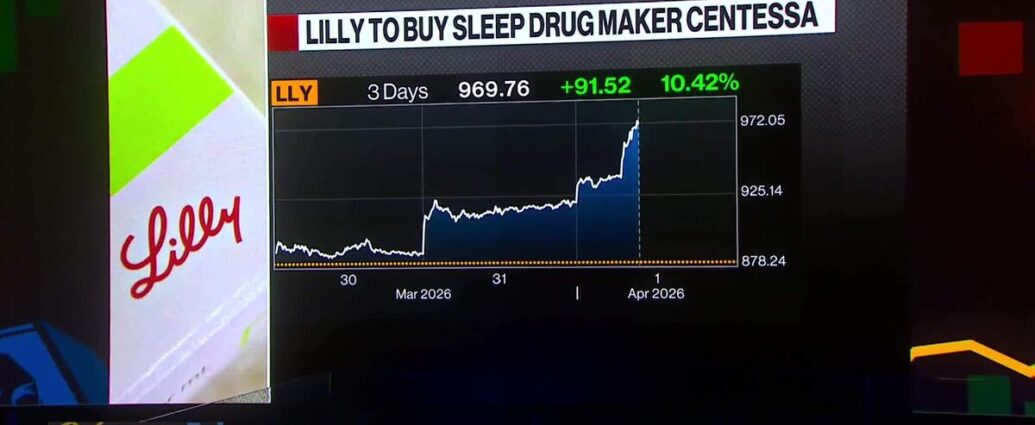
Called Foundayo, the tablet becomes the second one to receive FDA’s green light after Novo Nordisk’s Wegovy

The US Food and Drug Administration (FDA) gave the green light on Wednesday to a new oral weight-loss medication developed by the Indianapolis-based pharmaceutical company Eli Lilly.

Known as orforglipron or brand name Foundayo, the once-daily tablet becomes the second GLP-1 drug in pill form to hit the market in a short span of time, arriving after Novo Nordisk’s Wegovy pill received approval in December.

Continue reading…

This post was originally published here

British Medical Association leaders say PM’s threat to axe posts makes strike action more likely

Resident doctors have accused Keir Starmer of damaging the prospects of a deal to end their pay and jobs dispute by threatening to axe 1,000 new jobs for medics in the NHS.

The claim from the British Medical Association leaders came just before the Thursday deadline given by the prime minister for the union to accept the government’s final offer.

Continue reading…

This post was originally published here

Three months ago, this would’ve sounded absurd. Today, it’s math. Exxon Mobil Corp(NYSE:XOM) stock now trades at a higher forward P/E (price-to-earnings ratio) than Nvidia Corp (NASDAQ:NVDA).

Benzinga Pro data suggests their respective forward P/E ratios stand at 22.3x vs 21.4x (as on April 1)— flipping one of the market’s most dominant narratives: that AI commands the richest valuations.

It’s Not Just Higher Oil Prices

At first glance, it looks like oil has overtaken AI. But the reality is more nuanced.

Nvidia’s forward multiple has compressed as earnings expectations surge — the denominator is rising fast. …

Full story available on Benzinga.com

This post was originally published here

Commodity Futures Trading Chairman Michael Selig said today that the agency is in active discussions with all major sports leagues about prediction market integrity, as the industry’s biggest backer builds out institutional trading infrastructure.

“We’re talking to all the sports leagues because it’s critical that they’ve got the best information as to what’s manipulable in their markets and where the insider trading risks are,” Selig said.

From MLB To Every League

The comments come weeks after the CFTC signed a first-of-its-kind memorandum of understanding with Major League Baseball, establishing confidential information-sharing between the league and the federal regulator. Polymarket already holds exclusive prediction market partnerships with MLB, the NHL, MLS and UFC, suggesting NFL and NBA frameworks could follow.

Selig, speaking on the Faro Radio podcast, framed the push as urgent. “I’m concerned we’ll see the same with prediction markets if we keep pushing it offshore into the unregulated …

Full story available on Benzinga.com

This post was originally published here

Congress is pressing major private equity firms—including Apollo Global Management, KKR & Co., Carlyle Group, BlackRock and Blue Owl Capital—for detailed disclosures on their private credit operations.

The U.S. House Financial Services Committee wants info on sales practices, leverage, fees, incentives, audits, risk management, and potential economic vulnerabilities, according to Bloomberg.

This news comes as the private credit sector has experienced significant volatility in recent weeks. Rising rates, tighter liquidity, and a broader risk-off environment have combined to squeeze a corner of finance that expanded rapidly during the easy money era. 

Oaktree Capital Management elected to fully satisfy all redemption requests, representing 8.5% in its private credit fund for the first quarter. 

Meanwhile, Morgan Stanley (NYSE:MS) curbed redemptions after investors sought to withdraw nearly 11% of shares from its North Haven Private Income Fund …

Full story available on Benzinga.com

This post was originally published here

American workers held their jobs in force last week, sending a signal that the U.S. labor market remains one of the most resilient in a half-century — even as a drumbeat of economic warnings grows louder on the horizon.

The Labor Department reported Thursday that initial unemployment claims totaled 189,000 for the week ending April 25, falling 26,000 from a revised prior-week figure of 215,000 — the lowest reading in more than 50 years.  According to High Frequency Economics, the figure was the fewest new applications since September 1969.  The median forecast in a Bloomberg survey of economists had called for 212,000 applications. 

The four-week moving average — a measure that smooths out week-to-week swings — stood at 207,500, down 3,500 from the prior week’s revised figure. Continuing claims, a proxy for the number of people actively collecting unemployment benefits, dropped to 1.785 million for the week ending April 18, the lowest in two years. The insured unemployment rate held steady at 1.2%. 

The report landed the same morning the Commerce Department delivered a separate snapshot of the broader economy. GDP expanded at a 2% annualized rate in the January-through-March period, up sharply from the fourth quarter’s 0.5% pace, driven by resilient consumer spending, a surge in business investment, higher exports, and a rebound in government outlays that had been crimped by the record-long federal shutdown in late 2025.  Economists surveyed by FactSet had projected a 2.2% rate. 

Beneath the headline numbers, the underlying picture showed more vigor. Real final sales to private domestic purchasers — the so-called “core GDP” measure that strips out volatile government spending, inventories, and trade flows — grew at a 2.5% annualized clip, accelerating from 1.8% in the prior quarter. 

Yet the same report carried a clear warning. An uptick in imports, which rose at an annual rate of 21.4% from January through March, carved more than 2.6 percentage points off first-quarter growth.  And the economy now faces a war it did not fully absorb in Q1. The Iran conflict has sent energy prices skyrocketing due to a slowdown of traffic through the Strait of Hormuz, a critical chokepoint for global oil supply. On Thursday, the national average for a gallon of gasoline hit $4.30, the highest level since July 2022. 

Michael Pearce, chief U.S. economist at Oxford Economics, noted that the AI buildout and the tax cuts are continuing to feed through the economy but warned that the jump in energy prices will take some of the shine off what would otherwise have been a strong year. 

Olu Sonola, head of U.S. economics at Fitch Ratings, called it an AI-driven economy and cautioned that the longer the conflict with Iran drags on, the greater the risk that higher energy prices push inflation up and ultimately dampen growth. 

Heather Long, chief economist at Navy Federal Credit Union, put it plainly: companies and investors tied to AI are on fire, while middle and moderate-income households are struggling with high gas prices, slowing consumption as they manage mounting bills and growing unease about the future. 

The Personal Consumption Expenditures price index — the Federal Reserve‘s preferred inflation gauge — showed inflation running at a 3.2% annual rate in the first quarter, well above the Fed’s 2% target.  EY-Parthenon chief economist Gregory Daco projected the war could drag GDP down by 0.3 percentage points for the full year, with annual growth expected at 1.8% — a step down from the 2.1% pace recorded in 2025. 

On the jobs front, the historic claims figure is not without caveats. Carl Weinberg, chief economist at High Frequency Economics, cautioned that at some point, elevated energy costs and materials prices will cause firms to lay off marginal workers to protect profit margins.  The warning is not yet visible in the data — but economists are watching.

For now, the U.S. labor market is holding firm in the face of a war, elevated inflation, and high borrowing costs — a combination that has tripped up economies in the past. The question is how long that resilience holds.

JBizNews Desk.

© JBizNews.com. All rights reserved. This article is original reporting by JBizNews Desk. Unauthorized reproduction or redistribution is strictly prohibited.

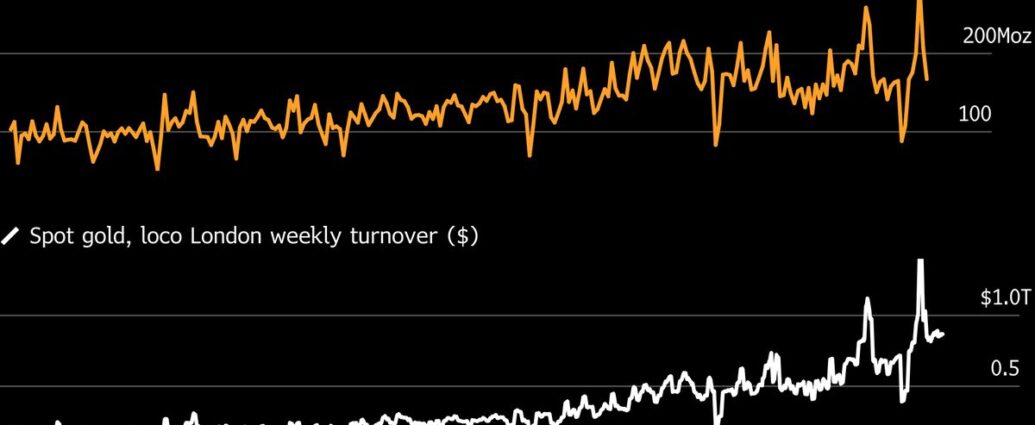
(RTTNews) – Gold prices have surged on Wednesday, with U.S. President Donald Trump sayingthat the U.S.-Israeli war with Iran could end in possibly two or three weeks, either with a U.S.-Iran deal or even without one.

This post was originally published here

Party, which has neo-Nazi roots, will hold ‘important ministerial posts within immigration’ if four-party coalition wins in September

The Swedish prime minister, Ulf Kristersson, has said that he will allow the far-right Sweden Democrats (SD) into government for the first time – and give its members key ministerial posts – if his coalition wins the next general election.

Despite becoming Sweden’s second biggest political party after the Social Democrats in the last election, SD currently plays only a supporting role in the minority-run coalition.

Continue reading…

This post was originally published here

Some underscore Trump’s unprecedented court appearance as protesters defend 14th amendment right

Around 250 demonstrators packed the steps of the supreme court on Wednesday, chanting in defense of birthright citizenship as Donald Trump himself watched from the public gallery in an unprecedented appearance.

Beija McCarter, an eighth grade US history teacher, and Noah Goldstein, a New Yorker who was also at last month’s trans rights rally, both arrived at the demonstration with little optimism about what the justices inside might decide.

Continue reading…

This post was originally published here

U.S. stocks rose, extending a “Hormuz Hope” rally from Tuesday that led all three major indexes to their biggest one-day gains in 10 months.

This post was originally published here. 

Dark Matter Technologies has launched Ask Aiva, a conversational AI-powered assistant embedded in its Empower loan origination system (LOS). The technology lets mortgage lenders query their origination environment in plain language and receive instant answers that can be traced to trusted sources, the company announced recently.

Available now to Empower clients and debuting at Dark Matter’s Horizon 2026 user conference, Ask Aiva is designed to surface operational and performance insights from lenders’ own LOS data without requiring custom reports, IT intervention or external business intelligence tools.

“The data lenders need to answer important operational questions has been just out of reach — buried in their own systems,” Sean Dugan, CEO of Dark Matter Technologies, said in a statement. “Ask Aiva changes that by allowing users to ask questions of their origination environment and receive answers they can act on, with the ability to trace those answers back to the source.”

Ask Aiva is built on a retrieval-augmented generation (RAG) architecture. The tool searches connected data sources in real time, retrieves relevant context and generates responses in natural language. Unlike many generic AI chat tools, Ask Aiva is integrated directly into the LOS workflow and is focused on a lender’s own data and configuration.

A key differentiator, according to Dark Matter, is the ability for users to click into each result and see the specific source data elements and logic behind the answer. That audit trail is intended to address common compliance and risk concerns about opaque AI outputs — particularly in a heavily regulated mortgage environment where lenders must be able to show how decisions and metrics were derived.

Dark Matter said Ask Aiva also serves as an embedded support layer for Empower, providing immediate answers to “how do I” questions on system use and configuration without requiring support tickets or long response times from help desks. For lenders, this could reduce training overhead and speed adoption of LOS features across distributed teams.

“The industry has seen a surge of AI tools that operate as bolt-ons, requiring users to leave their core systems and trust outputs without clear visibility into how they’re generated,” said Vikas Rao, chief technology officer at Dark Matter Technologies. “We built Ask Aiva differently. As one of the first AI experiences woven into the fabric of a mortgage LOS and deployed at scale, it gives lenders the ability to trace every answer back to its source, all within the system where they already work.”

Mortgage lenders have been under pressure to leverage their data to manage loan expenses, turn times and capacity planning, but most organizations still rely on static reports or analytics teams to answer basic operational questions. Embedded AI assistants that understand LOS data models and business rules could shorten that feedback loop, especially for line-of-business leaders who need quick insight into pipeline health, loan defects or bottlenecks.

Future releases, Dark Matter said, will expand Ask Aiva’s reach beyond core LOS data. Planned enhancements include support for lender-specific content such as underwriting guidelines, product matrices and internal policies, as well as broader integration across Dark Matter’s loan officer, borrower, broker and seller portals. The company also expects to introduce borrower-facing capabilities and extend Ask Aiva across the rest of its product suite.

For lenders evaluating AI in production environments, the launch underscores a broader shift from experimental pilots to embedded, workflow-level tools that must satisfy regulators’ expectations around explainability and data governance. Tools like Ask Aiva may give operations, risk and compliance leaders more comfort by surfacing not just an answer but the exact fields, rules and documents that inform it.

This article was generated using HousingWire Automation and reviewed by a HousingWire editor before publication. The system helps convert company announcements and industry data into HousingWire-style news coverage.

This post was originally published on here. 

The National Association of Realtors (NAR) has approved a set of initial governance changes aimed at streamlining its committee structure and reducing duplication.

Changes represent the first phase of a broader effort to modernize the association’s governance model, NAR leadership said.

“These member-led updates are grounded in what we’ve heard from our members”, said 2026 NAR President Kevin Brown. “Realtors have been clear that our governance system must evolve — becoming more focused, more effective and more responsive. These changes mark an important first step.”

The recommendations stem from a multi-source review conducted as part of NAR’s Committee Excellence Program — a key initiative within the association’s 2026–2028 Strategic Plan.

Member surveys, leadership feedback and a full audit of NAR’s more than 95 committees, forums, councils and advisory groups were included in the review.

Findings showed declining confidence in committee effectiveness, overlapping responsibilities across groups and opportunities to better utilize member and staff time.

As a result, NAR leadership approved a series of targeted sunset recommendations that will eliminate select committees and advisory groups whose functions are duplicative or better handled through existing channels or alternative models.

The following groups will be sunsetted as part of this initial phase:

Effective April 1:

  • Large State Forum
  • Medium State Forum
  • Small State Forum
  • State Leadership Idea Exchange Council
  • Reserves Investment Advisory Board

Effective Dec. 1:

  • Amicus Brief Advisory Board
  • Leading Edge Advisory Board
  • Leadership Identification and Development Committee

Changes are expected to reduce structural redundancy, decrease appointment volume and redirect member and staff resources toward committees and engagement opportunities that deliver the greatest strategic value, the association said.

“This process is following a deliberate, data-driven approach”, Brown added. “We are continuing to audit the system, follow the feedback and identify where additional improvements can and should be made. These initial actions will inform further changes.”

This article was generated using HousingWire Automation and reviewed by a HousingWire editor before publication. The system helps convert company announcements and industry data into HousingWire-style news coverage.

This post was originally published on here. 

Gregory S. Richardson has joined Virginia-based Atlantic Bay Mortgage Group as chief revenue officer, the company announced Thursday.

In his new role, Richardson will lead enterprise revenue strategy and alignment across production, capital markets, product development and institutional investor relationships, according to a press release.

Richardson brings more than 35 years of mortgage banking and capital markets experience to Atlantic Bay. He will oversee secondary marketing, pricing strategy, pipeline hedging and investor relationships while working with the executive team to support production growth, strengthen capital markets execution and advance the lender’s market expansion strategy.

“Greg is a highly respected leader in mortgage banking and capital markets, and we are excited to welcome him to Atlantic Bay,” Brian Holland, founder and CEO of Atlantic Bay Mortgage Group, said in a statement. “His deep experience managing large mortgage portfolios, leading capital markets teams and building strong relationships with institutional investors will play an important role as we continue expanding our production platform and delivering disciplined growth across the organization.”

Richardson most recently served as executive vice president of capital markets at Primis Mortgage, where he was part of the executive leadership team. During roughly three-and-a-half years at Primis, the company saw what Atlantic Bay described as “significant growth” in annual originations, although specific production figures were not disclosed.

Earlier in his career, Richardson held senior leadership roles at MAXEX, Movement Mortgage and AltaMira Mortgage Partners. At Movement Mortgage, he led the capital markets division that managed a $13 billion annual mortgage pipeline and oversaw loan sale execution across agency and institutional investors.

He also previously held leadership roles at Wells Fargo Securities and Wachovia Corp., where he managed a $35 billion residential mortgage portfolio and helped build a $20 billion whole loan acquisition program that generated more than $210 million in excess returns, according to the release.

The addition of a dedicated chief revenue officer with deep secondary and capital markets experience reflects how nonbank lenders are prioritizing execution and pricing in a market defined by volatile rates, thinner margins and intense competition for purchase business. For lenders, disciplined hedging, strong investor relationships and optimized loan sales strategies can be as critical to profitability as front-end production volume.

For retail loan officers and branch leaders, Atlantic Bay’s move signals a continued focus on capital markets sophistication and secondary execution, factors that can influence pricing competitiveness, product mix and turn times in local markets.

Founded in 1996, Atlantic Bay Mortgage Group is a private, full-service mortgage lender headquartered in Virginia Beach, Virginia. The company offers conventional, government and jumbo loans products across multiple states, and it has positioned itself as a purchase-focused lender with a customer-service emphasis.

According to Modex data, the company has 274 sponsored loan officers across 79 branch locations. It closed roughly $3.5 billion in volume across 11,175 units over the past 12 months.

Richardson’s hire comes two months after Atlantic Bay announced the addition of Robyn Zacharias as chief marketing officer. Zacharias has 30-plus years of experience in marketing and advertising leadership roles, including more than 20 years as an agency head where she spearheaded strategic, data-driven campaigns across multiple industries.

Neil Pierson reported and wrote this article with drafting assistance from HousingWire Automation, an editorial tool that helps transform announcements and industry data into HousingWire-style news coverage.

This post was originally published on here. 

Micron Technology Inc. (NASDAQ:MU) shares climbed Wednesday, rebounding after a week of declines driven by concerns over potential disruption in AI memory demand.

Investors previously fled due to fears that the new TurboQuant algorithm from Alphabet Inc. (NASDAQ:GOOGL) (NASDAQ:GOOG) would slash demand for AI memory chips.

Analysts Dismiss Demand Concerns

Market experts are pushing back against bearish sentiment. Bank of America Securities analyst Vivek Arya maintained a $500 price target on Micron. Arya noted the improvement likely leads to a “6x increase in accuracy and/or context length, rather than 6x decrease in …

Full story available on Benzinga.com

This post was originally published here

XRP (CRYPTO: XRP) gained 1.5% as Ripple launched Digital Asset Accounts and Unified Treasury, the first native digital asset capabilities embedded in an enterprise treasury management system.

The Treasury Solution

Ripple Treasury now lets CFOs view, hold, and manage both fiat and digital currency liquidity from bank and custody providers in a single system—eliminating separate platforms and manual reconciliation. 

No other treasury management system offers this.

The launch builds on Ripple’s 2025 GTreasury acquisition, which brought 40 years of enterprise treasury expertise. 

Last year, Ripple Treasury facilitated $13 trillion in payment volume for SMEs to Fortune 500 companies.

Moreover, Ripple’s 2026 survey of 1,000+ global finance leaders found 72% say they must offer digital asset solutions to remain competitive, yet most lack integration into existing workflows.

Digital Asset Accounts

Digital Asset Accounts let treasury teams create and manage …

Full story available on Benzinga.com

This post was originally published here

You’re probably sick of reading about artificial intelligence, maybe especially from this byline. But amid all the discussion, hype, and hysteria, Goldman Sachs economists Sarah Dong and Joseph Briggs have a sobering dose of reality in the data: Fewer than 19% of U.S. establishments have adopted it.

The Census Bureau’s Business Trends and Outlook Survey, as reported in Goldman’s March 2026 AI Adoption Tracker, shows that the figure is essentially flat from the prior month, though it is expected to rise to 22.3% over the next six months. It shows that adoption, while growing, has yet to reach the tipping point that would make AI a standard workplace tool rather than a competitive advantage reserved for early movers. But the data also suggests that, when used correctly, it saves a huge amount of time.

Enterprise workers who use AI are getting back nearly an hour a day, according to data from OpenAI dated December 2025. Specifically, Goldman reported that employees at companies with ChatGPT enterprise accounts save an average of 40 to 60 minutes per day thanks to AI, and 75% say they can now complete tasks they previously couldn’t do at all. The catch, of course, is that almost no one is doing this yet.

“We continue to observe large impacts on labor productivity in the limited areas where generative AI has been deployed,” the Goldman economists wrote, going on to essentially agree with the OpenAI disclosure. “Academic studies imply a 23% average uplift to productivity, while company anecdotes imply slightly larger efficiency gains of around 33%.”

Put simply: The companies using AI are pulling ahead, and most of their competitors aren’t even in the race yet.

The adoption gap is widening

The adoption divide isn’t just between industries—it’s also stark by company size. Firms with more than 250 employees report an AI adoption rate of 35.3%, more than double that of smaller establishments. But smaller businesses are starting to close the gap: Companies with 20 to 49 employees saw the largest recent increase in adoption, jumping 2.1 percentage points to 21.5%.

The sectors leading adoption are predictable—information services, professional services, finance and insurance, and education. Computing and web hosting firms top the list at 60% adoption. But broadcasting companies are expected to see the biggest surge over the next six months, according to Goldman’s analysis of Census Bureau data, signaling that the media and content industries are on the verge of a significant AI-driven transformation.

What most companies are missing

To be sure, the picture isn’t uniformly rosy. As Fortune reported last month, AI tools are also adding significant cognitive load for many workers, with time spent on some tasks increasing by as much as 346%, and deep-focus work hours dropping 2%. The time savings, it turns out, are often immediately reinvested in more work, not less.

Fortune also previously reported that some firms deploying AI are now completing product cycles that previously took 24 to 36 months in as little as six months—a compression of time-to-market that’s difficult to reverse once a rival has achieved it.

For the roughly 81% of U.S. firms not yet using AI, the data suggests they are leaving a substantial productivity dividend on the table. OpenAI’s enterprise figures show that its business users are now sending 30% more messages than they were just months ago—a signal that once workers start using the tools, engagement compounds quickly.

These stakes aren’t lost on the C-suite. A Fortune survey of CFOs published last week found that executives privately expect AI-attributed layoffs to be nine times as high in 2026 as current public figures suggest—even as many of those same CFOs acknowledged a persistent gap between the productivity gains they expected from AI and what they have actually measured so far.

The Goldman Sachs data, which shows real productivity acceleration in industries with higher adoption rates, suggests that the gap may be closing—but only for firms that have actually deployed the tools and done so correctly. To that point, Fortune reported last week that 77% of enterprises are actively pursuing AI initiatives—but many don’t know how to evaluate, procure, or deploy the tools effectively, leaving significant spending without measurable return.

The barriers to adoption are well-documented: insufficient employee skills, data security concerns, and difficulty identifying the right use cases, according to surveys from Deloitte, Gartner, and Bain & Company. But those barriers are softening. Bain found that more than 80% of reported AI use cases now meet or exceed expectations—a figure that undercuts the skepticism still common in many boardrooms.

For executives still evaluating whether to invest in AI tooling, Goldman Sachs’ data offers a clear warning: Firms that have already deployed AI are beginning to show measurable productivity gains relative to those that haven’t.

The 40 to 60 minutes a day that AI saves isn’t just a worker convenience. Across a team of 50, that’s roughly 33 to 50 hours of recovered productivity—every single day. The companies already capturing that aren’t waiting for the technology to mature. They’ve decided the risk of waiting is greater than the risk of moving.

There’s a more human dimension to that calculus, too. As Fortune reported in January, many workers whose productivity has genuinely improved with AI still describe a quiet sense of loss—of craft, of autonomy, of the slower rhythms that once defined skilled work. That hour they’re getting back, some say, doesn’t quite feel like it belongs to them anymore.

This story was originally featured on Fortune.com

After a four-year hiatus, Warren Buffett will once again host his annual charity lunch auction, and this time, he’s got some high-profile names to help him co-host. 

Stephen Curry, four-time NBA champion of the Golden State Warriors, and his wife, Ayesha Curry, a best-selling author and lifestyle entrepreneur, are partnering with Buffett for the exclusive lunch this year.

Buffett is reviving the auction, which has raised more than $53 million since it began in 2000, offering bidders a chance to win a lunch with the famed billionaire investor, this year dubbed “A Seat at the Table.” Buffett stepped away from the auction in 2022 after raising $19 million that year alone. The proceeds will be equally split with Buffett’s longtime partner GLIDE, a San Francisco-based social justice nonprofit that aids homeless individuals, and the Currys’ Eat. Learn. Play. Foundation. 

“Over the years, I’ve seen how the business community and innovative nonprofits can work together to create real change, and I’ve always believed in supporting organizations that are making a meaningful difference,” Buffett wrote in a statement. “This event is about coming together again—in a new way—with people I admire, to support work that truly matters. Partnering with Stephen and Ayesha to help launch something new in support of these communities is something I’m very happy to be part of.

Bidding starts on eBay on May 7 at 7:30 p.m. PDT and will close on May 14. The winner and up to seven guests will join Buffett and the Currys for lunch in Omaha, Nebraska, on June 24, 2026.

Previous winners include Ted Weschler, now a top investment manager at Berkshire Hathaway, and hedge fund manager David Einhorn. Every winning bid since 2008 has surpassed $1 million, but in the auction’s earlier days, $25,000 could buy you lunch with the Oracle of Omaha. 

Building a partnership

Buffett reached out to the Currys over the holidays after their foundation caught his attention, Eat. Learn. Play. CEO Chris Helfrich told Fortune. 

“For us, this is about using the platform we’ve been given to create something bigger than ourselves,” Stephen and Ayesha Curry said in a statement. “With this incredible auction, we are excited to turn this moment into real impact for students and families throughout the Bay Area community. Eat. Learn. Play. was built on the idea that every child deserves the chance to thrive, and by partnering with Warren and his incredible team alongside GLIDE, together we can extend our efforts and impact even further.” 

In just seven years, the foundation has distributed more than 25 million meals to kids and families in Oakland, the Currys’ adopted hometown. 

Only about a third of Oakland’s public school students read at grade level, which has inspired Eat. Learn. Play. to invest heavily in early literacy programs. The organization provides one-on-one professional tutoring to thousands of students three to five days a week, Helfrich said. The foundation is also remodeling more than 25 public elementary schoolyards in the Oakland Unified School District and has completed 15 new playgrounds, so far.  

“It’s safe to say that if this becomes an annual thing, that would be a dream for us,” Helfrich said. 

Continuing a legacy

The charity lunch has become one of Buffett’s signature philanthropic events, but it all started with his first wife, Susan Thompson Buffett. 

Susan volunteered at GLIDE, which is home to a host of social justice and community services, including daily free food assistance, helping people transition out of homelessness, and addiction recovery programs. 

“None of us knew who she was. We knew her name was Susie. She would come in, and she served meals in the kitchen,” GLIDE President and CEO Gina Fromer told Fortune. Volunteering turned into a years-long partnership before Susan passed in 2004, and Buffett continued the auction for years afterward. 

After stepping away from the auction in 2022, Salesforce CEO Marc Benioff took over the lunch for two years, raising $1.5 million in 2024.  

“I just think he came back, because he never left,” Fromer said. “He always watched and saw that the community of San Francisco, the revitalization coming back from COVID [and] how important GLIDE’s role has been in that.” 

This story was originally featured on Fortune.com

Michael O’Leary says UK’s reliance on Kuwait for jet fuel supply amid Iran war exposes it to possible shortages

The UK is the most vulnerable country in Europe to potential jet fuel shortages as the Iran war throttles supplies from the Gulf, the boss of Ryanair has said.

Michael O’Leary, the chief executive of the budget airline, said Britain would be the most exposed to jet fuel shortages because it relies on Kuwait for about 25% of its supply.

Continue reading…

This post was originally published here

Distressed riders who were stranded for hours say Apollo Go customer service agents offered ‘useless platitudes’

A “system malfunction” has caused several self-driving robotaxis to stall in the middle of the road in China, police have confirmed, after distressed riders were stranded for hours.

Local authorities in the central Chinese city of Wuhan said they began receiving calls “one after another” on Tuesday night from riders reporting that autonomous vehicles operated by the Chinese internet company Baidu had frozen.

Continue reading…

This post was originally published here

Discussion on how to ease impact from Iran war coincides with Food and Drink Federation almost tripling forecast

Food inflation could hit 9% in the UK this year even if the strait of Hormuz opens within the next few weeks, figures suggest, as the Iran war pushes up energy prices.

The Food and Drink Federation (FDF), which represents 12,000 food and drink manufacturers, has predicted prices will rise by “at least” 9% by the end of 2026, almost tripling a forecast of 3.2% that was made before the Middle East conflict.

Continue reading…

This post was originally published here

Crown Prosecution Service confirms support on inquiries after arrests on suspicion of misconduct in public office

Police are receiving advice from prosecutors as part of their inquiries into Peter Mandelson and Andrew Mountbatten-Windsor’s links to Jeffrey Epstein.

The former duke of York and the former UK ambassador to the US were both arrested in February on suspicion of misconduct in public office over their connections with the late financier. They have since been released under investigation.

Continue reading…

This post was originally published here

SpaceX has reportedly submitted a draft initial public offering (IPO) registration to the U.S. Securities and Exchange Commission (SEC).

According to Bloomberg, SpaceX is targeting a June listing with a valuation of more than $1.75 trillion, making it the largest IPO in history, surpassing Saudi Aramco‘s $29 billion debut in 2019.

By filing confidentially, SpaceX can receive SEC feedback and make adjustments before its prospectus becomes public.

According to previous reports, Bank of America, Goldman Sachs, JPMorgan Chase and Morgan Stanley have all secured senior roles on the deal. Citigroup is also among the banks preparing the IPO.

International banks are also taking part in the process. Royal Bank of Canada, Mizuho Financial Group and Macquarie Group …

Full story available on Benzinga.com

This post was originally published here

The Trade Desk Inc (NYSE:TTD) shares are trading lower on Wednesday. The move follows a brief Monday recovery. Investors are weighing increased bearish bets against lingering industry headwinds.

The Nasdaq is up 1.71% while the S&P 500 has gained 1.14%.

• Trade Desk stock is under selling pressure. Why is TTD stock trading lower?

Short Interest Surges

Short interest in the ad-tech giant rose during the last reporting period. Shorted shares increased from 46.29 million to 49.90 million. This now represents 11.4% of the company’s publicly available float. At current volumes, it would take 2.08 days for short sellers to cover.

Publicis Fallout Lingers

Confidence remains shaken by reports …

Full story available on Benzinga.com

This post was originally published here

Lamb Weston Holdings, Inc. (NYSE:LW) shares fell despite stronger-than-expected earnings and revenue as margin pressures weighed on sentiment.

Pricing headwinds and softer international demand overshadowed operational gains and a raised sales outlook.

• Lamb Weston Hldgs stock is taking a hit today. Why is LW stock dropping?

Quarterly Metrics

The company reported third-quarter adjusted earnings per share of 72 cents, beating the analyst consensus estimate of 61 cents. Quarterly sales of $1.565 billion outpaced the Street view of $1.492 billion.

Net sales at constant currency were essentially flat, as a 7% increase in volume was offset by a 7% decline in price/mix. 

Volume growth was …

Full story available on Benzinga.com

This post was originally published here

One of the most influential investors in crypto wants a bigger slice of the burgeoning prediction markets space. Venture capital firm Paradigm is developing a prediction markets trading terminal, according to sources familiar with the matter, who asked for anonymity to talk about private business dealings. Arjun Balaji, a partner at the venture firm, is leading the initiative, which will cater to professional traders and market makers, according to the sources, who say he’s been working on the project since late 2025.

Balaji did not respond to a request for comment. A spokesperson for Paradigm declined to comment.

The trading-terminal project comes at a time when mainstream financial institutions are scrambling to take advantage of the growing popularity of prediction markets, which let traders speculate on the results of sports games, elections, and even the price of Bitcoin. 

Paradigm has also mulled whether, in addition to creating a trading terminal, it should establish an internal market-making desk in the prediction markets space, said two sources. 

In addition, a third source familiar with Paradigm said the venture firm is working with researchers to explore the feasibility of creating prediction market indexes. This would entail bundling multiple prediction markets together into one tradable package, much like the S&P 500 combines the stocks of 500 companies into one index. The venture capital firm has already begun collecting prediction market data into a public dashboard.

Kalshi and Polymarket

Paradigm has been a prominent backer of Kalshi, one of the two leading prediction markets. The venture capital firm joined three successive raises for Kalshi in 2025 and led the funding round in December that valued Kalshi at $11 billion. Now, Kalshi has raised at least $1 billion in a new financing round that values the business at $22 billion.

Matt Huang, the venture firm’s cofounder and managing partner, is on the startup’s board of directors. Paradigm’s development of a prediction markets trading terminal isn’t competitive with Kalshi’s platform, said a source.

Archrival Polymarket has also exploded in growth and is in talks to raise a new round of funding at a roughly $20 billion valuation, the Wall Street Journal reported. Meanwhile, there is even a new venture firm focused solely on prediction markets, backed by the CEOs of both prediction markets.

Paradigm’s push into prediction markets also comes as the firm continues to expand beyond its historical remit of digital assets into other sectors in tech. The firm is raising as much as $1.5 billion for a new fund that will not only focus on crypto but also AI and robotics, the Wall Street Journal recently reported.

The venture firm has a history of incubating its own projects. In 2024, Paradigm CTO Georgios Konstantopoulos launched the crypto software development company Ithaca and served as the startup’s CEO. And more recently, Paradigm has partnered with fintech giant Stripe to build Tempo, a high-speed blockchain designed for stablecoins, or cryptocurrencies pegged to real-world assets like the U.S. dollar. 

Huang, the venture firm’s managing partner, is leading the project. Tempo employed around 70 staffers in early March, said a source familiar with the business.

This story was originally featured on Fortune.com

Who ever said that younger generations were impulsive spenders?

RTB House’s 2026 US consumer study “Before They Buy” reveals that 50% of Gen Z customers dwell on what’s in their cart for two or more days before committing to a purchase. Meanwhile, only 24% of boomers reported mulling over their purchasers for that long.

Overall, 40% of new shoppers visit e-commerce sites with a clear item in mind, while the other 60% are simply browsing or have a more flexible intent, suggesting most consumers simply do not know what they want to buy.

And although the younger cohort was giving its purchases a fair amount of thought, the survey, which recorded responses from 1,000 shoppers across the US, also found that both Gen Z and millennials are 50% more likely to spend more in the future versus older generations.

“Everything in today’s e-commerce environment is being driven by increased intensity of the research phase and true generational divides during the current macroeconomic environment,” Jaysen Gillespie, VP of product marketing and analytics at RTB House, said in a statement. “Marketers can no longer rely on broad assumptions about their potential customers. To win, brands must meet their customers across all devices and out-maneuver competitors during the critical research phase.”

The proclivity for research among Gen Zers also extends beyond their computers. Per a 2025 YouGov survey, 69% of Gen Z said they started their “decision-making” process when considering a purchase online, but 53% actually still went to a store to browse.

The findings come in light of rising costs and tightening consumer budgets. Recent reporting from USA Today found that shoppers were exhausted by inflation and tariff-driven price increases.

This report was originally published by Retail Brew.

This story was originally featured on Fortune.com

Shake Shack is adding more artificial intelligence to the burger chain’s menu. 

On Wednesday, the company announced “Project Catalyst,” a four-pillar initiative that will prioritize technology investments on digital systems, AI, and data to improve service speed and accuracy, generate insights that will make it easier for operators to run their restaurants, and offer more AI-driven personalized promotions to lure diners. Shake Shack says these investments are critical to help the business as it plots an expansion of the concept to 1,500 company-operated locations. 

“We’re opening a lot of new Shacks,” says Justin Mennen, who has served as chief information and technology officer at Shake Shack since January 2025. “What brought the company from one to 400 Shacks is probably a little different than what’s going to bring it from 400 to 1,500. We need to have a very efficient technology stack to power operators.”

Mennen says he’s especially focused on what he calls practical AI, which will include use cases that can simplify workflows for the corporate team, eliminate manual tasks, and help restaurant operators make better decisions. These new tools include Ask Shack, an internal knowledge-based AI chatbot that’s currently in pilot. One way that Ask Shack is currently being used is to help the real estate team analyze new restaurant locations.

Within the restaurant itself, Mennen says he intends that AI will be used to monitor data from disparate parts of the business—drive-thru orders, the queue at the kiosk, and in-store demand—and then make recommendations to shift labor to prioritize the most urgent tasks. When making these investments, Mennen says he wants to see a better guest experience, more accurate and faster orders, and more precise promotions through Shake Shack’s newly launched loyalty program.

Ideally, restaurant team members won’t even know that they’re working closely with AI. “They shouldn’t have to understand whether it’s an AI agent,” says Mennen.

Another pillar of Shake Shack’s Project Catalyst involves integrating a new vendor, Qu, a restaurant technology company that sells a consolidated, cloud-based point of sale system to handle all orders across online, app, and kiosks. Mennen says that Shake Shack tested Qu in the company’s restaurant labs in its Atlanta and New York offices, where the chain tests various technology solutions. He’s now piloting the technology to ensure all POS use cases are covered and anticipates making adjustments before Qu is fully rolled out.

Qu’s technology will make it easier for Shake Shack to add limited-time menu items to the chain’s digital menu boards, give operators more visibility into order flow, and help handle the massive swell in orders that are made at kiosks. Shake Shack, like many restaurant chains, made a big investment in kiosks after the pandemic and that channel is now larger than in-person ordering with a cashier.

The two remaining areas of focus for Project Catalyst are the chain’s new loyalty program rollout and an effort to unite operational data, guest behavior, and analytics. Mennen declined to quantify whether the investments in Project Catalyst were an increase from Shake Shack’s baseline IT spending.

Shake Shack’s efforts to lean on technology to more efficiently run restaurants comes as the broader industry faces increased expenses that have been exacerbated by tariffs, higher rents, and increased wages. Over the past two years, restaurant and takeout costs have climbed at a faster pace than grocery channels, according to consulting giant McKinsey.

Larger chains including Starbucks, McDonald’s, Taco Bell, and Burger King have also unveiled AI initiatives that have included AI-enabled headsets, using the technology to help predict when equipment maintenance issues occur, and to support drive-thru orders. The latter has been a particular popular AI use case, though results have been very mixed.

Another technological area of focus for the industry has been robotics, autonomous systems that can whip up fries or salads, serve as a waiter, or more commonly, be used for food delivery. Shake Shack has explored some partnerships in this space, including leveraging Serve Robotics’ autonomous robots to handle online deliveries from apps like Uber Eats in select markets like Los Angeles and Jersey City, New Jersey. But Mennen says that robotics aren’t a core priority.

“Project Catalyst is really, from an AI standpoint, focused on practical use that’s going to drive more immediate ROI for us,” says Mennen.

John Kell

Send thoughts or suggestions to CIO Intelligence here.

This story was originally featured on Fortune.com

A judge on Wednesday granted Luigi Mangione only a slight delay of his federal trial in the killing of UnitedHealthcare CEO Brian Thompson, moving it from September to October instead of next year, as his lawyers had wanted.

U.S. District Judge Margaret Garnett tied her decision to the schedule of Mangione’s state murder trial, which is set to begin June 8 and take four to six weeks. She rejected a defense request to postpone the federal case until January or February 2027 so that it could then seek to delay the state case until September.

Mangione’s lawyers had argued that back-to-back trials on a compressed timeline would violate his constitutional rights. However, Garnett said their proposal to push the federal case into 2027 and slot the state case in its place doesn’t “solve any of these problems because it shifts the very same problems from the summer to the fall.”

Jury selection in the federal case will begin on Oct. 5 instead of Sept. 8, followed by opening statements and testimony on Oct. 26 instead of Oct. 13, Garnett said. The schedule could change again if the state trial is delayed, she said.

Mangione, 27, has pleaded not guilty. He faces the possibility of life in prison if he’s convicted in either case.

“There really is no way around taking into account the events in the state case,” Garnett said at a hearing in Manhattan federal court. However, she said, “I am skeptical of moving the (federal) trial wholesale into 2027 when the state trial has not been adjourned. it is a little bit of a tail wagging the dog.”

Along with the new trial date, Garnett compressed preparations for jury selection in the federal case so that they don’t overlap with the state trial, giving Mangione more time to review questionnaires filled out by hundreds of potential jurors.

The judge in the state case, Gregory Carro, previously raised the possibility of moving the state trial to September — but only if federal prosecutors appealed Garnett’s decision barring them from seeking the death penalty. They declined to do so.

Garnett’s ruling on Wednesday leaves Carro little room to delay the state trial, and pushing it until after the federal trial could raise double jeopardy concerns.

The state’s double jeopardy protections kick in if a jury has been sworn in in a prior prosecution, such as a federal case, or if that prosecution ends in a guilty plea. The cases involve different charges but the same alleged course of conduct.

At a court hearing in February, Mangione spoke out against the prospect of two trials, telling the judge: “It’s the same trial twice. One plus one is two. Double jeopardy by any commonsense definition.”

Thompson, 50, was killed on Dec. 4, 2024, as he walked to a midtown Manhattan hotel for UnitedHealth Group’s annual investor conference. Surveillance video showed a masked gunman shooting him from behind.

Police say the words “delay,” “deny” and “depose” were written on the ammunition, mimicking a phrase used by critics to describe how insurers avoid paying claims.

Mangione, a University of Pennsylvania graduate from a wealthy Maryland family, was arrested five days later after he was spotted eating at a McDonald’s in Altoona, Pennsylvania, about 230 miles (370 kilometers) west of Manhattan.

His lawyers have argued that authorities prejudiced his case by turning his arrest into a “Marvel movie” spectacle, including by having armed officers parade him up a Manhattan pier after he was flown to New York and by publicly declaring their desire to seek the death penalty before he was indicted.

In January, Garnett dismissed a federal murder charge — murder through use of a firearm — that had enabled prosecutors to seek capital punishment, finding it legally flawed.

The judge, a former Manhattan federal prosecutor appointed to the bench by President Joe Biden, also threw out a gun charge but left in place stalking charges that carry a maximum punishment of life in prison.

This story was originally featured on Fortune.com

A shift in the auto market is becoming harder to ignore as consumer demand tilts back toward larger, gas-powered vehicles, even as electric vehicles struggle to maintain momentum.

STELLANTIS TAKES MASSIVE $26B HIT AFTER MOVING AWAY FROM EVS

FOX Business correspondent Jeff Flock joined FOX Business’ Stuart Varney on “Varney & Co.” to report from the New York Auto Show, where automakers are leaning into SUVs and trucks amid changing buyer preferences.

Recent sales data underscores that pivot. Midsize SUVs and trucks are seeing notable gains, while smaller cars and electric vehicles are losing ground, highlighting a widening gap between industry ambitions and what consumers are actually buying.

According to Cox Automotive and Kelley Blue Book, midsize SUV sales are up 15%, midsize truck sales are up 14%, while compact car sales are down 8% and EVs are down 26% in February compared to the same time last year. EV momentum has become increasingly uneven. Electric vehicles reached 10.5% of U.S. new-vehicle sales in the third quarter of 2025 but fell to 5.8% in the fourth quarter as incentives faded, highlighting a sharp pullback after earlier gains.

HONDA CANCELS 3 PLANNED EV MODELS FOR US

Nissan Americas Chairman Christian Meunier pointed to another pressure shaping the market: tariffs. Automakers and suppliers have absorbed billions of dollars in added costs, limiting their ability to pass those expenses on to buyers.

“It’s a lot of money, but it’s a lot less than the exposure we had a year ago when it was implemented,” Meunier said.

AMERICANS ARE PUMPING THE BRAKES ON ELECTRIC VEHICLE ADOPTION: ‘AFFORDABILITY IS A BIG ISSUE’

He added that the company has worked to reduce that burden while increasing domestic production.

“At the very beginning, we had an exposure of $4 billion. We took it down to $1.5 billion in 25, and we’re going to get it down to zero. That’s our mission to build as many cars in the U.S. as we can,” Meunier said.

GET FOX BUSINESS ON THE GO BY CLICKING HERE

This post was originally published here.