Teenager alleged she faced racism from teacher who told her to ‘go back to her country’ for refusing to stand for pledge of allegiance

A Palestinian and Arab middle school student in Michigan who was publicly admonished for refusing to stand for the pledge of allegiance as part of a personal protest against the war on Gaza has settled with her school district following a lawsuit around her first amendment free speech rights.

The teenager, identified as DK in court documents, said she faced racism from a teacher at the West Middle school in Canton, Michigan, after she did not participate in the pledge. The teacher reportedly told DK to “go back to her country”, Fox 2 Detroit reported.

Continue reading…

This post was originally published here

Exclusive: World Service director Fiona Crack says platform pursues stories ignored by the Gulf’s state-owned media

A senior BBC executive has defended BBC Arabic as a lone voice in the region covering the “Israeli perspective”, as she warned its critics that it pursued stories ignored by the Gulf’s state-owned media.

The corporation’s Arabic service has come under sustained criticism in recent years, for its selection of coverage and for featuring some guests that had expressed antisemitic views on social media. There have even been calls for the service to be closed down.

Continue reading…

This post was originally published here

Olivia Bailey says she wants Sure Start-style hubs that will be rolled out in England on Monday to be inclusive for all

Reform UK’s “pro-family” policies are a sham and exclude non-traditional families, the government’s early years minister has said before the rollout of hundreds of new Sure Start-style family centres across England on Monday.

Olivia Bailey said she wanted the hubs to be inclusive for all families and transform communities, after what she called the “criminal” dismantling of Sure Start under the last Conservative government.

Continue reading…

This post was originally published here

President Donald Trump’s war on Iran is colliding with U.S. debt investors, who demonstrated less appetite for Treasury securities as hopes for a quick end to the conflict evaporate.

This past week, auctions for two-, five- and seven-year Treasury notes all drew weak demand, forcing yields to go higher than expected. That’s a stark contrast from last month, when a Treasury offering saw the highest demand ever in the history of 30-year auctions.

The short end of the yield curve is under extra pressure as soaring oil prices boost the inflation outlook and put additional rate cuts from the Federal Reserve on hold, with odds of a rate hike also increasing.

Meanwhile, the cost of the U.S. war on Iran is worsening the debt picture amid reports the Pentagon is seeking $200 billion from Congress. Not only has the military depleted much of its most expensive munitions that must be replenished, Iranian attacks have damaged or destroyed U.S. aircraft, radar systems, and bases.

“The U.S. Treasury bond market has finally responded to the Mideast war, giving its assessment of the energy shock’s severity and the war’s effect on U.S. fiscal imbalance and inflation,” RSM Chief Economist Joseph Brusuelas said in a note on Wednesday, pointing to a notable increase in bond market volatility and a rising risk premium to buy Treasuries.

“Investors’ concerns include an unsustainable American fiscal position, rising inflation risk and a growing uncertainty about war,” he added.

The MOVE index that tracks volatility in the Treasury market has spiked to levels consistent with price instability and policy dysfunction, Brusuelas noted.

If uncertainty continues, it could trigger broader funding stress in debt markets that were already under pressure from worries about private credit, he predicted.

The warning highlights the role of “bond vigilantes,” a term coined by Wall Street veteran Ed Yardeni in the 1980s, referring to traders who protested huge deficits by selling off bonds to push yields higher.

Previous selloffs have reined in presidents, including Trump, who pulled back on his trade war last year after the bond market turned “yippy.” With the U.S. now in an actual shooting war, bond vigilantes could throw their weight around again.

“The need for additional spending to finance the war would increase U.S. debt, sparking a bond market selloff as investors require additional compensation to cover potential losses,” Brusuelas said. “Long-term rates such as 30-year mortgage rates are based in part on the benchmark U.S. 10-year yield. Most important: The bond market remains undefeated.”

At the same time, the Iran war has now entered its fifth week, with some analysts predicting it could drag on into the fall or even next year.

That’s as the conflict widens to Iranian allies in Iraq and Yemen, while Persian Gulf neighbors edge closer to taking direct military action against the regime, which is targeting their economic infrastructure.

Thousands of U.S. Marines and paratroopers are also on their way to the Middle East, while the White House reportedly weighs deploying another 10,000 troops for a potential ground assault in Iran to reopen the Strait of Hormuz.

A prolonged war that boosts borrowing costs would come as the federal government must refinance $10 trillion of debt that is coming due in the next 12 months, while the budget deficit is already on pace to hit $2 trillion, according to Apollo Chief Economist Torsten Slok.

But the government also faces more competition for bond investors’ dollars. He previously warned the flood of corporate debt could make borrowing more expensive for the administration, and that’s exactly what happened earlier this month during the single busiest day on record for U.S. corporate bond sales.

“Total gross corporate bond issuance in 2026 is likely to be around $2 trillion because of increased supply from hyperscalers,” Slok said in a note on Tuesday. “Adding it all up, the total amount of investment grade supply coming to the market this year is around $14 trillion. The bottom line is that the growing supply of investment grade fixed income product is putting upward pressure on rates and credit spreads.”

This story was originally featured on Fortune.com

Survivors tell coastguard smugglers ordered victims to be thrown overboard after six days adrift in boat from Libya

Two Sudanese men, believed by Greek authorities to have been behind a smuggling operation in which 22 people were “systematically” thrown overboard after succumbing to days without food or water at sea, have been ordered to appear before a local court on Crete.

Accused of illegally trafficking scores of would-be migrants into the south-eastern European country from Libya, the duo were given 48 hours to prepare to testify before an investigating magistrate on Monday.

Continue reading…

This post was originally published here

More than 100 charities, campaign groups and trade unions marched in a show of unity against far right politics

Tens of thousands of people have gathered in London to march against the far right in the biggest multicultural demonstration in UK history.

Organisers claimed half a million people have travelled to the capital for the Together Alliance march. Police estimated the turnout closer to 50,000, although they admitted it was difficult to judge due to how spread out the crowd was.

Continue reading…

This post was originally published here

Treasury department said Financial Times article about Scott Bessent’s views on Fed oversight was ‘manufactured’

The US treasury department demanded on Friday that the Financial Times (FT) retract a report on treasury secretary Scott Bessent’s views on the Federal Reserve, accusing the newspaper of publishing “false claims” in a formal complaint that was escalated to the news outlet’s parent company, Nikkei Inc.

The email from treasury officials, addressed to senior editors at the FT and Nikkei, disputed multiple claims in the story and criticized the headline as misrepresenting the underlying reporting.

Continue reading…

This post was originally published here

The moonshot compensation packages awarded to executives like Tesla CEO Elon Musk, Axon CEO Rick Smith, and DoorDash CEO Tony Xu in recent years have followed a predictable script: They promise astronomical pay if the leader of a company hits audacious financial targets. 

The idea behind moonshot pay is that conventional salaries and bonuses don’t motivate the kind of tectonic risk-taking and visionary leadership that turns good companies into generational ones. So boards offer executives the chance to get extraordinarily rich—but only if they deliver extraordinarily rare results.

This week Meta put a twist on the typical playbook: it extended moonshot-level stock grants to a broader swath of senior leaders that did not include CEO Mark Zuckerberg. 

The move may usher in a new wave of compensation packages for non-CEO C-Suite executives that are just as speculative as other investments in this stage of the AI race.  

Inside Meta’s ‘big bet’

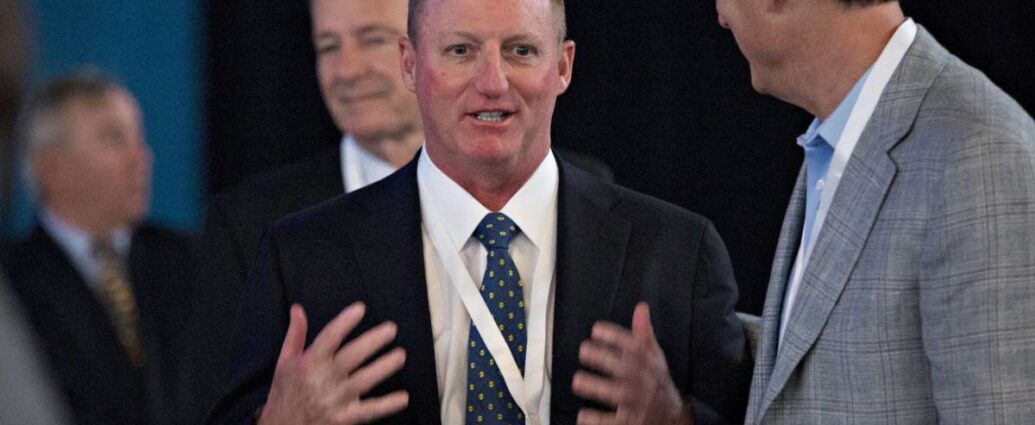
In SEC filings late Tuesday, Meta disclosed the new stock option program for its top executives that promises massive payouts if the tech giant achieves the ambitious goal of growing its market capitalization from roughly $1.5 trillion to $9 trillion by 2031. If Meta hits that mark, Meta Chief Technology Officer Andrew Bosworth, Chief Operating Officer Javier Olivan, Chief Product Officer Chris Cox, Chief Financial Officer Susan Li, Chief Legal Officer C.J. Mahoney and Vice Chairman Dina Powell McCormick would unlock options worth up to $625.6 million each, according to analysis by Equilar, a compensation research firm. That sum could rise to as much as $921 million when accounting for the restricted stock units Meta awarded to some of the executives, Equilar says.

A Meta spokesperson called the program a “big bet” that will not reward the executives unless “Meta achieves massive future success, benefiting all of our shareholders.”

Compensation experts have long been wary of this kind of award. Robin Ferracone, founder and CEO of Farient Advisors, an executive compensation, performance, and corporate governance advisory firm, doesn’t usually care for moonshots. “They create undue risk-taking,” she says, and they focus too narrowly on the tip-top of company leadership. 

Seventy-five public company executives have received awards with a grant date value of $100 million or more since 2018. Of the recipients, only 11 do not have the title of CEO, chair, or founder, according to Equilar data.

“One of the reasons I didn’t really like the Elon Musk award is that he can’t do it by himself. If he’s trying to get those big things done, he’s got to have a team doing it,” Ferracone says. 

What’s more, a January analysis of moonshot packages, reported by the Wall Street Journal, found that they rarely deliver the outsize returns they’re intended to spur. (While Musk and Smith made good on their moonshot deals and earned billions, Xu is far from unlocking the upper tranches of his package.) 

In the same boat as Zuckerberg

But Meta’s program is unique in that it covers multiple executives. “This recognizes it’s a broader group that has to get this done,” Ferracone says. 

The group of six certainly has a lot to do, and the new compensation program spreads the accountability around. Meta is racing to reinvent itself as an AI‑first company, pouring tens of billions into custom chips, data centers, and AI researchers to build frontier models and deliver on the promise of AI “superintelligence.” Meta estimates its capital expenditures could reach $135 billion this year, most of which will fund AI initiatives. Zuckerberg is expecting AI to transform how Meta’s workforce operates, enabling fewer employees to get more done. He has already overseen the flattening of teams and is reportedly developing a personal AI agent to assist with his own work. 

The stock options send a clear message to his leadership team, Ferracone says: “Figure out how to take advantage of AI and make it value-creating, and do it in the next five years.”

Make no mistake: The buck still stops with Zuckerberg. But as founder-CEO with a roughly 13% economic stake in the company, his fortune—pegged at $187 billion at Friday’s close—is already inextricably tied to Meta’s. 

“He’s got so much riding on this through his ownership,” Ferracone says. “And so this is a way to get [other executives] in the boat with him.”

Meta’s stock options may represent a new chapter in the AI-era talent war that’s already seen top technologists command nine-figure pay deals, with Meta among the top spenders. 

And just as Elon Musk’s initial moonshot package spawned a whole class of copycats (including Musk’s more recent $1 trillion plan), Ferracone expects other tech companies to mimic Meta’s latest move. “With technology companies, there’s kind of a lemmings mentality,” says Ferracone. “They really follow one another, and so I’m expecting to see more of these.”

This story was originally featured on Fortune.com

Incident in the city’s 8th arrondissement reportedly involved a homemade explosive device

French police prevented an apparent bomb attack outside a US bank in Paris on Saturday when they arrested a man about to set off a homemade explosive device, officials and sources close to the case said.

The incident occurred at about 3.30am (0230 GMT) in front of a Bank of America building in the city’s 8th arrondissement, a couple of streets away from the Champs-Élysées.

Continue reading…

This post was originally published here

The biggest winners from this year’s World Cup are poised to be those able to rent out their properties, especially in the tri-state area.

Bobby Roufaeal, who manages more than a dozen short-term rentals in New Jersey, said a luxury rental in the state could bring in $240,000 between June 11 and July 19 when the tournament runs. He said he’s tripling rates for his units in anticipation of fan inflow for the games and fielding calls from homeowners looking to capitalize on demand.

“They’re like, listen, I’ll figure it out. I’ll go stay with my relatives for the month or for a few weeks just to be able to capitalize on this revenue,” said Roufaeal, founder of Settled In Property Management.

Already listings show a surge in prices. One six-bedroom Airbnb Inc. property in Princeton, New Jersey, is offered at roughly $6,000 a night during the World Cup, about 140% higher than its price a year ago. That’s despite being more than an hour’s drive from the games being played at MetLife Stadium.

The fervor is reshaping the lodging market in World Cup cities across the US, which are expecting millions of visitors throughout the course of the tournament. Matches are also being held in Mexico and Canada.

For those renting out their homes, it can be a lucrative prospect — especially as Airbnb has offered as much as $750 in cash for first-timers to incentive new listings. For travelers, the cost of attendance adds up as prices surge for tickets, hotel rooms and flights. The tourism boom is expected to lift hotel rates in the host cities by an average of 300% around opening matches, the New York Times has reported. 

Those expenses are causing Mehdi Salem, the founder of French soccer fan association Les Baroudeurs du Sport, to find ways to save money as he organizes accommodations for 80 of his members to see France play at MetLife.

He’s squeezing eight people in a room designed to sleep four and booked hotels in Manhattan more than a year before the games when prices were lower. Now, he is looking at spaces in New York City’s outer boroughs like the Bronx and Queens, as well as Airbnbs in less-traveled New Jersey neighborhoods. 

“Some prices are totally ridiculous,” Salem said. 

Montclair, New Jersey, a well-off suburb, has seen a 169% increase in short-term rental occupancy during the group stage compared to the same dates last year, according to data as of March 26 from analytics platform AirDNA, which tracks rental demand, rates, and occupancy across host cities. Nearby towns of Clifton, Newark, Paterson and Jersey City, have also seen surges, the data shows. 

Jamie Lane, chief economist at AirDNA, said that as the games grow closer — prices are poised to increase. 

“When bookings start, people typically aren’t booking the properties that are priced really high,” he said. “Other properties that are more reasonably priced do get booked and then we see the delta between the available rates and the booked rates begin to merge.”

Attending the World Cup will be expensive for any spectator, especially those traveling from abroad. Ticket prices can range wildly, in part due to the implementation of FIFA’s dynamic-pricing strategy which raises rates depending on demand. Initially, tickets started at $60 and could be as much as $6,730 — though those increased in subsequent batches. The numbers are even larger on the secondary market, with those for the coveted July 19 final starting at around $8,000 and topping $50,000, according to listings on resale site StubHub. 

Salem, the French organizer, said that many of his members are staying home because of the high costs. “Globally, people are complaining about the prices and we lost many, many good followers and good fans are not coming because of the prices,” he said. 

Some fans are looking outside of the major hubs to smaller host cities that can be more affordable. Data from Expedia Group Inc. shows searches rising most sharply in secondary markets, such as Kansas City, Dallas and Houston. Lodging prices outside of the US in Canada and Mexico remain the most affordable. 

“If you look to the smaller towns, you can have venues that are more easily accessible,” said Michael Seiler, professor of real estate and finance at the College of William & Mary. 

Houston tourism officials say the pace of hotel bookings for June and July is already running more than double last year’s levels across major submarkets. In Dallas — which is hosting more matches than any other US city — searches for housing options are up 230% from last summer, according to the Expedia data from January. 

“Dallas is no stranger to major sporting events, but this isn’t simply another big event,” Zane Harrington, a spokesperson for the city’s tourism bureau said. “The FIFA World Cup is unlike anything we’ve experienced before.”​ 

Michael De Micco won World Cup tickets for a game at Gillette Stadium in Foxborough, Massachusetts, through his employer, Frito-Lay Inc. He plans to drive about nine hours from his home near Pittsburgh and has already ruled out hotels as too expensive. Instead, he considered Airbnb and Vrbo Holdings Inc. rentals in Providence, Rhode Island, after seeing a listing near the stadium that was out of his budget. 

“There’s no way am I spending a thousand dollars a night,” he said. 

Real-estate investor Geoff Colleran is on the other side of the equation, listing his homein Foxborough for more than $2,000 per night.  He said he hopes to use the profits to pad out his investments and pay off some debt. 

“I would be extremely disappointed if that entire portion of time from mid-June through July isn’t booked,” said Colleran. “On a typical summer we do $50,000 to $60,000. So I’d expect a six-figure summer.”

This story was originally featured on Fortune.com

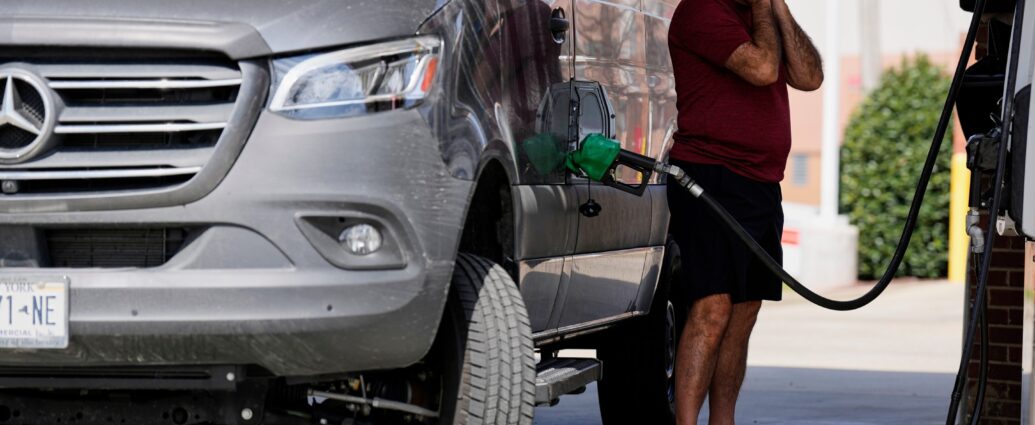
Oil prices have surged more than 40% since the start of the Iran conflict, rattling global energy markets and raising concerns that U.S. drivers could see further increases at the pump.

Analysts say consumers may not have felt the full impact yet because higher crude costs typically take weeks to filter through to retail gasoline prices. Even if oil stabilizes, pump prices could continue rising in the near term.

“More than likely there is more to come, because there’s usually a lag between crude prices and what consumers pay at the pump,” said Phil Flynn, a FOX Business contributor and senior market analyst at Price Futures Group.

IRAN WAR COULD PUSH INFLATION HIGHER THIS YEAR, GOLDMAN SACHS SAYS

Michael Mische, a supply chain expert and professor at the University of Southern California, also predicted the worst is not over, telling FOX Business, “There’s more still to come.” 

“There is a lag, and prices will continue to work their way through the system,” he added. 

U.S. benchmark West Texas Intermediate crude closed at $99.64 a barrel on Friday, remaining elevated after a volatile stretch tied to the conflict. While prices were on track for their first weekly decline in more than a month, they remain sharply higher than pre-conflict levels.

The rally follows supply disruptions linked to U.S. and Israeli strikes on Iran, which analysts estimate have removed roughly 10 million to 11 million barrels per day from global markets, tightening supply.

Geopolitical uncertainty continues to drive the market. The U.S. has extended a deadline for Iran to reopen the Strait of Hormuz — a critical route for global oil shipments — while also weighing additional military action. Prices could fall if the conflict eases but are likely to remain above pre-conflict levels, while a prolonged escalation could push prices higher.

IRAN WAR FUELS ASIA ENERGY CRUNCH AS INDIA, JAPAN, OTHERS FEEL STRAIN

“Even with this supply shock, the increase has been relatively orderly, and it could have been much worse,” Flynn said.

But Mische noted that strong domestic production has helped cushion the impact. 

“If we didn’t have current U.S. production levels, we would be in a real mess,” he said.

For consumers, gasoline prices have already begun to rise, but further increases may be ahead as the earlier crude spike continues to pass through the system.

The national average price for regular gasoline stood at roughly $3.98 per gallon, according to AAA, up about 6 cents from a week ago and nearly $1 higher than a month ago. GasBuddy data shows a similar trend, with prices rising about 7 cents week over week and more than $1 over the past month.

That increase largely reflects earlier gains in oil, and because retail fuel prices lag behind crude movements, analysts expect additional upward pressure in the coming weeks.

CLICK HERE TO GET FOX BUSINESS ON THE GO

Seasonal factors are also contributing. The transition to more expensive summer gasoline blends is underway, increasing refining costs and potentially keeping pump prices elevated even if crude stabilizes.

“Prices go up like rockets, and they come down like a feather,” Mische said.

Reuters contributed to this report.  

This post was originally published here. 

Matthew Uthoff and his wife, Amber Dena Snow, allegedly gave oxycodone-laced pasta dish to unknowing victim

Two people in Iowa were accused of giving a pregnant woman a lasagna laced with narcotics with the intention of causing a miscarriage, according to law enforcement.

Matthew Uthoff, 35, and his wife, 36-year-old Amber Dena Snow, are accused of delivering a lasagna containing oxycodone to the pregnant individual. The couple faces several charges including delivery of a controlled substance and purposefully terminating a human pregnancy without the knowledge and voluntary consent of the pregnant individual.

Continue reading…

This post was originally published here

Maybe Dad was right about getting to the airport early. But it turns out there’s still such a thing as TOO early.

Travelers panicked by scenes of never-ending lines at U.S. airport security checkpoints and frustrating tales of missed flights over the past few weeks are now showing up way before their departures. Some airports where the wait times have been manageable say those early birds are only adding to the misery — and in some cases causing other passengers to get to their gate too late.

In Ohio, John Glenn International Airport in Columbus is warning passengers against arriving hours in advance, even creating a chart showing when to show up: “90 minutes before departure is all you need.”

The airport says those premature arrivers — reacting to the funding standoff on Capitol Hill that’s creating crowded security checkpoints — are making things worse by creating bottlenecks during peak times.

“Arriving too early can actually create longer lines right when we open,” the airport said in a social media post Thursday. “Spacing out arrival times helps keep things moving smoothly for everyone.”

It’s Airport Dad’s moment — finally

In some ways, the airport chaos is turning into a full circle moment for “Airport Dad” — a humorous TikTok and social media take on the dad who always makes sure the family is out the door, parked, through security and positioned at the correct gate well before anyone else, with paper boarding passes in hand.

Airline customers aren’t laughing, at least right now. They’re facing record wait times in a jumbled environment — the modern American airport — that can serve up assorted stresses and snafus on the best of days.

Amber Campbell said she missed a morning flight this week despite arriving at Baltimore-Washington International Airport more than three hours ahead of time.

“We noted several people in line with later afternoon flights,” Campbell posted on Facebook. “There was no organization or consideration for those of us missing flights vs people with later flights. We missed our flight by ten minutes!”

What’s confusing for air passengers is that it’s hard to predict which airports will be plagued next by security lines spilling out of terminals.

Checkpoints in some places are beyond two hours

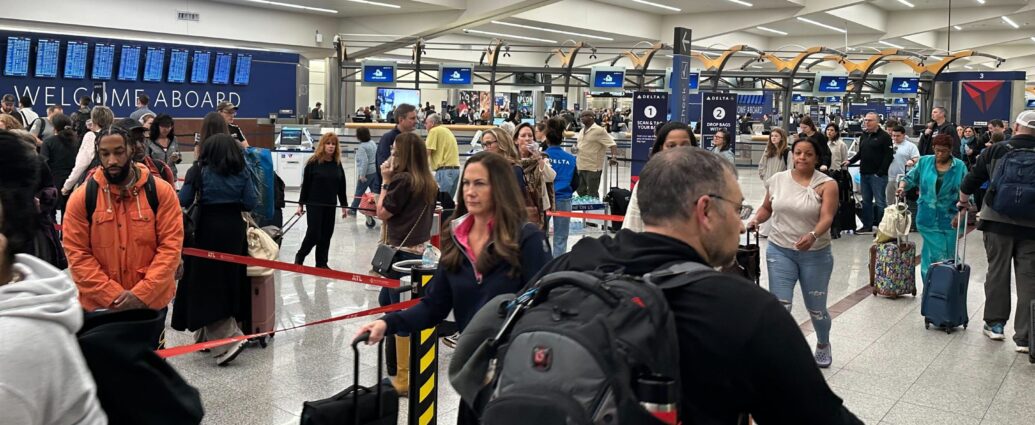
The government shutdown straining Transportation Security Administration staffing has ballooned checkpoint wait times beyond two hours at some major airports. George Bush Intercontinental Airport in Houston has become the biggest chokepoint for travelers with four-hour security lines.

“An absolute nightmare,” said Arthur Tsebetzis, while standing in a line Friday that snaked through the main terminal and spilled outside Hartsfield-Jackson International Airport in Atlanta.

Those are by far the worst-case scenarios. Many airports — like the one in Ohio — have been seeing wait times comparable with those in normal times. That’s why airlines say the best advice for passengers right now is to check TSA wait times before their scheduled departures.

It’s a bit reminiscent of the days of “panic buying” during the early part of the COVID-19 pandemic in 2020.

“It’s human nature. You don’t have control over what’s going on at an airport,” said Shari Botwin, a Philadelphia clinical social worker who counsels people about anxiety.

“There’s so much media attention about the chaos at airports,” she said. “They might not trust when someone says, ’Well, you don’t need to come out early anymore.’”

This story was originally featured on Fortune.com

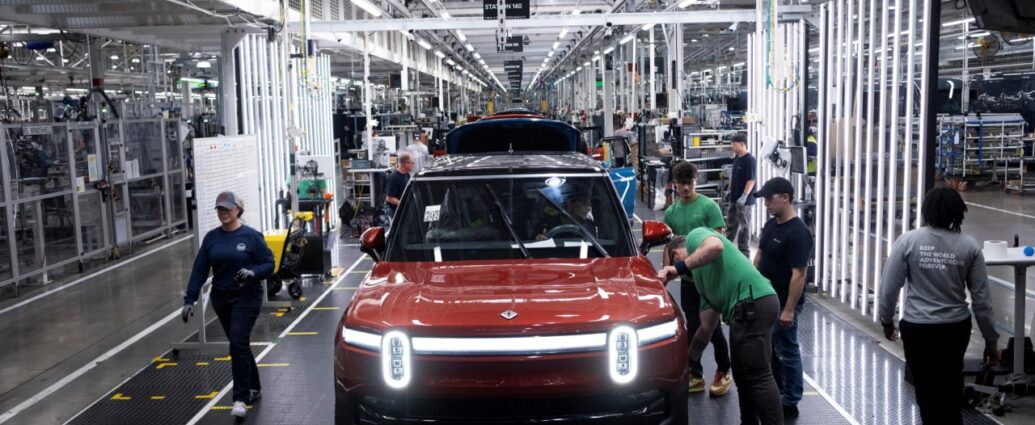
It has a catchy name — Build America, Buy America — and the lauded goal of bringing manufacturing jobs back to the United States.

But the law has spurred a bottleneck for affordable housing.

Nearly everything from HVACs and lighting to sink hooks and ceiling fans in affordable housing projects that get federal dollars must carry the Made in the USA label. But, developers say, numerous products do not, as they have long been imported from overseas markets with cheaper labor costs.

Although builders can apply for waivers, the process has been at a near standstill as the Department of Housing and Urban Development, which has had its staff slashed by the Trump administration, has only greenlit a handful of projects.

The waiver process has caused construction delays and hundreds of thousands of dollars in extra costs as the country faces an affordable housing crisis.

“They need to be treating this like the fire that it is,” said Tyler Norod, president of Westbrook Development Corporation, which builds affordable housing in Maine.

“We’ve sort of resigned ourselves that we’re just gonna build less units across the entire country during a housing crisis.”

Facing a standstill

Diana Lene has been on affordable housing waitlists for the past five years. The 75-year-old loves living close to her daughter and grandchildren in Fargo, North Dakota, but her apartment is too expensive on her Social Security income.

“It’s just maxing my budget down to pennies,” she said. To save money, she avoids driving often and buys food on sale.

“I’m just trying to keep a roof over my head, but it’s getting more and more difficult,” Lene said. “I don’t like to live in fear, and yet sometimes it jumps in there.”

Lene is on a waitlist for one of nonprofit developer Beyond Shelter’s apartments. CEO Dan Madler is building a 36-unit building for people like Lene, but he had to postpone lumber orders to verify they comply with the law and can’t find ceiling fans made in America. He doesn’t know when HUD will approve a waiver.

U.S. President Joe Biden signed the Build America, Buy America Act as part of the Infrastructure Investment and Jobs Act in 2021, building on longstanding efforts to boost American manufacturing at a time when the U.S. economy was emerging from a pandemic-era recession. Known as BABA, it applies to infrastructure projects funded by federal agencies, not just affordable housing.

Denver developer Julie Hoebel says she has spent over $60,000 just on a consultant to comb through websites and call suppliers to try to find American-made materials, not to mention the additional labor costs involved.

But the waivers she submitted to HUD in November for around 125 materials in an 85-unit building haven’t been approved.

“If they take much longer then we’ll come to a standstill,” she said.

A cumbersome process

HUD is taking at least six months to approve many waivers.

Even BABA advocates agree HUD must grant waivers more quickly and give the industry clearer instructions on how to prepare them, which they note other federal agencies are doing.

HUD did not address questions from The Associated Press about waiver approval delays developers say increase costs, as well as concerns about making the process more transparent. In a statement it said it’s committed to “ensuring that federal spending supports America’s industrial base” while “closely monitoring how compliance with these policies impact costs for builders.”

Asked in January about whether the delays and cost increases mean affordable housing should be exempt from BABA rules, HUD Secretary Scott Turner said the agency was looking into the issue, but did not provide details. “We are looking at this … with BABA as it pertains to HUD to provide flexibility to certain projects in certain places around our country,” Turner said, adding that HUD is committed to assuring developers get “the flexibility they need as it pertains to building.”

The law itself isn’t the problem, supporters say.

Unions representing the steel and manufacturing industries say taxpayer dollars should fund American-made materials and suppliers will adjust to meet demand for products that aren’t available.

“You’ve got a system in place that leans heavily on using imported materials to make a better profit,” said Scott Paul, president of the Alliance for American Manufacturing. “I don’t know if that serves the public good.”

Jennifer Schwartz, director of tax and housing advocacy at the National Council of State Housing Agencies, said there’s no national data on how much BABA is increasing costs. But the waiver process is “failing,” she said, because requirements were put in place before assessment of domestic manufacturing capacity.

It won’t be as challenging for suppliers to produce more raw materials in the U.S., but it will take time for manufactured products — such as appliances and elevators — to become available, said Kaitlyn Snyder, managing director of the National Housing and Rehabilitation Association, an affordable housing industry group.

“I don’t know that it economically, financially makes sense for people to be producing door hinges,” Snyder said. “We are an advanced country and we’ve outsourced a lot of that stuff.”

The housing bill that passed the Senate in March did not require HUD to address problems with implementing BABA.

“The process isn’t working for affordable housing,” said Jessie Handforth Kome, who spent nearly 40 years working at HUD until 2024. “People want to comply, but it’s unclear how to.”

Vermont-based Developer Jessica Neubelt estimates she spent an additional $150,000 just to verify iron and steel she used in a project was American-made. She’s just as frustrated over the hundreds of hours that takes, which, she said, could be spent on another project.

“I would like every member of Congress to sit in on a construction meeting,” Neubelt said. “The amount of detail that goes into figuring out if a specific thing is compliant or not is enormous.”

Debates over solutions

U.S. Rep. Mike Flood, a Nebraska Republican, has advocated to exempt some HUD funding from BABA.

“Owning a home is the American dream, but it’s out of reach in a very big way and anything that adds cost to that isn’t allowing hardworking Americans to achieve the dream,” Flood told the AP.

Roy Houseman, legislative director at United Steelworkers, said complaints about cost increases are overblown.

“A lot of developers seem to have tried to throw things in and make statutory changes to policies that have been in place for basically five years now instead of making a good-faith effort to really push HUD,” Houseman said.

Union leaders note the law offers some leeway.

Developers can get exemptions for an American-made product if it increases the project’s overall cost by more than 25%. A very small percentage of a project’s total material cost is also exempt. But most developers say that percentage isn’t enough to cover all items not made in the U.S.

Some developers are looking for ways to avoid federal funds altogether. But that is challenging. Even though federal dollars often make up a small portion of funding for affordable housing projects, that sliver can make or break whether there’s enough money to build them.

Kentucky developer Scott McReynolds says that instead of applying for a federal grant to build 20 to 30 affordable homes, he plans to build two four-unit projects, small enough so that they aren’t subject to BABA.

American-made materials are especially hard to find near the rural areasMcReynolds serves.

“It’s a nightmare,” he said.

This story was originally featured on Fortune.com

Raw Farm was also linked to 2024 salmonella outbreak that sickened 165 people and deaths of two cats from bird flu

A California raw milk dairy that was previously linked to a fatal outbreak of bird flu in cats has now been linked to an E coli outbreak involving cheddar cheese, affecting nine people in three states.

The US Food and Drug Administration (FDA) said in an alert that more than half of the people sickened so far are children under age five. Three people have been hospitalized after contracting a dangerous strain of E coli – O157:H7 – with one developing hemolytic uremic syndrome, a condition that can lead to kidney failure.

Continue reading…

This post was originally published here

As the war in Iran pushes U.S. gas prices toward $4 a gallon nationally, some lawmakers are pushing to suspend the federal gasoline tax in the latest attempt to try to control surging energy costs.

Lawmakers say the action would provide much-needed relief for families and businesses that rely on their cars and trucks to get to work and school and run everyday errands.

Asked about the gas tax at a Cabinet meeting Thursday, President Donald Trump said he has “thought about” suspending it but suggested states should consider suspending their fuel taxes.

“People have talked about” a gas tax suspension, Trump said. “It’s something we have in our pocket if we think it’s necessary.”

As gas prices have spiked, the Trump administration has released millions of barrels of oil from the U.S. Strategic Petroleum Reserve and temporarily lifted sanctions on some Russian and Iranian oil shipments already at sea. The U.S. is negotiating with countries reliant on Middle East crude to join a coalition to police the Strait of Hormuz, where about one-fifth of the world’s traded oil normally flows.

Here’s a look at what a gas tax holiday is and its potential impacts.

Temporary suspension of the federal gas tax

A gas tax holiday is a temporary suspension of the federal gas tax, currently set at 18.4 cents per gallon on gasoline and 24.4 cents per gallon on diesel fuel. That does not include state taxes, which often are higher.

The tax provides more than $23 billion per year in revenue for federal highway and public transit programs.

The president cannot suspend the federal tax on his own. Congress would have to approve the move.

Both the House and Senate are controlled by Republicans, and bills on the issue are unlikely to advance unless Trump signals his support.

Suspending the tax could provide some relief

Rising gas prices are putting renewed pressure on household finances, especially for low- and middle-income Americans who have less flexibility to absorb higher transportation costs. The increases can influence how much people drive, where they travel and how they spend money on other things.

“Trump’s war of choice with Iran is driving up gas prices across the country — and Americans shouldn’t have to bear the additional economic burden of Trump’s reckless decision making,” said Sen. Richard Blumenthal, a Connecticut Democrat who co-sponsored the Gas Prices Relief Act with fellow Democratic Sen. Mark Kelly of Arizona.

The bill would suspend the tax through Oct. 1. A similar measure was sponsored in the House by Democratic Rep. Chris Pappas of New Hampshire.

There are drawbacks, industry group says

The gasoline tax is the single largest source of revenue for federal highway and public transit programs.

While the House and Senate bills would offset any lost Highway Trust Fund revenue with general funds, the tax suspension could raise the federal deficit and jeopardize the long-term sustainability of investments for highway and public transit programs, according to the American Road & Transportation Builders Association, which represents the transportation construction industry.

The group cites studies showing that many retailers do not pass on the full amount of the gas tax reduction to consumers. Research also suggests that state and federal gas taxes are just one component of a complex pricing scheme that includes the global price of oil and other factors, the group said.

States are considering their own gas tax breaks

Some states are taking action to lower the gas tax. Georgia Republican Gov. Brian Kemp on March 20 signed into law a 60-day suspension of the state’s 33-cents-per-gallon tax on gas and 37-cents-per-gallon tax on diesel.

The law was supported by both Republicans and Democrats. Kemp said he wanted to “return taxpayer money where it belongs, in the pockets of hardworking Georgians.”

Early results are positive for Georgia drivers. It takes a few days or more for the tax holiday to trickle through to pump prices, because wholesalers pay fuel taxes in the state. But while gas prices nationwide went up an average of 10 cents per gallon in the week that ended Thursday, they fell 15 cents a gallon in Georgia, according to motorist group AAA. On Friday, the state had the 13th-lowest average gas price among states at $3.60 per gallon. Kansas was the lowest at $3.27.

Several states — including California, Connecticut, Florida, Maryland and Utah — have weighed gas tax holidays as a way to provide relief at the pump.

Connecticut Democratic Gov. Ned Lamont recently suggested a temporary suspension of the state’s 25-cent-per-gallon tax on gasoline and 48.9-cent diesel tax, but it remains unclear whether it will happen. State officials are also discussing possible rebate checks for taxpayers to help blunt high energy costs.

Florida Republican Gov. Ron DeSantis, who has supported past gas tax holidays, was skeptical that motorists would see real savings.

“Our ability to influence fuel prices are really marginal,” DeSantis said at a bill signing ceremony this month, according to Politico. “Sometimes the prices get raised so the consumer doesn’t see any difference. … I think when we did it in the past … I don’t think the consumer really felt relief.”

Driving habits can help reduce costs

The top advice for drivers looking to save at the pump is to obey the speed limit and drive smoothly, according to Consumer Reports. Driving habits can play a significant role in fuel economy, the magazine says.

Driving at a steady 55 mph can increase fuel economy by 6 to 8 mpg, the publication said in a report that offered tips to get the most out of a tank of gas. “Speeding up from 55 to 75 mph is like moving from a compact car to a large SUV,” the article said.

Beyond fuel concerns, speeding also is a safety risk. And drivers should avoid hard acceleration and braking whenever possible, and skip premium gas if their cars allow it, the magazine said

This story was originally featured on Fortune.com

President Donald Trump on Friday signed a promised executive action to pay Transportation Security Administration employees after a bid to end the shutdown of the Department of Homeland Security abruptly fell apart in Congress.

Trump signed the action with an eye toward easing long security lines at many of the nation’s top airports.

“America’s air travel system has reached its breaking point,” Trump said in the memo authorizing the payments. He added, “I have determined that these circumstances constitute an emergency situation compromising the Nation’s security.”

Trump said his administration would use “funds that have a reasonable and logical nexus to TSA operations” for the payments. In a statement Friday, Homeland Security Secretary Markwayne Mullin said TSA workers “should begin seeing paychecks as early as Monday.”

While Trump’s action could help ease the plight of air travelers, it does little to resolve the DHS shutdown that has jammed airports and imposed financial hardship on thousands of federal workers. The House and Senate ended the week by passing vastly different bills, creating a new impasse as lawmakers leave Washington for a two-week recess.

The shutdown of Homeland Security will reach 44 days on Sunday, eclipsing the record 43-day shutdown last fall that affected all of the federal government.

House Republicans reject Senate deal

The Senate passed a funding deal early Friday, but blowback from House Republicans came quickly. House Speaker Mike Johnson, upon opening the chamber for business, accused Democrats of playing a dangerous game and said he needed to talk with fellow Republicans about how to proceed.

After a lengthy conference call, Johnson blasted the Senate’s action and announced that the House would be going in a different route. “This gambit that was done last night is a joke,” Johnson said.

Instead, the House on Friday night passed a bill to fund the entire department through May 22. The vote was 213-203. Johnson said he had spoken with Trump about the House Republican plan and the president supported it.

House Republicans were livid that the bill passed by the Senate does not fund Immigration and Customs Enforcement and Border Patrol. Democrats refused to fund those departments without changes to immigration enforcement practices.

“We’re going to do something different,” Johnson said. He challenged the Senate to take up the House’s short-term fix to fund Homeland Security into May.

But senators left town after voting to fund most of DHS, so it would take time for them to return once the House passes a different measure. And even if they were to return, Senate Democratic leader Chuck Schumer made clear the House GOP plan would be “dead on arrival in the Senate, and Republicans know it.”

House Democratic leader Hakeem Jeffries said the Senate-passed bill would clear the House with Republican and Democratic votes if Johnson would allow it to be voted on.

“This could end, and should end, today,” Jeffries said.

What’s in the Senate compromise

Senators worked through the night to approve a bill by voice vote that would fund much of Homeland Security, including the Federal Emergency Management Agency, the Coast Guard and TSA.

Senate Republicans said they were disappointed by the lack of funding for ICE and Border Patrol, but noted that immigration enforcement has remained largely uninterrupted. That’s because the GOP’s big tax cuts bill that Trump signed into law last year funneled billions of dollars in extra funds to DHS, including $75 billion for ICE operations.

Conservative Republicans, however, were against establishing a precedent that allows Congress during the yearly appropriations process to fund some agencies within Homeland Security, but not others.

“We will fully fund ICE. That is what this fight is about,” Sen. Eric Schmitt, R-Mo., said. “The border is closing. The next task is deportation.”

Democrats have refused to provide funding for ICE and the Border Patrol after the deaths of two Americans protesting the sweeping immigration crackdown in Minneapolis.

They want federal agents to wear identification, remove their face masks and refrain from conducting raids around schools, churches or other sensitive places. Democrats have also pushed for an end of administrative warrants, insisting that judges sign off before agents search people’s homes or private spaces — something Mullin, the new DHS secretary, said he is open to considering.

The Republican leadership rift

The rejection of the Senate deal creates a noticeable rift between Johnson and Senate Majority Leader John Thune, R-S.D., who have mostly worked in tandem this Congress trying to enact Trump’s agenda.

With all Democrats opposed, Thune had to find a solution to the funding impasse that would win the 60 votes needed to break a filibuster in the 53-47 Senate.

After more than a week of intense negotiations — some involving the White House — the two sides agreed early Friday to fund most parts of the Homeland Security Department except for ICE and parts of CBP. It passed by voice vote with no objections from either side just after 2 a.m.

Asked if he had cleared the compromise with Johnson, Thune said the two had texted.

“I don’t know what the House will do,” Thune said.

The White House was silent as senators reviewed the compromise, and Trump did not weigh in publicly.

The next day, as the deal fell apart in the House, Thune did not respond to Johnson’s comments that he was left in the dark.

The speaker, asked about a rift with Thune, said Democrats in the Senate were to blame for the situation.

Airport lines grow as TSA workers endure hardships

The DHS shutdown has resulted in travel delays and even warnings of airport closures as more TSA workers missing paychecks stopped going to work. Those workers had already endured the nation’s longest government shutdown last fall.

Multiple airports have been experiencing greater than 40% callout rates of TSA workers, and nearly 500 of the agency’s nearly 50,000 transportation security officers have quit during the shutdown. Nationwide on Thursday, more than 11.8% of the TSA employees on the schedule missed work, according to DHS. That is more than 3,450 callouts.

This story was originally featured on Fortune.com

Escalation represents dangerous spread of war and brings threat of even more damage to the global economy

The US-Israeli war with Iran has expanded with the entry of Houthi forces in Yemen, representing a dangerous spread of the conflict and bringing with it the threat of more damage to the global economy.

Pakistan has said it would host a meeting of Middle Eastern powers on Monday in an effort to find a regional approach to ending the conflict. But the talks, which bring together the foreign ministers of Saudi Arabia, Turkey and Egypt, did not appear to include any of the warring parties, casting further doubt on persistent US claims of diplomatic progress.

Continue reading…

This post was originally published here

Iranian-backed Houthi rebels claimed a missile launch toward Israel early Saturday, their first since the war in the Middle East started. The Israeli military said it intercepted the projectile.

The now monthlong war erupted after the United States and Israel attacked Iran, which retaliated with strikes against Israel and neighboring Gulf Arab states. The conflict has upended global air travel, disrupted oil exports and caused fuel prices to soar. Iran’s stranglehold on the Strait of Hormuz, a strategic waterway, has exacerbated the economic fallout.

Israel struck Iran’s nuclear facilities hours after threatening to “escalate and expand” its campaign against Tehran on Friday. Iran vowed to retaliate and struck a base in Saudi Arabia, wounding more than a dozen U.S. service members and damaging planes.

Before Saturday’s attack, there appeared to be a breakthrough as Tehran agreed to allow humanitarian aid and agricultural shipments through the strait.

Israeli airstrikes continued Saturday. Associated Press footage showed smoke rising from northeastern Tehran. Iran sent missiles toward Israel with loud booms heard in Jerusalem.

Houthi involvement could further complicate the war

Houthi Brig. Gen. Yahya Saree said on the rebels’ Al-Masirah satellite television station Saturday that the Houthis launched a barrage of ballistic missiles toward what he described as “sensitive Israeli military sites” in southern Israel. The attack came hours after Saree signaled in a vague statement Friday that the rebels would join the war.

Sirens went off around Israel’s southern city of Beer Sheba and near Israel’s main nuclear research center as Iran and Hezbollah fired on Israel overnight. Explosions filled the air in Tel Aviv, where Israel’s Fire and Rescue Service said it responded to 11 impact sites.

Saturday’s assault calls into question whether the Houthis will target commercial shipping in the Red Sea corridor, as they did during the Israel-Hamas war. About $1 trillion worth of goods passed through the Red Sea annually before the war. Any attacks on Red Sea shipping routes would disrupt traffic through the Suez Canal, a crucial waterway for vessels bearing oil, gas and sundry goods to the Mediterranean Sea. About 10% of global maritime trade — including 40% of container ship traffic — passes through the canal each year.

Houthi rebels attacked over 100 merchant vessels with missiles and drones, sinking two vessels, between November 2023 and January 2025.

The Houthis’ involvement would complicate the deployment of the USS Gerald R. Ford, the aircraft carrier that sailed to Crete for repairs then to Split, Croatia, where it arrived on Saturday. Sending the carrier to the Red Sea could draw it into similar attacks as experienced by the USS Dwight D. Eisenhower in 2024 and the USS Harry S. Truman in the 2025 campaign against the Houthis.

The Houthis have held Yemen’s capital, Sanaa, since 2014. Saudi Arabia launched a war against the Houthis on behalf of Yemen’s exiled government in 2015 and the rebels had thus far stayed out of the recent conflict due to their uneasy ceasefire with Saudi Arabia.

US troops suffer casualties at Saudi base, AP sources say

More than two dozen U.S. troops have been wounded in Iranian attacks on Saudi Arabia’s Prince Sultan Air Base in the past week, according to two people who have been briefed on the matter. Iran fired six ballistic missiles and 29 drones at the base Friday, injuring at least 15 troops, including five seriously, according to the sources who were not authorized to comment publicly and spoke on the condition of anonymity.

The base, about 96 kilometers (60 miles) from the Saudi capital of Riyadh, came under attack twice earlier in the week, including a strike that wounded 14 U.S. troops, according to the people briefed on the matter. The base is run by the Royal Saudi Air Force but is also used by U.S. troops.

Attempts at diplomacy as US sends more troops to the region

The latest attacks happened after Trump claimed that talks on ending the war were going “very well.” He said he had given Tehran until April 6 to reopen the Strait of Hormuz. Iran says it has not engaged in any negotiations.

With the economic repercussions from the war extending far beyond the Middle East, Trump is under growing pressure to end Iran’s chokehold on the strait.

Pakistan said Saturday that Saudi Arabia, Turkey and Egypt will send their top diplomats to Islamabad for talks aimed at ending the war.

Foreign Minister Ishaq Dar said in a statement that Saudi Foreign Minister Prince Faisal bin Farhan, Turkey’s Foreign Minister Hakan Fidan and Egypt’s Foreign Minister Badr Abdelatty will arrive Sunday for a two-day visit to “hold in-depth discussions on a range of issues, including efforts to de-escalate tensions in the region.”

Pakistan’s Prime Minister Shehbaz Sharif said Saturday that he and Iranian President Masoud Pezeshkian held “extensive discussions” on regional hostilities and efforts aimed at end the war.

Also Saturday, the Iranian foreign minister, Abbas Araghchi, told his Turkish counterpart by phone that Iran was skeptical about recent diplomatic efforts to stop the war. Iranian state-run media reported that Araghchi accused the United States of making “unreasonable demands” and exhibiting “contradictory actions” that raised doubts about the prospect of an agreement.

Trump envoy Steve Witkoff has said Washington delivered a 15-point “action list” to Iran for a possible ceasefire, with a proposal to restrict Iran’s nuclear program and reopen the strait. Tehran rejected the proposal and presented its own five-point proposal that included reparations and recognition of its sovereignty over the waterway.

Meanwhile, U.S. ships drew closer to the region carrying some 2,500 Marines, and at least 1,000 paratroopers from the 82nd Airborne who are trained to land in hostile territory to secure key positions and airfields have been ordered to the Middle East.

Secretary of State Marco Rubio said the U.S. “can achieve all of our objectives without ground troops.”

Death toll climbs

Iranian authorities say more than 1,900 people have been killed in the Islamic Republic, while 19 have been reported dead in Israel.

In Lebanon, where Israel has started an invasion in the south, officials said more than 1,100 people have been killed since the start of the war.

Meanwhile, at least 13 U.S. troops have been reported killed, while in Iraq, where Iranian-supported militia groups have entered the conflict, 80 members of the security forces have died.

In the Gulf states, 20 people have been killed and four others in the occupied West Bank.

The U.N.’s International Organization for Migration also said Friday that 82,000 civilian buildings in Iran, including hospitals and the homes of 180,000 people, were damaged.

Israel strikes Iranian nuclear facilities

Israel focused its attacks Friday on sites “in the heart of Tehran” where ballistic missiles and other weapons are produced, the military said. It said it also hit missile launchers and storage sites in Western Iran, while witnesses in eastern Tehran reported a partial power outage following airstrikes.

Iran’s Atomic Energy Organization said the Shahid Khondab Heavy Water Complex in Arak and the Ardakan yellowcake production plant in Yazd Province were targeted, IRNA reported. The strikes did not cause casualties and there was no risk of contamination, it said.

Yellowcake is a concentrated form of uranium after impurities are removed from the raw ore. Heavy water is used as a moderator in nuclear reactors.

The Israeli military later said raw materials are processed for enrichment at the Yazd plant and the strike was a major blow to Iran’s nuclear program. Tehran vowed to retaliate.

Possible breakthrough to allow aid and agricultural shipments through Hormuz

Iran agreed to allow humanitarian aid and agricultural shipments through the Strait of Hormuz following a request from the United Nations. Ali Bahreini, the country’s ambassador to the U.N. in Geneva, said Iran agreed to “facilitate and expedite” such movement.

The vital waterway usually handles a fifth of the world’s oil shipments and nearly a third of the world’s fertilizer trade. While markets and governments have largely focused on blocked supplies of oil and natural gas, the restriction of fertilizer ingredients and trade threatens farming and food security around the world.

This story was originally featured on Fortune.com

Kristi Noem was replaced by Markwayne Mullin as DHS secretary and Gregory Bovino was demoted, signally a change in tone even as arrests have continued

Throughout last year, Donald Trump delivered on his signature campaign promise of mass deportation in draconian and theatrical style. Hardline figures such as Kristi Noem, the homeland security secretary, and Gregory Bovino, the border patrol commander, became the face of Trump’s crackdown, defending a strategy of large-scale raids that sent immigration agents flooding into US cities, terrorizing communities and clashing with protesters.

Then in January, immigration officers killed two US citizens, Renee Nicole Good and Alex Pretti, in a matter of three weeks. The killings spurred a sweeping backlash that has led Democratic members of Congress to block funding for the Department of Homeland Security (DHS) for more than a month in an attempt to rein in ICE. Even Trump said “maybe we could use a little bit of a softer touch”.

Continue reading…

This post was originally published here
Murder investigation launched after man, 26, killed in central London on Friday night

The Metropolitan police have launched a murder investigation after a man was stabbed in central London on Friday night.

Officers were called to Abbey Orchard Street, Westminster, at 10.17pm after receiving reports that a man had been stabbed. The scene of the incident is near Parliament Square and Westminster Abbey.

Continue reading…

This post was originally published here

More use of two-way charging will earn money for owners and could avoid the need to expand North Sea oil drilling

The Iran war has sent petrol and diesel prices to their highest levels in years, sparked warnings of fuel rationing across Europe and triggered calls for Britain to drill more North Sea oil and gas. But analysis suggests the UK is looking for solutions in the wrong places – and that one of them is sitting on people’s driveways or parked in the street.

If more drivers switched electric vehicles, Britain would sharply reduce its petrol and diesel consumption, with every car charged from the grid rather than the pump extending the country’s fuel reserves – and experts say the potential impact goes far beyond that.

Continue reading…

This post was originally published here

Secretary of state Marco Rubio repeats administration’s belief that US can achieve its aims without a ground war

Amid tentative White House efforts at diplomacy to end the war in Iran, US troops have also been arriving in the region to deliver what Donald Trump has hoped could be a knockout blow if he can’t negotiate a ceasefire with Tehran.

Thousands of US marines aboard navy amphibious ships from the 31st and 11th expeditionary units have been deployed to the Middle East from Asia. Another 2,000-odd paratroopers from the 82nd Airborne are also being sent to the theatre – they are tasked with deploying worldwide within 18 hours of notification and execute parachute assaults, including against a “defended airfield” to prepare for further ground operations.

Continue reading…

This post was originally published here

Benzinga examined the prospects for many investors’ favorite stocks over the last week — here’s a look at some of our top stories.

Markets extended their selloff this week as surging oil prices and escalating geopolitical tensions pushed major indexes toward correction territory. The Nasdaq Composite officially entered a correction, while the Dow Jones Industrial Average and S&P 500 posted sharp declines as crude prices surged toward — and in some cases above — $100 per barrel amid disruptions tied to the Iran conflict. Investor sentiment deteriorated further as uncertainty around a potential ceasefire and shifting policy signals from President Donald Trump failed to stabilize markets.

Technology stocks led the downturn, with major names under pressure following legal setbacks and broader concerns about the sustainability of the AI-driven rally. The sector’s weakness dragged the Nasdaq lower, highlighting how elevated valuations and rising geopolitical risk are colliding to unwind one of the market’s strongest trades. At the same time, investors grew increasingly cautious about capital spending trends and regulatory headwinds facing large tech firms.

Meanwhile, rising oil prices are feeding into broader inflation fears, complicating the Federal Reserve’s outlook and prompting markets to reassess expectations for rate cuts. With bond yields climbing and traders pricing in a higher-for-longer rate environment, equities remain under pressure as geopolitical risks, inflation concerns and policy uncertainty converge. The week’s action underscores a fragile market backdrop, where energy shocks and macro headwinds continue to drive volatility across sectors.

Benzinga provides daily reports on the stocks most popular with investors. Here are a few of this past week’s most bullish and bearish posts that are worth another look.

The Bulls

“Arm Holdings Stock Soars As Company Targets $15 Billion In Annual Sales From New In-House Chip,” by Adam Eckert, reports that Arm Holdings PLC

Full story available on Benzinga.com

This post was originally published here

Bill passes by 213 to 203 votes in move prolonging weeks-long budget standoff that has disrupted travel

US House Republicans rejected a bipartisan Senate deal to temporarily fund the Department of Homeland Security and instead passed their own funding measure late Friday, extending a weeks-long budget standoff that has disrupted travel.

The stopgap bill, which proposes funding the DHS in full for eight weeks, passed by 213 to 203 votes after Republicans in the lower chamber refused to take up a Senate-passed deal that excluded money for Immigration and Customs Enforcement (ICE) and Border Patrol.

Continue reading…

This post was originally published here

Retail investors talked up five hot stocks this week (March 23 to March 27) on X and Reddit’s r/WallStreetBets, driven by retail hype, Iran war, earnings, AI buzz, and corporate news flow.

Robinhood Markets Inc. (NASDAQ:HOOD), Netflix Inc. (NASDAQ:NFLX), Arm Holdings PLC ADR (NASDAQ:ARM), Meta Platforms Inc. (NASDAQ:META), and GameStop Corp. (NYSE:GME), spanning investing, crypto, streaming, semiconductors, social media, and gaming, reflected diverse investor interests.

Robinhood Markets

  • HOOD’s board authorized a new $1.5 billion share repurchase program, replacing the prior one and adding over $1.1 billion in capacity, to be executed over roughly three years this week. This signaled management confidence amid 37% year-to-date stock slump despite strong 2025 revenue and crypto growth. The announcement was paired with a new $3.25 billion revolving credit facility led by JPMorgan.
  • Some retail investors were looking for an entry point below the price of $69 per share.
A comment on r/WallStreetBets subreddit.
Source: Reddit
  • The stock had a 52-week range of $29.66 to $153.86, trading around $69 to $72 per share, as of the publication of this article. It rose 57.28% over the year, fell by 42.23% and 37.90% over the last six months and year-to-date, respectively.
  • HOOD had a weaker price trend in the short, medium, and long term, with a solid growth ranking, as per Benzinga’s Edge Stock Rankings.

Netflix

  • NFLX announced this week that it is again raising prices across all its streaming plans. The monthly rates will climb by at least $1, citing expanding investments in original programming and live events. Political figures like Sen. Elizabeth Warren (D-Mass.) criticized Netflix Inc.‘s (NASDAQ:NFLX) latest price increase, saying that the hike was followed by receiving a “$2.8 BILLION payout …

Full story available on Benzinga.com

This post was originally published here

You probably know a woman supporting an unemployed man. Maybe you’ve been that woman. What used to be an embarrassing secret has quietly become a macroeconomic data point, and the Federal Reserve has the receipts.

As of early 2026, women held more nonfarm payroll jobs than men in the United States. This has happened twice before — briefly during the Great Recession and again just before Covid — and both times it reversed. Laura Ullrich, a labor economist at the Federal Reserve Bank of Richmond who authored a new analysis through Indeed’s Hiring Lab, says this time is structurally different.

“It definitely doesn’t, to me, seem like the change has been driven by a recessionary period, which is what typically drives it,” she told Fortune. “This seems to be more of a long-term decline that’s led to more of a permanent shift going forward, or at least semi-permanent.”

The gap by the numbers

In the early 1990s, men held nearly 7 million more jobs than women. That gap gradually shrank over the last three decades, and is now gone. The trend continued over the last year.

Over the past 12 months, jobs held by men fell by a net 142,000, while women gained 298,000. Of the 1.2 million jobs added between February 2024 and February 2026, two-thirds went to women.

The gender gap in labor force participation rate has also narrowed. The male rate has fallen nearly 20 points since tracking began in 1948, from 86.7% to 67.2% today. The female rate jumped from 32% to 57.2% in that span.

It’s not women entering, it’s men leaving

This is where the narrative gets complicated — and more interesting.

Both male and female participation rates are lower than they were in 2000. But men are falling off at a rate that dwarfs women’s decline. Right before Covid, the male labor force participation rate was 69.2%. It’s now 67.2% — a two-point drop. The female rate dropped just 0.6 points over the same period.

“It’s fewer men entering,” Ullrich said. “Younger men today are less likely to be working than their fathers were at that same age.”

So who’s supporting them?

“There has been more of a transition where parents are supporting their adult children for longer,” she said. “The data do show that more young adult men live with their parents than women. The wealth transfer from older generations to younger generations is part of that story.”

And then there are the partners. “Almost everybody you talk to will have a story” about supporting an unemployed man, Ullrich said, adding that what’s changed isn’t the dynamic itself, but the fact that it no longer carries the stigma it once did. The stay-at-home boyfriend, once a punchline, is now a statistically significant labor market phenomenon.

A landmark paper published in the Journal of Political Economy, first circulated through the National Bureau of Economic Research, found that roughly 70% of the hours young men aren’t working are being spent on video games and recreational computer use. The economists calculated that improvements in gaming technology since 2004 alone can explain nearly half the increase in young men’s leisure hours.

“I think that’s part of the story — the basement story,” Ullrich said.

The opioid epidemic compounded it, hitting non-college-educated men especially hard. And critically, men largely don’t qualify for government assistance programs like SNAP or TANF without a disability, meaning when they exit the workforce, the financial burden falls on whoever is closest to them.

The jobs that are growing and the jobs that aren’t tell you almost everything.

Healthcare and social assistance, 78.9% female, added 1.8 million jobs between July 2023 and July 2025, accounting for more than half of all U.S. job growth during that period. But male-skewing sectors like manufacturing, tech, financial activities, and media have been stagnant or contracting.

Women have the training for the jobs that exist. As of 2023, 87% of nursing bachelor’s students were women. In speech-language pathology, a six-figure profession, 96.4% of master’s students are female. Medical schools have been majority-female since 2019.

“Women are the ones who have the training for these jobs,” Ullrich said. “The growth that’s happening in the economy in terms of jobs is happening in female-dominated sectors.”

The pipeline is female, the growth sectors are female, and the jobs most protected from AI displacement — caregiving, healthcare, in-person services — are female. The jobs most exposed to AI are disproportionately held by men.

What it means

Economist Richard Reeves, founder of the Institute for Research on Boys and Men, has argued that the same cultural efforts that moved women into STEM need to be applied in reverse, steering men toward healthcare, education, and psychology.

So far, there’s little sign of that happening. The educational programs feeding the growth sectors are, if anything, becoming more female over time.

As Ullrich put it, the trend in the labor force participation gap shows no post-recession bounce, no cyclical correction, no historical parallel to prior reversals. It is, structurally, a one-way door.

“If you look at that overall downward trend,” she said, “it’s just been on a downward trajectory.”

The stay-at-home boyfriend is no longer just a TikTok trend. He’s a Federal Reserve data point. And the woman paying his rent is, increasingly, the American economy.

This story was originally featured on Fortune.com

Experts say paid participants are using automated tools to generate unreliable survey responses at scale

If you had been keeping tabs on the news about church attendance in Britain lately, you would be forgiven for thinking the country was in the midst of a Christian revival.

Stories of swelling congregations, filled with young people returning to the flock, spurred on by everything from social media to a rise in bible sales appeared to be confirmed by a 2024 report from the Bible Society.

Continue reading…

This post was originally published here

AI-generated footage depicts group of men performing a corrido, singing phrases including ‘return to your roots’

An AI-generated video from the US embassy in Mexico encouraging migrants to “self-deport” has sparked disbelief and outrage online.

The video posted this week on official embassy social media accounts depicts a group of men wearing black caps and sporting tattoos performing a kind of traditional Mexican ballad known as a corrido.

Continue reading…

This post was originally published here

Prime minister is scrambling to clean up her government after youth vote powered a damaging referendum defeat

Filippo Michelini was having a drink at San Calisto, a popular bar in Rome’s Trastevere neighbourhood on Wednesday night. As he chatted to his friends, Giorgia Meloni’s far-right government was reeling from a failed referendum, and her beleaguered tourism minister, Daniela Santanchè, had just resigned.

Michelini, a 29-year-old computer scientist who lives in Brussels, was spending a few days in the Italian capital after returning home last weekend to cast his ballot in the plebiscite on judicial changes.

Continue reading…

This post was originally published here

The White House has depicted the war in Iran online with videos that weave real life images of missile strikes and destruction with clips from video games, sports clips, and action movies.

(Image credit: White House via Getty Images)

This post was originally published here

The first year Rick Chorney ran his own cleaning company, he didn’t take a single day off. He was in the field by 7 a.m., home by 8 p.m., and back at his laptop until 1 in the morning—seven days a week, hauling in roughly $14 an hour subcontracting jobs across the suburbs of Vancouver. He told Fortune plainly that it broke something in him.

“I went a little crazy,” he said. “There came a day where I was just like, ‘I am done.’” What happened next changed everything: he spent four hours looking at how AI could help him “simplify the business a little bit.”


Today, Chorney is 29 years old, based in Abbotsford, British Columbia, and running Echo Janitorial Services—a company he co-founded in 2023 with his best friend Adrian (they’ve known each other since they were age 2). It’s been going well—thanks to artificial intelligence (AI).


Rick Chorney, man in black polo against dark gray background
Rick Chorney is expected to clear $1.3 million in sales this year.
Rick Chorney

“So last year we did just under a million dollars,” he told Fortune, sharing a remarkable growth story. The year before that had been $242,000, still impressive but, as Chorney explained, not optimized for the AI entrepreneur era: “That first year I didn’t really put in a lot of AI, I was mostly focused on SEO.” Once he added AI agents to his workflow, he was able to fast-track quoting, hire more workers, and begin a flywheel. Fortune reviewed Chorney’s business records to verify his explosive growth in revenues.

“I had a meeting today, I thought this was pretty cool,” he shared. “I had Claude make me a case study on what it would cost them to pay me $1,000 a month more than they’re paying me now, versus hire their in-house cleaners and what the risks and costs of that look like.” Claude sealed the deal, he added, making an ironclad case that in-house cleaners would be a worse deal for the client.

Chorney projected that he’ll cross $1.3 million in sales this year and his business has grown to 16 cleaners on staff, two business partners, and one AI receptionist handling up to 15 phone calls an hour. Chorney said he now only works only eight hours a day, and even takes vacations.

Whether he knows it or not, Chorney is a data point in one of the more striking economic trends of the moment. Torsten Slok, chief economist at Apollo Global Management, noted on his Daily Spark blog recently that AI tools are “dramatically reducing the cost and complexity of launching a company,” leading to a surge in new business formation.

Slok explained more in a recent appearance on the Prof G Markets podcast. “People are inventing new businesses in a way that we just have not seen, literally for decades.” Far from a job killer, Slok argued, it’s helping many people become much more entrepreneurial. “The consequence of this must be that we were going to be generating a lot more jobs associated with people’s ideas now coming to life a lot faster.”

Forrest Zeisler, co-founder and CTO of Jobber—the platform powering Chorney’s AI receptionist — told Fortune that he sees Chorney as emblematic of a larger shift. “No one’s going to benefit more than the small blue-collar businesses from AI,” Zeisler told Fortune. “For them, time is literally money. They’re out and about in the field, not sitting at a computer.”

Chorney’s story maps precisely onto the phenomenon Slok is describing: a first-generation entrepreneur, without institutional resources or formal training, using AI to compress what would once have taken years of costly trial and error.

Rick Chorney mopping the floor
Rick Chorney said he started off making $14 an hour.
courtesy of Echo Janitorial

The Kid Who Wanted a House

Chorney grew up without much of a safety net. Adopted at 5, he relocated from Ontario to British Columbia as a child. As a teenager, he fell into substance abuse, passed through a group home, and wound up on a provincial youth agreement—a government program that covered his rent while he aged out of the child welfare system. That support was set to evaporate at 19. “It got pretty ugly and I was getting arrested a lot,” he said, explaining that he wasn’t violent, just misguided, and he’s on good terms with his parents now.

But financially, and in terms of what school was giving him, he told Fortune, he was practically in a very tight spot. “I got put into a group home and I didn’t do so well in the group home. So the ministry decided to start paying my rent for me.” He explained that the ministry’s financial support was due to end and he was facing a hard stop. “There was a deadline hanging over me.”

Chorney assessed his circumstances and didn’t see school as an option. He was in grade 11, doing grade 10 courses, when he started applying for jobs, including the day he walked into a Greyhound office. His future boss was mortified, heavily encouraging him not to drop out, “but he offered me the job anyways.”

Within two years, Chorney had rented the three-bedroom townhouse he’d been working toward.

From there, he spent years doing door-to-door sales for Vivint, a smart home company, moving to a new city every four months, knocking on strangers’ doors every day. Vivint was, in its own way, a graduate program. The company sent him to Tony Robbins seminars, introduced him to the leadership canon—Simon Sinek, Brian Tracy, Leaders Eat Last—and gave him a visceral education in resilience and sales. His first cleaning business, started around COVID, didn’t scale the way he’d hoped. When he moved to Abbotsford in 2022, he was ready to try again.

Using AI to remove overhead

Echo Janitorial Services launched in 2023, and the early months were brutal. Echo was subcontracting, which meant long hours for thin margins. Chorney was cleaning construction sites and offices across the Lower Mainland, managing client relationships, handling every email, phone call, and quote himself.

“There came a day,” he said, “where I was just done.”


That day, instead of opening another quote or answering another email, he sat down and spent four hours researching how AI tools could take work off his hands. He automated his customer intake form so that new inquiries flowed directly into his job management platform. He installed an AI receptionist. He set up automatic acknowledgment messages for new clients. It took half a day.

Rick Chorney
Rick Chorney named the company after a beloved dog.
Rick Chorney

“I realized I don’t have to be doing all the things I’m doing,” he said. It gave him the time to take his first vacation ever.

Within weeks, he and a business partner drove across Canada to Montreal, caught a UFC event, and slowly worked their way back home across the country. They were gone a month and a half.

It’s a pattern that Zeisler said he has watched play out across thousands of Jobber customers. “None of them got into business for business,” he said. “They were great at a trade—they had a craft, they had a skill, and they wanted to bring that skill to the world. But they end up spending so much of their time on all the administrative burdens and overhead. That’s just a tax on the productivity of these businesses. That’s not the stuff that pays the bills.”

There’s only one downside that Chorney admitted to: “as far as how much information these companies have about each of us individually, maybe that’s a little scary. But unfortunately, we live in a world where that can’t be prevented.” The companies that have enabled these AI tools have “all of our information … available in some database somewhere,” but this is just the price of doing business.

“I have to give AI my information because it makes doing business easier.”

The Stack That Changed Everything

Chorney started with ChatGPT—using it the way most first-time adopters do, to polish emails and format documents. His early motivation was almost embarrassingly practical. “I can make as many typos, I can swear, I can be as direct as I want to be—and it’ll polish it all up and make it what I want,” he said.

But the tool he talks about with wide-eyed appreciation is Claude, which he describes less as a productivity app and more as a business advisor. “It just starts asking me questions until it’s got this perfect response,” he said. For instance, he uses it to navigate BC labor law when HR situations get complicated, to build client-facing case studies on the fly, and to document company operations for what he eventually hopes will become a national franchise.

Chorney reeled off his army of AI colleagues, marveling at how much time it’s freed up for him to scale up his business. “One deals with all your social media. One deals with all your customer inquiries. It will respond to emails, answer text messages and phone calls.” Another will go through your bank statements and help you make cashflow projections.

Rick Chorney
Rick Chorney says he’s getting his life back, thanks to AI tools.
courtesy of Rick Chorney

The high-school dropout CEO said he’s a widespread adopter of AI tools, noting that he uses Perplexity for research, Grok for content creation, and is currently piloting Synthesia—an AI video platform that generates training videos using a digital likeness of Chorney himself, walking new employees through cleaning procedures without him entering a room.

For phone traffic, Jobber’s AI receptionist fields up to 15 calls per hour—fielding job inquiries, vendor pitches, the occasional invitation to a training seminar in Costa Rica—and escalates only what matters. A human doing the same job would cost roughly $4,000 a month in wages and payroll taxes. Chorney pays $99. For email, a tool called Fixer AI pre-sorts his inbox each morning into four buckets—action required, drafted reply, likely spam, confirmed spam—and texts him a daily briefing. He claimed that he spends 20 minutes a day on email.

Jobber’s numbers suggest that Chorney’s approach is the right one. “Our best adopters—the people who are using all our AI products—they’re growing 90% faster than those who aren’t,” Zeisler said. “They go all in. They use all the tools, and they see the impact on the bottom line.”

This is precisely what Slok had in mind when he described AI as a growth engine for new business formation. “We can go together on ChatGPT or Gemini or Claude and we can ask for a business plan and it can spit it out literally in seconds,” Slok said. “And we can even use the large language models as part of our business.” The consequence, he argued, won’t just be more companies—it’ll be more jobs. “The number of new businesses is at the highest level in decades because people have become much more entrepreneurial. The consequence of this must be that we are going to generate a lot more jobs associated with people’s ideas now coming to life a lot faster.”

Thinking Bigger

With his days reclaimed—down from 19-hour slogs to a manageable eight hours—Chorney is channeling freed-up time into expansion. He calls it Project Echo: a comprehensive operational playbook, built with AI assistance, that he believes will serve as the blueprint for a national franchise. Toronto, Edmonton, and Calgary are the first targets. A friend has raised his hand for Arizona and Delaware.

“Claude is going to bring me to be a national franchise brand within the next two years,” he said.

Zeisler predicted that many more entrepreneurs like Chorney will have similar ambitions going forward. “The next generation of millionaires—there are going to be a lot of blue-collar millionaires,” he said. The businesses that are starting now don’t have decades of legacy systems and approaches ingrained in them, he added. “Those businesses are AI-first from day one.”

Chorney said he has grown as an entrepreneur to the point that he’s investing in the people around him. His first employee, Kai—they met at a pool party, hired the day after Chorney let someone else go—worked with such singular commitment that Chorney and Adrian gave him a 10% equity stake and the company co-signed his car loan. Employees who want leadership roles at Echo must read at least one book from a curated list of 15 to 20 titles. Leaders Eat Last sits at the top.

When the conversation turned to education—specifically, whether a system that didn’t work for him could ever evolve—Chorney didn’t hesitate. “Schools are so focused on repetitive behavior instead of preparing you for the world,” he said. “Kids aren’t learning how compound interest works. They’re learning how to be at school at 8:30 so that when they’re adults, they’ll get up, go to work, and pay taxes.”

Slok framed the same dynamic in macroeconomic terms: AI doesn’t just help established businesses run more efficiently—it lowers the barriers to entry so dramatically that people who previously couldn’t afford to start a business, professionally or financially, now can. In that sense, Chorney isn’t an outlier. He’s a leading indicator.

“If you can learn what AI is capable of,” Chorney said, “and use it how it was intended to be used … it’s the way of the world now. It’s not really an option.”

This story was originally featured on Fortune.com