Coeur Mining, Inc. (NYSE:CDE) shares are sliding in Thursday’s premarket session.

This downward movement stems primarily from a sharp retreat in precious metals prices. Gold fell below $4,500 per ounce, while silver dropped under $70 per ounce, according to Trading Economics.

As a primary producer, Coeur’s revenue remains directly tied to these market values.

Geopolitical Statements Unsettle Markets

The decline follows conflicting reports regarding potential peace talks between the U.S. and Iran. President Donald Trump stated Wednesday that Iran was eager to reach a deal. However, Iran’s foreign minister contradicted this, saying Tehran has no plans to negotiate. This uncertainty has led gold …

Full story available on Benzinga.com

This post was originally published here


During times of turbulence and uncertainty in the markets, many investors turn to dividend-yielding stocks. These are often companies that have high free cash flows and reward shareholders with a high dividend payout.

Benzinga readers can review the latest analyst takes on their favorite stocks by visiting Analyst Stock Ratings page. Traders can sort through Benzinga’s extensive database of analyst ratings, including by analyst accuracy.

Below are the ratings of the most accurate analysts for three high-yielding stocks in the consumer staples sector.

Conagra Brands Inc (NYSE:CAG)

  • Dividend Yield: 9.14%
  • Wells Fargo analyst Chris Carey downgraded the stock from Equal-Weight to Underweight and cut the price target from $20 to $15 on March 12, 2026. This analyst has an accuracy rate of 62%
  • Morgan Stanley analyst Megan Alexander maintained an Equal-Weight rating and raised the price target from $18 to $19 on Feb. 18, 2026. This analyst has an accuracy rate of 59%.
  • Recent News: On March 6, Conagra Brands announced …

Full story available on Benzinga.com

This post was originally published here

As the market for GLP-1 weight-loss drugs explodes toward a projected $150 billion, NFL legend Tom Brady is stepping into the arena — not to promote a magic pill, but to infuse the clinical surge with his trademark “TB12” discipline.

“Making a difference in other people’s lives, trying to share some of the things that have been in my mind that I’ve learned from incredible mentors, understanding and trying to inspire through the different people that have come into my life to communicate the messages that I’ve been able to get, that have helped me kind of live my dream, and I want to do that for others,” Brady said in an exclusive “Mornings with Maria” interview that aired Thursday.

The seven-time Super Bowl champion and eMed CEO Linda Yaccarino joined forces to announce a massive $200 million funding round, valuing the digital health company at more than $2 billion. The duo is aiming to revolutionize “population health” by using AI and clinical oversight to provide employers with a sustainable way to offer GLP-1 weight-loss medications like Ozempic and Mounjaro, while slashing corporate insurance claims.

“The raise confirms immense momentum and establishes us as the definitive company for population health and helping employers break the runaway health care costs and break their cost curve,” Yaccarino told Bartiromo.

TOM BRADY SAYS POST-N.F.L. LIFE IS ABOUT ‘BUILDING TRUST’ AS HE MAKES BUSINESS PLAY WITH HERTZ

“When you have overweight or obese people, their health care costs are two times the average employee who’s not obese,” she continued. “So that is the question that hasn’t been answered yet, that finally, eMed steps in, is able to deliver those solutions to employers all over the country.”

While many Americans use GLP-1s as an easy weight-loss solution, Brady views the eMed platform as a kickstart for those who lack the biological advantage of natural high-willpower. He insists that medication must be based on a foundation of clinical support and personal accountability.

“This isn’t about shortcuts for anybody. This is about a well-delivered program for people to kick-start their health journey in certain ways,” Brady clarified. “I’ve been so fortunate to be around the best professionals, the best doctors, the best trainers, the best nutritionists. And I realized how fortunate I was at having that guidance.”

“I really want to kind of break the stigma around the fact that, you know, discipline and hard work and willpower are something that… we’re born with. I was born with that, and I have the ability to do that. I think there’s a lot of other people that that is something that is more of a struggle,” he added. “But we need to be able to provide support for those people as well.”

Brady further detailed how his most valuable asset required a level of maintenance that is only now becoming mainstream.

“I realized because I was an athlete, my body was my asset,” the former quarterback said. “If I loved playing football and I love being on the field, then I love performing my very best. I had to treat my body, you know, a very certain way. I tried to get a lot of muscle work to repair injured tissue. I hydrated all the time. I tried to eat a low inflammatory diet. I tried to get the proper rest.”

“How can I ever stop? This is my life, I tell you, I’ve been so obsessed with training. I would feel horrible and worse if I didn’t move all the time. I feel like I have a lot of energy… I want to stay active. I have three children. I want to go out there and play basketball and swim and hit the golf ball, and play volleyball with my daughter in the backyard,” Brady said.

GET FOX BUSINESS ON THE GO BY CLICKING HERE

Yaccarino — the former CEO of X Corp who declined to comment on Wednesday’s social media verdict — explained that the goal of eMed is to take Brady’s “rigor” and apply it to the American workforce and minimize chronic diseases.

“Ninety-percent of people stay on our program. They do two things: First, and most important, what Tom was referencing, they get healthier,” she said. “And when you get people on the program, when you deliver those health outcomes, that’s the secret sauce for employers, for CEOs, CFOs — who you have on your show all the time — because they get their return on their investment.”

READ MORE FROM FOX BUSINESS

This post was originally published here. 


Top Wall Street analysts changed their outlook on these top names. For a complete view of all analyst rating changes, including upgrades, downgrades and initiations, please see our analyst ratings page.

  • Rothschild & Co analyst Oliver Holmes upgraded Westinghouse Air Brake Technologies Corp (NYSE:WAB) from Neutral to Buy and raised the price target from $262 to $285. Westinghouse Air Brake shares closed at $248.32 on Wednesday. See how other analysts view this stock.
  • Needham analyst Charles Shi upgraded Arm Holdings PLC – ADR (NASDAQ:ARM) from Hold to Buy and announced …

Full story available on Benzinga.com

This post was originally published here


Top Wall Street analysts changed their outlook on these top names. For a complete view of all analyst rating changes, including upgrades and downgrades, please see our analyst ratings page.

  • BNP Paribas cut Chewy Inc (NYSE:CHWY) price target from $38 to $28. BNP Paribas analyst Chris Bottiglieri reiterated a Neutral rating. Chewy shares closed at $26.57 on Wednesday. See how other analysts view this stock.
  • Bernstein cut the price target for Qualcomm Inc (NASDAQ:QCOM) from $175 to $140. Bernstein analyst Stacy Rasgon downgraded the stock from Outperform to Market Perform. Qualcomm shares closed at $130.35 on Wednesday. See how other analysts view this stock.
  • Wells Fargo raised United Natural Foods Inc (NYSE:UNFI) price target from $40 to $56. Wells Fargo analyst Edward Kelly upgraded the stock from Equal-Weight to Overweight. United Natural Foods shares closed at $43.56 on Wednesday. See how other analysts view this stock.
  • Rothschild & Co increased price target for Westinghouse Air Brake …

Full story available on Benzinga.com

This post was originally published here


TORONTO, March 26, 2026 /CNW/ – RBC Global Asset Management Inc. (“RBC GAM”) today announced that RBC Target 2026 Canadian Government Bond ETF (TSX:RGQO), RBC Target 2026 Canadian Corporate Bond Index ETF (TSX:RQO) and RBC Target 2026 U.S. Corporate Bond ETF (TSX:RUQO) will mature on or about Friday, September 11, 2026 (the “Maturity Date”).

Unlike traditional exchange-traded funds which have a perpetual life, the RBC Target Maturity Bond ETFs have a specified maturity date that is established when the ETFs are launched and disclosed in its prospectus. When the ETF reaches its maturity date, the ETF’s final net asset value (“NAV”) is returned to unitholders.

Each RBC Target Maturity Bond ETF’s portfolio contains securities that mature throughout its stated maturity year. This structure results in a duration profile similar to that of an individual bond, where the ETF’s duration can be expected to decline as it approaches maturity, reducing sensitivity to interest rate changes. The RBC Target Maturity Bond ETFs do not seek to return any predetermined amount at maturity.

The family of RBC Target Maturity Bond ETFs includes six Canadian government bond ETFs, six Canadian corporate …

Full story available on Benzinga.com

This post was originally published here


The U.S. dollar has dropped 10% since the beginning of President Donald Trump’s second term. 

While a double-digit decline in a major currency often sparks fears of a global financial shift, a new report from the Brookings Institution suggests the dollar isn’t losing its “reserve currency” crown just yet. 

According to the post by Senior Fellow Robin Brooks, the drop has been driven by “short, sharp bursts” of volatility linked to specific policy events: 

  • April 2025: A chaotic rollout of reciprocal tariffs. 
  • January 2026: Escalated rhetoric regarding Greenland during the Davos summit.

Is the Dollar Losing Its Global Status? 

Despite the 10% slide, the data shows that central banks around the world — like those in China and Japan — are not dumping their dollars.

The International Monetary Fund‘s Currency Composition of Official Foreign Exchange Reserves data indicates that while the dollar is weaker, there are no viable alternatives. 

The euro has failed to gain ground, and the Chinese yuan has seen its share of global reserves decrease during this period. 

The report concludes that the 10% drop is likely “benign,” meaning it’s driven by standard economic expectations and interest rates rather than a fundamental collapse of the U.S. financial system. 

What This Means for Your Portfolio

A weaker dollar creates both winners and losers in the stock market:

  • Winners: U.S.  Multinationals
    Companies …

Full story available on Benzinga.com

This post was originally published here

As demand grows for slip‑on sneakers that don’t sacrifice performance, HandsFree Labs is bringing its technology to one of the world’s biggest footwear brands.

This post was originally published here. 


As of March 26, 2026, two stocks in the consumer discretionary sector could be flashing a real warning to investors who value momentum as a key criteria in their trading decisions.

The RSI is a momentum indicator, which compares a stock’s strength on days when prices go up to its strength on days when prices go down. When compared to a stock’s price action, it can give traders a better sense of how a stock may perform in the short term. An asset is typically considered overbought when the RSI is above 70, according to Benzinga Pro.

Here’s the latest list of major overbought players in this sector.

Tri Pointe Homes Inc (NYSE:TPH)

  • On Feb. 25, Tri Pointe Homes posted upbeat quarterly earnings. The company’s stock gained around …

Full story available on Benzinga.com

This post was originally published here

European Commission says social messaging app is exposing children to grooming and sexual exploitation

Brussels has opened an investigation into Snapchat over concerns that the social messaging app is exposing children to grooming, sexual exploitation and other criminality.

In a separate decision on Thursday, the European Commission also said four pornographic websites were failing to prevent minors seeing adult content.

Continue reading…

This post was originally published here

‘Misappropriation of financial resources’ from actor, 90, tracked to property, vineyards and olive groves in Tuscany

Italian authorities have seized €20m (£17.3m) of assets in Tuscany, including property, vineyards and olive groves, allegedly bought with money embezzled from the actor Ursula Andress.

Andress, 90, had filed a complaint in her native Switzerland alleging a “progressive and significant depletion of her assets” by individuals charged with managing her finances, Italy’s financial crimes police said in a statement on Thursday.

Continue reading…

This post was originally published here


Robin Energy Ltd (NASDAQ:RBNE) shares continued their upward trajectory during Thursday’s premarket session. The move follows a volatile week for the energy transportation provider.

Short Interest Spikes Significantly

Short interest in Robin Energy climbed from 314,620 to 856,160 shares during the last reporting period. This surge means 12.66% of the company’s float is now held short.

Board Authorizes $3 Million Buyback

The company is executing a strategic tender offer. Robin Energy announced on Tuesday it will purchase up to 1,000,000 shares of its common stock. The company set the purchase price at $3.00 per …

Full story available on Benzinga.com

This post was originally published here

Coinbase (NASDAQ:COIN) again rejected support for the Clarity Act this week over stablecoin yield provisions, drawing backlash from Senator Cynthia Lummis (R-Wyo.), who warned that blocking the bill now means waiting until 2030 for another chance at crypto legislation.

Coinbase Holds The Line

Representatives of Coinbase told Senate offices this week that the exchange couldn’t support the latest version of the legislation due to significant concerns about “stable yield language,” according to Punchbowl News. 

This marks the second time CEO Brian Armstrong has withdrawn support, famously stating in January that “we’d rather have no bill than a bad bill.”

The bill bans crypto platforms from paying users to hold stablecoins, similar to how banks pay interest on savings accounts. 

Coinbase earns substantial revenue by …

Full story available on Benzinga.com

This post was originally published here

U.S. stock futures were lower this morning, with the Dow futures falling around 300 points on Thursday.

Shares of Worthington Steel Inc (NYSE:WS) fell sharply in pre-market trading after the company reported weaker-than-expected third-quarter financial results.

The company reported quarterly earnings of 27 cents per share, which missed the analyst consensus estimate of 46 cents per share. The company reported quarterly sales of $769.800 million, which missed the analyst consensus estimate of $882.950 million.

Worthington Steel shares dipped 14.1% to $30.10 in pre-market trading.

Here are some other stocks moving lower in pre-market trading.

  • urban-gro Inc (NASDAQ:UGRO) dipped …

Full story available on Benzinga.com

This post was originally published here
When investors talk about “rotation” in 2026, it’s no longer just about shifting from one U.S. sector to another or moving between small-cap and large-cap stocks. Increasingly, investors are looking beyond U.S. borders—especially toward Europe. Valuations across major European markets appear more reasonable compared with the high-growth, high-multiple U.S. Tech sector, and economies from Germany to the UK are showing early signs of stabilizing.

A major attraction is Europe’s more balanced market structure. Unlike the U.S., where the Magnificent 7 dominate index weightings, Europe’s market capitalization is spread more evenly across sectors such as Healthcare, Industrials and Consumer Goods. For investors seeking diversification and less concentration risk, this balance is becoming harder to ignore.

February alone was record-setting for European stocks, with Europe-focused ETFs gathering $14.1 billion in net inflows during the month, according to the S&P Global. Notably, $10 billion came in the first two weeks alone, and inflows were led by broad-market and thematic equity strategies. This shift began accelerating in 2025 as global investors moved away from U.S. large-cap and growth stocks. Even as European markets posted steady gains in late 2025, interest only grew—and that trend has continued into 2026.

U.S. Investors Still Underweight European Equities

Even with the recent surge in interest, U.S. retail investors remain meaningfully underweight European equities. For years, Europe lacked the high-growth Tech exposure that dominated U.S. investor demand, making it easy to overlook. The S&P 500’s persistent outperformance didn’t help either. Over much of the last decade, U.S. large-cap stocks beat European benchmarks by wide margins, reinforcing the home-bias mentality.

Geopolitical concerns also played a role. Europe’s proximity to conflict zones—most notably the war in Ukraine—combined with spikes in natural gas prices and worries about European companies’ reliance on Chinese consumers, added to investor hesitation. Taken together, these factors kept many U.S. investors close to …

Full story available on Benzinga.com

This post was originally published here


Higher housing costs, along with economic uncertainty that comes with the Iran war, are causing some house hunters to think twice. 

The weekly average mortgage rate has hit a three-month high of 6.22% as the Iran war and jitters about inflation rattle markets. The daily average mortgage rate rose as high as 6.55% on Tuesday. 

Markets are bouncing around this week as investors try to keep up with conflicting messages about the conflict in the Middle East; stocks and bonds rallied on Monday after the White House said the U.S. and Iran had productive conversations, but it is unclear when the conflict will end. 

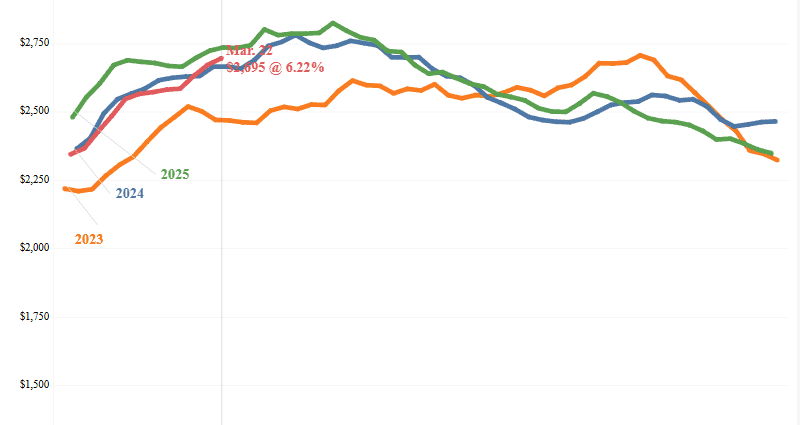
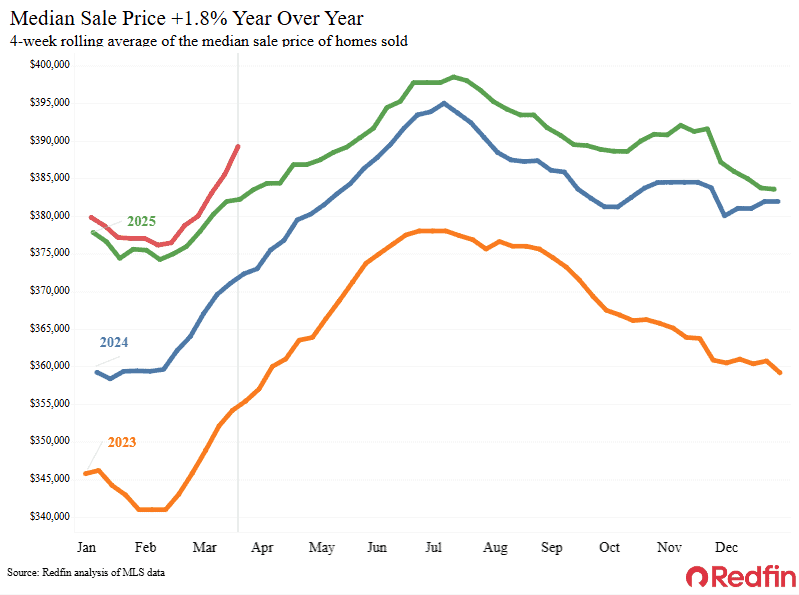
Rising mortgage rates, along with a 1.8% year-over-year increase in U.S. home-sale prices, have driven the median monthly housing payment to $2,695—the highest level since June (housing payments are seasonal; they typically peak in late spring or early summer). The median payment is down 1.5% compared to a year ago, the smallest decline in five months.

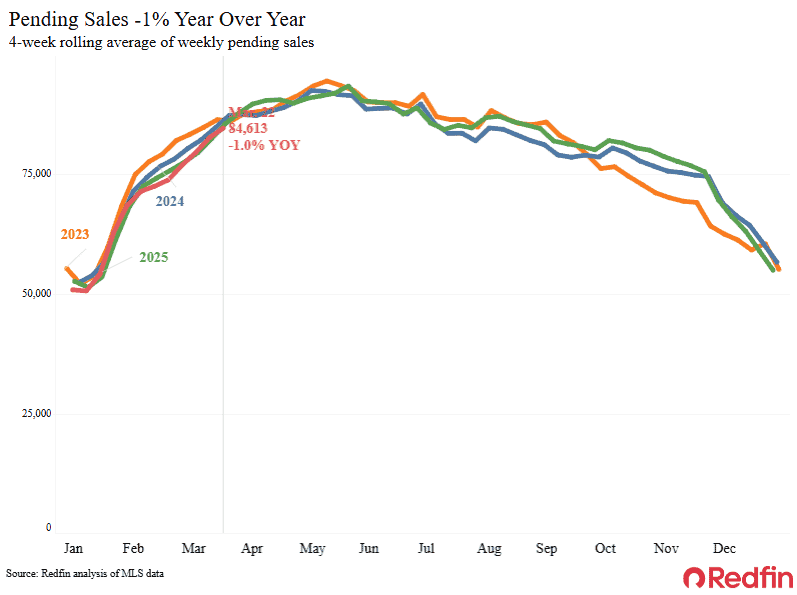
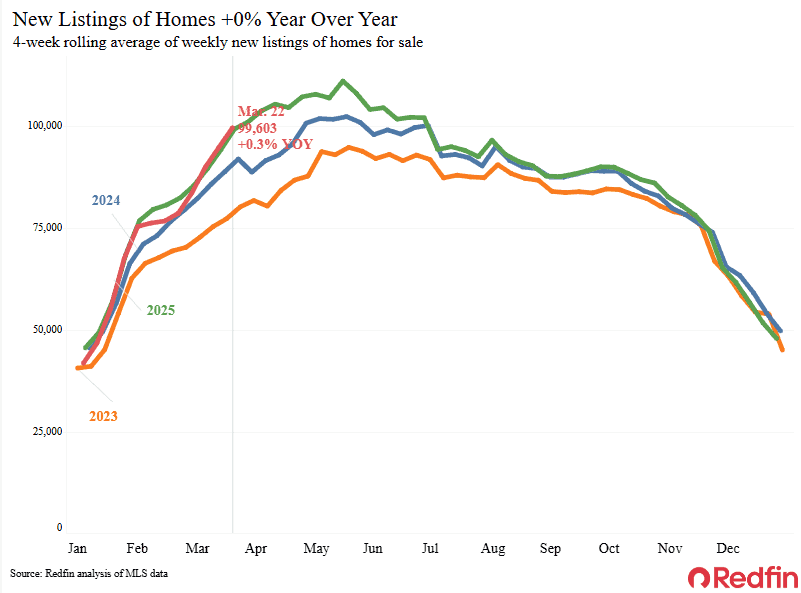
Higher housing costs, along with the economic uncertainty that comes along with the Iran war and rising oil prices, are pushing some house hunters to the sidelines. Pending home sales fell 1% year over year, the biggest decline in a month. On the selling side, new listings inched up 0.3% year over year. 

“In Boston, where a mortgage payment can be $10,000 per month, small changes in rates make a big difference,” said Aditi Jain, a Redfin Premier agent in Boston. “Many buyers are waiting, hoping interest rates dip below 6% for a meaningful amount of time, before jumping into the market. The buyers who need to move now–maybe they’re expecting a baby or relocating for a job–are moving forward, but they may opt for a smaller home or a condo instead of a single-family house to keep their monthly payment in budget.”

A separate Redfin report shows there are hundreds of thousands more home sellers than buyers in the market overall, giving house hunters negotiating power.

For Redfin economists’ takes on the housing market, please visit Redfin’s “From Our Economists” page. 

Leading indicators 


Indicators of homebuying demand and activity
Value (if applicable) Recent change Year-over-year change Source
Daily average 30-year fixed mortgage rate 6.48% (March 25) Up from 4-year low of 5.99% a month earlier Down from 6.72% Mortgage News Daily 
Weekly average 30-year fixed mortgage rate 6.22% (week ending March 19) Highest level in over 3 months Down from 6.67% Freddie Mac
Mortgage-purchase applications (seasonally adjusted) Down 5% from a week earlier (as of week ending March 20) Up 5% Mortgage Bankers Association 
Google searches of “homes for sale” Up 12% from a month earlier (as of March 23) Up 16% Google Trends
Touring activity Up 23% from the start of the year (as of March 19) At this time last year, it was up 35% from the start of 2025 ShowingTime
Redfin’s Homebuyer Demand Index was removed this week to ensure data accuracy. 

Key housing-market data


U.S. highlights: Four weeks ending March 22, 2026

Redfin’s national metrics include data from 400+ U.S. metro areas and are based on homes listed and/or sold during the period. Weekly housing-market data goes back through 2015. Subject to revision. 

Four weeks ending March 22, 2026 Year-over-year change Notes
Median sale price $389,269 1.8% Biggest increase since November
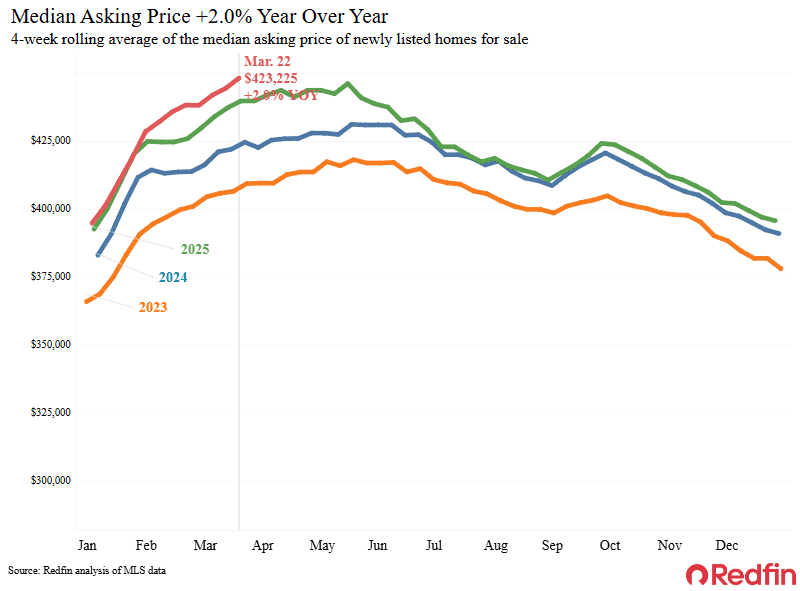
Median asking price $423,225 2%
Median monthly mortgage payment $2,695 at a 6.22% mortgage rate -1.5% Smallest decline in 5 months
Pending sales 84,613 -1% Biggest decline in a month
New listings 99,603 0.3%
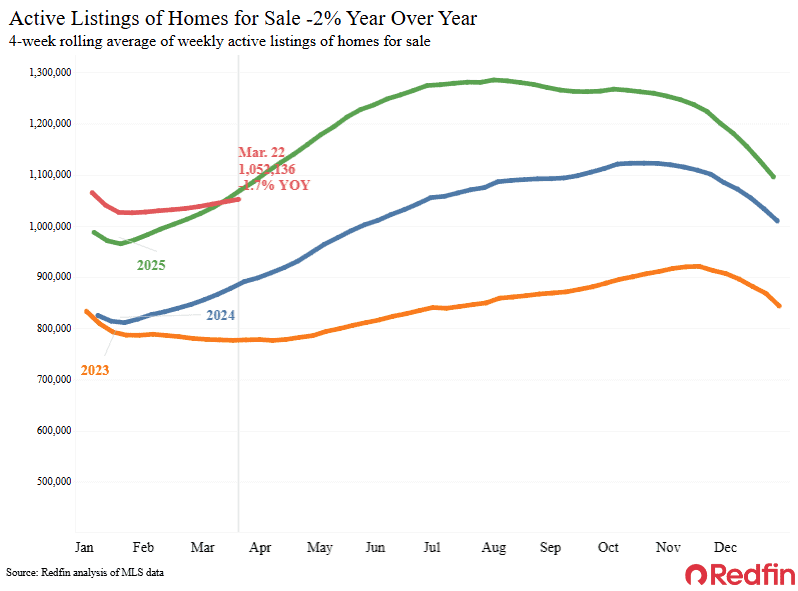
Active listings 1,052,136 -1.7% Biggest decline since 2023
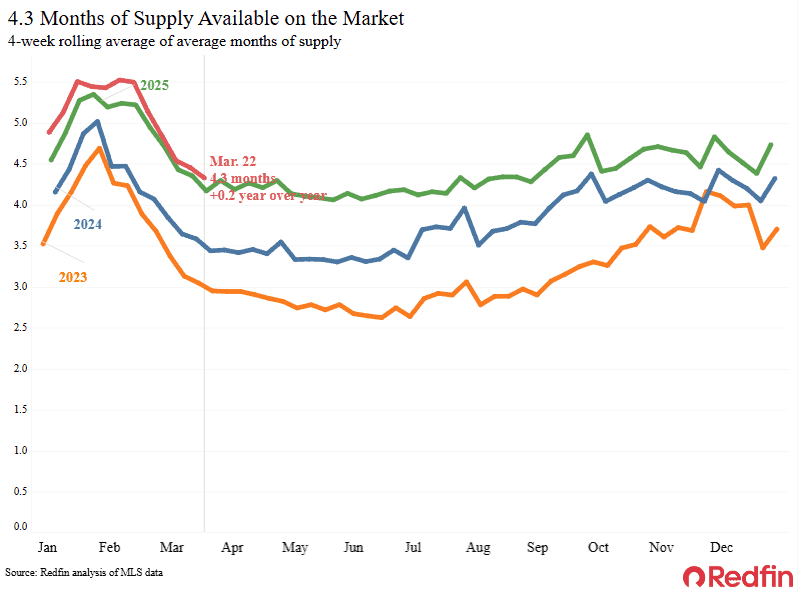
Months of supply  4.3 +0.2 pts.  4 to 5 months of supply is considered balanced, with a lower number indicating seller’s market conditions 
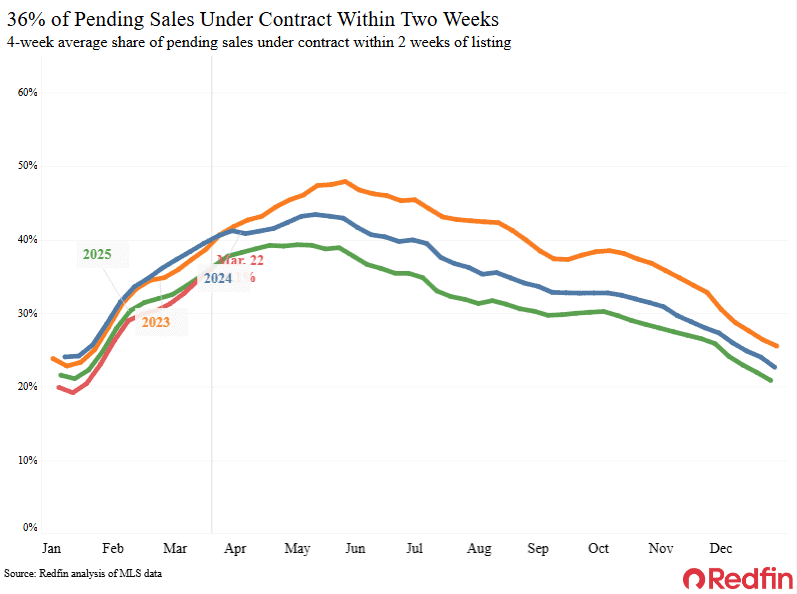
Share of homes off market in two weeks  36.1% Essentially unchanged
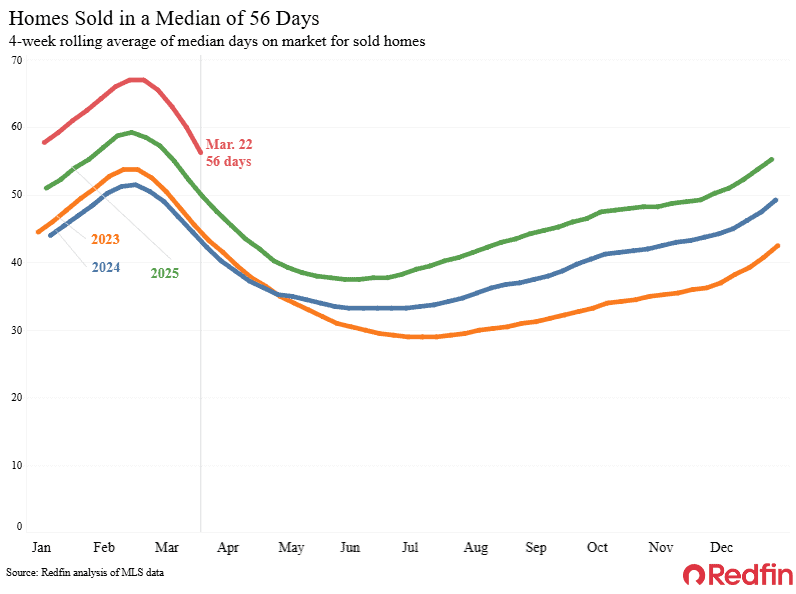
Median days on market 56 +6 days
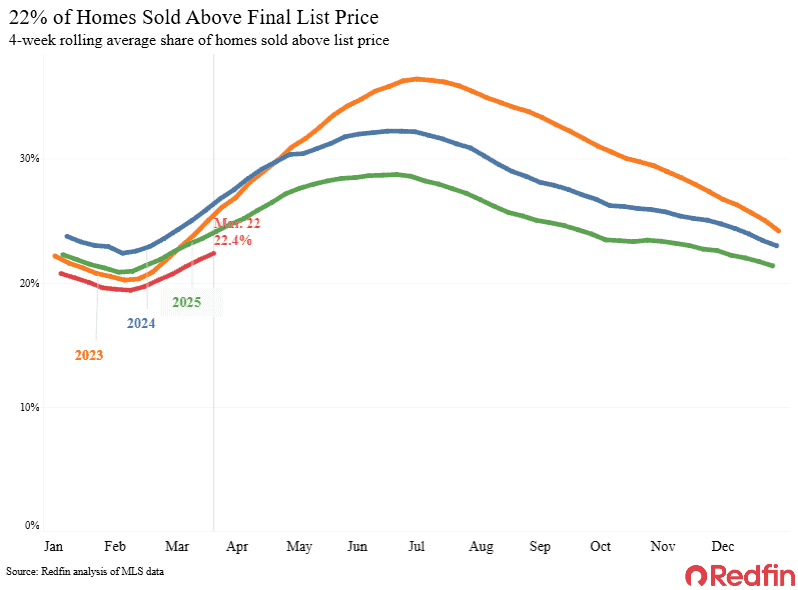
Share of homes sold above list price 22.4% Down from 24%
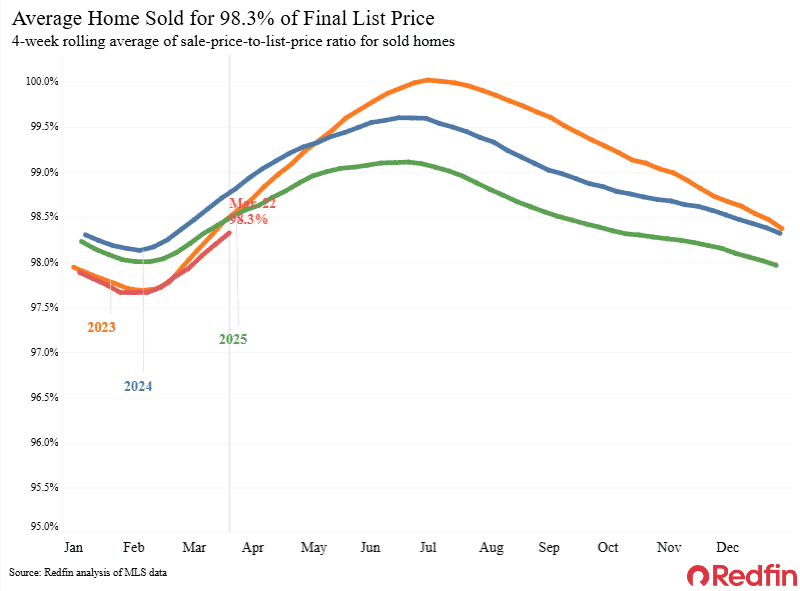
Average sale-to-list price ratio  98.3% Down from 98.5%

Metro-level highlights: Four weeks ending March 22, 2026

Redfin’s metro-level data includes the 50 most populous U.S. metros. Select metros may be excluded from time to time to ensure data accuracy. 

Metros with biggest year-over-year increases Metros with biggest year-over-year decreases

Notes

Median sale price Baltimore (8.4%)

San Francisco, CA (7.6%)

Pittsburgh (6.8%)

Cincinnati (6.7%)

Milwaukee (6.1%)

Oakland, CA (-5.4%)

Dallas  (-4.2%)

Austin, TX (-2.1%)

Denver (-1.6%)

Houston (-1.3%)

Declined in 12 metros

Pending sales West Palm Beach, FL (20.5%)

Austin, TX (11.9%)

Milwaukee (9.8%)

Miami (6.9%)

Phoenix (6.7%)

New Brunswick, NJ (-19%)

Nassau County, NY (-19%)

Providence, RI (-18.1%)

New York (-16.8)

Houston (-14%)

New listings Milwaukee, WI (13.4%)

Washington, D.C. (6.4%)

Cleveland (4.7%)

Portland, OR (3.9%)

Seattle (3.8%)

Providence, RI (-23.8%)

Nassau County, NY (-17.1%)

Tampa, FL (-14.2%)

Miami (-13.7%)

Jacksonville, FL (-11.1%)

Refer to our metrics definition page for explanations of all the metrics used in this report.

The post Market Jitters Drive Mortgage Rates Up, Sending Some Would-Be Homebuyers to the Sidelines appeared first on Redfin Real Estate News.

This post was originally published here. 

Aipac-backed lawmakers denounce ‘extremist’ violence in West Bank as support for Israel becomes a political liability

As Israeli settlers ramp up violent attacks on Palestinian civilians in the West Bank, often as Israeli forces stand by, denunciations are mounting in the US, even from Democratic legislators and public figures who are typically staunch defenders of Israel.

In recent days, dozens of settlers have torched homes and vehicles and attacked Palestinians in apparently coordinated attacks. Since the start of the month, Israeli settlers and police have killed at least 10 Palestinian civilians in the occupied West Bank, including two young brothers and their parents as they returned from a Ramadan shopping trip.

Continue reading…

This post was originally published here

Blossom Health has raised $20 million in seed and Series A funding to bring an AI “copilot” for psychiatry to patients nationwide, Fortune has exclusively learned. The announcement comes as venture dollars have largely chased more generic AI plays, but as investors have increasingly begun to fund AI enabled health tech. The New York–based startup is positioning itself as an AI‑native psychiatry platform, arguing that the technology finally makes it possible to scale high‑quality mental health care without flooding clinics with more staff.

The round, led by Headline with participation from Village Global, TA Ventures, Operator Partners, and Correlation Ventures, also adds Headline cofounder Mathias Schilling to the board. 

“We’ve been very intentional and disciplined around capital raising,” founder and CEO John Zhao told Fortune, noting that all of Blossom’s rounds were oversubscribed but that the company “could raise more, but we choose not to.” Capital, he added, “is both a weapon and a liability.”

Zhao, who previously worked at two hyperscale startups—Athelas, now a multibillion‑dollar company, and online insurance marketplace EverQuote, which he helped scale through an IPO—frames Blossom as a chance to build a “generational company” in mental health. “As long as there are human beings, we’re going to need healthcare, and mental health is only a larger and larger component of each person’s holistic health,” he said.

Blossom’s timing, he sees as a counterpoint to the perception that digital mental health has already been solved by the last wave of teletherapy and telehealth platforms. Those platforms, Zhao described as “ill‑equipped or nonexistent” in the psychiatry space.

Blossom markets itself as an “all‑in‑one AI copilot” that both augments psychiatrists’ clinical decisions and automates the back office tasks that typically bog down an in‑network practice. That means turning what Zhao describes as historically “extremely episodic” care into a continuous relationship driven by AI agents that text patients between visits, help surface warning signs, and tee up information for clinicians. He pointed to a postpartum depression case, where instead of waiting a month until the next visit, Blossom follows up with conversational check‑ins on sleep and mood, “just like texting a therapist,” rather than relying on static questionnaires. In general, most patients on the platform are seen in under 48 hours, oftentimes same-day. 

Zhao is blunt that AI in health care will only work if clinicians buy in. “It starts with listening to clinicians—and not just listening, but involving them in the creation of all our AI products every step of the way,” he said, noting that Blossom’s clinical director and “100‑plus clinicians” pilot features before they roll out more broadly.

He draws a sharp line between clinical tools and support agents, however. “These are ways we help clinicians treat patients more confidently, accurately, and effectively,” Zhao told Fortune. Everything else—billing, scheduling, dealing with insurers and pharmacies—is handled by agents that replace what he describes as the “army of people” it used to take to run a clinic.

Blossom says its tools are already used by hundreds of clinicians treating more than 10,000 patients across multiple states, and it markets in‑network coverage with major insurers and average copays around $22. The company pitches itself against a backdrop in which roughly one in four U.S. adults experience a mental health condition in a given year, and more than 28 million adults with mental illness receive no treatment at all.

Zhao’s ambition is to turn Blossom into the “destination of choice” in psychiatry, analogous to a JPMorgan Chase in retail banking, with concrete plans to expand well beyond the nine states it currently serves in the near future, deepen payer relationships, and keep investing in applied AI R&D. “Previously, scale was something that broke healthcare companies,” Zhao said. “Now we’ve flipped that paradigm on its head. The more we grow, the better we are at helping our doctors and helping

This story was originally featured on Fortune.com

Exchanging U.S. dollars for Mexican pesos seems simple. But, at large enough scales and high enough speeds, transactions can get complicated, especially if businesses trade in the dollar-pegged digital tokens known as stablecoins. The Miami-headquartered startup XFX aims to make the foreign exchange process more efficient—for fiat and stablecoins—and has drummed up $17 million in a Series A fundraise, the company announced Thursday. 

The crypto investor Castle Island Ventures, which has carved out a niche in making stablecoin bets, led the round. Other participants include Haun Ventures and Coinbase Ventures, both of which invested in XFX’s $9 million seed round. Santiago Alvarado, cofounder and CEO of XFX, declined to specify at what valuation his startup raised its most recent stash of capital. 

“They’re building FX [foreign exchange] and payment infrastructure that matches the speed of stablecoins,” Chris Ahn, a partner at Haun Ventures, told Fortune.

Fiat to stablecoins

Stablecoins are one of the hottest sectors in fintech. Proponents say the tokens can speed up cross-border payments and reduce transaction fees, among other benefits. Venture capitalists have poured hundreds of millions into the space over the past year, backing buzzy startups like Zerohash, Rain, and KAST. And, last week, the payments goliath Mastercard agreed to buy the London-based company BVNK for up to $1.8 billion in the biggest deal yet for a stablecoin company.

Founded in 2025, XFX hopes to draft off of that momentum. The company’s three cofounders met while they were employees at Bitso, the Latin American exchange that lets traders buy and sell Bitcoin, Ethereum, and other cryptocurrencies. Alvarado is a former civil engineer-turned-fintech founder. Jason Losh is a longtime developer who eventually led a team of 300 at Bitso. And Alberto Sánchez Tello has a traditional finance pedigree working for companies like Deutsche Bank, UBS, and BlackRock.

At Bitso, the trio grew frustrated with how difficult it was to exchange stablecoins for Latin American fiat currencies, like the Mexican peso, said Alvarado, XFX’s CEO. Crypto transactions happen in seconds, but bank transfers can take days. So, the trio teamed up to create a company that would make the foreign exchange process quicker and more efficient. XFX has built what Alvarado describes as an “engine” to match buyers and sellers of currency more easily, among other enhancements. “How can we process the maximum amount of volume with a minimum possible amount of capital?” said Alvarado. “That is what we’re trying to build.”

In addition to letting customers swap between stablecoins, XFX lets customers exchange three fiat currencies: the U.S. dollar, the Mexican peso, and the Colombian peso. Instead of first focusing on breadth of coverage, the startup aims to create deep liquidity in a subset of currencies before expanding outward. In other words, XFX wants customers to be able to trade between two currencies without one transaction significantly affecting prices.

The startup’s current clients include financial institutions, money transmitters, and crypto exchanges, said Alvarado, declining to specify with whom they’re working. With their new injection of capital, XFX plans to hire more “quants,” or math-savvy traders, as well as expand the startup’s relationships with trading desks and banks.

This story was originally featured on Fortune.com

Foreign investors are purchasing U.S. government debt at near-record levels, driving total foreign holdings to a staggering $9.3 trillion in January, even as structural cracks emerge in the broader bond market.

Japan And Allies Drive The Surge

Global demand for U.S. Treasuries saw a sharp uptick at the start of the year, with total foreign holdings swelling by $34.8 billion, according to Macromicro.me data shared by The Kobessi Letter.

Japan solidified its position as the largest foreign creditor, purchasing $39.8 billion to bring its total stockpile to $1.2 trillion—the highest since July 2022.

The United Kingdom closely followed, adding $29.3 billion to reach $895.3 billion, its third-highest level on record. The European Union also increased its holdings by $8 billion.

Collectively, foreign investors now own more U.S. debt than ever before, acting as a crucial pillar for the growing federal deficit.

Full story available on Benzinga.com

This post was originally published here. 

Back-to-back courtroom losses have put technology giants, including Meta and Google, in uncertain territory as they face lawsuits and bans on teen users.

This post was originally published here

Firm’s sales up 54% this month and Good Energy reports doubling of interest in solar after latest oil price shock

Solar panel sales have risen sharply since the start of the Iran war, according to Octopus Energy, and households are opting for bigger arrays of roof panels.

Sales were up 54% so far this month compared with the same period last month, the company said on Thursday.

Continue reading…

This post was originally published here

Campaigners criticise frequent use of storm overflows when parts of the country were in drought for months

Raw sewage was discharged into rivers and seas almost 300,000 times last year after the driest spring for more than 100 years and the sunniest and warmest year on record in England.

Water companies released raw sewage into rivers and seas from storm overflows – designed to be used in extreme wet weather conditions – 291,492 times. This was a 35% reduction on record spills in 2024. Average discharges were 20.5 spills for each overflow, compared with 31.8 in the previous year.

Continue reading…

This post was originally published here

Does the one person unicorn exist? Or is it the startup version of a ‘cryptid,’ a mythical creature that is oft-discussed but may or may not actually exist?

I wondered that when chatting recently with Ben Broca, CEO and founder of Polsia, whose company offers an AI “co-founder” that claims to build and run an entire company autonomously. (You may recognize Broca’s name, as he was a very early employee at Travis Kalanick’s CloudKitchens.)

“You give [Polsia] an idea, and it will go ahead and build a product,” said Broca. “It will fix bugs. It will handle support. It will run marketing campaigns, including ads. It will do all of this autonomously. Every night, it wakes up, does work, and reports back via email to the user with what it has done, what it plans to do the next day, and how the general state of the business is.”

Broca is practicing what he preaches: He posted last week on LinkedIn that Polsia (whose investors include True Ventures) had hit a revenue run rate of $4.5 million—with him as the sole employee. 

“Polsia is preaching solopreneurship,” said Broca. “I’m preaching letting go of the ‘99%’ that are not technical, not in Silicon Valley, not in New York, don’t have access to code. I want to give them a chance to survive in this new economy that’s going to be completely disrupted by AI.”

I’m famously skeptical of any and all revenue-related startup claims in the AI era. I told this to Broca, who says he believes Polsia’s revenue has some stability based on the level of user engagement he’s seeing. He also, despite being a “solopreneur,” does work with people. His central idea is one of an outsourced “virtual team.”

“That’s my crazy solution to the solopreneur problem,” said Broca. “I can leverage people, but in a different way. They don’t have to be full‑time employees… I can still have a GC with a law firm. I can have an infrastructure team with an infrastructure‑for‑agents company… and they’re incentivized for me to be as big as possible.” 

But direct employees? For now, nope.

“Initially I was ‘for now I’m alone,’” said Broca. “And then, since online the response has been so overwhelmingly positive and people [are] amazed how much you can do, it’s becoming almost like an odd performance where I’m like, ‘Well, okay, how far can I go?’” 

See you tomorrow,

Allie Garfinkle
X:
@agarfinks
Email: alexandra.garfinkle@fortune.com

Submit a deal for the Term Sheet newsletter here.

Joey Abrams curated the deals section of today’s newsletter. Subscribe here.

This story was originally featured on Fortune.com

Good morning. AI is already making workers more productive, but the financial results haven’t yet caught up.

“Artificial Intelligence, Productivity, and the Workforce: Evidence from Corporate Executives” is a new working paper by researchers at Duke University’s Fuqua School of Business and the Federal Reserve Banks of Richmond and Atlanta. It finds that while CFOs report productivity gains from AI, revenue-based evidence tells a more measured story—for now.

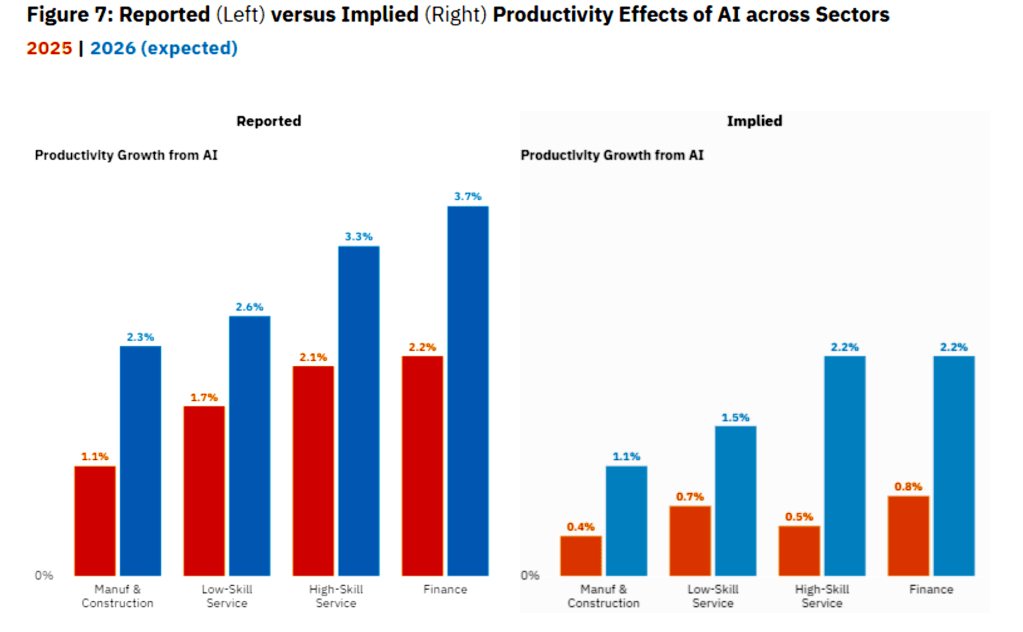
Based on surveys of nearly 750 executives, the research identifies a “productivity paradox.” Companies reported AI-driven productivity gains averaging 1.8% in 2025, but when researchers calculated implied gains using actual revenue and employment data, those gains were much smaller across all major industries—in both 2025 and 2026, the report found.

“It’s not really hitting the top line yet in full force,” John Graham, a professor of finance at Duke’s Fuqua School of Business and a co-author of the study, told me. “There is some level of delay in here for sure.”

Courtesy of The CFO Survey

“It is possible that CFOs are just optimistic about all the potential,” he added. “By productivity, we explicitly ask output per employee.”

But Graham points primarily to timing. Companies that ramped up AI investment in late 2025 haven’t fully rolled out capabilities, adjusted pricing, or realized revenue gains. Reported 2025 gains closely match revenue-implied gains for 2026—suggesting a one-year lag.

The pattern mirrors the famous “productivity paradox” described by economist Robert Solow in 1987, who noted that computer use was widespread but invisible in productivity statistics for years. The paper’s authors argue AI may be following the same trajectory.
 
 Regarding AI, gains are uneven across industries. High-skill services like finance show the strongest growth, while manufacturing, construction, and low-skill services lag but remain positive. Differences reflect how AI is deployed across sectors and company types.

“For some industries, AI is going to be about replacing the call center,” Graham said. “For another, it’s going to be about something to do with a conveyor belt in a factory. For another, it’s going to be about having fewer analysts—having the AI take the place of a financial analyst.”

Importantly, these gains are driven less by capital investment and more by efficiency and quality improvements.

For CFOs, the challenge is justifying AI spending before returns are visible.

“ROI often depends on exactly how you calculate it—a point-in-time estimate like this year’s revenue increase divided by this year’s investment,” Graham said. “What you’d really want to do is say, the amount I’m investing today—how much will that increase value this year, next year, the year after?”

He continued, “You really want to use some measure of value creation that captures several years, at least, of forward-looking improvements, rather than just a point in time.”

Graham advises a multi-year perspective: “If you can’t kind of show it over a three or four year horizon, then you might have to be a lot more cautious.” It could be that you’re caught up in the trend, but you haven’t mapped out yet how it’s going to actually benefit your company, he said.

“You want to look over longer than just a one-year horizon, but you have to do it with discipline, so you’re not just kind of pie in the sky hoping it gets better,” Graham said.

Sheryl Estrada
sheryl.estrada@fortune.com

This story was originally featured on Fortune.com

Top Wall Street analysts changed their outlook on these top names. For a complete view of all analyst rating changes, including upgrades, downgrades and initiations, please see our analyst ratings page.

  • Bernstein analyst Stacy Rasgon downgraded Qualcomm Inc (NASDAQ:QCOM) from Outperform to Market Perform and cut the price target from $175 to $140. Qualcomm shares closed at $130.35 on Wednesday. See how other analysts view this stock.
  • Citizens analyst Silvan Tuerkcan downgraded Terns Pharmaceuticals Inc (NASDAQ:

Full story available on Benzinga.com

This post was originally published here

Bitcoin fell below $70,000 on Thursday morning as traders turned cautious ahead of a $14.1 billion options expiry. 

Deribit data indicates a massive $18.6 billion in crypto options expiring today, with Bitcoin alone accounting for over $14.1 billion.

Bitcoin ETFs saw $7.81 million in net inflows on Wednesday, while Ethereum ETFs reported $8.51 million in net outflows.  


Cryptocurrency
Ticker Price
Bitcoin (CRYPTO: BTC) $69,215
Ethereum (CRYPTO: ETH) $2,067
Solana (CRYPTO: SOL) $87.66
XRP (CRYPTO: XRP) $1.37
Dogecoin

Full story available on Benzinga.com

This post was originally published here

The European Medicines Agency just approved a new Moderna mRNA flu vaccine—after clinical data demonstrated strong protection for older adults. In the United States, the same technology is facing a political blockade.

The FDA recently refused to review an mRNA flu vaccine application—despite a 40,000-person clinical trial showing it outperformed standard flu shots in older adults. The agency later reversed course, but the damage was done:

Across the U.S. biotech sector, the conclusion is now widespread: Secretary Robert F. Kennedy Jr. is subjecting mRNA medicines to political scrutiny rather than scientific review.

The message to investors is unmistakable. And the numbers confirm it.

In 2023, investors poured more than $500 million into mRNA vaccines. Last year, that figure collapsed to $174 million—a 66% decline in a single year. Before the FDA reversed course, Moderna’s CEO Stéphane Bancel warned the company would no longer pursue new late-stage vaccine trials in the United States. “You cannot make a return on investment,” he said, “if you don’t have access to the U.S. market.” Moderna is not alone.

This is a stunning reversal for a technology that President Trump championed. Operation Warp Speed—his administration’s public-private partnership—helped bring the COVID-19 vaccine to market at record speed. The consequences of the current policy shift are already materializing.

NTx Bio has halted construction of a $31 million RNA manufacturing facility in Plano, Texas. Announced by Governor Greg Abbott in May 2025 and backed by $1.5 million from the Texas Enterprise Fund, the plant was meant to anchor a $4 billion life sciences innovation district. Eight months later, the jobs are gone.

The rest of the world isn’t waiting. Mexico launched “Plan Mexico”—a five-year national strategy to build domestic mRNA manufacturing. President Trump has promised to bring manufacturing home. His administration is actively driving one of America’s most strategic industries offshore.

The U.K. committed £1.1 billion in R&D and is building a 250-million-dose manufacturing facility. Canada established a long-term Moderna partnership. Australia is targeting domestic production by 2026. Rwanda is building Africa’s first mRNA manufacturing hub. Senegal, Indonesia, and Brazil are all entering new biopharma partnerships.

The United States is conspicuously absent from that list.

These are high-skilled jobs—research, development, manufacturing, quality control, specialized supply chains. Each facility lost represents hundreds of direct positions and thousands more in supporting industries.

Our adversaries are seizing the advantage. China now leads 46% of all mRNA vaccines in global clinical development—up from 15% just five years ago. Beijing isn’t waiting for Washington. It’s building the manufacturing capacity and patent portfolio we’re abandoning.

We have seen this before. It took a $52 billion federal investment to begin rebuilding America’s semiconductor industry after we ceded that ground to foreign competitors. We are watching the same exodus with mRNA—this time with no excuse.

The irony is sharp. The United States provided the foundational research that made mRNA vaccines possible—decades of NIH grants, private investment, and Operation Warp Speed. That investment is now paying dividends for other nations while American companies face a hostile regulatory climate at home.

The timing could not be worse. mRNA is just beginning to fulfill its promise beyond COVID. Clinical trials are showing success against pancreatic cancer, melanoma, and rare genetic disorders that were previously untreatable. The pipeline of new mRNA therapies is entering its most consequential growth phase.

Other nations see where this is going. They are building the workforce, infrastructure, manufacturing capacity, and regulatory frameworks needed to capture that growth—for their workers and their patients.

The question is not whether mRNA manufacturing will expand globally—it already is. The question is whether American companies will participate from facilities on U.S. soil or somewhere else. America won the race to develop mRNA medicine. Secretary Kennedy’s ideological agenda is forfeiting the prize.

The opinions expressed in Fortune.com commentary pieces are solely the views of their authors and do not necessarily reflect the opinions and beliefs of Fortune.

This story was originally featured on Fortune.com

A few years ago, Allison Posner was barely involved in politics.

Now the 42-year-old mother of two from Maplewood, New Jersey, hands out food and diapers to immigrant families outside a nearby detention facility. She waves signs on a highway overpass in between school pickups and orthodontist appointments. And this weekend, she’ll lead a “No Kings” protest march across this affluent town alongside her husband, her children and thousands of others who are convinced that President Donald Trump represents a direct threat to American democracy.

“The people in the suburbs are definitely radicalizing,” said Posner, a freelance actor.

A growing faction of concerned citizens living in suburban communities across the United States — places once known for political moderation or even conservatism — are increasingly positioned on the front lines of the anti-Trump resistance. More than a year into the Republican president’s second term, the so-called “soccer moms” are becoming bona fide activists taking to their well-manicured streets to fight Trump and his allies.

The leftward lurch could cost Republicans control of Congress for the president’s final two years in office. It could also reshape the Democratic Party by elevating a fresh crop of fiery progressive candidates emboldened to push back against the Trump administration more aggressively than the establishment may prefer.

Indivisible, the activist organization spearheading the third round of No Kings protests this weekend, said roughly two-thirds of more than 3,000 planned demonstrations will be held outside urban areas. Overall, more than 9 million people are expected to turn out nationwide for what leaders predict will be the largest single day of protesting in U.S. history.

“We’re going to be everywhere,” said Indivisible co-founder Ezra Levin.

Organizers said sign-ups have been especially enthusiastic in suburban areas with high-profile congressional races like Scottsdale, Arizona; Langhorne, Pennsylvania; East Cobb, Georgia; and here in northern New Jersey’s 11th district, which holds a special election April 7.

Democratic voters last month chose Analilia Mejia, a former political director for Sen. Bernie Sanders, as their candidate to replace Mikie Sherrill, the more moderate Democrat who was recently elected as New Jersey’s governor.

Posner said she’s excited to have a fighter represent her district, someone who can channel the outrage that she sees every day.

“I’m seeing people from the PTA or the neighborhood who would have never joined a protest in the past, who are now asking how they can get involved,” Posner said. “This is not some other people’s fight. This is our fight.”

‘Hair on fire’

For decades, affluent suburbs like those in northern New Jersey helped elect Republicans who fit the districts they represented: business-oriented, culturally moderate and disinterested in ideological fights.

That began to change in the Trump era.

Across the country, college-educated suburban voters recoiled from Trump’s brand of politics. They shifted sharply toward Democrats in the 2018 midterms and in the presidential elections that followed. Districts like New Jersey’s 11th, once a Republican stronghold, have since become part of a new liberal coalition rooted in places that were, until very recently, politically competitive.

Even in Summit, New Jersey, one of the nation’s wealthiest suburbs, Jeff Naiman feels like he’s living in an “authoritarian nightmare” of Trump’s making.

“It’s like our hair is on fire,” says Naiman, a 59-year-old radiologist who leads his local chapter of Indivisible. “Our country’s being torn apart.”

He’s supporting Mejia, and he has no doubt that she will win next month’s special election — and again in November’s general election.

“In this environment,” Naiman said, “I think the chances of her losing the general election are basically zero.”

Mejia, an outspoken progressive activist endorsed by Sanders and Rep. Alexandria Ocasio-Cortez, D-N.Y., emerged from the crowded Democratic primary last month, beating more moderate candidates like former congressman Tom Malinowski.

She’s critical of Israel’s war in Gaza, calls for the abolition of the U.S. Immigration and Customs Enforcement, and backs Medicare for All. She’s also eager to raise concerns about what she describes as Trump’s dictatorial tendencies, and will be one of the featured speakers at a “No Kings” protest this weekend.

“A ZIP code does not protect anyone from rising violent authoritarianism,” she said in an interview.

Mejia still describes herself as a “soccer mom,” even as her Republican critics accuse her of trying to soften her activist image ahead of Election Day.

“My youngest plays baseball and soccer, my oldest lacrosse and basketball,” she said. “And when I take my children to activities, to games, and I speak to other parents, I know that we’re all experiencing this economy and this political moment very similarly.”

Mejia defended herself against accusations of antisemitism for her position on Israel, which she accused of committing genocide in the war in Gaza, a topic that emerged as a key issue in the race.

“When I say Palestinians have rights, like Jewish people and Israelis have rights, that is not antisemitism, that is humanism,” she said while acknowledging there is antisemitism within the Republican and Democratic parties. “I am an Afro Latina raising two Black sons in America. I know othering kills. I know how dangerous it is when we dehumanize communities.”

A Republican balancing act

New Jersey’s 11th district was represented by a Republican until Sherrill was elected during the 2018 midterm elections that served as a harsh verdict at the halfway mark of Trump’s first term.

Joe Hathaway, the Republican nominee in next month’s special election and a town councilman from Randolph Township, hopes to convince voters that Mejia is too radical for them. Republican strategists in Washington, too, believe a surge of far-left Democratic candidates nationwide like Mejia in otherwise moderate districts might help their party maintain its razor-thin House majority this fall.

Yet suburban Republicans are facing serious political headwinds from the leader of their own party in the White House. Hathaway, for example, initially declined to say whether he voted for Trump.

“I don’t think it’s important,” he said in an interview, before acknowledging that he cast his ballot for the president three times. “This job is representing the district, NJ-11 comes first, before a president, before your party.”

Hathaway backs the president’s war in Iran and many of the economic policies in Trump’s “one big, beautiful” bill. But he was also quick to highlight areas of disagreement.

The Republican said he supports most of the Democrats’ demands in the Department of Homeland Security shutdown fight, including proposals to require federal immigration agents to wear body cameras, clearly identify themselves, take off face masks and receive better training.

He also wants Republicans who lead Congress to stand up to Trump, whose use of executive authority Hathaway said is “pressure testing” the checks and balances outlined in the Constitution.

“Congress needs to reassert that it is the first branch of government and take more of a leadership role than it’s been doing,” he said.

Inside the suburban shift

Suburban Americans have been slowly moving away from the Republicans over the past 15 years, according to Gallup polling that tracks party affiliation over time.

Trump was unable to stop the shift despite warnings that Democrats would “destroy” the suburbs with low-income housing.

In 2020, Joe Biden won 54% of voters who said they lived in the suburbs while Trump won only 44%, according to AP VoteCast. That was a substantial improvement on Democrat Hillary Clinton’s performance in a smaller survey of validated 2016 voters conducted by the Pew Research Center, which found that Clinton and Trump split the group about evenly.

The suburbs have also grown more diverse and educated over the past few decades, demographic shifts that may make Democrats more confident. In both of the past two presidential elections, AP VoteCast found that college-educated and non-white suburban voters were much likelier to support the Democratic candidate.

Naiman, the Summit radiologist, said he’s witnessed a transformation in his town, which was represented by Republicans at the state and federal level for decades until Trump took over.

“I don’t think that Summit is going to be swinging towards Republicans anytime soon — at least not as long as Trumpism is around,” he said.

___

Associated Press polling editor Amelia Thomson DeVeaux in Washington contributed.

This story was originally featured on Fortune.com

Iran’s foreign minister has said Tehran has ‘no intention of negotiating for now’. Plus, the AI users whose lives were wrecked by delusion

Good morning.

Iran dismissed a US ceasefire proposal on Wednesday and responded with its own negotiation plan as intermediaries sought to keep diplomatic channels between the warring countries open.

What is the toll? The US-Israel war on Iran has killed more than 1,000 people in Lebanon, more than 1,500 in Iran and 16 in Israel, according to each country’s authorities. More than a dozen deaths have been reported in the West Bank and Gulf Arab states. Experts warn there has been a collapse in healthcare access.

This is a developing story. Follow our live blog for the latest updates.

What did the Los Angeles plaintiff allege? The 20-year-old woman testified that she became addicted to YouTube at age six and Instagram at nine, which she said harmed her wellbeing. She blamed the platforms for her experience of body dysmorphic disorder and social phobia in her adolescence.

How much will the companies pay the plaintiff? The jury awarded the plaintiff in the case damages of $6m, with Meta to pay 70% and YouTube the remainder.

Continue reading…

This post was originally published here

George Bush Intercontinental Airport in Houston has become the symbol for how the ongoing partial government shutdown has wreaked havoc on the nation’s air travel system.

While long security lines have hobbled airports across the U.S., Bush Intercontinental’s problems have been more pronounced. Frustrated travelers at Houston’s largest airport have confronted warnings of four-hour wait times to get through security, as many Transportation Security Administration workers aren’t showing up for their shifts since they’re not getting paid during the shutdown.

“And we’ve been in this airport since 8 o’clock in the morning. Very tired, queuing and queuing and very slow,” Edgaer Fernando, who was traveling to Guatemala, said on Tuesday.

Union and airport officials have offered a variety of reasons why Bush Intercontinental seems to be worse than other airports.

These include the Houston airport having one of the highest callout rates of TSA workers in the country due to the economic challenges they are facing, higher passenger traffic as the airport is a major hub for United Airlines, and a busy tourism month for Houston.

More TSA workers in Houston are not coming to work compared to other cities

Both Bush Intercontinental and Hobby, the city’s other major airport, have had some of the highest callout rates in the U.S.

While 11% of TSA workers nationally did not show up for work on Tuesday, at Bush Intercontinental, that number was nearly 40%. At Hobby, it was even higher — 43%. The callout rate in Houston has averaged between 35% and 40%, said Johnny Jones, the secretary and treasurer for Council 100 of the American Federation of Government Employees, which represents TSA workers nationwide.

But Bush Intercontinental is much busier than Hobby, having served over 48.4 million passengers in 2024, compared to 14.6 million passengers at Hobby.

Jim Szczesniak, director of aviation for the Houston Airport System, said that at Bush Intercontinental, 37 TSA checkpoint lanes are usually operating. Only between a third and 50% of lanes are currently being operated, he said.

“We worry conditions will only get worse at airports across the U.S. until Congress ends this shutdown,” Szczesniak said in a video posted on social media Tuesday.

TSA workers were already dealing with financial difficulties and debt from last year’s shutdown, and with higher costs for groceries and gas, employees “are just tired of it,” Jones said.

“There could be a million factors, but I can just tell you as simple as this: If everybody’s being paid, you wouldn’t have no lines,” Jones said.

Bush Intercontinental is among the nation’s largest hub airports

The Houston airport is one of the nation’s busiest and is also a major hub for United Airlines. Of the 48.4 million passengers that went through the airport in 2024, 34.8 million were from United Airlines.

“There’s high call outs, but it’s also the excessive origination point for a lot of flights,” Jones said.

With the high volume of passengers, the Houston airport might have also been experiencing a staffing shortage even before the shutdown, as no TSA workers have been hired around the country in about a year, Jones said.

March has been a busy month for Houston

Besides spring break travelers, Houston has hosted a variety of high-profile events this month.

These include games during the World Baseball Classic and CERAWeek, a major energy conference with more than 10,000 participants from around the world. The Houston Livestock Show and Rodeo reportedly drew 2.6 million attendees, many from outside the metro area, during its three-week duration. And this week, two of the NCAA Tournament’s Sweet 16 games will be played in Houston.

“While the delays are frustrating for travelers, they do not appear to be impacting tourism. In fact, Houston is experiencing the strongest month of March in terms of hotel rooms and reservations in the city’s history,” Mayor John Whitmire said in a statement.

Wait times at Bush Intercontinental seemed to improve on Wednesday as it took less than two hours to get through TSA security.

“Everyone’s trying their best. And thanks to all the TSA members who are here,” Raj Chauhan, who was traveling to Miami, said on Wednesday.

This story was originally featured on Fortune.com

Two landmark jury verdicts against social media companies have arrived at the front of a wave of lawsuits alleging that the popular platforms endanger the mental health of children.

Financial penalties total $381 million in the two cases involving tech giant Meta in New Mexico and both Meta and YouTube in California. The verdicts highlight a growing shift in the public perception of social media companies and their responsibilities toward child safety.

But it may be too soon to tell whether litigation will change the way popular social media and messaging platforms function — or influence the complex algorithms that deliver content to billions of users worldwide.

Here are looming questions as related lawsuits approach trial.

Will these verdicts harm Meta’s business?

The answer is not really — or, at least, not yet.

Meta — the owner of Instagram, Facebook and WhatsApp — says it had $201 billion in sales last year.

That revenue stream dwarfs the $375 million in civil penalties imposed on Tuesday by a jury in New Mexico with a verdict that Meta knowingly harmed children’s mental health and concealed what it knew about child sexual exploitation on its social media platforms.

Meta said it disagrees with the verdicts and plans to appeal the jury’s finding that it violated the state Unfair Practices Act.

And tech companies still are shielded from legal responsibility for posted content, based on Section 230 of the 1996 Communications Decency Act.

Investors are shrugging off the verdicts. Meta’s stock closed slightly higher Wednesday, although it is down about 8% year-to-date.

Does Meta have to make changes now to its design or algorithm?

The verdicts this week don’t mandate specific changes to the design of social media platforms, nor to the algorithms that make them tick.

But a second phase of the New Mexico trial in May, before a judge with no jury, could spell out changes for Meta’s platforms for local users by court order.

A state district court judge will determine whether Meta created a public nuisance — and could impose restrictions and order the company to pay for programs that remedy potential harms to children.

New Mexico Attorney General Raúl Torrez, who filed the lawsuit against Meta in 2023, says his office wants improvements to Meta’s enforcement of minimum age limits and removal of sexual predators — in part by lifting encryption on communication that can interfere with police work.

Meta says it continuously works to improve safety and already has made changes that phase out encryption on Instagram and limit access to explicit content by teenagers, block unsolicited messages to children from adults and help young users manage time spent on its platforms and avoid sleep disruptions.

Both the California and New Mexico trials highlighted the addictive properties of platform algorithms and the negative impacts on child mental health.

How much money do Meta and YouTube have to pay?

In New Mexico, a jury in Santa Fe arrived at the $375 million fine against Meta by endorsing the maximum penalty of $5,000 per violation of state consumer protection law — multiplied by thousands of social media accounts for children under 18.

Prosecutors intend to pursue more damages in that trial’s second phase, while an appeal could delay payment — or reverse penalties.

In California, the jury ruled that Meta and Google’s video streaming platform YouTube must pay at least $3 million in damages to a 20-year-old woman who says she became addicted to social media as a child, exacerbating her mental health struggles. TikTok and Snap settled before the trial began.

California jurors recommended an additional $3 million in punitive damages pending a judge’s final review.

Google defends YouTube as a responsibly built streaming platform, and not a social media site.

More trials to come on social media safety

The California verdict has much broader legal and financial implications. The case was designated as a bellwether test that might guide the resolution of other lawsuits. There are thousands of those lawsuits pending, including hundreds in California.

The New Mexico verdict may be an early indicator for lawsuits brought by other publicly elected prosecutors.

Attorneys general in more than 40 states have filed suit against Meta, claiming it is contributing to a mental health crisis among young people. Most are pursuing remedies in U.S. federal court.

This story was originally featured on Fortune.com

Argan, Inc. (NYSE:AGX) will release earnings for its fourth quarter after the closing bell on Thursday, March 26.

Analysts expect the Arlington, Virginia-based company to report quarterly earnings of $1.98 per share, down from $2.22 per share in the year-ago period. The consensus estimate for Argan’s quarterly revenue is $255.32 million (it reported $232.47 million last year), according to Benzinga Pro.

On Dec. 4, Argan reported mixed third-quarter results.

Argan shares fell 1.7% to close at $437.48 on Wednesday.

Benzinga readers can access the latest analyst ratings on the Analyst Stock Ratings page. Readers can sort by stock ticker, company name, analyst firm, rating change or other variables.

Let’s have a look at how …

Full story available on Benzinga.com

This post was originally published here

The U.S. Postal Service is seeking a temporary 8% charge on certain popular products, including Priority Mail, to help blunt the impact of rising transportation costs.

USPS filed notice on Wednesday with the Postal Regulatory Commission seeking the price increase, which would take effect on April 26 and remain in place until Jan. 17, 2027, pending final approval.

“This temporary price adjustment will provide needed flexibility for the Postal Service by helping to ensure that the actual costs of doing business are covered, as required by Congress,” the agency said in a news release, noting that its competitors have reacted to rising fuel prices with “a number of surcharges.”

“We have steadfastly avoided surcharges and this charge is less than one-third of what our competitors charge for fuel alone,” the agency said in a statement. If approved, the price increase would affect Priority Mail Express, Priority Mail, USPS Ground Advantage, and Parcel Select. No other products or services would be affected, including First-Class Stamps, the agency said.

The notice comes as Postmaster General David Steiner has warned Congress that the Postal Service, which has seen letter volumes plummet, will run out of cash within a year unless lawmakers lift a decades-old cap and allow the independent agency to borrow more money. Steiner favors other reforms as well, including the authority to raise postage prices high enough to cover losses.

This story was originally featured on Fortune.com

Iran and the United States hardened their positions as a diplomatic push for a ceasefire in the Middle East war appeared to falter on Thursday. Tehran moved to formalize its control over the crucial Strait of Hormuz while Washington prepared for the arrival of U.S. troops in the region that could be used on the ground in the Islamic Republic.

Sirens over Israel warned of barrages of incoming Iranian missiles and in the United Arab Emirates, two people were reported killed and three were wounded by falling shrapnel from a missile interception over Abu Dhabi on Thursday.

The secretary-general of a bloc of Gulf Arab countries said that Iran is charging fees for ships to safely transit the Strait of Hormuz. Industry experts say some ships are paying in Chinese yuan to pass through the Strait of Hormuz, where 20% of all traded oil and natural gas is transported in peacetime.

Israel said Thursday it killed Commodore Alireza Tangsiri, the head of Iranian Revolutionary Guard’s navy — the key official overseeing the closure of the strait. Israeli Defense Minister Israel Katz said he had been killed along with other senior naval commanders in a strike overnight. Iran did not immediately acknowledge Tangsiri’s killing.

Meanwhile, a strike group anchored by the amphibious assault ship USS Tripoli drew closer to the Mideast with some 2,500 Marines. Also, at least 1,000 paratroopers from the 82nd Airborne have been ordered to the region.

The troop movements don’t guarantee U.S. President Donald Trump will use force to try and compel Iran to open the strait and halt its attacks on Gulf Arab states.

Trump previously deployed a large force in the Caribbean before the American military captured former Venezuelan leader Nicolás Maduro in January. In the current situation, the U.S. is seen as focused on possibly seizing Iran’s oil terminal at Kharg Island or other sites near the strait.

U.S. Navy Adm. Brad Cooper, who commands the American military in the region, said his forces have hit more than 10,000 targets since Israel and the U.S. started the war Feb. 28, destroying 92% of Iran’s largest ships and more than two-thirds of the country’s missile, drone and naval production facilities.

“We’re not done yet,” said Cooper, who heads the U.S. Central Command, in a video message. “We are on a path to completely eliminate Iran’s wider military apparatus.”

Iran seen as operating Strait of Hormuz as ‘de facto toll booth’

With its stranglehold on traffic through the Strait of Hormuz, which leads from the Persian Gulf toward the open ocean, Iran has been blocking ships it perceives as linked to the U.S. and Israeli war effort, but letting through a trickle of others.

Jasem Mohamed al-Budaiwi, of the Gulf Cooperation Council, accused Iran of charging for safe passage through the strait — the first top official to do so. Al-Budaiwi oversees the GCC, a bloc of six Gulf Arab nations including Bahrain, Kuwait, Oman, Qatar, Saudi Arabia and the United Arab Emirates.

The Fars and Tasnim news agencies, both close to Iran’s paramilitary Revolutionary Guard, quoted lawmaker Mohammadreza Rezaei Kouchi as saying that parliament was working to formalize the process of charging fees to let ships pass.

“We provide its security, and it is natural that ships and oil tankers should pay such fees,” he was quoted as saying.

Lloyd’s List Intelligence called it a “de facto ‘toll booth’ regime.”

The shipping intelligence firm said vessels have to provide manifests, crew details and their destination to Iran’s Guard for sanctions screening, cargo alignment checks that currently prioritizes oil over all other commodities, and for what is described as ‘geopolitical vetting.’”

“While not all ships are paying a direct toll, at least two vessels have and the payment is settled in yuan,” Lloyd’s List said, referring to China’s currency.

Iran’s grip on the strait and relentless attacks on Gulf regional energy infrastructure has sent oil prices skyrocketing and concerns of a global energy crisis surging. Brent crude, the international standard, traded at US$104 early Thursday, up more than 40% from the day the war started.

“To make it crystal clear, this war is a catastrophe for world’s economies,” German Defense Minister Boris Pistorius told reporters during a visit to Australia.

US maintains negotiations are ongoing but Iran says there are no talks

Using Pakistan as an intermediary, Washington has delivered to Iran a 15-point ceasefire proposal, which includes the reopening of the Strait of Hormuz.

Trump, speaking at a fundraiser Wednesday night in Washington, insisted that Iran still wants to cut a deal.

“They are negotiating, by the way, and they want to make a deal so badly, but they’re afraid to say it because they figure they’ll be killed by their own people,” Trump said.

Iran’s Foreign Minister Abbas Araghchi said in an interview on state TV, however, that his government has not engaged in talks to end the war, “and we do not plan on any negotiations.”

Araghchi said the U.S. had tried to send messages to Iran through other nations, “but that is not a conversation nor a negotiation.”

Press TV, the English-language broadcaster on Iranian state television, said Iran has its own five-point proposal, which includes “sovereignty over the Strait of Hormuz.”

A wave of Israeli airstrikes hits as Iran fires on Gulf neighbors

Israel said it carried out a wave of attacks early on Thursday targeting Iranian infrastructure, and air defenses were heard in Tehran, while heavy strikes were also reported around Isfahan, a city some 330 kilometers (205 miles) south of the Iranian capital.

Ifahan is home to a major Iranian air base and other military sites, as well as one of the nuclear sites bombed by the U.S. during the 12-day war between Israel and Iran in June.

Sirens sounded very early on Thursday morning in parts of Tel Aviv and cities in central Israel and later explosions were heard in Jerusalem. Rescue workers said two people were injured in a blast in Kfar Qasim.

Saudi Arabia’s Defense Ministry said it intercepted multiple drones over its oil-rich Eastern Province, and Bahrain reported extinguishing a blaze in a neighborhood that is home to the Bahrain International Airport.

Since the war began, more than 1,500 people have been killed in Iran, its Health Ministry says. Seventeen people have been killed in Israel while three Israeli soldiers have also been killed in Lebanon, including one whose death was announced Thursday. At least 13 American troops have been killed. Four people have been killed in the occupied West Bank and 20 in Gulf Arab states.

Nearly 1,100 people have died in Lebanon, authorities said. In Iraq, where Iran-backed militias have entered the conflict, 80 members of the security forces have been killed.

___

Rising reported from Bangkok. Associated Press writers Julia Frankel in Jerusalem, Rod McGuirk in Melbourne, Australia, and Giovanna Dell’Orto in Miami, Florida, contributed to this report.

This story was originally featured on Fortune.com

On CNBC’s “Halftime Report Final Trades,” Jenny Van Leeuwen Harrington, chief executive officer of Gilman Hill Asset Management, LLC, said Ardagh Metal Packaging S.A. (NYSE:AMBP) has a 9.5% dividend yield.

On the earnings front, Ardagh Metal Packaging, on Feb. 26, reported fourth-quarter earnings of 3 cents per share which beat the analyst consensus estimate of 2 cents per share. The company reported quarterly sales of $1.346 billion which beat the analyst consensus estimate of $1.279 billion.

Joshua Brown, co-founder and CEO of Ritholtz Wealth Management, said he likes Netflix, Inc. (NASDAQ:

Full story available on Benzinga.com

This post was originally published here

  • Younger generations are looking to the Midwest for homeownership because of the region’s significantly lower housing costs compared to major coastal cities. Many Midwest metros have median home prices well below the national average, while also offering a lower cost of living. As a result, some Midwest cities have higher rates of young homeowners.

Younger generations are typically associated with wanting to live a big-city lifestyle, but the high cost of housing on the coasts is driving Gen Z to consider other options. 

The Midwest is becoming a more attractive place to plant roots, considering housing costs there can be at least 30% cheaper than living in major coastal metros like New York City or Los Angeles. 

In fact, seven out of the 10 most accessible metros for young homeowners are in the Midwest, according to a ConsumerAffairs’ analysis of U.S. Census Bureau and Federal Financial Institutions Examination Council (FFIEC) data published in July 2025. 

The Midwest cities with the highest rates of homeownership under age 35 include: 

  • Omaha, Nebraska (18.2%)
  • Grand Rapids, Michigan (21.1%)
  • Des Moines, Iowa (19.8%)
  • Wichita, Kansas (18.4%)
  • Cincinnati, Ohio (17%)
  • Minneapolis, Minnesota (16.5%)
  • Akron, Ohio (14.2%)

Minneapolis is also considered as one of the most affordable places to live, according to Zillow, along with other Midwest cities like St. Louis, Detroit, Indianapolis, Cleveland, Cincinnati, and Kansas City. 

All of these are cities where half or more of the homes for sale are considered affordable, according to Zillow, meaning housing consumes less than 30% of a typical household’s budget. 

Median home prices in many Midwest cities hover around $200,000 to $275,000, while the national median has crossed $400,000, Danielle Andrews, a realtor with Realty One Group Next Generation, told Fortune. That price gap can cut monthly housing costs by 30% to 50%, even before factoring in lower property taxes and insurance, she added. 

Why Gen Z is leaving the coasts for the Midwest

During the pandemic, many professionals moved to locations with more appealing weather and amenities while working from home. But now that many workers have been forced back to the office and housing costs have continued to rise, those cities don’t always make financial sense for homeowners anymore.   

Andrews said she’s worked with several Gen Z buyers—especially remote workers and young professionals—who are leaving higher-cost areas like Florida for more affordable housing.

“For many, it’s not just about cheaper homes, but about being able to build wealth earlier without drowning in overhead,” Andrews said. She also cited a StorageCafe statistic showing Gen Z and millennials made up nearly 30% of all interstate movers, with states like Indiana and Wisconsin seeing some of the biggest gains. 

A Realtor.com analysis published in August also shows suburban zip codes in the Midwest heated up in 2025, meaning they’re getting attention through a mix of lifestyle appeal, relative affordability, and strong ties to nearby economic hubs.

“The Northeast and Midwest dominate, driven by buyers from high-cost metros looking for relief without sacrificing access to jobs and amenities,” Realtor.com chief economist Danielle Hale said in a statement. “Many of these neighborhoods also offer newer homes than the surrounding areas, highlighting the critical role of new and infill construction in meeting today’s buyer demand—even in a tough market.”

In its analysis of interest in areas that offer more space, more access to jobs, and better value, Realtor.com found that three of the 10 hottest zip codes are in the Midwest cities of Ballwin, Mo.; Strongsville, Ohio; and Bexley, Ohio. While these three cities have higher prices than their respective larger metro areas, their price points remain moderate on a national scale.  

Although home prices in the Midwest are rising, the region is one of the most affordable homebuying regions in the country, according to Redfin. Take Detroit, which has the lowest median sales price of any major metro at $80,000, or Cleveland at about $125,500. Both of these cities’ median home prices are less than half of the overall U.S. figure. 

“Importantly, the cost of living [in the Midwest], especially for essentials like groceries, gas, and health care, is better aligned with local wages, allowing Gen Z buyers to not just get by—but actually get ahead,” Andrews said. “The Midwest is no longer just affordable: It’s aspirational for a generation redefining success.”

A version of this story was originally published on Fortune.com on August 5, 2025.

More on housing:

  • Gen Z can’t afford a house. Some parents are choosing to fund their down payments over their college funds
  • We may be looking at the housing affordability crisis all wrong. Higher earners are driving home prices, not lack of supply, researchers say
  • ‘Something big’ just happened in the U.S. housing market, real estate CEO says. And it could mean the difference of being able to buy a home or not

This story was originally featured on Fortune.com

McCormick & Company, Incorporated (NYSE:MKC) will release earnings for its first quarter before the opening bell on Tuesday, March 31. The spice and condiment company also wants to buy Unilever’s (NYSE:UL) food business.

With the recent buzz around McCormick, some investors may be eyeing potential gains from the company’s dividends. Currently, McCormick has an annual dividend yield of 3.64%, which is a quarterly dividend amount of 48 cents per share ($1.92 a year).  

So, how can investors exploit its dividend yield to pocket a regular $500 monthly?

To earn $500 per month or $6,000 annually from dividends alone, you would need an investment of approximately $164,938 or around 3,125 shares. For a more modest $100 per month or $1,200 per year, you would need $32,988 or around 625 …

Full story available on Benzinga.com

This post was originally published here

Larry Fink, CEO of BlackRock (NYSE:BLK) — the fund manager that oversees $14 trillion in assets — in an interview with the BBC this week, said something unusual to hear from Wall Street: that American society made a mistake by idolizing careers in finance and law, while quietly looking down on people who work with their hands.

“We really put judgment on so many jobs and so many people who probably should not have gone into banking or media or law,” Fink said in a podcast episode released Wednesday.

“We need to now rebalance that approach.”

AI Is Creating Trades

Fink’s argument is mathematical. Artificial intelligence is going to hollow out demand for certain white-collar roles. What it can’t replace is the physical infrastructure needed to run itself: the data centers, the power grids, the electrical systems, he said. The people who build those things are electricians, welders, and plumbers. And right now, there aren’t enough of them.

His latest annual letter to shareholders, published …

Full story available on Benzinga.com

This post was originally published here

Documents obtained by Guardian show company increased different fees to ‘offset revenue loss’ from FTC rule change

Following a wave of regulations banning the surprise fees that appear at the end of a transaction, Ticketmaster stopped charging the extra few dollars it added to each order at checkout. Typically shared with the venue, the order processing fee was a boon to a global platform that sells hundreds of millions of tickets a year.

But documents obtained by the Guardian show that while Ticketmaster eliminated this fee to comply with the rules, the company simply raised the cost of different fees in a number of its venues to ensure it didn’t lose money.

Continue reading…

This post was originally published here

Clear Secure has seen jump in new sign-ups amid the partial government shutdown as TSA workers go unpaid

As travelers continue to face sprawling security lines across the US, one company is thriving amid the ongoing chaos.

Clear Secure, a biometric firm that allows travelers to bypass Transportation Security Administration (TSA) lines at more than 60 airports in the US, has reportedly seen a jump in new sign-ups this month amid the Department of Homeland Security (DHS) shutdown.

Continue reading…

This post was originally published here

Shirine Khoury-Haq denies exit linked to allegations about behaviour at retail and funerals group as it sinks to £125m loss

The Co-op Group has announced that its chief executive will step down this weekend after a difficult year that included a cyber-attack and recent claims of a “toxic” culture at the business.

Shirine Khoury-Haq will depart on 29 March and Kate Allum, a board member and former boss of the dairy group First Milk, will step in as interim boss while a permanent replacement is sought.

Continue reading…

This post was originally published here

Micron Technology, Inc. (NASDAQ:MU) shares experienced a sharp surge as the stock’s momentum score jumped from 24.18 to 50.9 on a week-over-week basis.

AI Memory Shortages Drive Revenue Surge

Micron reported second-quarter revenue of $23.86 billion, surpassing analyst estimates of $19.94 billion, and adjusted earnings of $12.20 per share, versus the projected $9.21.

CEO Sanjay Mehrotra said, “We are only able to supply, for our key customers in the midterm, about 50% to two-thirds of their requirements.”

Mehrotra emphasized that memory has become a “strategic asset” in the AI era, and supply-demand conditions for DRAM and NAND are expected to remain tight beyond 2026.

The company is expanding its global manufacturing footprint to support growing demand.

The Benzinga Edge Stock Rankings show that the company’s medium- and long-term trends have turned positive, while the short-term trend remains negative, according to the latest data.

Full story available on Benzinga.com

This post was originally published here

One struck a market in North Darfur and the other hit a truck carrying civilians in North Kordofan as the country’s civil war approaches its fourth year

At least 28 civilians have been killed in two separate drone strikes in Sudan, according to health workers, as the country’s brutal civil war between the army and the paramilitary Rapid Support Forces approaches its fourth year.

A strike hit a market in the town of Saraf Omra in North Darfur state on Wednesday, killing “22 people, including an infant, and injuring 17 more”, a health worker at the local clinic told AFP.

Continue reading…

This post was originally published here

Economist Peter Schiff warns that a severe financial meltdown is imminent following a sharp spike in U.S. import and export prices, compounded by massive global oil shocks.

Schiff Warns Of 19% Annualized Inflation

Following a significant jump in U.S. import and export prices, economist Schiff is issuing a dire warning to the markets and the Federal Reserve. Schiff declared on X that the U.S. is “headed for a full-blown financial crisis,” pointing to the latest inflation indicators as a harbinger of economic disaster.

According to Schiff, the situation is already critical, noting that “February import prices spiked 1.3% while export prices surged 1.5%.” He calculated that these surging numbers are “annualizing to inflation rates of 16.8%–19.6%.”

This post was originally published here

  • In today’s CEO Daily: Fortune‘s executive editorial director for Europe Kamal Ahmed reports on Rishi Sunak’s AI outlook.
  • The big leadership story: Social media faces its Big Tobacco moment.
  • The markets: Down globally as an Iran peace deal remains elusive.
  • Plus: All the news and watercooler chat from Fortune.

Good morning. Is it worth a 100-mile train ride from London to England’s second city, Birmingham, to hear the former U.K. prime minister talk about the AI revolution? Despite my original train being cancelled (this is Britain) and a mad dash from the main Birmingham rail station to the venue to be there in time (through a hail storm)—it turns out, yes.

Rishi Sunak was prime minister from 2022 until 2024—when he was defeated by Keir Starmer. Although they come from different parties (Sunak is a Conservative, Starmer leads the Labour Party), they are surprisingly close on the issue of AI development (more and faster, please). The U.K. business department regularly contacts Sunak to ask for advice.

Sunak is considered an expert on technology and is U.S.-friendly, which is key to creating AI momentum in Europe. He has an MBA from Stanford and is an advisor to Goldman Sachs, Microsoft and Anthropic.

In front of an audience of hundreds of smaller business leaders, Sunak laid out some golden rules for AI application: 

  • Don’t think of the technology first, think about what your business needs. 
  • Make decisions at speed or risk being left on the wrong side of a “K-shaped” economy (AI adopters on the up, laggards drifting backwards). 
  • Pilot and iterate—rather than try and boil the whole ocean in one go.

I heard fascinating insights from the business leaders in the audience about how they are approaching AI. One founder talked of the “false confidence” risk engendered by AI products like Gemini, Claude and Perplexity. Each give slick, plausible answers in the blink of an eye to any question you ask. Which answers, though, are worth your time?

To understand that, you need a strong understanding of your business and its value to your customers. It may be a new AI approach. Or it may be something that is very human in nature.

Sunak was soundly defeated in 2024, and Starmer came in on a wave of hope that Britain could redefine its role in the world. But the polls have turned against Labour, the U.S. president has described him as “no Churchill,” and now neither the Conservatives nor Labour lead in the polls (Nigel Farage of Reform does).

But there is brain power in the U.K. in AI. Nscale, a builder of data centers, is valued at $14.6 billion. Revolut, in financial services, is valued at $75 billion. Sunak wants AI thinking to flourish on this side of the Atlantic and argues that smaller businesses, which employ most people, will lead many of the advances. They are more nimble and quicker than big bureaucracies, he argues. He also hopes that in this one aspect, at least, the U.K. can show the U.S. a thing or two.

If only the trains could run on time.—Kamal Ahmed

Contact CEO Daily via Diane Brady at diane.brady@fortune.com

This story was originally featured on Fortune.com

OECD says the Middle East war will test the world’s resilience with Australia expected to suffer from higher rates and inflation

The world economy is on the brink of a major inflationary spike as soaring fuel prices threaten growth in European and Asian nations, the OECD has warned, and local economists are slashing Australia’s growth prospects for this year and the next amid the ongoing US-Israel attack on Iran.

The Organisation for Economic Cooperation and Development’s latest interim outlook said the US-Israel war on Iran will “test the resilience of the global economy”, and warned of the “significant downside risk” to their forecasts should the oil supply disruptions prove more persistent and push energy prices even higher.

Continue reading…

This post was originally published here

Reddit co-founder Alexis Ohanian spotlighted Monumental Labs’ massive Bitcoin (CRYPTO: BTC) marble sculpture in an X post on Wednesday.

‘Decentralied Digital Currency’

Monumental Labs uses AI-driven robotics to create large-scale, Renaissance-style stone and marble sculptures. It aims to progressively automate stone fabrication and reduce costs up to 90%.

In the latest X post, it showcased a 4-foot-wide, 1,000-pound marble Bitcoin sculpture, carved with intricate circuit engravings and inscribed with “Decentralized Digital Currency.”

The coin was also commissioned for Ti Morse’s interview set with Coinbase CEO Brian …

Full story available on Benzinga.com

This post was originally published here

Maine’s lobster industry is facing mounting pressure after a harsh winter reduced fishing activity, slowed catches and added to rising costs across the sector.

The state, the largest lobster producer in the U.S., recorded its fourth consecutive annual decline in total catch, according to the Maine Department of Marine Resources.

A key driver was fewer days on the water. Maine lobster harvesters took more than 21,000 fewer fishing trips in 2025 than in 2024, the agency said. Total landings fell to just over 78 million pounds, the lowest level since 2008.

“It started in December, and in December you usually get to fish a lot of days, and we didn’t get to fish,” said lobsterman Greg Turner.

Turner, who has worked on a boat since childhood, said crews were only able to fish about half as many days as normal during peak winter months.

“If it’s zero out, and it’s blowing negative 25, you can’t go because it’s just – if something happened – you’d be done. You’d die out there, probably,” said Turner. 

HOME HEATING OIL FIRMS SQUEEZED AS DIESEL, CRUDE PRICES SURGE AMID MIDDLE EAST TENSIONS

Colder temperatures also affected lobster behavior, further limiting catches.

“It makes the lobsters slow down and stop crawling quicker, because when it gets cold, they don’t want to eat,” said Turner. 

RARE ‘COTTON CANDY’ LOBSTER CAUGHT IN NEW ENGLAND: ‘1 IN 100 MILLION’

The winter conditions have compounded existing financial pressures on the industry, including inflation, tariffs and shifting market dynamics.

Maine Department of Marine Resources Commissioner Carl Wilson wrote that inflation and market uncertainty in 2025 challenged fishermen’s bottom lines. He added that a late molt limited access to new shell lobsters during summer, prompting some harvesters to reduce trips.

Despite the challenges, Maine’s commercial harvesters generated more than $600 million in 2025, marking the 14th straight year earnings exceeded $500 million. However, fishermen say higher revenues have not translated into stronger profits at the dock.

“Trust me, we’re not getting it, we are not getting it. But I mean, everything’s gone up for us – the price to buy it, to transport it, cook it, prepare it, that must all be gone up too. It’s just the world that we live in now,” said Turner. 

The average boat price remained relatively strong at $5.85 per pound, but industry advocates say higher dock prices are needed to sustain fishermen.

“We want to see a higher price on the dock. That’s what’s going to go directly to your fishermen and, hopefully, keep them fishing because they’re a really, really important part of our community,” said Alexa Dayton, executive director at the Maine Center for Coastal Fisheries.

MAINE LOBSTER FISHERMAN REVEALS WHY THE CRUSTACEANS SHE CATCHES TASTE ‘SWEETER,’ ‘BETTER’

Dayton is currently conducting a cost survey of several hundred lobstermen and said early responses highlight how significantly fishing time dropped this winter.

“They ideally want to be out, you know, 15 days in a month. This year they’re down to about five days,” said Dayton. 

She also pointed to uneven ocean conditions across the state. Waters in Down East Maine, from Stonington to Machias, have been significantly colder than average, particularly at the ocean floor, while parts of the western Gulf of Maine have seen relatively warmer conditions.

“There is such a thing as too cold for them,” Dayton said, referring to lobsters’ temperature range.

US LOBSTER INDUSTRY GRAPPLES CLIMATE CHANGE, WHALE PROTECTION REGULATIONS AS CATCHES DROP

Rising input costs are adding further strain. Dayton said bait prices have surged dramatically since her last survey in 2010.

“I mean it’s like 350% increases. It used to be kind of a thing you didn’t really worry so much about. Now it’s a real driver at the end of the day, what’s left in your pocket,” she said.

The financial pressure is extending beyond the docks into coastal economies. Dayton said many communities rely heavily on fishing income.

“But the stress of making a living and, again, you’re sort of watching days go by without an income that hurts both the fishing industry and also what happens on Main Street,” said Dayton. “I mean, this is, you know, 80% dependent on fishing for many of these coastal communities, at least that’s what our survey shows, and it trickles right down to what happens at the grocery store.”

GET FOX BUSINESS ON THE GO BY CLICKING HERE

She added that most Maine lobstermen operate as small, independent businesses rather than corporate entities, making them particularly vulnerable to cost swings and lost fishing days.

“Fishermen operate their own individual businesses here in Maine. These aren’t corporate owners. I think that makes us unique and special.”

This post was originally published here. 

Organisation for Economic Cooperation and Development says UK economy will grow by just 0.7% this year

The conflict in the Middle East will damage the UK’s economy more than any other industrialised nation, according to analysis by the Organisation for Economic Cooperation and Development (OECD), which warned over rising inflation.

In the first major assessment by a leading international thinktank of the economic impact from the attack on Iran, the OECD said the UK economy would grow by just 0.7% this year, compared with its last forecast, made in December, of 1.2% for 2026.

Continue reading…

This post was originally published here

In the fast-paced and highly competitive business world of today, conducting thorough company analysis is essential for investors and industry observers. In this article, we will conduct an extensive industry comparison, evaluating Coeur Mining (NYSE:CDE) in relation to its major competitors in the Metals & Mining industry. Through a detailed examination of key financial metrics, market standing, and growth prospects, our objective is to provide valuable insights and illuminate company’s performance in the industry.

Coeur Mining Background

Coeur Mining Inc is a metals producer focused on mining precious minerals in the Americas. It is involved in the discovery and mining of gold and silver and generates the vast majority of revenue from the sale of these precious metals. The operating mines of the company are palmarejo, Rochester, Wharf, and Kensington. Its projects are located in the United States, Canada, and Mexico generating maximum revenue from United States.

Company P/E P/B P/S ROE EBITDA (in billions) Gross Profit (in billions) Revenue Growth
Coeur Mining Inc 18.78 5.57 5.30 6.71% $0.41 $0.39 120.94%
Newmont Corp 15.89 3.26 4.96 3.88% $3.94 $4.13 20.63%
Agnico Eagle Mines Ltd 21.68 3.89 8.12 6.31% $2.7 $2.2 60.27%
Barrick Mining Corp 13.30 2.46 3.92 9.31% $4.64 $3.29 64.53%
Wheaton Precious Metals Corp 37.89 6.41 24.09 6.65% $0.74 $0.66 127.25%
Anglogold Ashanti PLC 17.25 5.59 4.57 9.25% $1.14 $1.19 -27.6%
Kinross Gold Corp 14.88 4.05 5.04 10.97% $1.39 $1.24 42.89%
Pan American Silver Corp 20.10 3.10 5.43 6.63% $0.69 $0.57 44.66%
Royal Gold Inc 34.83 2.76 15.73 1.77% $0.24 $0.24 85.29%
Alamos Gold Inc 19.93 3.95 9.78 10.25% $0.61 $0.36 53.09%
Iamgold Corp 15.56 2.49 3.62 10.48% $0.7 $0.59 131.56%
Eldorado Gold Corp 13.63 1.60 3.90 5.75% $0.35 $0.3 32.46%
Triple Flag Precious Metals Corp 27.52 3.28 17.05 3.82% $0.11 $0.09 60.24%
OR Royalties Inc 31.90 4.55 23.71 4.61% $0.09 $0.08 59.43%
B2Gold Corp 14.96 1.57 2.03 4.93% $0.53 $0.55 110.88%
SSR Mining Inc 14.10 1.51 3.47 5.31% $0.24 $0.3 61.43%
Orla Mining Ltd 48.53 7.55 4.84 12.89% $0.2 $0.23 308.02%
Aris Mining Corp 42.63 2.49 3.60 3.95% $0.12 $0.17 104.24%
Centerra Gold Inc 5.96 1.65 2.52 9.64% $0.28 $0.16 32.8%
Average 22.81 3.45 8.13 7.02% $1.04 $0.91 76.23%

Full story available on Benzinga.com

This post was originally published here

In the dynamic and fiercely competitive business environment, conducting a thorough analysis of companies is crucial for investors and industry enthusiasts. In this article, we will perform an extensive industry comparison, evaluating Microsoft (NASDAQ:MSFT) in relation to its major competitors in the Software industry. By closely examining crucial financial metrics, market position, and growth prospects, we aim to offer valuable insights for investors and shed light on company’s performance within the industry.

Microsoft Background

Microsoft develops and licenses consumer and enterprise software. It is known for its Windows operating systems and Office productivity suite. The company is organized into three equally sized broad segments: productivity and business processes (legacy Microsoft Office, cloud-based Office 365, Exchange, SharePoint, Skype, LinkedIn, Dynamics), intelligence cloud (infrastructure- and platform-as-a-service offerings Azure, Windows Server OS, SQL Server), and more personal computing (Windows Client, Xbox, Bing search, display advertising, and Surface laptops, tablets, and desktops).

Company P/E P/B P/S ROE EBITDA (in billions) Gross Profit (in billions) Revenue Growth
Microsoft Corp 23.22 7.05 9.06 10.2% $58.18 $55.3 16.72%
Oracle Corp 26.22 12.52 6.61 11.65% $8.16 $11.1 21.66%
Palo Alto Networks Inc 85.12 13.23 11.02 4.78% $0.64 $1.91 14.93%
ServiceNow Inc 61.71 8.32 8.12 3.31% $0.76 $2.73 20.66%
Fortinet Inc 32.60 47.17 8.87 51.3% $0.69 $1.52 14.75%
Nebius Group NV 1004.13 6.31 54.96 -5.3% $0.01 $0.1 55.85%
Check Point Software Technologies Ltd 14.80 5.30 5.74 10.21% $0.22 $0.59 9.95%
Gen Digital Inc 20.07 5.06 2.56 8.02% $0.57 $0.97 25.76%
UiPath Inc 21.02 2.81 3.70 5.21% $0.09 $0.41 13.56%
Dolby Laboratories Inc 23.74 2.16 4.26 2.04% $0.1 $0.3 -2.88%
Monday.Com Ltd 30.93 2.84 2.99 6.1% $0.01 $0.3 24.59%
CommVault Systems Inc 41.54 16.18 3.14 8.33% $0.03 $0.25 19.5%
Qualys Inc 16.53 5.72 4.90 9.75% $0.06 $0.15 10.11%
Teradata Corp 19.27 10.43 1.51 16.48% $0.08 $0.26 2.93%
BlackBerry Ltd 82.25 2.62 3.67 1.87% $0.02 $0.11 -1.25%
Average 105.71 10.05 8.72 9.55% $0.82 $1.48 16.44%

Full story available on Benzinga.com

This post was originally published here

In today’s rapidly changing and highly competitive business world, it is imperative for investors and industry observers to carefully assess companies before making investment choices. In this article, we will undertake a comprehensive industry comparison, evaluating Micron Technology (NASDAQ:MU) vis-à-vis its key competitors in the Semiconductors & Semiconductor Equipment industry. Through a detailed analysis of important financial indicators, market standing, and growth potential, our goal is to provide valuable insights and highlight company’s performance in the industry.

Micron Technology Background

Micron is one of the largest semiconductor companies in the world, specializing in memory and storage chips. Its primary revenue stream comes from dynamic random access memory, or DRAM, and it also has minority exposure to not-and or NAND, flash chips. Micron serves a global customer base, selling chips into data centers, mobile phones, consumer electronics, and industrial and automotive applications. The firm is vertically integrated.

Company P/E P/B P/S ROE EBITDA (in billions) Gross Profit (in billions) Revenue Growth
Micron Technology Inc 18.03 5.95 7.45 21.0% $18.48 $17.75 196.29%
NVIDIA Corp 36.47 27.60 20.28 31.11% $51.28 $51.09 73.21%
Broadcom Inc 62.15 18.90 22.72 9.12% $11.15 $13.16 29.47%
Advanced Micro Devices Inc 84.39 5.70 10.40 2.44% $2.86 $5.58 34.11%
Texas Instruments Inc 36.10 11.01 10.16 7.03% $2.07 $2.47 10.38%
Analog Devices Inc 58.87 4.65 13.56 2.46% $1.52 $2.04 30.42%
Qualcomm Inc 26.28 6.03 3.18 13.57% $4.11 $6.68 5.0%
Marvell Technology Inc 32.07 6.02 10.45 2.79% $0.75 $1.15 22.08%
Monolithic Power Systems Inc 86.99 15.56 19.37 4.95% $0.21 $0.41 20.83%
NXP Semiconductors NV 24.86 4.97 4.10 4.53% $0.98 $1.81 7.2%
GLOBALFOUNDRIES Inc 29.40 2.15 3.84 1.68% $0.73 $0.51 0.0%
ON Semiconductor Corp 217.59 3.24 4.33 2.33% $0.45 $0.55 -11.17%
Tower Semiconductor Ltd 97.29 7.27 13.69 2.78% $0.13 $0.09 11.26%
First Solar Inc 13.62 2.18 3.99 5.62% $0.7 $0.67 11.15%
Astera Labs Inc 98.63 15.02 25.34 3.41% $0.07 $0.2 91.77%
MACOM Technology Solutions Holdings Inc 110.88 13.58 18 3.64% $0.07 $0.15 24.52%
Credo Technology Group Holding Ltd 57.09 10.37 18.07 10.03% $0.16 $0.28 201.49%
Lattice Semiconductor Corp 5036 19.31 26.61 -1.08% $0.01 $0.1 24.16%
Rambus Inc 45.46 7.60 14.81 4.81% $0.09 $0.15 18.09%
Average 341.9 10.06 13.49 6.18% $4.3 $4.84 33.55%

Full story available on Benzinga.com

This post was originally published here

In the dynamic and cutthroat world of business, conducting thorough company analysis is essential for investors and industry experts. In this article, we will undertake a comprehensive industry comparison, evaluating Tesla (NASDAQ:TSLA) and its primary competitors in the Automobiles industry. By closely examining key financial metrics, market position, and growth prospects, our aim is to provide valuable insights for investors and shed light on company’s performance within the industry.

Tesla Background

Tesla is a vertically integrated battery electric vehicle automaker and developer of real world artificial intelligence software, which includes autonomous driving and humanoid robots. The company has multiple vehicles in its fleet, which include luxury and midsize sedans, crossover SUVs, a light truck, and a semi truck. Tesla also plans to begin selling a sports car and offer a robotaxi service. Global deliveries in 2025 were nearly 1.64 million vehicles. The company sells batteries for stationary storage for residential and commercial properties including utilities and solar panels and solar roofs for energy generation. Tesla also owns a fast-charging network and an auto insurance business.

Company P/E P/B P/S ROE EBITDA (in billions) Gross Profit (in billions) Revenue Growth
Tesla Inc 357.36 17.63 14.36 1.04% $2.91 $5.01 -3.14%
General Motors Co 23.43 1.13 0.40 -5.22% $0.42 $-1.12 -5.06%
Ferrari NV 30.96 12.54 6.92 9.89% $0.69 $0.93 3.79%
Thor Industries Inc 14.50 0.99 0.44 0.41% $0.1 $0.25 5.34%
Winnebago Industries Inc 22.22 0.75 0.32 0.45% $0.03 $0.09 12.32%
Workhorse Group Inc 0.04 0.87 0.21 -28.77% $-0.01 $-0.01 -4.97%
Average 18.23 3.26 1.66 -4.65% $0.25 $0.03 2.28%

Full story available on Benzinga.com

This post was originally published here

In the ever-changing and fiercely competitive business landscape, conducting thorough company analysis is crucial for investors and industry experts. In this article, we will undertake a comprehensive industry comparison, evaluating NVIDIA (NASDAQ:NVDA) and its primary competitors in the Semiconductors & Semiconductor Equipment industry. By closely examining key financial metrics, market position, and growth prospects, our aim is to provide valuable insights for investors and shed light on company’s performance within the industry.
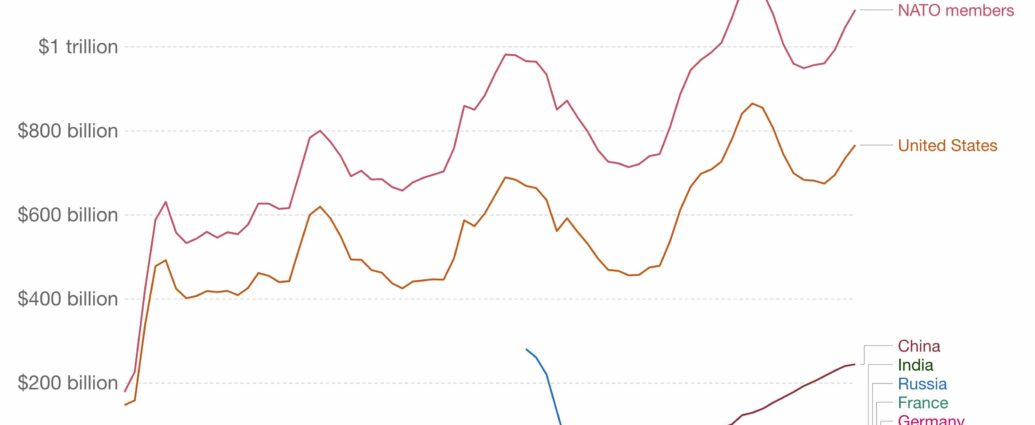
NVIDIA Background

Nvidia is a leading developer of graphics processing units. Traditionally, GPUs were used to enhance the experience on computing platforms, most notably in gaming applications on PCs. GPU use cases have since emerged as important semiconductors used in artificial intelligence to run large language models. Nvidia not only offers AI GPUs, but also a software platform, Cuda, used for AI model development and training. Nvidia is also expanding its data center networking solutions, helping to tie GPUs together to handle complex workloads.


Company P/E P/B P/S ROE EBITDA (in billions) Gross Profit (in billions) Revenue Growth
NVIDIA Corp 36.47 27.60 20.28 31.11% $51.28 $51.09 73.21%
Broadcom Inc 62.15 18.90 22.72 9.12% $11.15 $13.16 29.47%
Micron Technology Inc 18.03 5.95 7.45 21.0% $18.48 $17.75 196.29%
Advanced Micro Devices Inc 84.39 5.70 10.40 2.44% $2.86 $5.58 34.11%
Texas Instruments Inc 36.10 11.01 10.16 7.03% $2.07 $2.47 10.38%
Analog Devices Inc 58.87 4.65 13.56 2.46% $1.52 $2.04 30.42%
Qualcomm Inc 26.28 6.03 3.18 13.57% $4.11 $6.68 5.0%
Marvell Technology Inc 32.07 6.02 10.45 2.79% $0.75 $1.15 22.08%
Monolithic Power Systems Inc 86.99 15.56 19.37 4.95% $0.21 $0.41 20.83%
NXP Semiconductors NV 24.86 4.97 4.10 4.53% $0.98 $1.81 7.2%
GLOBALFOUNDRIES Inc 29.40 2.15 3.84 1.68% $0.73 $0.51 0.0%
ON Semiconductor Corp 217.59 3.24 4.33 2.33% $0.45 $0.55 -11.17%
Tower Semiconductor Ltd 97.29 7.27 13.69 2.78% $0.13 $0.09 11.26%
First Solar Inc 13.62 2.18 3.99 5.62% $0.7 $0.67 11.15%
Astera Labs Inc 98.63 15.02 25.34 3.41% $0.07 $0.2 91.77%
MACOM Technology Solutions Holdings Inc 110.88 13.58 18 3.64% $0.07 $0.15 24.52%
Credo Technology Group Holding Ltd 57.09 10.37 18.07 10.03% $0.16 $0.28 201.49%
Lattice Semiconductor Corp 5036 19.31 26.61 -1.08% $0.01 $0.1 24.16%
Rambus Inc 45.46 7.60 14.81 4.81% $0.09 $0.15 18.09%
Average 340.87 8.86 12.78 5.62% $2.47 $2.99 40.39%

Full story available on Benzinga.com

This post was originally published here