AI for Financial Advisors: A Review of Zocks, the AI Note-Taking Tool
2026-03-23
This post was originally published here

This post was originally published here
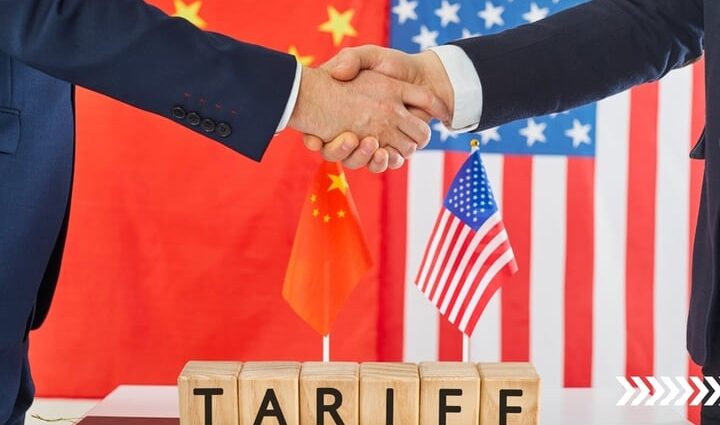
Despite a Supreme Court ruling aimed at reining in executive trade powers, U.S. households are facing a massive spike in trade-related costs.
The average U.S. family is on track to pay more than $2,500 in tariff-related costs this year—a 43% increase from the $1,745 average estimated during the first year of President Donald Trump’s second term, according to data recently released by the Joint Economic Committee.
The report suggests that rather than providing the expected inflationary relief, the administration’s immediate pivot to new, legally compliant tariffs has kept the tax burden on consumers at historic highs, forcing more households to juggle everyday bills, higher prices and existing debt all at once.
The committee’s estimates are based on tariff revenue recorded in January. If the levels hold steady through December, the total cost passed on to American families will exceed $330 billion for the year.
The surge comes in the wake of a high-profile Supreme Court decision that struck down the bulk of Trump’s initial tariff agenda as illegal.
But the victory for trade advocates appears to have been short-lived. Following the ruling, the administration moved to rapidly enact a Plan B of new tariffs.
Treasury Secretary …
This post was originally published here

Bitcoin (CRYPTO: BTC) has climbed back above $70,000 after weekend weakness, but on-chain data suggests the broader correction may not be over.
CryptoQuant data shows Bitcoin is undergoing its longest period of decoupling from the S&P 500 since 2020.
While equities continued to perform, Bitcoin entered a downturn starting in October, diverging from its usual correlation with traditional markets.
The shift was triggered by a major liquidation event on Oct. 10, when roughly 70,000 BTC in open interest was wiped out, erasing months of positioning in …

Americans are paying more for gas nationwide, with some states hit harder than others as the Iran conflict drives oil prices higher.
The national average is now $3.95 per gallon, up $1.02 from a month ago, according to AAA.
Prices are climbing across nearly every region, with some states already well above the national average. On the West Coast, drivers are seeing the highest costs, with prices reaching $5.79 per gallon in California and $5.27 in Washington.
OIL, GAS PRICES JUMP AS TRUMP FLIRTS WITH STRIKING IRANIAN OIL INFRASTRUCTURE
Along the East Coast, gas prices are approaching or exceeding $3.70 in several areas, including $3.86 in New York and $3.80 in Maine.
In the Midwest, Illinois stands out at $4.16 per gallon, while much of the region remains closer to the mid-$3 range. Southern states are generally lower, though still rising, with Texas at $3.62 and Florida at $3.93.
THE UNLIKELY TOOL TRUMP IS EYEING TO TACKLE RISING OIL PRICES AMID THE IRAN CONFLICT
Diesel is outpacing gasoline due to its link to freight and industry, meaning increases can ripple through supply chains and raise costs. It averaged $5.28 a gallon, up $1.69 over the same period, according to AAA.
The surge comes as traders closely watch the Strait of Hormuz, a critical global energy chokepoint where tanker traffic has slowed to a crawl as tensions intensify.
TRUMP PROMISED LOWER COSTS; THE IRAN CONFLICT NOW THREATENS THAT PLEDGE
Just 21 miles wide at its narrowest, the waterway between Iran, the United Arab Emirates and Oman carries roughly 20 million barrels of oil per day and about one-fifth of global liquefied natural gas, along with significant volumes of jet fuel.
GET FOX BUSINESS ON THE GO BY CLICKING HERE
For U.S. drivers, prices could keep climbing just as summer travel and road trip season begins.
Oil prices remained elevated and volatile over the weekend (March 21 to 22) as traders highlighted persistent supply disruptions in the Middle East against shifting geopolitical signals and policy responses.Brent crude held above the US$100 per barrel mark for much of the period, while West Texas Intermediate (WTI) traded near or just below that level, reflecting continued concerns over constrained flows through the Strait of Hormuz, a critical chokepoint that typically handles roughly 20 percent of global oil supply.Reports of reduced tanker traffic and production curtailments across key Middle Eastern producers have kept a firm risk premium embedded in prices, even as headlines around potential pauses in hostilities trigger short-lived pullbacks.After spiking to US$112 during the course of the weekend, Brent crude briefly fell below US$100 before rallying back to the US$100 threshold early on Monday (March 23) morning. Despite the volatility, market participants are increasingly focused on the duration of the disruption, rather than its immediate severity.According to Shawn Severson, CEO and head of market and thematic research at Water Tower Research, futures markets are signaling that elevated prices may persist well beyond the near term.“The equity market has not sufficiently priced in the expected persistence of high oil prices as indicated by the futures market,” Severson said via email, pointing to FactSet data showing December-dated WTI contracts for 2026, 2027 and 2028 trading at record highs, with volumes also surging. “The futures market is not treating this as a disruption it expects to resolve quickly … it is pricing in a longer duration, and that distinction is everything for equities,” he added. That longer-term pricing dynamic suggests the market is beginning to factor in a sustained energy shock, rather than a temporary spike. Analysts note that while spot prices near US$95 to US$100 may be manageable in the short term, prolonged strength at those levels could have broader macroeconomic consequences.“A US$95 oil price that lasts three weeks is a headline, but a $US95 oil price that institutional traders are embedding into 2026, 2027 and 2028 has time to fully permeate the economy,” Severson said, highlighting potential impacts across transportation, food and industrial costs, as well as consumer spending.At the same time, policy responses have offered only limited relief. Discussions among G7 nations around coordinated strategic petroleum reserve releases have helped cap upside momentum, but analysts widely agree such measures are unlikely to fully offset supply losses if disruptions persist.The key variable remains the trajectory of the conflict and its impact on supply chains. With futures curves pointing higher and geopolitical risks unresolved, oil markets appear increasingly positioned for a prolonged period of elevated prices, a scenario that could reshape both energy equities and the broader economic outlook in the months ahead.Don’t forget to follow us @INN_Resource for real-time updates!Securities Disclosure: I, Georgia Williams, hold no direct investment interest in any company mentioned in this article.Editorial Disclosure: The Investing News Network does not guarantee the accuracy or thoroughness of the information reported in the interviews it conducts. The opinions expressed in these interviews do not reflect the opinions of the Investing News Network and do not constitute investment advice. All readers are encouraged to perform their own due diligence.
This post was originally published here

Mississippi’s law counts mail-in ballots sent by some voters if they were postmarked on or before, and received up to five business days after, Election Day.
This post was originally published here
This post was originally published here
Bill was introduced in the Senate on Monday as prediction market companies face greater scrutiny on state level
Prediction markets are facing fresh bipartisan scrutiny in the US Senate as companies like Kalshi and Polymarket continue to battle state-led efforts to regulate online betting.
A bill was introduced in the US Senate Monday that would ban federally regulated platforms from allowing wagers on sporting events, what would be a huge blow to marketplaces where billions of dollars have been traded on major events like the Super Bowl and the NCAA’s March Madness.
This post was originally published here


This post was originally published here
CEO of asset manager says only a few firms and investors may reap rewards from growth in the technology
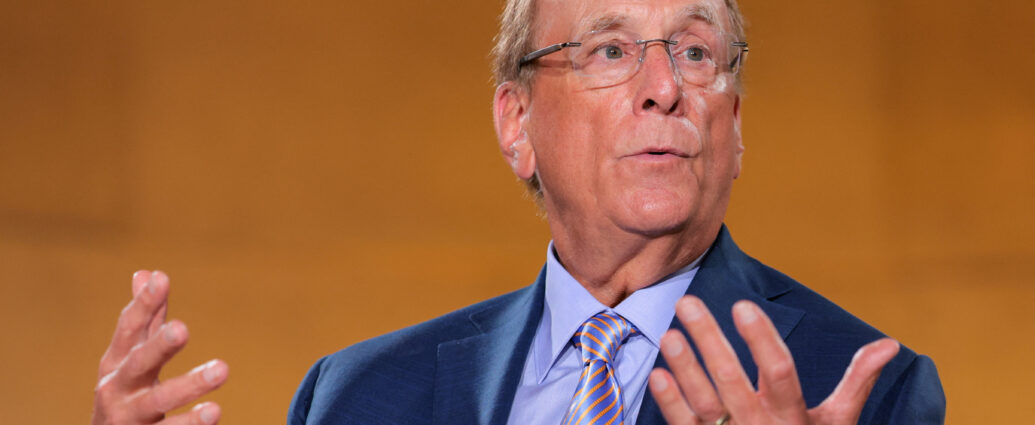
The boom in artificial intelligence risks widening inequality, with only a handful of companies and investors likely to reap its financial rewards, the BlackRock chief executive, Larry Fink, has said.
The boss of the $14tn (£10.4tn) asset manager used his annual letter to investors on Monday to highlight potential hazards around the exponential growth in AI, which has attracted rapid investment and become, he said, “central to strategic competition” between global powers such as the US and China.
This post was originally published here
BitMine Immersion Technologies, Inc. (AMEX:BMNR) shares rose Monday after the company reported total crypto, cash, and “moonshot” holdings of $11.0 billion, underscoring its growing Ethereum exposure.
The company holds 4.66 million Ethereum (CRYPTO: ETH), including 3,142,643 staked ETH, valued at $6.5 billion, as well as $1.1 billion in cash. BitMine now owns 3.86% of the total ETH supply and is over 77% toward its “Alchemy of 5%” target within eight months.
The company has accelerated accumulation, including a recent weekly purchase of 65,341 ETH.
BitMine generates annualized staking revenue of $184 million, with potential to reach $272 million as staking scales. The MAVAN staking solution remains on track for a first-quarter 2026 launch.
In addition to Ethereum, BitMine holds 196 Bitcoin (CRYPTO: BTC), a $200 million stake in Beast Industries, and $95 million in Eightco Holdings (NASDAQ:ORBS).
Management pointed to regulatory developments, including a 68% probability that the Clarity Act will pass in 2026, as a potential catalyst for Ethereum.
“Bitmine has maintained …
This post was originally published here
This post was originally published here
Case focuses on RNC’s challenge to a Mississippi law that allows ballots to count if they arrive after election day
The US supreme court appeared poised on Monday to curtail how mail-in ballots can be counted if they arrive after election day, which would affect laws in more than a dozen states during a midterm election year.
The justices are considering Watson v Republican National Committee, a challenge over a Mississippi state law that was brought in 2024 by the Republican party. Mississippi allows mailed ballots to be counted if they arrive within five business days of election day, so long as they were postmarked by election day. Mississippi changed its laws in 2020, during the Covid-19 pandemic.
This post was originally published here
This post was originally published here
This post was originally published here
This post was originally published here
This post was originally published here
The Investing Club holds its “Morning Meeting” every weekday at 10:20 a.m. ET.
This post was originally published here
This post was originally published here
This post was originally published here
This post was originally published here
This post was originally published here
This post was originally published here
This post was originally published here

Prominent economist Peter Schiff made a bold call on Monday, drawing a direct parallel between gold’s current selloff and the 2008 Global Financial Crisis.
Writing on X, Schiff said, “In the early months of the 2008 GFC, gold crashed 32%, about 40% of its prior bull-market gain.”
He argued the setup looks identical today. Gold nearly hit $4,100 Monday, down 27% from its peak — also roughly 40% of its gain since the $2,000 level. His conclusion: “A 178% surge from that low puts gold at $11,400.”
Gold hit an all-time high of $5,589 in January. It has since shed over 22%, last trading at $4,357.29. The U.S.-Iran conflict sent oil above $112, stoking …
This post was originally published here

This post was originally published here
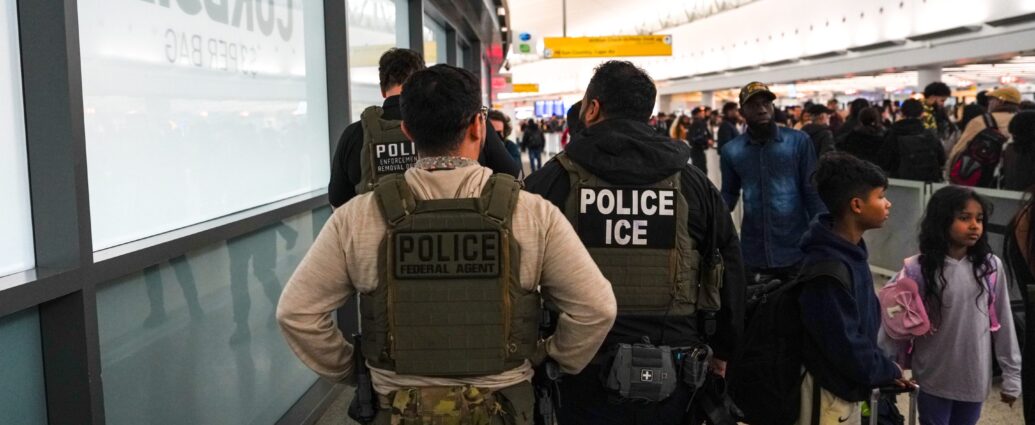
More federal immigration officers are making their way to U.S. airports after President Donald Trump said he’d deploy them to supplement the Transportation Security Administration during a government shutdown that has caused long lines at security checkpoints across the country.
On Monday morning, a handful of federal officers were seen by The Associated Press near busy lines at Hartsfield–Jackson Atlanta International Airport. And a handful of other airports — including Louis Armstrong International in New Orleans, as well as Houston’s George Bush Intercontinental and William P. Hobby airports — said Immigration and Customs Enforcement officers would also be on site to support TSA operations.
Federal officers are a routine presence at international airports, where Customs and Border Protection officers screen arriving travelers and Homeland Security Investigations agents handle criminal cases tied to smuggling, trafficking and fraud. But what’s unusual in the current moment is their visibility at TSA security checkpoints.
Monday’s deployments came as hundreds of thousands of Homeland Security workers, including from the TSA, U.S. Secret Service and Coast Guard, have worked without pay since Congress failed to renew DHS funding last month. That’s led many TSA agents to call in sick — or even quit their jobs — as financial strains pile up. The staffing shortages have forced some airports to close checkpoints at times, with wait times swinging dramatically for travelers.
On Sunday, the Trump administration signaled it would deploy federal immigration officers to large airports with the longest wait times — and Department of Homeland Security spokesperson Lauren Bis said that would include “hundreds” of ICE officers, but she did not disclose all the airports they would go to, citing security reasons.
Some fear the move to deploy federal immigration agents will only escalate tensions.
“This latest threat of ICE invasion at the airports is another distraction from solutions that protect Americans,” a coalition of unions representing flight attendants and other workers — including the Association of Flight Attendants-CWA and International Association of Machinists and Aerospace Workers — said in a Sunday statement. Transportation security officers “can’t simply be replaced” by federal immigration officers, they noted, adding that ICE’s presence and potential attempts to question passengers about immigration status may also “distract them from ensuring airport security.”
The unions called for TSA workers to be paid immediately.
Trump said on Sunday that he would order federal immigration agents to airports to assist TSA by guarding exit lanes or checking passenger IDs unless Democrats agreed to fund the DHS. Funding for the department lapsed Feb. 14, as Democrats refused to fund ICE as well as Customs and Border Protection without changes to their operations in the wake of the deaths of Alex Pretti and Renee Good in Minneapolis.
Democrats are continuing to demand major changes to federal immigration operations — including policy changes that would require ICE officers to get a warrant from a judge before forcefully entering homes, the removal of masks and clear identifying information on uniforms.
Trump on Monday directed ICE officers not to wear face coverings in their work at airports. In a social media posted, Trump said he supports ICE officers wearing masks when dealing with “hardened criminals” but suggested it isn’t necessary “when helping our Country out of the Democrat caused MESS at the airports.”
Beyond TSA operations, New York’s LaGuardia Airport shut down following a deadly collision on the runway late Sunday. An Air Canada regional jet struck a fire truck while landing, officials said — killing the pilot and copilot while around 40 passengers and crew members were taken to area hospitals, some with serious injuries.
According to the FAA, LaGuardia is expected to remain closed until at least 2 p.m. ET on Monday. Air traffic has been diverted, and Monday morning operations also were halted at Newark Liberty International Airport in neighboring New Jersey.
___
Grantham-Philips reported from New York. Associated Press writer Collin Binkley in Washington contributed to this report.
This story was originally featured on Fortune.com

This post was originally published here

This post was originally published here


Video allegedly shows actor striking a man in front of actor’s kids in what looks like a suburban Tennessee neighborhood
Alan Ritchson, the actor best known for his role in the hit action series Reacher, was filmed allegedly assaulting his neighbor in front of the actor’s children.
In a video obtained by TMZ on Sunday, the 43-year-old appeared to strike a man several times as he kneeled on the ground in what looked like a suburban neighborhood in Tennessee. Two children, reported by TMZ to be Ritchson’s, can be seen nearby sitting on motorbikes and watching the incident unfold.
This post was originally published here


A troubling breakdown in the longer term trend have technical analysts anticipating more downside ahead.
This post was originally published here
This post was originally published here
This post was originally published here


This post was originally published here

The oil crises of the 1970s prompted a range of policy changes that still exist today. For one, we invented the high occupancy vehicle (HOV) lane to incentivize workers to carpool. A nationwide 55 mph speed limit made sure those carpools weren’t guzzling too much gas. Cars became more fuel efficient; we (temporarily) started driving less. But some experts say those measures, coupled with those taken during the 2022 energy shock in the wake of Russia’s invasion of Ukraine, pale in comparison to what we’re about to see next thanks to the Iran war.
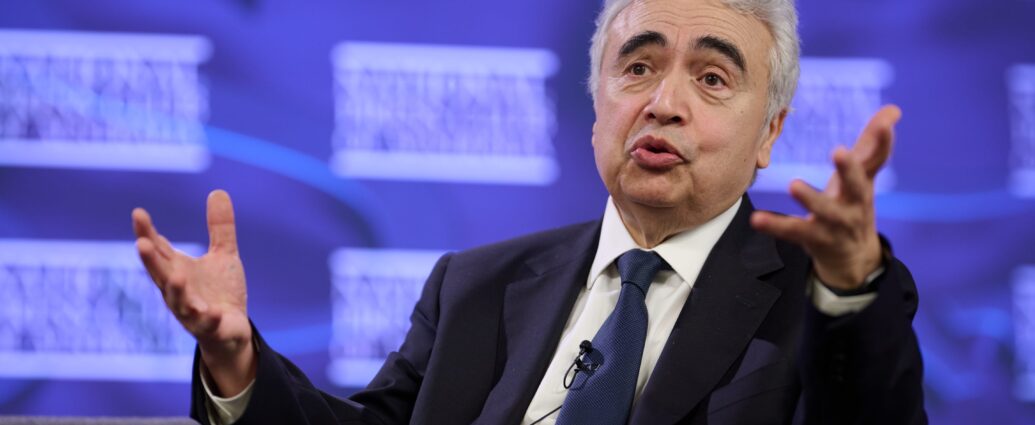
Earlier this month, the Paris-based intergovernmental agency International Energy Agency (IEA) released a record-breaking 400 million barrels of oil to temper rising prices. IEA executive director Fatih Birol, who coordinated the release, finally broke his three-week silence and sounded the alarms on how much damage the war is causing. In an interview Monday at the National Press Club of Australia, Birol said world leaders are underestimating the energy crisis, saying the ongoing energy shock is worse than previous ones.
“The depth of the problem was not well appreciated by the decision makers around the world,” he said. “If you want to put in a context, this crisis as it stands now: two oil crises and one gas crisis put all together,” he said.
Even as President Donald Trump said early Monday the U.S. was in talks with Iran—and would therefore withhold from striking critical energy sources for the next five days—Brent crude last week soared north of $110 per barrel. After the president’s announcement, oil prices fell about 10%, yet remain stubbornly high at about $102 as of 12 p.m. ET. Economists expect the oil shock to reverberate across the U.S. economy, potentially jacking up food prices, jeopardizing the possibility of a Fed rate cut this year (while raising the odds of a rate hike), and even threatening to halt the entire economy if oil prices rise to $140 a barrel.
Birol elaborated on the numbers behind his assertion, saying the losses already accrued are far worse than those from the 1970 oil crises and the Ukraine war.
“Many of us remember the two consecutive oil crises in [the] 1970s: 1973 and 1979,” he said. “In each of the crises, the world has lost about 5 million barrels per day, both of them together 10 million barrels per day.”
“And today, only as of today, we lost 11 million barrels per day, so more than two major oil shocks put together.”
He added that after Russia’s invasion of Ukraine the gas markets, particularly in Europe, “lost about 75 billion cubic meters, 75BCM. And as of now, as a result of this crisis, we lost about 140BCM, almost twice” as much.
Beyond the energy shocks, Birol said the war is severing ties to some of the vital arteries of the global economy by disrupting other critical supply chains. The war, he said, has interrupted the trade of petrochemicals, fertilizers, sulfur, and helium, some of the most critical building blocks of the world economy. For example, roughly half of the world’s urea supply, a critical compound for fertilizer, runs through the Strait of Hormuz, potentially impacting the cost of U.S. food prices within the coming months.
“If fertilizer disruptions or inflation drives higher corn prices, that is going to be felt everywhere throughout the food supply,” Dr. Ricky Volpe, an agricultural economist and professor of agribusiness at Cal Poly, said in a recent interview with Fortune.
Even as Trump promises to withhold strikes on energy sources for several days, Birol said there are already many damaged oil refineries, gas fields, and pipelines across nine countries, which means that even when the war concludes, it could take some time for oil prices to adjust to their pre-war levels.
“Forty energy assets in the region are severely or very severely damaged,” he said. “It will take some time for these assets—these oil fields, gas fields, refineries, pipelines—[to] come to the normal capacity that they were running before the war.”
This story was originally featured on Fortune.com

In just weeks, Wall Street has gone from optimistically waving off the U.S. and Israel’s strikes on Iran as a short-term blip to the more pessimistic assumption that the chaos in the Middle East could have long-term ramifications.
Likewise, consumers—already sensitive to the cost of living—are struggling with yet another affordability issue as oil and gas prices shot up after supply from the region was restricted.
As Larry Fink wrote in his annual letter to shareholders today: “We are living through a period where things that would’ve defined a decade have become routine: wars with global repercussions, trillion-dollar companies, a fundamental reordering of international trade, and the advent of the most significant technology since, at least, the computer.”
Frankly, it’s been hard to keep up—and the BlackRock CEO wrote that the drama and uncertainty threatened by day-to-day headlines may be obscuring longer-term trends.
Fink, worth $1.3 billion according to Forbes, said that the vast majority of wealth historically has flowed to people who owned assets, as opposed to those who earned their money by working. Since 1989, he observed, a dollar invested in the U.S. stock market has ballooned at 15 times the value of a dollar tied to median wages. This wealth effect will likely be the same in the age of AI, with those wealthy enough to invest in the technology seeing their portfolios benefit the most from increasing to asset prices.
As such, the BlackRock founder wrote: “This is where much of today’s economic anxiety comes from: a deeper feeling that capitalism is working—just not for enough people.”
For individuals looking to make a quick buck in the rollercoaster stock market by trying to buy the dips and sell the peaks won’t see the same benefits as those holding historical wealth, Fink said: “A focus on short-term investing is not a fix for that.” Over the past two decades, the BlackRock CEO noted, every dollar invested in the S&P 500 grew by more than eight times. But if an investor were to have missed out on the 10 best days of the market then they would have earned less than half that return.
As such, “staying invested has mattered far more than getting the timing right,” and as such, “it is long-term investing that allows countries to build domestic industries, that lets people build enduring wealth and shows how their country’s growth can benefit them too.”
Fink’s take on the shifting nature of capitalist sentiment is echoed by research into the American Dream. In 2024, Pew Research asked nearly 9,000 respondents if the American Dream existed, and only a slim majority—53%—said it was still achievable. 41% said the American Dream was once possible, while 6% said it was never a reality.
There was also a marked split in opinion: Those with a college level of education, who were defined as having higher levels of income, were notably more optimistic about the possibility of achieving such a goal.
U.S. citizens are uniquely placed to benefit from the largest economy on earth and its domestic but globally market-leading businesses. However, Fink wrote that many households don’t have enough cash on hand to make ends meet—let alone any left over to invest in volatile markets over a sustained period of time.
A BlackRock survey of 1,000 voters conducted in January found that one-third of respondents don’t have $500 dollars on-hand for an emergency like a car repair, Fink said: “In fact, many are forced to pull money out of the markets just to make ends meet. Last year, a record number of workers withdrew money from their 401(k) plans so they could cover financial emergencies. The challenge is saving enough money to invest in the first place.”
The creation of products like Trump Accounts will help families get a foot on the ladder to long-term investing, Fink said. However, a major lever which could be used to foster wealth creation and potentially address income inequality is Social Security.
Fink mused on the current structure of the program, which “emphasizes stability and predictability.” He added: “What it doesn’t do is let people grow their benefits along with the broader economy. The question is whether the Social Security system could allow both. Could a portion of the system be invested more like other long-term pension plans—carefully, broadly, and over decades—while ensuring the program remains a strong safety net?”
This is by no means a bid to privatise social security, Fink said, but some state and local government employees already contribute to public pension schemes which are invested in diversified portfolios: “If long-term investing is already helping millions of public servants build retirement security, it raises a reasonable question: Why shouldn’t more Americans have access to that same kind of long-term growth?”
This story was originally featured on Fortune.com



This post was originally published here

This post was originally published here
Nvidia Corp (NASDAQ:NVDA) announced a partnership with six major U.S. energy companies to build a new class of AI data centers designed to tap up to 100 gigawatts of underutilized capacity across the U.S. power grid.
The chipmaker announced the collaboration at CERAWeek 2026 in Houston alongside Emerald AI and six energy partners: AES Corp (NYSE:AES), Constellation Energy Corp (NASDAQ:CEG), Invenergy, NextEra Energy Inc (NYSE:NEE), Nscale Energy & Power and Vistra Corp (NYSE:VST).
For the four publicly traded names in the deal, the partnership may offer a new revenue stream: selling flexible power services to AI data centers, on top of the demand tailwind that has already pushed Constellation and NextEra to Big Tech-level valuations.
The facilities will run on Nvidia’s Vera Rubin DSX AI Factory reference design, unveiled at GTC earlier this month, which includes DSX …
This post was originally published here
Steve Eisman, the fund manager from The Big Short, says a credit cycle is emerging and SoFi Technologies (NASDAQ:SOFI) may be sitting at the center of it.
“There is no doubt in my mind that a credit cycle is emerging,” Eisman said on his weekly podcast.
He devoted a significant chunk of the episode to SoFi’s securitization problems, calling them “potentially a disaster.”
Eisman broke the mechanics down.
SoFi makes consumer loans, pools them into securitizations, and sells the debt to investors.
SoFi charges borrowers 10%, pays securitization investors 5%, and keeps the spread. That spread is SoFi’s entire margin.
When losses breach a preset level called the cumulative net loss trigger, SoFi stops getting paid.
Eisman cited Bloomberg data showing SoFi’s SCP 2025-1 securitization hit CNLs of 2.97% against a trigger of 2.60%.
Everything now goes to securitization investors until they’re made whole. He added that the 2025-2 deal looks likely …
This post was originally published here
Toyota on Monday announced $1 billion in investments in two U.S. plants as part of a plan to invest up to $10 billion domestically over the next five years.
This post was originally published here

Digitally fluent, socially connected and budget-conscious, Generation Z is entering the residential market with growing momentum. Over just five years, young renter households skyrocketed from 700,000 to 4.4 million, a sixfold expansion redrawing the map of demand from Birmingham, Alabama, to San Jose, California.
Although the vast majority of twentysomethings continue to rent rather than own, the pace at which young buyers are acquiring property is accelerating even faster – despite representing fewer than 1 million households overall. In fact, only 17% of Gen Zers own a home so far.
A RentCafe analysis of 97 U.S. metropolitan areas – each with at least 15,000 Gen Z households – reveals where the youngest generation of renters and buyers is choosing to live and which markets are recording the sharpest gains.
Today’s young renters are looking for cities with employment prospects, healthy wage gains and plenty of outdoor and entertainment options for a balanced lifestyle. But opportunity no longer resides exclusively in expensive coastal corridors. Emerging youth hubs across the South are absorbing much of the demand.

Birmingham, Alabama, exemplifies this shift. Five years ago, the metro barely registered on any Gen Z radar; today it leads the nation in young renter growth with a thirteenfold increase – from 1,683 households in 2018 to 23,859 in 2023. A lower cost of living (9% below the national average), expanding business activity, and diverse entertainment options draw young renters to Alabama’s largest metro.
Huntsville, Alabama, reinforces Alabama’s popularity among Gen Zers, ranking 11th after an eightfold increase.
Raleigh, North Carolina, ranks second with a twelvefold jump (3,079 to 39,887). The metro area’s appeal rests on its emergence as a tech hub and a 299% income gain in five years. Here, nine of 10 Gen Zers rent.
Buffalo, New York, climbed to third via affordability and remote-work appeal. Nashville, Tennessee, is fourth on the list after a ninefold surge that led to more than 65,000 Gen Z renter households in the metro area. Denver, in fifth place, posted a comparable ninefold gain driven by outdoor access and activities, and a strong job market.
Jackson, Mississippi, and Lafayette, Louisiana, round out the Southern contenders as affordable alternatives to coastal metros.
Large gateway cities continue to attract significant Gen Z renter volume. Washington, D.C., ranks seventh with nine times more young renter households in 2023 than in 2018 – reaching 115,473. The capital’s government, policy, technology and consulting sectors, combined with a tripling of typical young-professional income, sustain its pull.
San Jose, California, holds the eighth growth spot while claiming the highest renter share – nearly 95%. Miami follows at ninth and Boston at 10th, each posting eightfold increases.
New York ranks 12th and commands the largest absolute count at close to 280,000 Gen Z renter households after an eightfold expansion. New York City’s appeal is fueled by unmatched opportunities, experiences and networking, but also the quadrupling of Gen Z’s average income. Minneapolis and Philadelphia each recorded sevenfold gains; across all three metros, eight of every 10 Gen Zers rent.
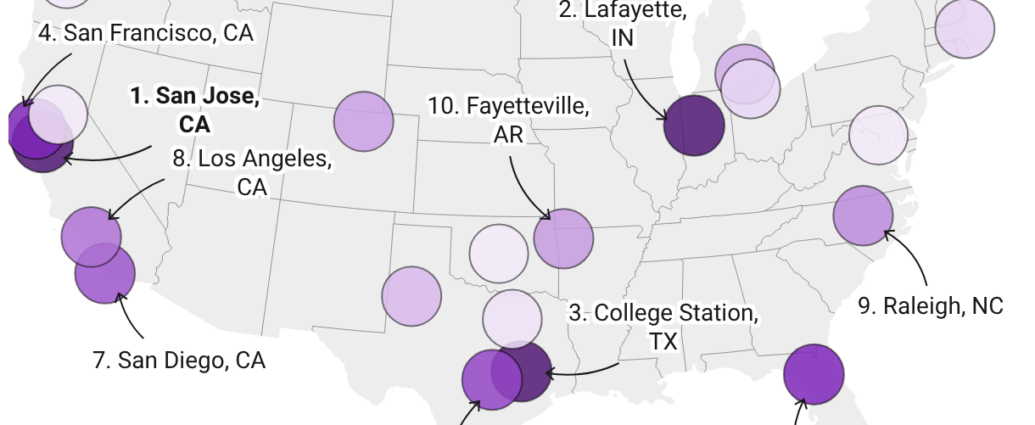
San Jose tops the concentration rankings with 95% of Gen Zers in the renter category. Four additional California metros feature in the top 20: San Francisco at 92%, Los Angeles at roughly 91%, San Diego at 91%, and Sacramento, California, at about 88%. Despite paychecks tripling in five years, elevated home prices keep ownership out of reach, reinforcing renter density.
Texas contributes four metros as well. College Station, Texas, places third at 93%, driven by Texas A&M University’s enrollment expansion. Austin, Texas, ranks sixth at approximately 92%. College-town Lafayette, Indiana, is the runner-up at 94%, while Raleigh and Ann Arbor, Michigan, each show nine of 10 Gen Z households renting.
Lower mortgage rates between 2020 and 2022 triggered the first substantial wave of Gen Z home purchases, concentrated in smaller and mid-sized metros across the South and Midwest where affordable prices coincide with strong income gains.

Tucson, Arizona, leads by a wide margin: Owner-occupied Gen Z households surged 170-fold, from 35 in 2018 to roughly 6,000 in 2023 – aided by the University of Arizona’s presence and a market far less expensive than Phoenix. Jacksonville, Florida and Dayton, Ohio, follow with approximately 60-fold jumps; both offer below-average living costs and solid wage growth.
Omaha, Nebraska, recorded a 44-fold increase to exceed 9,000 households, buoyed by housing costs roughly 20% under the national benchmark. Lafayette, Louisiana, ranks fifth with more than 3,400 homeowners in 2023 versus 78 in 2018 – 22% of all young-adult households. Louisville, Kentucky; Lincoln, Nebraska; San Antonio, Texas; Des Moines, Iowa; Lansing, Michigan; and Buffalo, New York – the highest-ranking Northeastern metro – also posted rapid gains.
Among the 97 metros studied, 10 have more than one-quarter of Gen Zers owning a home. Ogden, Utah, leads at approximately 41%, aided by proximity to Salt Lake City and local homeownership assistance programs. Detroit follows with one-third of young adults owning homes after household counts surpassed 29,500. Birmingham, Alabama, and Jackson, Mississippi, each register 30%, propelled by incomes that more than tripled. Greenville, South Carolina, ranks next at about 28%.
At the opposite extreme, San Jose, California, has the smallest Gen Z homeowner share at just 5% – underscoring how affordability constraints and a preference for flexibility keep nearly all young residents in the rental market.
For more insights, charts, and a detailed methodology, read the full report on RentCafe.com.
YouTube gamer planned audacious alibi, appeared grief-stricken at wake and apparently spied on victim’s family
To get away with murder, Stephen McCullagh planned an audacious alibi: he would trick the world into thinking he was at home livestreaming a video game when in fact he was 17 miles away, extinguishing a life.
He prerecorded a six-hour session of him playing Grand Theft Auto and uploaded it on the night of 18 December 2022, to give the impression to his YouTube channel’s 37,000 subscribers that he was at home in Lisburn, County Antrim, wearing a Santa hat, eating snacks, sipping Guinness and making jokes. “I am not leaving the house tonight,” he said.
This post was originally published here
Belfast court heard how Stephen McCullagh livestreamed recording of himself as part of concocted ‘cover story’
A man who set up a false alibi involving himself livestreaming a video game on YouTube has been found guilty of murdering his pregnant partner.
Natalie McNally, 32, was 15 weeks’ pregnant when she was violently attacked and killed at her home in Lurgan, County Armagh, in December 2022.
This post was originally published here
Diesel prices have surged about 40% to $5.29 per gallon, the highest level since 2022, as the U.S. war against Iran has disrupted oil supplies.
This post was originally published here

XRP (CRYPTO: XRP) is up 3% over the past 24 hours, with improving on-chain data and adoption trends supporting a bullish outlook.
| Cryptocurrency | Ticker | Price | Market Cap | 7-Day Trend |
| XRP | (CRYPTO: XRP) | $1.43 | $88.8 billion | -2.7% |
| Bitcoin | (CRYPTO: BTC) | $70,194 | $1.42 trillion | -3.5% |
| Ethereum | (CRYPTO: ETH) | $2,130 | $262.97 billion | -4.8% |
Trader Notes: Crypto chart analyst Ali Martinez said XRP whales accumulated about 40 million tokens over the past week, adding that a TD Sequential buy signal points to a potential rebound.
XRP is holding support near $1.40, with analysts viewing the recent pullback as a short-term correction within a broader …
Jay Woods reviews why he’s keeping a close eye on the IWM and XLY indexes, the S&P 500 and Nvidia stock.
This post was originally published here
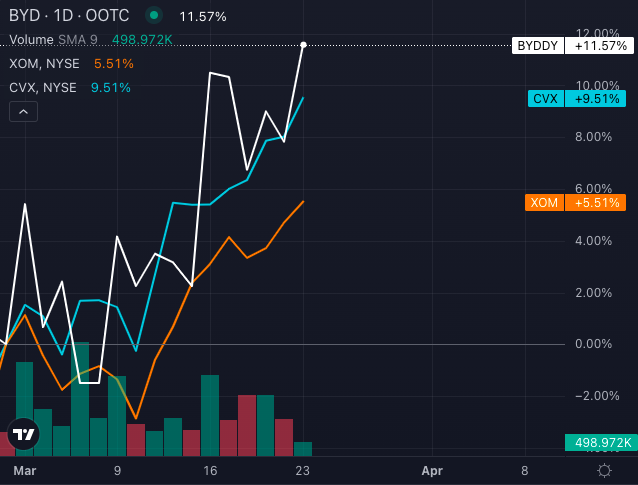
The Iran war is pushing oil prices higher—but markets may already be positioning for what comes next. Oil price has surged sharply since the conflict escalated, lifting energy stocks and reviving inflation concerns. But while oil majors have gained, the bigger move may be happening elsewhere.
China’s battery giants— BYD Co., Ltd. (OTC:BYDDF) (OTC:BYDDY) , Contemporary Amperex Technology Co., Ltd (CATL) and Sungrow Power Supply Co., Ltd.—have added more than $70 billion in market value at the Chinese stock market since the conflict began, with their China shares rising roughly 19–22% over the period, Financial Times reported.
This post was originally published here

This post was originally published here
Gavin Burrows tells high court that claimants in case against Daily Mail publisher ‘very misled’ over his work
A private investigator whose disputed confessions of illegal activity form a key part of the case brought by Prince Harry and others against the Daily Mail’s publisher has said the admissions were “a thing of fiction”.
Giving highly anticipated evidence at the high court, Gavin Burrows said the claimants in the case, as well as their lawyers, had been “very misled” over his work, adding that the supposed admissions in his name were “a pack of lies”.
This post was originally published here
One case that sparked tension involved Justin Sun, a major backer of the Trump family’s World Liberty Financial venture. Another involved Tesla CEO Elon Musk.
This post was originally published here


Shares in Hybe, the parent company of South Korean boyband BTS, fell 15% on Monday as their much-anticipated comeback drew a smaller crowd than expected.
This post was originally published here

Bitcoin (CRYPTO: BTC) is up 3% over the past 24 hours after President Trump announced a 5-day postponement of attacks on Iranian energy infrastructure, following what he called productive talks.
Trump said in a Truth Social post that the two countries held productive conversations regarding a complete resolution of hostilities in the Middle East.
The five-day hiatus doesn’t end the war as Iran continues to strike targets across the Gulf and Israel would also need to sign up.
Bitcoin, which sank below $68,000 overnight, climbed above $71,000 in early U.S. hours before retreating closer to $70,000 after Fars cited an unidentified source denying any talks between the countries.
Ethereum (CRYPTO: ETH), Dogecoin (CRYPTO: DOGE), Solana (CRYPTO: SOL), and Chainlink (CRYPTO: LINK) all rose as much as 5% over 24 hours before giving back part of …
A study of analyst recommendations at the major brokerages shows that Royal Gold Inc (Symbol: RGLD) is the #11 broker analyst pick, on average, out of the 50 stocks making up the Metals Channel Global Mining Titans Index, according to Metals Channel. The Metals Channel Global M
This post was originally published here
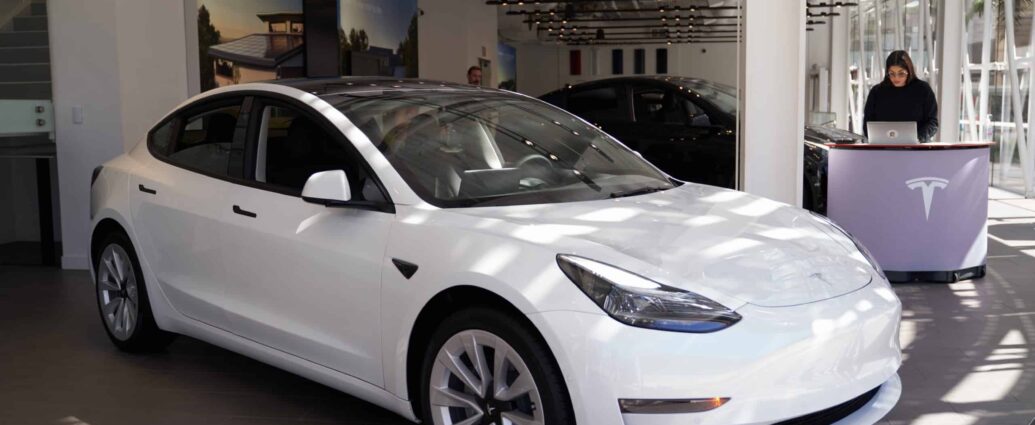

Behind the nation’s greatest college basketball teams is a steady flow of donations from billionaires with varying industry backgrounds and connections to the schools.
Among them are the cofounder of the Carlyle Group, one of the world’s largest investment firms; the owner of the NFL’s Dallas Cowboys, and a Houston hospitality mogul whose name is flashed on an entire arena. Several powerhouse teams bankrolled by billionaires are favored to advance far in this year’s March Madness tournament.
Considering the global sports entertainment industry is estimated to be worth more than $3 trillion, it’s no wonder America’s wealthiest are eager to throw money at the nation’s best college athletics programs.
This year’s March Madness tournament is particularly flush with billionaire money. The Big Ten alone sent six teams to the Sweet 16, meaning the financial stakes for some of the country’s wealthiest athletic boosters have never been higher. This year’s men’s tournament is expected to have more than $270 million in payouts, with each of the 135 available units (games) valued at roughly $2 million, paid out to conferences over six years (that’s about $350,000 per year).
That money flows directly to conferences, not schools. That’s why wealthy alumni and other billionaire boosters step in to fill the gap, pouring hundreds of millions into facilities, NIL deals, and recruiting budgets that tournament checks can’t offer.
Fortune has compiled a sampling of billionaire donors to schools participating in this year’s Sweet 16. Note, this list is not exhaustive.
Rubenstein, cofounder of The Carlyle Group, grew up in Baltimore and earned his undergraduate degree from Duke University in 1970, where he has made generous donations over the decades.
He cofounded The Carlyle Group in 1987 with just $5 million in capital, but grew it to one of the world’s largest private equity firms with $477 billion in assets under management. Rubenstein is worth an estimated $4.2 billion.
Rubenstein has donated more than $60 million to his alma mater, including a $10 million gift to Duke Athletics in 2012. He said he made the donation because of Duke’s “success in so many sports over so many years, [and] because of the program’s commitment to academic achievement and excellence.”
The Carlyle cofounder has made several other multimillion-dollar donations to Duke over the years, including a $20 million scholarship endowment for first-generation students in 2017 and a $25 million gift to support the arts. The billionaire also served on Duke’s board of trustees from 2005 to 2017, including a term as chairman.
Duke, the No. 1 seed in the NCAA Tournament’s East Region, faces St. John’s on Friday at 7:10 p.m. EST on CBS. The Blue Devils are favored to advance.
Jones, the longtime owner of the Dallas Cowboys, has a deep connection to one of this year’s Sweet 16 schools. He’s a University of Arkansas alum and played for the Razorbacks football team in the 1960s before he went on to become a successful oil businessman and the owner of the Dallas Cowboys in 1989. Jones is currently worth an estimated $19.4 billion, with the Cowboys worth approximately $13 billion.
In 2015, Jones donated $10.65 million to Arkansas’ athletic program, which he credited for his success. The gift supported Arkansas’ Student-Athlete Success Center.
“My experiences at the University of Arkansas as a student-athlete under the legendary Coach Frank Broyles helped shape me as a man and guide me on my future career path,” Jones said at the time of the donation. “I would not be where I am today without those life lessons learned as a student-athlete at the University of Arkansas.”
Arkansas faces No. 1 seed Arizona on Thursday at 9:45 p.m. EST on CBS. The Razorbacks are considered a significant underdog, but freshman star Darius Acuff Jr. has made them one of the tournament’s most exciting teams to watch.
Fertitta is the definition of a hometown billionaire backer. The CEO of Fertitta Entertainment and owner of the NBA’s Houston Rockets, he is Houston’s richest sports owner with an estimated net worth of $11.2 billion—a fortune built on hospitality, gaming, and entertainment through his Landry’s restaurant and hotel empire with more than 600 dining, entertainment, and gaming locations nationwide.
In 2016, Fertitta pledged $20 million to the University of Houston’s athletics program to renovate the school’s on-campus basketball arena. This was the largest individual athletic donation in UH history at the time. Fertitta attended UH, although he left before finishing his degree. But the school awarded him with an honorary doctorate in August.
“This gift is personal,” Fertitta said when he made the 2016 donation. “It represents a commitment from my family and me to support the University of Houston in its quest to strengthen our nationally competitive institution, both in academics and athletics.”
“Upgrading our athletics facilities shows we are serious about competing at the highest levels of collegiate sports for many years to come,” he continued.
The arena was subsequently renamed Fertitta Center. He made an additional $50 million pledge to UH’s medical school in 2022.
Houston, the No. 2 seed in the South Region, faces Illinois on Thursday at 10:05 p.m. EST on TBS. The Cougars are favored to win.
Ellison cofounded tech giant Oracle and is currently one of the world’s wealthiest individuals with a net worth of nearly $200 billion.
He also reportedly underwrote the richest recruiting flip in college football history. Ellison reportedly helped the University of Michigan fund a name, image, and likeness sports package to poach quarterback recruit Bryce Underwood from Louisiana State University in November 2024. While Ellison didn’t have a prior connection to the Wolverines, his wife, Jolin, is a Michigan alumna.
Michigan, the No. 1 seed in the Midwest Region, faces Alabama on Friday at 7:35 p.m. EST on TBS. The Wolverines, who are favored to win on Friday, have three projected first-round NBA draft picks on their roster.
Gilbert founded Rock Financial in 1985, which would eventually become mortgage behemoth Rocket Companies. The fintech and homeownership services company has a $40 billion market cap, and Gilbert has an estimated net worth of $29.4 billion. He also owns the NBA’s Cleveland Cavaliers.
Gilbert donated $15 million to his alma mater, Michigan State University, in 2016 for use toward the school’s basketball program. Both he and his wife, Jennifer, attended Michigan State and said that, at the time, the school had “played a large role in both of our lives.”
Michigan State, the No. 3 seed in the East Region, faces UConn on Friday at 9:45 p.m. EST on CBS. UConn is slightly favored to win.
Haslam is a University of Tennessee alum and the owner of the NFL’s Cleveland Browns, a franchise he purchased in 2012. He and his family built their fortune through Pilot Flying J, the nation’s largest truck-stop chain, which they sold to Berkshire Hathaway in a deal that totaled $13.65 billion over several years. Haslam is worth nearly $10 billion today.
The Haslam family has donated $50 million to the University of Tennessee, one of the largest gifts in school history, supporting academics and athletics at the Knoxville campus. The family’s name adorns Haslam College of Business at UT.
Tennessee, the No. 6 seed in the Midwest Region, faces Iowa State on Friday at 10:10 p.m. EST on TBS. Iowa State is currently favored to win.
This story was originally featured on Fortune.com

Sending your resume into the void has never felt more useless.
Employers cut 92,000 jobs in February alone. Unemployment among entry-level employees peaked last July at 13.3%, the worst entry-level market in 37 years. Two-thirds of companies have put hiring on pause while they wait to see where AI can fill the gaps, and in the meantime, 1.17 million jobs have been cut since last year.
So you do what everyone does: You turn to AI to write a cover letter that slightly exaggerates the role you held in your junior year of college. That’s totally fine, since three-quarters of resumes never reach a human’s eyes anyway. This means you’re using AI to write something that gets read by AI, fulfilling some twisted ouroboros that Socrates and the lot would have had a doozy explaining to their students.
For Wharton Business Economics Professor Judd Kessler, there’s a simple alternative: Toss the fake enthusiasm and pick up the phone. The University of Pennsylvania professor and author of Lucky by Design: The Hidden Economics You Need to Get More of What You Want instead thinks the cover letter’s days are numbered.
“I expect that in the not too distant future, cover letters are gone,” Kessler told Fortune. “Either cover letters will be required and everybody will have AI write good ones and they’ll be ignored, or employers will stop asking for them because they realize they’re not looking at them and they’re not adding value.”
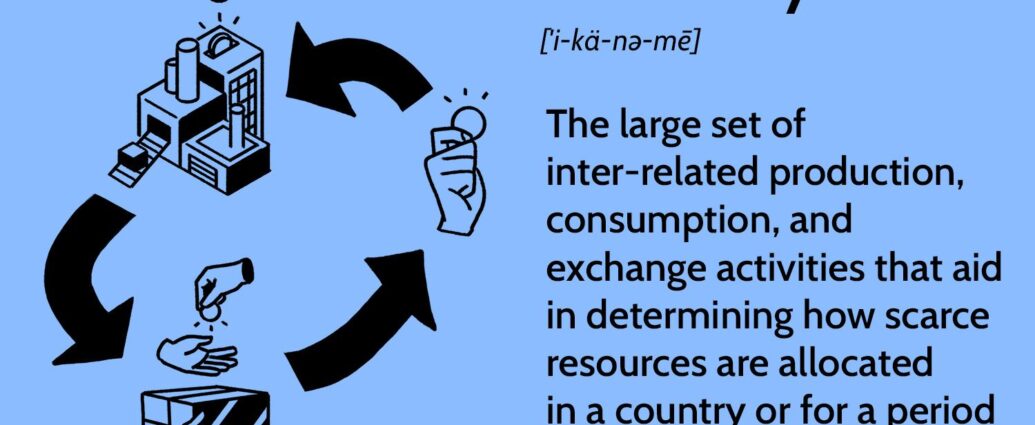
Kessler says job hunting is starting to look a lot like the good ol’ days: It’s all about who you know. At the heart of his argument is the concept of a hidden market: any system that has to allocate something valuable without simply letting the highest bidder win. Think of Taylor Swift pricing concert tickets at $99 when millions of fans would pay 10 times that, or a university with 50,000 applicants for 2,000 freshman seats. Price alone can’t decide who gets what, so other rules take over—rules like knowing a roadie who can get you behind the stage, or having an alumni vouch for you. These are all signals in a hidden market.
And the labor market is one of the biggest hidden markets of all.
“We want to allocate scarce resources, and we don’t want to let price do the job on its own,” Kessler said. “We find it more efficient to have a search process where we identify the best person for the role.”
In this dynamic, signals like the cover letter used to matter, because it meant candidates were spending the time and making the effort to show their enthusiasm.
“It was a costly signal that a job candidate could send that they were really interested in a particular role,” Kessler said. “And it was costly because writing a good one was hard and took time, and you couldn’t do it for every firm.” The signal was hard to ignore: This candidate was serious; after all, they wrote a cover letter.
That all changed when AI made it a quick snap to fake enthusiasm in three frivolous paragraphs.
“Generative AI comes, and something that used to take a few hours to do well now takes a few seconds, or maybe a few minutes,” Kessler said. “And all of a sudden that signal that used to be costly is now very cheap. Economists would call it cheap talk: You can make it look like you are really motivated to join that firm, that the job was designed for you, but you can create that signal very cheaply.”
The research backs him up. Kessler pointed to a study by economists Jingyi Cui, Gabriel Dias, and Justin Ye that tracked what happened when a major job platform introduced an AI cover-letter writing assistant. Letter quality improved because they were better targeted, and well-targeted letters led to more interviews. But as the tool spread, “employers stopped relying on cover letters in their hiring decisions,” Kessler said. “The cover letters got better, and they became a less useful tool overall.”
“In the old days, there used to be a few good cover letters, and that was how you could identify the best-fit candidates,” he said. “Now, all the cover letters pass some threshold. They become a prerequisite rather than a differentiator.”
Once every application looks polished, none stand out—and the rational employer either outsources the reading to AI or stops reading altogether. “That’s when you would hand it off to AI to be responsible,” Kessler said.
Kessler has watched it happen in his own hiring. Despite selecting research assistants at Wharton for the last 15 years, “all of the best cover letters have come in the last 12 months,” he said with a laugh, all of which suddenly reference his research papers.
“That used to be a way that I could tell who was actually motivated,” he said. “But now everybody does that, and my guess is it’s not because everybody has read that research. Everybody has figured out that AI can write a good summary of what I work on and weave that into a narrative. And that means I can’t use the cover letter as a good indication that somebody’s motivated to work with me.”
Instead of relying on an AI-written CliffNotes summary of his own research, Kessler now points to other hidden market signals: “Do they take my course? Do they come to office hours? Do they try to meet with me in person? Those are the signals I start to rely on more, because the cover letter is insufficient.”
The cover letter is dead, Kessler says and as a result, the signals are going old school: reaching out and classic networking.
“For the specific signal of ‘I really want to work at this firm,’ which is a signal that the applicant themselves can send, it’s going to be more things that cannot be replicated with AI,” he said.
“It’s going to be doing in-person networking with members of the leadership team at the firm, taking people that work at the firm out to coffee, going to the coffee chat that the firm has. And those are real costly signals, because they can’t be replicated with AI,” he added. “When I choose to go talk to people at a firm, I’m using hours that I can’t spend talking to people at another firm.”
While the coffee chat isn’t new, Kessler said the return to meeting people and showing other signals spells the cover letter’s inevitable end.
“I often describe this as the age of the cover letter being over,” Kessler said. “AI killed the cover letter.”
This story was originally featured on Fortune.com

In the time it takes to walk from your car to your desk, President Donald Trump added $1.7 trillion to stocks and pushed the price of oil down by $17, or approximately 15%. By the time you got your coffee, Iran had reportedly called him a liar, and half those gains vanished.
This is the average Monday morning for a very market-oriented executive in the fourth week of war.
At approximately 7 a.m. ET, Trump posted in all-caps on Truth Social that the U.S. and Iran held “very good and productive conversations” over the weekend toward “a complete and total resolution” of hostilities in the Middle East. He ordered the Pentagon to pause all strikes on Iranian power plants and energy infrastructure for five days.
Washington had kept Israel informed of the talks, Reuters reported, and Israel is expected to follow the U.S. in suspending strikes on Iranian power plants.
That came after Trump issued an ultimatum to Iran Saturday night, calling on the regime to reopen the Strait of Hormuz or face bombardment of its power grid. Now, it appears he’s buying time for the workweek, and leaving the weekend as a buffer before any next move.
S&P 500 futures swung nearly 4% off their lows, Brent crude collapsed from $109 to a low of $92 before partially recovering, and West Texas Intermediate touched $88.70, its lowest point since the war began.
Iran’s state media reported that the talks never happened, citing an unnamed “senior security official” in a post on Telegram. The official called it a ploy to manipulate markets and said there’s no communication lines between the two countries. As of time of writing, no official from Iran has publicly confirmed or denied Trump’s claim.
Trump told Fox Business that talks did occur Sunday night, involving special envoys Jared Kushner and Steve Witkoff, facilitated by Egypt, Pakistan and Turkey. Iran wants a deal “badly,” he said.
“We have major points of agreement—I would say almost all points of agreement. Perhaps that hasn’t been conveyed,” he added, also joking that Iran needs “better public relations people.”
Wall Street has a word for all of it, coined by Financial Times columnist Robert Armstrong last May: TACO, or Trump Always Chickens Out. The acronym describes Trump’s habit of making catastrophic threats that cause market panic, then reversing course before economic pain can set in. The trade has minted money for investors who bought every dip, confident that Trump’s tolerance for damage had a ceiling.
The pattern was seen in his trade war last year as he announced prohibitively high tariffs only to reach a deal later. It played out in Greenland too early this year, when Trump spent weeks threatening to seize the island only to settle for a vague base agreement.
The Iran war is, theoretically, supposed to function differently: after all, it takes “two to TACO,” since Trump cannot just unilaterally end the war the same way he could unilaterally pull back sanctions.
Oil analyst Rory Johnston wrote on Monday that though the “base case” was that Trump would try to back out and declare victory, it won’t be that simple to bring down oil prices.
“Hormuz flow still hasn’t resumed and every day we’re shedding more oil from the system,” he wrote on X. “That’ll catch up—can’t jawbone 10 to 15 million barrels per day stock draws.”
It is unclear who Trump is even negotiating with on Iran’s side. He told Fox Business he’s dealing with the man who’s “most respected” in Iran, though “It’s a little tough — we’ve wiped out everybody.”
U.S.-Israeli forces have killed most of Iran’s top brass, including Supreme Leader Ayatollah Ali Khamenei, security chief Ali Larijani, and other senior leaders. When asked a few weeks ago whom Trump wanted to see replace the ayatollah, Trump said “everyone we had in mind is dead.”
The Jerusalem Post has reported that Trump’s actual interlocutor is Iranian parliament speaker Mohammad Bagher Ghalibaf.
Trump also said on Fox Business Monday that he and new Supreme Leader Mojtaba Khamenei—son of the late Ali Khamenei—would together be in charge of the Strait of Hormuz.
This story was originally featured on Fortune.com

This post was originally published here

This post was originally published here

The ‘Gen Z stare’ became an internet meme last year—used to describe a blank, expressionless look from a generation often glued to their phones. But it’s not just a phenomenon among today’s young people—even Mark Zuckerberg once had his own version of it.
On a recent episode of The Social Radars podcast, Y Combinator cofounder Paul Graham recalled meeting the Facebook cofounder around 2007—and being struck by his lack of social skills.
“[Zuckerberg] has this weird thing where if he didn’t have anything to say, he wouldn’t fill the gap with passing conversation,” Graham said. “He had no concept of small talk.”
The silence coming from the twentysomething Harvard dropout, Graham added, was more jarring than expected: “It was surprisingly disconcerting. I didn’t realize how important small talk was until I met the lack of it. But he would just stare at you if there wasn’t anything [to say].”
In the 1990s, Graham cofounded the software company Viaweb, which Yahoo acquired in 1998 for $49 million. In 2005, he co-founded the startup accelerator Y Combinator, which has helped launch billion-dollar Silicon Valley companies including Airbnb, Stripe, Dropbox, and Reddit. While his exact net worth is not public, Graham has likely earned substantial income through his investments.
Now 41, Zuckerberg’s communication skills have in fact visibly evolved. From delivering Harvard’s commencement address in 2017 to testifying before Congress multiple times, he’s grown into a far more polished public speaker—and it’s worked to his advantage. Zuckerberg himself now has a net worth of $210 billion.
Graham quipped his first meeting with Zuckerberg was before he “had learned to imitate a normal person,”—but the tech founder himself has acknowledged he has struggled with communication as he’s taken his social media platform from a Harvard dorm room idea to one of the biggest companies in the world with a $1.5 trillion market cap.
“Look, historically I’ve had a very hard time expressing myself,” Zuckerberg told NBC News in 2019. “I just come across as robotic.”
He echoed that sentiment years later on Threads, saying that feedback about his awkwardness initially made things worse—but he’s improved with time: “Being awkward and getting negative feedback on how I came across definitely made me more careful and scripted,” Zuckerberg wrote in 2024.
Fortune reached out to Y Combinator and Meta for further comment.
Graham’s observations about a young Zuckerberg—and his evolution—underscore a broader point: communication, even seemingly trivial small talk, can shape how ideas are received and careers unfold. While Zuckerberg had a breakthrough product and early momentum to offset his social awkwardness, many Gen Z workers don’t have that cushion—and are struggling with communication in today’s tech-driven workplace.
About 38% say networking makes them anxious, according to a survey conducted by Strand Partners for LinkedIn, with many young people avoiding it altogether because they don’t know where to start. But the stakes go beyond just missed opportunities: communication gaps are among the reasons some employers have already begun giving the pink slip to recent Gen Z hires.
Strong communication has long been a hallmark of effective leadership. Richard Branson, the billionaire founder of Virgin Group, has called it the “most important skill any leader can possess.”
“Communication makes the world go round. It facilitates human connections, and allows us to learn, grow and progress,” Branson wrote in 2015. “It’s not just about speaking or reading, but understanding what is being said – and in some cases what is not being said.”
And in the age of AI, those human skills are becoming even more valuable than ever.
“AI can’t replace genuine human connection,” said Michael C. Bush, CEO of Great Place To Work. “It can’t listen, care, or inspire people. That’s what leaders do. Technology can help us work smarter, but only people can build trust.”
It’s a view shared by JPMorgan Chase CEO Jamie Dimon, who said that soft skills like communication matter more than ever.
“My advice to people would be critical thinking, learn skills, learn your EQ [emotional quotient], learn how to be good in a meeting, how to communicate, how to write,” Dimon told Fox News late last year. “You’ll have plenty of jobs.”
This story was originally featured on Fortune.com
Pontiff tells Italian airline staff aerial bombings should be banned, in latest condemnation of war
Pope Leo has said aeroplanes should be “carriers of peace” and that aerial bombardments should be banned, in his latest condemnation of war amid the US-Israeli conflict with Iran.
The Catholic church’s first American pontiff made the comments during a meeting on Monday with staff from the Italian national airline ITA Airways.
This post was originally published here

Palantir Technologies Inc. (NASDAQ:PLTR) shares are climbing Monday. The rally follows a mix of geopolitical relief and significant military contract news.
The broader market recovered after President Donald Trump signaled a five-day pause on planned U.S. strikes. Trump described recent discussions with Iranian officials as “very good and productive” via Truth Social. This follows a tense weekend involving an ultimatum regarding the Strait of Hormuz.
Contextualizing the gains, Reuters reported Friday that the Pentagon will formally adopt Palantir’s Maven Smart System. Deputy Secretary of Defense Steve Feinberg issued the directive on March 9. The move locks in …
This post was originally published here


This post was originally published here

This post was originally published here

Top Wall Street analysts changed their outlook on these top names. For a complete view of all analyst rating changes, including upgrades, downgrades and initiations, please see our analyst ratings page.
This post was originally published here
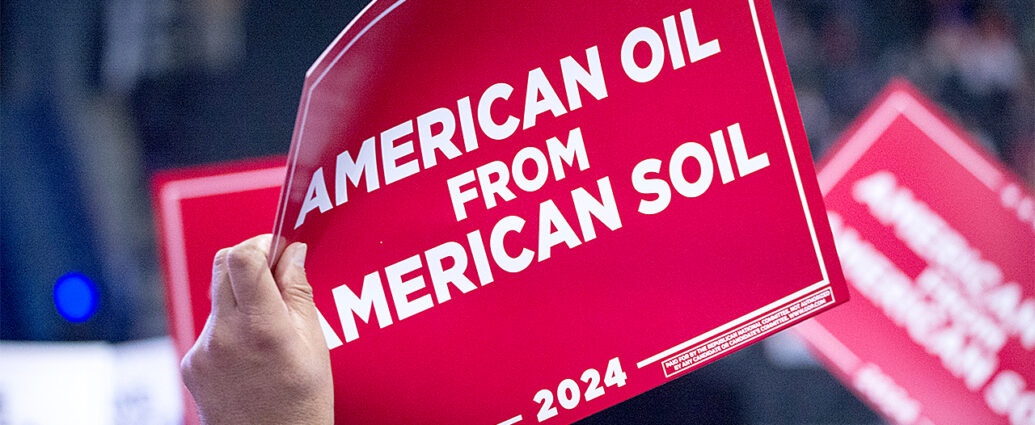
FIRST ON FOX: The Trump Department of the Interior secured a landmark agreement with energy giant TotalEnergies to redirect nearly $1 billion away from “unreliable” and “ideological” wind farm projects approved under the Biden administration and instead invest in U.S. oil and natural gas as part of the president’s “energy dominance agenda.”
Secretary Doug Burgum announced the agreement with TotalEnergies on Monday at the CERAWeek conference, an annual gathering of global oil and energy leaders in Houston.
TotalEnergies is renouncing its U.S. offshore wind leases and instead investing a total of $928 million in oil, natural gas and liquefied natural gas production in the U.S., according to the department. Additionally, after the department paused all leases for large-scale offshore wind projects under construction in the U.S. due to “national security risks,” TotalEnergies has pledged not to develop any new offshore wind projects in the country.
The department said that “under this innovative agreement driven by President Donald J. Trump’s Energy Dominance Agenda, the American people will no longer pay for ideological subsidies that benefited only the unreliable and costly offshore wind industry.”
OIL PRICES SLIDE AS US EXPANDS INFLUENCE OVER GLOBAL ENERGY MARKETS
As part of the agreement, TotalEnergies will invest $928 million in the development of a liquefied natural gas plant in Brownsville, Texas, as well as shale gas production and upstream conventional oil in the Gulf of America.
In turn, the U.S. will terminate wind farm leases in the Carolina Long Bay Area and in the New York Bight area. Both of these leases were granted to TotalEnergies by the Biden administration in 2022. The U.S. will be reimbursing TotalEnergies for these investments.
According to the department, these reinvestments “directly advance the Trump Administration’s ongoing efforts to lower costs for American families, increase baseload and grid reliability, and help maintain global leadership in artificial intelligence.”
Burgum called the agreement “yet another win for President Trump’s commitment to affordable and reliable energy for all Americans.”
TRUMP WEIGHS LIFTING IRAN OIL SANCTIONS AS ENERGY PRICES SOAR AFTER QATAR LNG STRIKE
“Offshore wind is one of the most expensive, unreliable, environmentally disruptive, and subsidy-dependent schemes ever forced on American ratepayers and taxpayers,” Burgum told Fox News Digital.
He added that the administration welcomes TotalEnergies’ commitment to “developing projects that produce dependable, affordable power to lower Americans’ monthly bills while providing secure U.S. baseload power today — and in the future.”
U.S. Attorney General Pam Bondi also commented on the deal, telling Fox News Digital that “today’s agreement prioritizes affordability for hardworking American consumers over the prior administration’s ideological, ineffective energy policies.”
Bondi predicted that “Americans will benefit from this significant investment in our energy industry,” which she said will “also enhance our national security and grid reliability.”
OIL PRICES WILL COME DOWN ‘VERY, VERY FAST’ AFTER CONFLICT, FORMER ENERGY CHIEF SAYS
Patrick Pouyanné, CEO of TotalEnergies, told Fox News Digital that the company is “pleased” to sign onto the agreement with the DOI and to support the administration’s energy policy.
GET FOX BUSINESS ON THE GO BY CLICKING HERE
He explained that the decision to renounce the offshore wind developments in favor of U.S. oil investment was made in consideration that offshore wind projects are “not in the country’s interest.”
Pouyanné said these investments will help supply Europe with “much-needed” U.S. liquified natural gas and provide gas for U.S. data center development. He said TotalEnergies believes this is “a more efficient use of capital in the United States.”
Ukrainian-American billionaire who owned subscription service for adult content died of cancer, the company says
Leonid Radvinsky, the owner of OnlyFans, has died of cancer at the age of 43, the company announced on Monday.
“We are deeply saddened to announce the death of Leo Radvinsky. Leo passed away peacefully after a long battle with cancer,” said a spokesperson for the company, best known for subscriptions to pornographic content creators. “His family have requested privacy at this difficult time.”
This post was originally published here

This post was originally published here
Josh Brown and Sean Russo break down these two tech giants.
This post was originally published here
President claims immigration agents could help manage long lines as TSA agents go unpaid during partial shutdown
Security lines stretched for hours on Monday at US airports where unpaid Transportation Safety Administration (TSA) screening agents refused to report for duty and ICE agents deployed by Donald Trump were reportedly seen in a dozen cities.
The president claimed over the weekend that immigration agents could help manage long lines, but in Atlanta, little immediate impact of their presence could be observed. Meanwhile, airport staff were getting creative trying to herd thousands of discontent passengers.
This post was originally published here

Top Wall Street analysts changed their outlook on these top names. For a complete view of all analyst rating changes, including upgrades, downgrades and initiations, please see our analyst ratings page.
This post was originally published here
This post was originally published here
This post was originally published here
The U.S. government is insolvent. That’s not hyperbole — it’s the conclusion drawn directly from the Treasury Department’s own consolidated financial statements for fiscal year 2025, released last week to near-total media silence. The numbers: $6.06 trillion in total assets against $47.78 trillion in total liabilities as of September 30, 2025.
Importantly, the $47.78 trillion in reported liabilities does not include the unfunded obligations of social insurance programs like Social Security and Medicare — those are disclosed separately in the off-balance-sheet Statement of Social Insurance (SOSI).
The government’s consolidated balance sheet position, excluding the SOSI, deteriorated by nearly $2.07 trillion between FY 2024 and FY 2025, reaching a staggering negative $41.72 trillion. Total liabilities are now nearly eight times the value of reported assets. The largest drivers were a $2 trillion increase in federal debt and interest payable (now $30.33 trillion) and a $438.8 billion increase in federal employee and veteran benefits payable (now $15.47 trillion).
The off-balance-sheet picture is even more alarming. The 75-year unfunded social insurance obligation surged by $10.1 trillion in a single year, rising from $78.3 trillion in FY 2024 to $88.4 trillion in FY 2025 — driven primarily by a $6.9 trillion jump in projected Medicare Part B shortfalls and a $2.5 trillion increase for Social Security. The Treasury’s Statement of Long-Term Fiscal Projections shows the 75-year fiscal gap widening from 4.3% of GDP in FY 2024 to 4.7% in FY 2025.
If the $88.4 trillion in 75-year off-balance-sheet obligations were added to the $47.8 trillion in official balance sheet liabilities, total federal obligations would now exceed $136.2 trillion — roughly five times U.S. annual GDP.
The Government Accountability Office (GAO) issued a disclaimer of opinion on the U.S. government’s FY 2025 financial statements — the 29th consecutive year it has been unable to determine whether the statements are fairly presented. This is primarily due to serious, ongoing financial management problems at the Department of Defense and weaknesses in accounting for interagency transactions.
Not only has the financial press ignored the consolidated financial statements, but most members of Congress and members of the general public will not read the consolidated financial statements. Documents like the consolidated financial statements are not the kind of thing you want to read before driving. If that’s not bad enough, most people cannot relate to the trillion-dollar numbers in the financial statements. Therefore, it is appropriate to translate them into terms that people will understand.
Most people cannot relate to trillion-dollar figures on a government ledger. So consider this: divide every number by 100 million — drop eight zeros — and federal finances look like a household budget in freefall.
That household earns $52,446 and spends $73,378 — running a $20,932 annual deficit. Its total liabilities and unfunded promises amount to $1,361,788 against just $60,554 in assets, leaving it $1.3 million in the hole. Uncle Sam, by any accounting standard, is insolvent.
Congress has clearly lost control of the nation’s finances. America is facing a fiscal catastrophe. The reckoning, long deferred, is becoming impossible to ignore.
Addressing this crisis — and preventing recurrence — requires two specific legislative actions.
First, Congress should pass the bipartisan H.R. 3289 — Fiscal Commission Act, sponsored by Rep. Bill Huizenga (R-MI), Rep. Scott Peters (D-CA), and 41 co-sponsors. Such a commission would force a public reckoning with the facts, the trade-offs, and the hard choices that restoring fiscal health requires.
Second, Congress should call an Article V Convention limited to proposing a fiscal responsibility amendment to the U.S. Constitution. H.Con.Res. 15, sponsored by Rep. Jodey Arrington (R-TX), would do exactly that.
Modeled on Switzerland’s Debt Brake, such an amendment would mandate a balanced budget over the business cycle and prohibit federal spending from growing faster than the U.S. economy.
These two bills represent the most credible path forward — if Congress has the will to act.
The opinions expressed in Fortune.com commentary pieces are solely the views of their authors and do not necessarily reflect the opinions and beliefs of Fortune.
This story was originally featured on Fortune.com
Local people say incident is just the latest example of hostility that has built up over a long time
The blasts that boomed out in the early hours of Monday in suburban north-west London struck terror into people living in the surrounding streets. Their effects in Golders Green, with its large Jewish population, were still reverberating later that morning.
The antisemitic attack, in which four ambulances run by the Jewish charity Hatzola were set on fire, has left local people afraid. They are afraid because of the incident itself but also because of what they see as a febrile atmosphere of antisemitism in the UK more generally.
This post was originally published here
Nine people hospitalised and airport closed after landing plane hits fire truck responding to separate incident
The pilot and co-pilot of an Air Canada Express regional jet have been killed after it collided with a fire truck while landing at New York’s LaGuardia airport, in an incident that closed the airport.
The collision also caused serious injuries, with nine people in the hospital. It happened as a firefighting vehicle was responding to a separate incident, according to the Port Authority of New York and New Jersey, which runs the airport.
The Associated Press contributed reporting
This post was originally published here
Federal Reserve Governor Stephen Miran — who has dissented in favor of rate cuts at every meeting since his appointment by President Donald Trump last year — said Monday that the Iran-driven oil shock does not alter his policy outlook, arguing the Fed should wait for clearer evidence before assessing the inflation impact of higher energy prices.
“I think that we shouldn’t be making policy based on short-term headlines,” Miran said Monday during a Bloomberg interview.
“It’s just still premature to have a clear view about what this is going to look like as you look 12 months out.”
Since the start of the war in Iran, oil prices — as tracked by the United States Oil Fund (NYSE:USO) — have rallied nearly 40%, fueling fears of an upcoming inflationary wave.
“These oil shocks have been things that this Fed has looked through for a long time,” Miran said.
“It would be highly unusual for the Fed to start looking through them now.”
Traditional central banking holds that oil shocks hit headline inflation hard but pass through to core inflation only weakly, and that central banks should look through the first-round effects unless two specific conditions emerge: inflation expectations beyond the first year start to rise, or wages begin responding to higher energy prices in a way that creates a self-reinforcing spiral.
Miran said he sees neither.
But financial markets are sending a different signal. Prediction markets now put a 34% probability on zero Fed rate cuts in 2026 — …
Reverse recruiting flips traditional hiring on its head, and its growth may reveal deeper shifts in the labor market.
This post was originally published here

Face-faced college graduates are watching the American Dream be swept out from underneath them, and entering a gloomy entry-level job market pillaged by AI automation. However, not every company is reeling back hiring young professionals in favor of the tech tools; Reddit CEO Steve Huffman says his business is actually ramping up its recruiting of the digitally-savvy generation.
“The kids coming out of college right now learned how to program with AI,” Huffman said recently during the Sourcery with Molly O’Shea podcast. “They’re really good at it, and so I think we will go heavy on new grads, because they’re so much more AI native.”
While some CEOs marvel over the abilities of chatbots and AI agents, recent graduates are actually ripe for the new tech-driven world of work: the digital natives grew up with the internet, and spent most of their higher education in the ChatGPT era. They’re deeply familiar with the technology and are much more apt to leverage it in their work. And the cofounder of the $26.7 billion social media empire says that propensity is actually a gift: older generations are more resistant to automating their craft, even if it’s for the better.
“It’s the old people like me, it’s like I didn’t want to give [coding] up. I finally did,” the 42-year-old millennial CEO explained. “The younger people don’t have that baggage. They just write with AI.”
Tech workers may be nervous that their AI use will lead to their inevitable displacement—but Huffman was resolute that the tech won’t reduce the company’s engineering headcount.
A Reddit spokesperson also underscored to Fortune that its emerging talent team focuses on recruiting young professionals, also offering new grad opportunities and internships developing essential skills like machine learning, data science, and computer science.
While the tide seems to have shifted away from tech companies recruiting college talent before graduation, Huffman warned that could be a costly mistake. The billionaire says employers need to hire graduates “right out of the gate,” or risk having to pay them 100 times more down the line.
“There are so many reasons to hire new grads,” Huffman continued. “If you don’t hire them as new grads, you will never see them. They will never be on the job market again. They’re too valuable to ever let them be on the job market.”
As companies enforce sweeping layoffs and reel back hiring, entry-level graduates are contending with a fierce labor market.
The proportion of unemployed Americans who are first-time workers hit a 37-year high in 2025, hitting a peak of 13.3% in July before tapering down to 10.6% last month. And some CEOs even believe the percent of unemployed college graduates could skyrocket within just a couple of years.
However, there’s a vocal cohort of leaders who won’t leave Gen Z out in the cold—and in fact, their inexperience is sometimes seen as an asset. Echoing Huffman’s point that Gen Z doesn’t come with “baggage,” Ricardo Amper, the founder and CEO of $1.25 billion software company Incode Technologies, believes Gen Z’s naivety is exactly what businesses need to innovate. They aren’t held back by preconceived notions of work or a professional mindset shaped by decades of career experience.
“My belief [is] that coming out with a fresh mind, first principles, is important. That’s why young people are particularly helpful in tech, because they’re less biased,” Amper told Fortune earlier this year. “I think too much knowledge is actually bad in tech: you’re biased.”
Even if employers believe that AI agents can take over the jobs of their young employees, automating their roles could do long-term damage.
Airbnb’s CEO Brian Chesky, has warned against shutting Gen Z professionals out of the workforce because the consequences are stifled innovation and a lack of talent ready to step into millennial’s and Gen Xer’s positions.
“[AI] can do a lot of lower-level, more entry-level position jobs. But if no young people can get jobs, then you have no one in the future to do the highly strategic leadership positions,” Chesky told ABC News in a 2025 interview. “So we need to make room for people early in their careers, even if AI can do the interns’ work.”
Plus, some CEOs like Mark Cuban even argue that it’s an opportune time for Gen Z to seize the moment. Older generations less skilled with AI will need to learn how to implement the tools effectively—and that’s where young digitally-savvy workers step in.
“Learn all you can about AI, but learn more on how to implement them in companies,” Cuban advised young workers during the TBPN podcast in 2025. “Learn to customize a model, walk into a company, show the benefits. That is every single job that’s going to be available for kids coming out of school.”
This story was originally featured on Fortune.com
Elliott did not disclose the exact value of its investment, but described Synopsys as “essential to the global chip industry.”
This post was originally published here
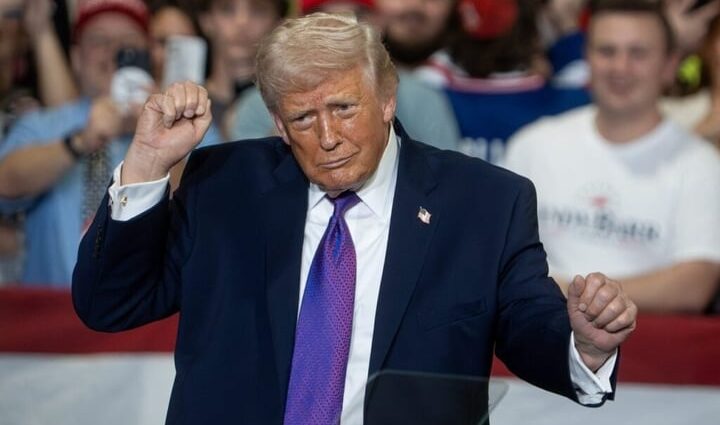
President Donald Trump posted on Truth Social Saturday night that he would “hit and obliterate” Iran’s power plants if the Strait of Hormuz wasn’t reopened within 48 hours.
By Monday morning, he said the U.S. had held “very good and productive conversations” with Iran and postponed all strikes on energy infrastructure for five days.
Iran’s foreign ministry denied any dialogue had taken place, saying Trump’s announcement was designed to lower energy prices.
West Texas Intermediate futures cratered more than 10% to around $89 a barrel. The S&P 500 (NYSE:SPY) ripped nearly 2%.
Gold erased its entire 2026 gain, plunging over 6% to $4,285 in what may be the biggest weekly drop since 1983.
Between the threat and the walkback, …
This post was originally published here

This post was originally published here
This post was originally published here
The EU’s reluctance to replace petrol cars and gas boilers keep it hooked on foreign fuels, say industry groups
Europe has made “staggering progress” in producing clean power but neglected efforts to phase out fuel-burning machines, the head of an industry group said as the global oil crisis deepens.
Adrian Hiel, director of the Electrification Alliance, said the EU has “radically transformed” its power supply and must now focus on getting “more electricity into the stuff we use every day”.
This post was originally published here
Woodcocks and pochard, pintail and goldeneye ducks among threatened species protected by proposals
Hunters will be banned from shooting a rare and beautiful duck under new proposals to halt the decline of six British wild birds.
The new rules would restrict the shooting of species including the distinctive woodcock, and the striking pintail, goldeneye and pochard ducks, all of which are classed as under threat and have seen their populations fall sharply in recent years.
This post was originally published here
Bitmine (NYSE:BMNR) purchased 65,341 Ethereum (CRYPTO: ETH) for roughly $138 million last week, accelerating buying for the third consecutive week as Chairman Tom Lee bets ETH is in the final stages of a “mini-crypto winter.”
Bitmine now holds 4.66 million ETH worth approximately $9.7 billion at $2,072 per token, representing 3.86% of ETH’s circulating supply.
The company increased its weekly purchase pace from an average of 45,000-50,000 tokens to 65,341 last week.
“Our base case is ETH is in the final stages of the ‘mini-crypto winter,’” Lee said, noting that ETH has outperformed equities by 2,450 basis points since the Iran war began, rising 18% while gold fell more than 15%.
Cash reserves stand at $1.1 billion, with total crypto and cash holdings reaching $11 billion including 196 Bitcoin (CRYPTO: BTC), a $200 million stake in Beast Industries, and $95 million in Eightco …