The U.S. Department of Defense (DoD) has flagged new national security risks tied to Anthropic’s hiring of foreign personnel, including workers from China.

What Are The Implications Of Foreign Hiring Risks?

Anthropic employs “a large number of foreign nationals to build and support its LLM products, including many from the People’s Republic of China (PRC), which increases the degree of adversarial risk should those employees comply with the PRC’s National Intelligence Law,” the court filing stated.

While other major U.S. artificial intelligence labs working with the DoD may have similar risks, their strong security practices and history of responsible, trustworthy behavior help reduce those risks. “Anthropic’s case, however, is different,” Pentagon undersecretary Emil Michael wrote in the declaration.

“Anthropic’s leadership demonstrated an intent to prevent the U.S. military’s lawful use of their LLM product, Claude, despite the company’s publicly stated knowledge that adversarial nation states have a practice …

Full story available on Benzinga.com

This post was originally published here

(RTTNews) – Extending the losses from the two previous sessions, gold prices have moved lower on Friday as attacks in the gulf region intensify, stoking broader inflationary concerns, with expectations of a rate cut by the U.S. Federal Reserve in the short-term fading completely.

This post was originally published here

The insects covered its largest area since 2018, despite threats from habitat loss, climate crisis and pesticides

The population of monarch butterflies in Mexico increased 64% this winter, compared with the same period in 2025, offering a glimmer of hope for an insect considered at risk of extinction.

The figures, released this week by the World Wildlife Fund (WWF) Mexico, showed that the area occupied by monarchs expanded to 2.93 hectares (7.24 acres) of forest from 1.79 hectares (4.42 acres) the previous winter, the largest coverage since 2018.

Continue reading…

This post was originally published here
Staffing shortages intensify and lead to longer screening times as TSA workers go for weeks without pay

Many travelers across the US are continuing to face significant delays at airport security checkpoints as the homeland security department shutdown, which has affected staffing of the Transportation Security Administration, remains ongoing.

With TSA workers going for weeks without pay, staffing shortages have intensified, leading to longer screening times and growing frustration among passengers.

Continue reading…

This post was originally published here

Sabri Essid also found guilty of crimes against humanity after harrowing evidence from women enslaved by jihadist

A French member of Islamic State has been convicted of genocide and crimes against humanity for atrocities committed against Yazidis in a historic judgment that highlighted the atrocities committed by jihadists.

The Paris criminal court found Sabri Essid, who was tried in his absence, directly participated in an organised system of killing, raping and enslaving members of the Iraqi ethnic and religious minority who are descended from some of the region’s most ancient roots.

Continue reading…

This post was originally published here


U.S. equities fell to their lowest level since November on Friday as surging energy prices from the ongoing Middle East conflict deepened stagflation fears, with the S&P 500 shedding nearly 1% and the 10-year Treasury yield climbing to its highest point since July 2025.

In an official statement, Iran reiterated its hardline stance on the Strait of Hormuz, saying it will not engage in any discussions while under attack.

WTI crude surged past $97 per barrel, while Brent hit $110, up 50% since the start of the war, as energy infrastructure attacks headlined by the strike on Qatar’s South Pars LNG field and Kuwait’s key refineries continued to rattle traders.

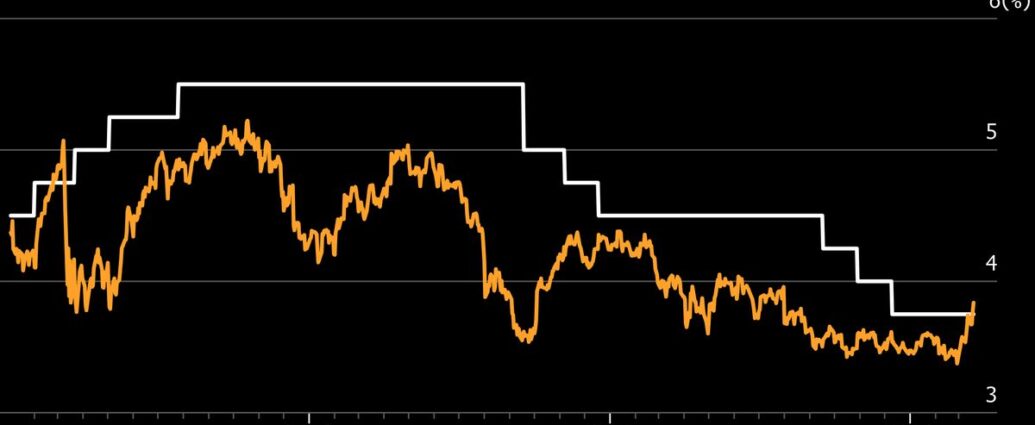
The 10-year Treasury yield responded by jumping 12 basis points to 4.38%, its highest since July 2025. The 2-year note rose 9 bps to 3.89%, and the 30-year yield climbed to 4.95%.

Interest-rate markets now price in a roughly 50% probability of a Federal Reserve rate hike by October.

Across U.S. equity markets by midday Friday, losses were broad-based, with all major benchmarks trading lower and volatility rising.

The S&P 500 fell 0.8% to 6,554 points, hovering near four-month lows. The Dow Jones Industrial Average slipped 165 points, or 0.4%, to 45,855.

The Nasdaq 100 dropped 1% to 24,100 while the small-cap Russell 2000 underperformed, down 1.35% to 2,460.

Meanwhile, the CBOE Volatility Index (VIX) jumped 5.8% to 25.46, signaling a pickup in market stress.

Precious metals sold off sharply — gold – as tracked by the SPDR Gold Shared

Full story available on Benzinga.com

This post was originally published here


Boaz Weinstein runs Saba Capital Management, a $5 billion hedge fund best known for picking fights with closed-end fund managers.

Now he’s picking a bigger one.

He’s tendering to buy shares in Blue Owl Capital Inc’s (NYSE:OWL) private credit BDC at 65 cents on the dollar.

Blue Owl’s retail investors have been trying to cash out of the fund, but redemption requests are piling up faster than the fund can pay.

Weinstein is stepping in with a lowball bid, betting that some investors would rather take 65 cents now than wait years in a queue.

The Pitch

Weinstein’s argument on Bloomberg’s Money Stuff podcast was blunt.

Retail investors were promised they could pull 5% of their money per quarter from these funds. That promise, he said, is “fire insurance that doesn’t work if there’s actually a fire.”

The fire is here. Cliffwater’s fund saw redemption requests spike from 4% to 14% in one quarter.

Blackstone Inc’s

Full story available on Benzinga.com

This post was originally published here

The Middle East’s thriving luxury sector isn’t immune to the war in Iran, and CEOs of top brands have their eyes on the region.

“Clearly, we look close and every day on the situation,” Hugo Boss CEO Daniel Grieder said during an earnings call earlier this month. “It has a direct impact on store opening and store performance because there’s not many tourists or less tourists shopping. That’s clear. That has an effect on the shopping centers and so forth and for all the brands.”

A recent Bernstein Research report forecasted luxury sales in the Middle East would fall by 50% this month, primarily a result of a decline in traffic and tourism.

Still, it’s too early to say what the overall impact of the conflict will be, Grieder said, adding that the German designer brand has not yet seen any fallout. Executives at Prada and Salvatore Ferragamo have shared similar sentiments in recent calls with investors.

The Middle East region makes up about 6% of the world’s luxury market, but is among the fastest-growing geographies, with sales growing 6% to 8% organically, Bernstein reported. That’s compared to an otherwise stagnant sector.

“If the war was to end relatively shortly, this would not be a huge issue for the global luxury goods in the states,” Luca Solca, senior analyst of luxury goods at Bernstein, told Fortune. “If the war was to continue, then I think if oil and gas prices were staying high, then I think there would be a higher probability of a recession.”

The expanding luxury market in the Middle East

Luxury brands have grown deep roots in the Middle East, particularly in airports in Dubai, Doha, and Abu Dhabi. According to Bernstein, Dior and Gucci, which each get 20% of sales, excluding beauty and multi-brand stores, from the region.

The high-end market has grown along with the area’s wealth. From 2019 to 2022, the ultra-wealthy in the Middle East and North Africa saw their wealth double, per a 2023 OxFam report. The richest 106,080 people (making up 0.05% of the population) saw their wealth swell 75% from $1.6 trillion to $3 trillion in that span.

The wealth from these high-net-worth individuals has helped to drive the expansion of luxury sectors in the area. RBC Capital analyst Tom Narayan told Fortune these wealthier buyers are willing to splurge on the more expensive, top-of-the-line models, such as luxury supercars, making them a lucrative customer base for high-end brands.

“It’s certainly the high-margin region,” Narayan said, “meaning the cars they sell in the Middle East are more profitable versus the cars they sell outside that region.”

When luxury brands should begin to worry

Some brands are already shifting focus away from their usually reliable Middle East buyers. Ferrari and Maserati have temporarily halted shipments to the region, the companies said earlier this week.

To be sure, the Middle East accounted for just 4.6% of Ferrari’s 2025 global shipments, and Narayan said the automakers should be able to make up for lost deliveries in other markets, such as in Europe.

Still, consequences of a prolonged war loom. Bernstein said an ongoing conflict could throttle travel to the region, which is responsible for 30% of sales. Higher oil and gas prices, as well as concerns of a recession or fear of terrorist threats could also drive lower sales.

While President Donald Trump has signalled the conflict could last about a month, some analysts predict oil prices could remain elevated through 2027, making travel more expensive and adding economic pressures on consumers.

“Higher energy prices could potentially make global recession more likely,” Solca said. “If that materialized, then, of course, we would have a ricochet on discretionary sectors, and luxury is one of those. So we cannot take a global recession lightly.”

This story was originally featured on Fortune.com

Lawsuit alleges university violated civil rights of Jewish and Israeli people in aftermath of war in Gaza

The Trump administration renewed its assault on Harvard University on Friday, filing a lawsuit in Massachusetts alleging the Ivy League institution violated the civil rights of Jewish and Israeli people in the aftermath of the war in Gaza.

The lawsuit, shared publicly by the New York Times, accuses Harvard of allowing anti-Israel protesters to operate on campus “with impunity” following the 2023 Hamas terrorist attack on Gaza and Israel’s massive military response.

Continue reading…

This post was originally published here


Morgan Stanley (NYSE:MS) filed a second amended S-1 for its spot Bitcoin (CRYPTO: BTC) ETF, setting the ticker MSBT for the Morgan Stanley Bitcoin Trust on NYSE Arca with a $1 million seed investment.

The MSBT Filing Details

The filing discloses a basket size of 10,000 shares and an initial seed of 50,000 shares expected to raise about $1 million. 

Morgan Stanley bought two shares early this month for audit purposes.

BNY Mellon will handle the fund’s cash and administrative functions, while Coinbase (NASDAQ:COIN) will serve as prime broker and custodian of its Bitcoin holdings.

The amendment signals progress but does not guarantee approval. If approved, the Morgan Stanley ETF …

Full story available on Benzinga.com

This post was originally published here

Chuck Norris, dead at 86, was a certain type of hairy 1980s American man. For the uninitiated, here are a few jokes that Gen Xers and millennials used to make in middle school about the all-American martial arts star of their youth. You can still see some shared on social media: The flu gets a Chuck Norris shot every year. The chief export of Chuck Norris is pain. There is no chin behind Chuck Norris’ beard, only another fist. And perhaps most timely for our world today: Chuck Norris doesn’t worry about high gas prices, his vehicles run on fear.

The legendary martial arts master and actor died on Friday, after years of being the epitome of toughness and dodging death with jokes that ludicrously snowballed with higher stakes of death-defying physical and mental fortitude.

The Walker, Texas Ranger star first gained notoriety for his physical command as a martial artist, eventually working his way into Hollywood as an action film star in the late 1970s. Outside of playing the title character on Walker, Texas Ranger on CBS from April 1993, to May 2001 (in which he played a gun-totting, no-nonsense lawman), he was the lead in a string of action movies, famously starring opposite Bruce Lee in The Way of the Dragon—his debut screen role, where he played a thug opposite Lee’s hero trying to save his family’s restaurant in Rome) and even turned to thrillers before he took a break from acting. But he still maintained his tough persona throughout the years, posting on Instagram just 10 days ago “I don’t age. I level up,” and sharing a video of him boxing on his 86th birthday. 

But his physical and mental fortitude weren’t the only things the action star is known for: he’s amassed a $70 million fortune in his five-decade long career, and has poured significantly into giving back to the community. But most strikingly, he stayed true to his ever-increasingly tough-guy persona by offering CBS an offer they couldn’t refuse after taking on the network for refusing to honor their contract.

A $70 million fortune

Norris built one of Hollywood’s most unlikely financial empires— starting with nothing and eventually amassing an estimated net worth of $70 million. His rise from a $12-a-week laborer to a global action icon tracks as closely with discipline as it does with dollars.

His early film paychecks were modest by any standard. Norris earned just $10,000 for his 1976 debut Breaker! Breaker!, which jumped to $40,000 for Good Guys Wear Black the following year, then $125,000 for A Force of One in 1978, and $250,000 for An Eye for an Eye by 1980. His salary exploded, however, when he landed the starring role in Walker, Texas Ranger, where he commanded $375,000 per episode across 203 episodes—a figure that dwarfed every other cast member on the show.

Despite that hefty per-episode rate, Norris alleged he wasn’t getting his full cut. In 2018, he filed a lawsuit against CBS claiming the network owed him more than $30 million in profits from Walker, Texas Ranger. His contract had entitled him to 23% of all profits, but Norris argued CBS structured the show’s distribution deals—including streaming revenue going back to 2004—in ways that deliberately avoided triggering the profit-sharing clause. At the time of the suit, the series had generated over $692 million in total revenue, making the alleged shortfall all the more striking. The case was settled in July 2023 for an undisclosed amount, with CBS issuing only a brief statement that “the parties have resolved the dispute”.

Beyond the courtroom, Norris’s current income draws from a wide range of sources—including endorsement deals, real estate, and his brand ventures—putting his estimated annual earnings at around $30 million.

Off the balance sheet, Norris has poured significant energy into giving back. In 1990, he founded Kickstart Kids, originally called the Kick Drugs Out of America Foundation, which provides free martial arts and character development programs to middle and high school students. Launched in four Houston-area schools with the support of President George H.W. Bush in 1992, the program now operates in 58 schools across Texas, has served over 120,000 students since its inception, and currently enrolls approximately 8,349 students annually. Norris himself has said the program teaches kids “how to make good decisions,” and research tied to it shows participants demonstrate higher self-esteem, lower drug use, and less violence.

“He lived his life with faith, purpose, and an unwavering commitment to the people he loved,” wrote his family in an Instagram post announcing his death. “Through his work, discipline, and kindness, he inspired millions around the world and left a lasting impact on so many lives.”

This story was originally featured on Fortune.com

This blog is now closed

Severin Carrell is the Guardian’s Scotland editor.

Malcolm Offord, Reform UK’s Scottish leader, has doubled down on his defence of the party’s vetting by dismissing remarks by candidates backing Tommy Robinson or describing Humza Yousaf as an “Islamist moron” (see 10.12am) as “fruity language”.

It has taken a matter of hours for Reform Scotland’s big launch to fall apart and their true colours to show.

If Nigel Farage refuses to act and remove this candidate, Malcolm Offord must step up and show some leadership himself. This incident has confirmed once and for all how poisonous and chaotic Reform is and I have no doubt that Scots will send them packing.

Again, as I say, this was done in a former life before she became a member of Reform. We’ve all said things in the past that may be intemperate… I am saying that we have to grow up on this and not take offence at every moment in time.

I’ve been very clear that we have brought in a whole range of candidates, 80% of whom are not politicians. They’re real people with real lives who said real things in a past life. Okay, this was said before she was a candidate. She wasn’t even a member of the party at that time.

And what we got in the situation is that in all our lives in the past, we’ve made comments that might sometimes be intemperate. But the issue with this modern world we live in is everything is now written down and remembered. I just think we have to be more, more realistic about the fact that real people say real things, and now she’s a candidate, she will be held to a higher standard.

Liberal Democrats urge the government to ensure the NCA or new National Police Service takes over investigations into serious waste crime. We also need an independent review of the entire waste crime system to crack down on organised gangs once and for all. New powers for the Environmental Agency simply won’t cut it.

Continue reading…

This post was originally published here


Bitcoin (CRYPTO: BTC) is hovering near $70,000 amid ETF outflows and weak sentiment, with one analyst warning the current pattern may mirror past bear markets.

Short-Term Rally Or Deeper Drop?

In a Mar. 20 podcast, crypto analyst Benjamin Cowen said Bitcoin appears to be following a familiar cycle seen in 2014, 2018 and 2022.

He described a recurring pattern in which Bitcoin bottoms in February, rallies into March and then weakens, often leading to another leg lower.

While a short-term move toward the …

Full story available on Benzinga.com

This post was originally published here

On March 18, the U.S. House voted 211–207 to advance a Balanced Budget Amendment — far short of the two-thirds majority required to pass it. The same day, total federal debt surged past $39 trillion, or 125% of GDP. That’s up from $5.7 trillion, or 55% of GDP in 2000. On March 19, the Trump administration confirmed plans to seek up to $200 billion in supplemental funding for its war against Iran.

In the face of such numbers, the U.S. House of Representatives failed on March 18 to pass a proposed Balanced Budget Amendment, and the Trump Administration announced its plans to seek major supplemental funding for as much as $200 billion to support its war efforts against Iran.

America has been adding to its record debt at record rates, and Congress has become addicted. Absent a change in course, the nonpartisan Congressional Budget Office (CBO) projects that Uncle Sam’s debt will soar to 175% of GDP in 30 years. And those projections were made before the U.S.-Israeli war against Iran began.

If that’s not bad enough, the federal debt is just the tip of Uncle Sam’s financial iceberg. Total liabilities and unfunded social insurance promises exceed $125 trillion. That is a stunning 3.2 times higher than the current federal debt. Despite the federal government’s fiscal time bomb, the U.S. Congress and the President remain with their heads in the sand.

The Swiss model Washington rejected

The U.S. House’s failed Balanced Budget Amendment proposal (H. J. Res. 139) was based on a modified version of the Swiss Debt Brake, a constitutional amendment that was passed in a Swiss national referendum with overwhelming support in 2001.

The Balanced Budget Amendment proposal would limit federal spending to an average of federal receipts over a three-year period, adjusted for population increases and inflation. Its primary object is to achieve a primary budget balance––a balance of receipts and expenditures, excluding interest payments. The legislation includes a release valve that would be triggered by a supermajority vote in Congress for declarations of war and other selected events. Since Switzerland adopted its Debt Brake, the country’s federal debt has remained below 30% of GDP — a stark contrast to America’s trajectory.

While the balanced budget amendment proposal failed, it did properly recognize, in our view, that only a constitutional amendment can force current and future Congresses to restore and sustain fiscal sanity. The problem is that, given the current political environment, there is virtually no chance that Congress will revisit the Balanced Budget Amendment. Therefore, it is time to let the states initiate a change to the U.S. Constitution via the utilization of Article V of the Constitution. Such a fiscal amendment to the U.S. Constitution would ensure fiscal sanity.

The constitutional backdoor that’s been waiting since 1979

Our nation’s founders recognized that Congress might be unwilling or unable to propose a path forward for needed constitutional amendments. Therefore, the founders provided a second way to propose constitutional amendments. Specifically, if two-thirds of the states file an application for a convention to propose one or more amendments to the Constitution, Congress is mandated to call the convention. Importantly, unlike the Convention in 1787, this would be an amendments convention, not a convention to rewrite the Constitution.

Shockingly, about three years ago, we at the Federal Fiscal Sustainability Foundation (www.FFSF.US) discovered that there were enough active state applications for a single-issue convention to propose a fiscal responsibility amendment to the U.S. Constitution. Indeed, the required number of applications has existed since 1979 and remained in limbo because the U.S. Congress has failed to act. In September 2025, our findings were confirmed by none other than the National Federalism Commission, an official interstate governmental body.

House Budget Committee Chairman Jodey Arrington (R–TX) has sponsored H.C.R. 15 to right this congressional wrong. However, it looks like Congress plans to stiff the states and fail to discharge its express and mandated constitutional duty.

The time has come for one or more state attorneys general to sue Congress for failing to act. If the states fail to do so, they will effectively be mooting the states’ rights to propose amendments under Article V. The time for the states to assert their constitutional rights is now! The future of America’s fiscal health is at stake.

The opinions expressed in Fortune.com commentary pieces are solely the views of their authors and do not necessarily reflect the opinions and beliefs of Fortune.

This story was originally featured on Fortune.com


Gold is being hit from two directions simultaneously — and the combination is producing a sell-off not seen in over four decades.

• SPDR Gold Shares stock is showing weakness. Why is GLD stock trading lower?

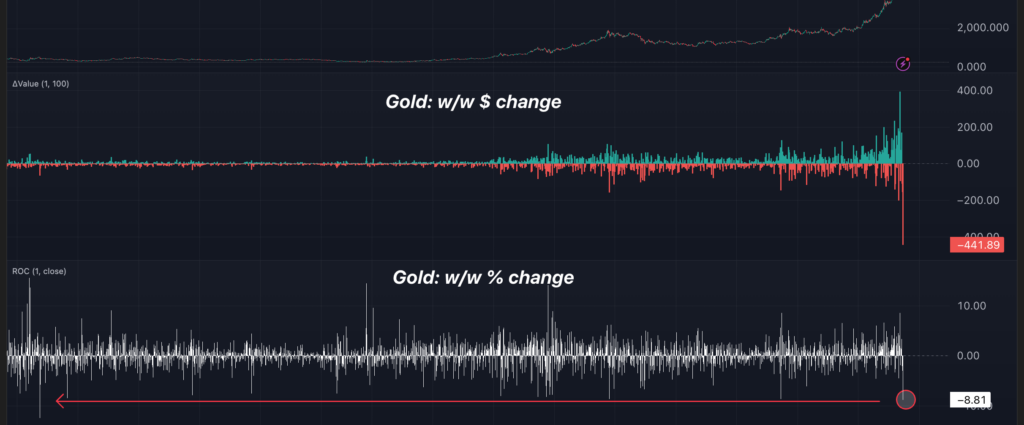
The precious metal is down nearly 9% week-to-date through Friday morning — its worst weekly performance in over four decades.

While rising expectations for Fed rate hikes have been the primary driver, another pressure point is emerging: growing speculation that some Gulf states may be forced to sell gold reserves to plug fiscal gaps as crude export revenues evaporate.

The chart tells two stories simultaneously. The percentage decline of 9.11% is the worst weekly move since 1983.

But the dollar loss is even more striking — gold has shed $441 per ounce this week, the largest weekly dollar decline in the metal’s recorded history, a direct consequence of prices that were near all-time highs when the selling began.

The Rate Hike That Broke Gold’s Most Powerful Tailwind

Gold’s most powerful tailwind entering 2026 was the expectation of falling real interest rates. Two to three Federal Reserve rate cuts were priced for the year.

Lower real rates reduce the opportunity cost of holding gold — a non-yielding asset — and that dynamic had driven bullion to record highs in 2025.

The Iran war destroyed that thesis in three weeks.

The CME FedWatch tool now shows a 52% probability of a Fed rate hike by October. Polymarket prices the odds of a 2026 hike at 24%, up from just 6% before the conflict began.

When rate hike expectations surge, real yields climb, the …

Full story available on Benzinga.com

This post was originally published here. 

Job seekers are up against a brutal labor market, sending thousands of applications out to no avail, and resorting to in-person stunts to get an employer’s attention. And a new report is confirming their suspicions: hiring managers are ghosting their candidates, and it’s getting worse for talent every year. 

More than half, 53%, of job seekers experienced ghosting within the last year, according to a new report from pre-employment testing company Criteria. And that number just reached a three-year peak, as 48% of applicants were ignored by employers in 2025, and 38% were ghosted in 2024. 

Job seekers may point the finger at lethargic hiring managers, but in actuality, the worrying trend might chalk up to an overwhelming hiring process “increasingly ineffective” at finding the right match. 

“We’re seeing a surge in application volume, largely fueled by AI tools that make it easier than ever to apply and tailor résumés at scale,” Josh Millet, the cofounder and CEO of Criteria, tells Fortune. “The result is that hiring teams are spending more time reviewing applications, but getting less meaningful signals from each one.”

And as job seekers and hiring managers both increasingly use advanced technology, it’s muddying the best way to pick talent. Millet explained that the résumé, once the benchmark of a job application, is now becoming a “weaker signal” because it can be easily generated by AI. As more people highly tailor their résumé with AI tools, it then becomes harder to differentiate the frontrunner in a pool of polished applications. As a result, employers aren’t always answering back to the thousands of candidates who applied to an open role within the span of just hours. 

“Recruiters are inundated, screening methods are less reliable, and communication suffers,” Millet continued. “In many ways, ghosting is less about intent and more about a hiring process that hasn’t caught up to how candidates are applying today.”

‘Ghost jobs’ are also flooding the market, and job-seekers are losing faith 

AI has undoubtedly upended the hiring process and turned it into a numbers game; job-seekers send out a deluge of applications until something sticks, while managers are stuck sifting through thousands of candidates for every open role. The trend has been intensifying for years, leaving many job-hunters out in the cold—and sometimes, employers are intentionally ghosting.

About 81% of recruiters said that their employer posts “ghost jobs,” or roles that either don’t exist or have already been filled, according to a 2024 report from MyPerfectResume. 

Unlike conventional ghosting, these fake postings are created for a purposeful reason: about 38% of recruiters reported that they post fake positions to maintain a presence on job boards when they aren’t hiring, 36% did so to assess the effectiveness of their job postings, and 26% hoped gain insight into the job market and competitors. 

Jasmine Escalera, a career expert for MyPerfectResume, told Fortune in 2024  that another big reason is wanting to improve their employers’ image; nearly a quarter said that fake jobs help their company look like they’re not freezing hiring, and one fifth fessed up to posting ghost jobs to improve the reputation of their business.

“Companies are trying to project ‘We’re okay, we’re still maintaining hiring, that we’re still moving in a growth-oriented trend. In this market, our organization is doing well.’ That ties into why these fake jobs might be appearing more from a comforting perspective,” Escalera explained. “It really is about the business, the bottom line, showing growth, showing trends, and how that can connect to maintaining profit.”

But the trend is discouraging for candidates vying to land a new role.

“We often hear job-seekers saying, ‘I’m tired, I’m depressed, I’m desperate,’ using these very harsh words when it comes to the job market,” the career expert continued. “This is one of the reasons why they are losing faith in organizations and companies.”

This story was originally featured on Fortune.com


Velo3D Inc (NASDAQ:VELO) shares are trading lower on Friday. The move follows a volatile week for the 3D printing technology firm. The company is set to report earnings on Tuesday.

Market Downturn Pressures VELO

Macroeconomic factors are weighing heavily on the stock as the Nasdaq fell 1.09% during Friday’s session. Similarly, the S&P 500 shed 1.06%.

Recent Debt Conversion Impact

The slide follows a pullback that began Thursday. Shares are giving back gains from a recent rally. That rally was driven by insider debt conversions. CEO Arun Jeldi, on March 11, converted $5 million in debt at $16.38 per share. Director Ken Thieneman converted $10 million at …

Full story available on Benzinga.com

This post was originally published here


U.S. stocks traded lower midway through trading, with the Nasdaq Composite falling more than 1% on Friday.

The Dow traded down 0.56% to 45,765.84 while the NASDAQ fell 1.18% to 21,829.08. The S&P 500 also fell, dropping, 0.80% to 6,553.81.

Check This Out: How To Earn $500 A Month From Goldman Sachs Stock Ahead Of Q4 Earnings

Leading and Lagging Sectors

Energy shares climbed by 1% on Friday.

In trading on Friday, consumer discretionary stocks fell by 1.3%.

Top Headline

Xpeng Inc – ADR (NYSE:XPEV) shares fell around 6% on Friday after the company reported worse-than-expected fourth-quarter sales results and issued soft first-quarter delivery guidance.

The company delivered 22.25 billion Chinese yuan ($3.18 billion) in quarterly revenue, a 38.2% year-over-year (Y/Y) jump that landed just shy of the $3.32 billion analyst consensus forecast.

Equities Trading UP
           

  • Scholastic Corp (NASDAQ:SCHL) shares shot up 12% to $38.20 after the company reported better-than-expected third-quarter adjusted EPS results. Also, the company announced a $200 million …

Full story available on Benzinga.com

This post was originally published here


Federal Reserve Governor Christopher Waller said Friday he was planning to vote against the central bank’s decision to hold rates steady this week after February’s jobs report showed 92,000 payroll losses.

“I thought that’s it, I’m dissenting,” Waller told CNBC’s Squawk Box. But the closure of the Strait of Hormuz and surging crude prices convinced him otherwise.

Brent crude traded around $107 Friday morning, up roughly 55% from pre-war levels near $68. The United States Oil Fund (NYSE:USO), which tracks WTI crude futures, has surged since the conflict began Feb. 28.

The Fed Cannot ‘Look Through’ This Oil Shock

Waller drew a line between temporary price disruptions and what the Iran war is producing. A “high and persistent” oil shock would not have a transitory impact on inflation, he said, meaning the Fed cannot dismiss it the way it dismissed post-pandemic supply chain noise.

The FOMC voted …

Full story available on Benzinga.com

This post was originally published here


Ecolab Inc. (NYSE:ECL) shares are down on Friday as the company announced its plan to acquire CoolIT Systems, a leader in advanced liquid-cooling technologies for AI data centers.

This news comes amid a challenging market environment, with major indices such as the S&P 500 and Nasdaq experiencing declines.

Under the terms of the agreement, Ecolab will pay approximately $4.75 billion in cash for CoolIT, which is expected to generate around $550 million in sales over the next 12 months.

As of December 2025, the company had cash and equivalents worth $646.2 million and long-term debt of $7.365 billion.

This acquisition aims to enhance Ecolab’s Cooling-as-a-Service offering, helping AI data centers improve performance and reduce water usage.

The acquisition is anticipated to close in the third quarter of 2026, subject to regulatory approvals. Ecolab expects its first quarter 2026 adjusted diluted earnings per share to be in the range of $1.69 to $1.71, reflecting a 13% to 14% increase compared to the previous year.

The broader market is experiencing downward pressure, with the S&P 500 down 1.04% and the Nasdaq falling 1.06%. Ecolab’s decline aligns with this …

Full story available on Benzinga.com

This post was originally published here


Bloom Energy Corp (NYSE:BE) shares are trading lower Friday. The move comes as major indices face selling pressure. The Nasdaq Composite has dropped 1.09%, while the S&P 500 has shed 1.06%.

Broader Market Headwinds

The decline in Bloom Energy follows a period of significant outperformance. The stock remains up 62.84% year to date. Investors appear to be locking in profits as macroeconomic sentiment shifts.

AI Data Center Demand

Despite Friday’s slide, Bloom’s fundamental narrative remains tied to AI infrastructure. Data centers use Bloom’s solid oxide fuel cells to bypass utility grid delays. These systems provide 24/7 power using natural gas, biogas, and hydrogen. The company positions this …

Full story available on Benzinga.com

This post was originally published here


Shares of i-80 Gold (NYSE:IAUX) are trading lower on Friday after the company said it would advance its gold projects through a $250 million offering of convertible senior notes. This move comes amid a mixed market day, with major indices declining.

The company priced its offering of unsecured convertible senior notes due 2031, upsizing from an initially planned $200 million to $250 million, with an option for additional notes. The proceeds are earmarked to advance various stages of its gold projects, refurbish the Lone Tree processing plant, and fund resource expansion and infill drilling.

In addition to the offering, the notes will bear a cash interest rate of 3.75% per annum, with an initial conversion price set at approximately $1.93 per share, representing a 37.5% premium over the previous closing price. This strategic move aims to bolster the company’s financial position and support its growth initiatives in the competitive gold mining sector.

The broader …

Full story available on Benzinga.com

This post was originally published here

Eightco Holdings (NASDAQ:ORBS) invested an additional $40 million in OpenAI, bringing total commitment to $90 million and adding Bitmine (NYSE:BMNR) Chairman Tom Lee to its board.

The OpenAI Investment

OpenAI now represents approximately 30% of Eightco’s total treasury position. 

The company’s holdings include 277.2 million WLD tokens, 11,068 ETH, and $76 million in cash and stablecoins. 

Eightco holds nearly 10% of current WLD supply in circulation, positioning it as the largest public market participant in the Worldcoin ecosystem.

“Access to high-growth private companies has historically been limited to institutional investors, and we’re proud to offer retail investors meaningful exposure to one of the most important AI companies in the world,” said Kevin O’Donnell, CEO of Eightco.

The company recently announced $125 million in new funding commitments led by $75 million from …

Full story available on Benzinga.com

This post was originally published here

Mediahuis suspends Peter Vandermeersch, who says he ‘fell into trap of hallucinations’, after investigation by newspaper where he was once editor-in-chief

The publisher of the Dutch newspaper De Telegraaf and the Irish Independent has suspended one of its senior journalists after he admitted using AI to “wrongly put words into people’s mouths”.

Peter Vandermeersch, the former head of the Irish operations at Mediahuis, said he “fell into the trap of hallucinations” – the term for AI-generated errors – when using the technology.

Continue reading…

This post was originally published here

A study of analyst recommendations at the major brokerages shows that Eldorado Gold Corp (Symbol: EGO) is the #47 broker analyst pick, on average, out of the 50 stocks making up the Metals Channel Global Mining Titans Index, according to Metals Channel. The Metals Channel Globa

This post was originally published here

This live blog is now closed, you can read more of our European news coverage here

Meanwhile, French president Emmanuel Macron has confirmed the seizure of the tanker, which he said belonged to the Russian shadow fleet.

In a strongly worded post on X, he said:

“The French navy boarded this morning in the Mediterranean a new vessel from the shadow fleet, the Deyna.

The war in Iran will not divert France from its support for Ukraine, where Russia’s war of aggression continues.

Continue reading…

This post was originally published here

Move follows the granting of a worldwide asset-freezing order on company’s founder, Paresh Raja

The UK’s financial regulator has launched an investigation into Market Financial Solutions (MFS), the mortgage lender that collapsed last month amid allegations of fraud.

The move follows the granting of a £1.3bn worldwide asset-freezing order on MFS founder Paresh Raja on Wednesday, as creditors successfully gained court orders in London and Dubai barring the tycoon from dissipating assets.

Continue reading…

This post was originally published here

White-collar tech roles have faced waves of layoffs in recent months, as companies like Amazon, Meta and Oracle trim headcounts in the name of efficiency. But the same firms culling workers are running into a roadblock with their AI ambitions: a severe shortage of skilled workers needed to build and maintain data centers. And the talent shortfall is in the hundreds of thousands. 

Demand for robotics technicians has jumped 107%, HVAC engineers increased 67%, and construction roles grew by 30% since late 2022, according to an analysis of more than 50 million job postings by Randstad. Roles like welders and electricians are also on the rise, up 25% and 18% over the past three years, respectively.

But supply has yet to keep up. In the manufacturing space in particular, for every 100 young people entering the manufacturing sector, 102 leave, according to the report. Randstad CEO Sander van’t Noordende said the imbalance is creating a major opening for Gen Z workers to step into lucrative, AI-resilient careers.

“For a long period, societies generally pushed a narrative that the ultimate marker of success is a four-year university degree and a desk job,” Noordende told Fortune in an emailed statement. “This outdated perception led to skilled trade work becoming overlooked. However, AI is now revealing just how critical these roles are and how elevated they are becoming.”

Unlike many white-collar paths, these roles often don’t require a four-year degree. Instead, workers can enter through apprenticeships and training programs that allow them to earn while they learn—offering a faster, and often cheaper, route into the workforce than going to college.

Some trade workers’ salaries are soaring past $250,000 thanks to the AI data center boom

The lack of supply of skilled workers to build America’s rapidly growing AI infrastructure is actually pushing blue-collar wages to new highs.

Construction workers on data center projects currently  earn an average of about $81,800 annually, or $39.33 an hour—roughly 32% more than those on non-data center builds—according to data from Skillit, an AI-powered hiring platform for construction workers.

“Because of the huge demand and the nature of this construction work, which is fueling the arms race of AI… the budgets are not as tight,” Skillit CEO Fraser Patterson told Fortune last year. “I would say they’re a little more frothy.”

Industry leaders indicate the trend is only accelerating. Nvidia CEO Jensen Huang called the AI boom “the largest infrastructure build-out in human history that’s going to create a lot of jobs” for professions like plumbers, electricians, and steel workers. At the World Economic Forum in Davos earlier this year, he also added that salaries are climbing into the six figures.

Electricians, in particular, are emerging as one of the most-in-demand, and best-paid,  jobs on the market. Electrical work accounts for an estimated 45% to 70% of total data center construction costs, according to the International Brotherhood of Electrical Workers. The U.S. will need roughly 300,000 new electricians over the next decade, in addition to replacing the 200,000 expected to retire.

In some cases, the pay is already reaching eye-popping levels. TV star Mike Rowe, known for his stint hosting Dirty Jobs, recently said he met three electricians under the age of 30 making between $240,000 and $280,000 per year at a data center in Plano, Texas.  They each had no college debt, and companies are regularly trying to poach them.

The skilled trade trade-off: high pay, but demanding work

For all the upsides, careers in the skilled trades also come with clear drawbacks.

The work is often physically demanding, requiring long hours on your feet in unpredictable environments. One day might mean working indoors with air conditioning; the next could involve pulling cable through mud or working in extreme heat or cold.

Hours can also be inconsistent. Because many roles are tied to large-scale construction projects, workers may face intense schedules as deadlines approach—followed by gaps between jobs or the need to relocate to wherever the next project is underway. 

There are also long-term uncertainties. Some business leaders, including Elon Musk, have suggested that advances in robotics could eventually automate aspects of skilled trade work—though that shift, if it comes, is likely years away.

Still, for many young workers, the trade-offs are worth it. For Gen Zer Jacob Palmer, skipping college in favor of an electrician apprenticeship quickly paid off. By 21, he launched his own business, grossing nearly $90,000 in 2024 and surpassing six figures the following year. Unlike many of his peers burdened by student debt and an uncertain job market, he told Fortune simply: “I don’t owe anybody anything.”

This story was originally featured on Fortune.com

Long-duration stocks faced heavy selling pressure Friday as the U.S. 10-year Treasury yield climbed to 4.33%. Investor Gary Black, Managing Partner of The Future Fund LLC, issued a “duration risk alert” on X.

He noted the yield sat at 3.95% before the war began.

Yield Spikes Hit Growth Names

Black highlighted that rising rates impact companies like Tesla Inc (NASDAQ:TSLA), AeroVironment, Inc. (NASDAQ:AVAV) and Palantir Technologies Inc (NASDAQ:PLTR) most. These “long duration” stocks see their future cash flows discounted more heavily when yields rise.

Black said that if Brent crude prices remain elevated and higher 10-year Treasury yields persist, losses could continue.

Full story available on Benzinga.com

This post was originally published here
Government bonds, especially Treasuries, have long been seen as a safe haven during recessions, geopolitical calamities, and other market-moving disasters that create uncertainty.

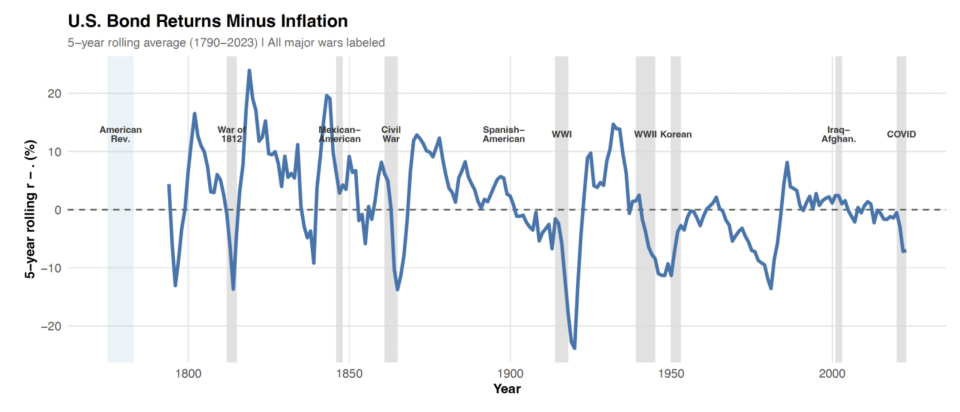
But after looking at 300 years of U.S. and U.K. history, the Center for Economic Policy Research found that wars and pandemic-scale emergencies have pummeled holders of debt.

“The historical evidence reveals a striking pattern: government bonds have repeatedly generated substantial real losses during these extreme episodes,” authors Zhengyang Jiang, Hanno Lustig, Stijn Van Nieuwerburgh, and Mindy Xiaolan wrote. “They have even underperformed equities and real estates which are traditionally regarded as risky assets.”

That’s because wars typically triggered large increases in government spending, averaging about 7% of GDP annually during the first four years, and tax hikes alone were rarely sufficient for financing needs, they added.

The finding comes as the U.S. is waging war on Iran while the national debt has exploded to $39 trillion. The Pentagon is seeking more than $200 billion in a budget request for the conflict, sources told the Washington Post.

Across their dataset, the CEPR authors calculated that bondholders suffered average real losses of roughly 14% during the first four years of conflicts. The losses were so steep that they reduced the real value of government debt outstanding.

To add insult to injury, cumulative bond returns were more than 20% below the cumulative returns on stocks and real estate, the opposite of how those assets perform during financial crises or recessions.

“Whenever there is a major war, we observe a sharp decline in the bond performance — wars are always disaster times for bondholders,” they warned. “Similarly, the bondholders also suffered large losses during the ‘war on Covid-19.’”

Center for Economic Policy Research

A key factor in bond losses is inflation, according to CEPR, which said the cumulative rate averaged about 20% in the first four years of wars.

In fact, during the current U.S.-Israel war on Iran, Treasuries and government debt from other countries have sold off sharply as surging oil prices have raised expectations for elevated inflation while budget deficits are also seen worsening. Since the war began three weeks ago, the U.S. 10-year yield has soared more than 40 basis points.

But profligate spending wasn’t the only way inflation weighed on bonds. The think tank said it was often the result of policy choices to reduce debt burdens without explicitly defaulting, such as by suspending gold standard commitments.

Another reason bonds perform so poorly during wars is so-called financial repression, or government policies that curb borrowing costs by influencing financial markets. That prevents bond yields from keeping pace with inflation.

For example, the Federal Reserve implemented yield-curve control, capped Treasury rates, and launched massive bond buying during World War II.

CEPR’s findings have particular relevance for U.S. debt as Treasuries continue to form the foundation of the global financial system with the dollar serving as the world’s reserve currency.

That status has allowed the U.S. to borrow more cheaply than investors would otherwise allow. Meanwhile, the interest on U.S. debt is now the fastest-growing budget item and is already at $1 trillion a year. CEPR said its report presents governments with an important tradeoff.

“Protecting taxpayers from large spending shocks may require shifting part of the burden onto bondholders through inflation or financial repression,” it said. “Economic theory suggests that such policies may be optimal when taxation is highly distortionary. However, they also reduce the safety of government debt and may raise borrowing costs over time if investors anticipate these risks.”

This story was originally featured on Fortune.com

Deficit rises unexpectedly to £14.3bn in February as stock markets slide amid fears that Iran war will escalate

UK government borrowing costs have reached their highest level since 2008, while financial markets now expect up to three interest rate rises this year as investors digest the impact of the Iran conflict.

The yield, or interest rate, on 10-year borrowing was pushed to heights not seen since the global financial crisis, as investors dumped UK government bonds.

Continue reading…

This post was originally published here
DocuSign Inc (NASDAQ:DOCU) shares are gaining momentum Friday.

This follows the release of stronger-than-expected fourth-quarter fiscal 2026 financial results on Tuesday. The company reported adjusted earnings of $1.01 per share. This beat the analyst consensus of 95 cents per share.

• Docusign shares are trending higher. What’s pushing DOCU stock higher?

Revenue Growth and IAM Success

Total revenue reached $836.86 million, up 8% year-over-year. This surpassed the $827.84 million estimate. The Intelligent Agreement Management (IAM) platform showed significant strength.

“In 2026, customers using IAM represented over $350 million in ARR,” said CEO Allan Thygesen.

Analysts Maintain …

Full story available on Benzinga.com

This post was originally published here

Peter Coates’s family welcome end to years pursuing answers after he died when outage stopped oxygen machine

A family has welcomed a coroner’s conclusion that ambulance delays possibly contributed to their father’s death in 2019 after enduring “years of distress trying to pursue answers”.

The family of Peter Coates said they had been met with “delays and resistance” from a regional ambulance service as they tried to discover the full circumstances of his final minutes.

Continue reading…

This post was originally published here

Intuitive Machines, Inc. (NASDAQ:LUNR) on Thursday reported downbeat fourth-quarter sales results.

The company reported revenue of $44.78 million, missing the consensus estimate of $53.68 million.

CEO Steve Altemus said 2025 was a “transformational year” for the company, pointing to the completion of its second lunar mission, expansion into national security space programs and acquisitions, including KinetX Aerospace and Lanteris Space Systems, as part of efforts to expand scale and growth opportunities.

Intuitive anticipates …

Full story available on Benzinga.com

This post was originally published here
Federal Reserve Vice Chair for Supervision Michelle Bowman said on Friday that she’s penciled in multiple rate cuts before the end of the year.

“I’m still concerned about the job market,” Bowman, considered one of the more hawkish members of the Federal Open Market Committee, said during an interview on FOX Business Network’s “Mornings with Maria.” I want to see a little bit of recovery there. But, of course, I’ve written three cuts in for before the end of 2026 to hopefully support the labor market.”

Bowman also said she expects to continue to see strong economic growth this year.

FEDERAL RESERVE HOLDS INTEREST RATES STEADY

Her comments come after the FOMC on Wednesday voted 11-1 to leave the benchmark federal funds rate unchanged at a range of 3.5% to 3.75%. It marked the second straight meeting with rates being held steady after three successive 25-basis-point cuts in September, October and December to end last year.

Policymakers also released a summary of economic projections (SEP), which showed that the median projection for interest rates sees just one 25 basis point cut the rest of this year followed by a single cut of that size in 2027.

WILL THE FEDERAL RESERVE CUT INTEREST RATES IN 2026?

“In our SEP, FOMC participants wrote down their individual assessments of an appropriate path for the federal funds rate under what each participant judges to be the most likely scenario for the economy,” Federal Reserve Chair Jerome Powell said. “The median participant projects that the appropriate level of the federal funds rate will be 3.4% at the end of this year and 3.1% at the end of next year, unchanged from December.”

During the press conference following the Fed’s interest rate decision, Powell was asked what officials were seeing that led them to project a cut despite higher forecasts for both inflation and unchanged projections for the unemployment rate and economic growth. 

FED’S POWELL SAYS IT’S ‘TOO SOON TO KNOW’ IRAN WAR’S IMPACT ON ECONOMY

“Essentially, the forecast is that we will be making some progress on inflation, not as much as we had hoped, but some progress on inflation,” Powell said. “It should come as we start to see in the middle of the year progress on tariffs going through once and then tariff inflation coming down. We should be seeing that.”

The latest rate decision comes amid a softening labor market and growing uncertainty over the war in Iran. Similar to Powell, Bowman said it’s too soon to know how the conflict in the Middle East will affect the U.S. economy.

CLICK HERE TO GET FOX BUSINESS ON THE GO

“I think it’s too early to tell what the longer-term imprint will be on U.S. economic activity and how we should think about that in terms of our longer-term economic forecast and how we should think about that in terms of our FOMC meetings and any rate changes that we might make as a result of economic evolution going forward.”

This post was originally published here

It all began with an anonymous Twitter handle named “Ivan the K.” The self-appointed “Lead Independent Director of Finance Twitter” had a dark theory in the depths of the pandemic. In 2020, they asked the universe, “Why is no one talking about a K recovery?” since there was much discussion at that time about an economic bounceback in the shape of either a U, an L, or, most bullish of all, a V. “Some things will bounce back,” Ivan wrote, “some will not recover. Think about it.”

Economists seem to have thunk on it and agreed: The K is real. It bears similarities to another saying, invented nearly 200 years earlier by the great English romantic poet Percy Bysshe Shelley: “The rich get richer, the poor get poorer.” 

This is also called “the Matthew effect,” as some trace the sentiment all the way back to the bible’s Book of Matthew 25:29: “For to everyone who has, more will be given, and he will have abundance; but from the one who does not have, even what he has will be taken away.”

If you ask Mark Zandi, chief economist for Moody’s Analytics, this old-time religion got a new lease on life in the Reaganomics of the 1980s. “You really start to see this in the Reagan era,” Zandi told Fortune. “That’s when you get a structural divergence between productivity growth and median wage growth.” 

Zandi argued many elements combined then to weaken labor in favor of capital income: globalization, the decline of unions and manufacturing and major tax reforms. “The share of national income going to labor has been trending down since the early 1980s,” he said, “and the share going to capital owners—those who already have wealth—has gone up.”

So what is it about 2026, six years after the pandemic severed something economically, that accelerated both sides of the “K” for the wealthy and the poor?

Data doesn’t lie

First, consider the extraordinary surges in economic data seen, halfway through the 2020s. The stock market rallies have led to several record highs in 2025, incentivizing the (wealthier) Americans with money in the markets to loosen their purse strings. But the bottom half of the K is extending downwards, with fast-casual restaurants like Chipotle and Cava, and fast-food joints like McDonald’s, noting that lower-income customers, especially young people, are pulling back and preferring to dine at home.

Zandi’s own research has turned up some stunning results, notably that in the second quarter of 2025 the top 10% of wealthiest Americans were responsible for a whopping 49% of consumer spending. That means the economy has grown so lopsided—or K-shaped—that the richest Americans are responsible for half the economy. The K-shape is creating the illusion in economic data that despite sticky inflation and tariff-related sticker shock, consumer spending remains “resilient.” 

Morgan Stanley Wealth Management’s Lisa Shalett has increasingly been sounding the alarm from her perch as chief investment officer. She told Fortune in an October 2025 interview “the income inequality stuff is really getting like completely wackadoo,” specifically citing Zandi’s research: “That means 90% of the country is only half the consumption, I mean holy cannoli.” 

Shalett covered the K-shaped economy specifically in a November 2025 research note, in the context of whether 2026 marks an early or late stage of the economic cycle for investors. “Decoding this conundrum may hinge on the so-called K-shaped economy,” she wrote, “a concept that captures the widening chasm between the ‘haves’ and ‘have-nots.’”

Then Shalett said the situation is actually even worse than what Zandi produced: “For the U.S. consumer, wealth concentration has produced a situation where the top 40% of households by income account for approximately 60% of all spending; those households, in turn, control nearly 85% of America’s wealth, two-thirds of which is directly tied to the stock market, which has climbed more than 90% in three years.” She calculated that spending by the wealthiest households was growing 6x-7x faster than for the lowest cohort. 

Even Federal Reserve chair Jerome Powell talked about seeing the pattern at last December’s Federal Open Market Committee meeting. “We hear about this a lot,” Powell said. “If you listen to the earnings reports for consumer-facing companies that tend to deal with low- and moderate-income people, they’ll all say that we’re seeing people tightening their belts, changing products that they buy, buying less, and that sort of thing. And so it’s clearly a thing.”

When did the K-shaped economy emerge?

The concept of a bifurcated economy has been baked into American society longer than even the days of Reagan, according to Tyler Schipper, associate professor of economics at the University of St. Thomas.

“There’s this underlying thing that has been true for decades and decades and decades,” Schipper told Fortune. “Number one, lower income households always struggle more in the economy. They tend to be more impacted by price changes because they’re spending a higher percentage of their income. 

“And second, that it tends to be that after each recession, lower income workers fall further behind in the income distribution,” he added.

Today, conversations around the shape of the American economy are more urgent because more of the middle class—and those making about $100,000 per year—are getting pushed into the lower half of the K, Schipper said. This can be seen in mid-income and higher-income earners flocking to discount retailers like Walmart and Dollar General. It can even take on more absurd forms, with “Ralph Lauren Christmas” trending at unprecedented levels during the projected $1 trillion 2025 holiday season, but TikTok and Instagram full of tips on how to achieve the look of red-tartan-plaid and cozy sweaters on a budget—in other words, not at an actually expensive Ralph Lauren store. 

Why is this happening?

That lower half of the K is extending ever downward as the consumer encounters a unique set of challenges, including the inflationary impact of tariffs, according to Schipper. Lower-income households tend to spend more on essential goods more likely to be impacted by tariffs. The Yale Budget Lab calculated that the levies impact the bottom of the income ladder more than three times more than the top.

A low-fire, low-hire labor market has also contributed to evidence of a two-tiered economy, said Claudia Sahm, chief economist at New Century Advisors and a former Federal Reserve economist. While tech layoffs have been top of mind following massive cuts from Amazon, layoff rates are still low, Sahm told Fortune, meaning if you have a job, you may feel more financially secure. If you’re just entering the job market like Gen Z is, you may have a hard time finding a job as firms contract following a post-COVID hiring spree, and as AI begins to displace entry-level jobs. To be sure, January 2026 data from Challenger, Gray & Christmas found U.S. employers cut more than 108,000 jobs in January, the largest January reduction since 2009.

But another part of the resurgence of discussions about a bifurcated economy comes from the relative nature of a K-shaped economy, according to Schipper. While the economy has historically been two-tiered, diverging consumer sentiment has also contributed to a narrative that two income groups are moving away from each other. 

For example, in 2022 when the stock market declined, consumer sentiment in both the top-third and bottom-third of income levels converged, according to data from the University of Michigan’s Survey of Consumers. A similar pattern occurred last April, when the announcement of Liberation Day tariffs spooked Americans across income levels, Schipper noted. Last year, however, consumer attitude toward the economy saw a greater split, with low-income Americans feeling far less confident about the economy than those high-income, a trend continuing into 2026.

How monetary policy created the two-tiered economy

Some economists point to the widening divide between the rich and the poor as a consequence of monetary policy. The Fed, over the past few years, has had a historic tightening cycle—11 rate hikes between 2022 and 2024—which was meant to pare down inflation. However, it also reinforced the split since wealthy households, flush by years of asset appreciation, could weather the slowdown better than lower income households facing higher mortgage rates and shrinking credit, Zandi said.

Cheap money in the 2010s and early pandemic years boosted stocks and home values, but the 2022-and-on tightening squeezed borrowers and renters without necessarily reversing those gains. That means even as inflation has cooled, the damage lingered as asset holders retained their windfall but wage earners bore the brunt of disinflation. 

“Folks in the top third of the income and wealth distribution are doing well, but the remaining two-thirds of Americans are struggling… they borrowed during the pandemic when rates were low, and now they’re having to pay on that debt at a higher rate,” Zandi said.

How can the economy become less bifurcated?

Though Fed chair Powell has acknowledged today’s K-shaped economy, a more restrictive monetary policy is helping keep it in place, Sahm argued, making it unlikely for the two diverging K lines to come any closer together.

“We have a Fed that’s still trying to fight inflation that’s been elevated, and part of the tool that they have for fighting inflation is interest rates are elevated, and they’ve been elevated for some time,” Sahm said. “This is the way restrictive monetary policy works: It’s going to hit households hardest who are more financially constrained.”

Zandi had a different perspective. He argued the gap will require policy changes far beyond the Fed’s remit.

“The Fed can’t fix the K-shaped economy,” he said. “It can only stabilize prices and employment. The distributional effects are up to fiscal policy.” Instead, Zandi argued for a reversal of some choices made on the fiscal side that would “do no harm” to lower-and-middle-income Americans.

“Don’t impose tariffs—that exacerbates inequality,” he said. “Lower- and middle-income households spend a much higher share of their budget on imported products like food, clothing, and cars.” 

He also criticized President Donald Trump’s “highly restrictive” immigration policy, which he said hurts jobs for industries that rely on immigrants, such as construction, agriculture and manufacturing broadly. 

Beyond just addressing self-inflicting wounds, Zandi argued that progress depends on both structural and cyclical forces: raising productivity through education, broad-based jobs creation, and ensuring that gains from AI will be equally shared. “If the benefits of AI are distributed more broadly,” he said, “and if job losses are offset by new opportunities, we’ll be fine.”

What’s so bad about a K-shaped economy?

Clear evidence of a two-tiered economy doesn’t mean a recession is imminent, economists said. It does, however, mean that if economic indicators were to take a nosedive, the risk of a recession would increase.

“The K-shaped economy, the bifurcated economy, is potentially a more vulnerable economy,” Sahm said.

Though layoff rates are still relatively low, if the rate of job cuts increased, there would be many more people in a job market where there’s not much hiring. The labor market today doesn’t look like it did in the job-hopping era of 2023, even when interest rates were still high, Sahm noted. Right now, only the healthcare and hospitality sectors are adding jobs in earnest, creating a concentration of growth not optimal for economic stability.

“Anytime you have that, you’re more vulnerable if something bad happens,” Sahm said.

A version of this story was published on Fortune.com on Nov. 7, 2025.

More on the K-shaped economy:

  • Welcome to the ‘E-shaped’ economy: Wealth gap is no longer between just high and low earners, the middle class is also struggling
  • McDonald’s newest $3 value menu is sounding an alarm about America’s K-shaped economy
  • Economist behind K-shaped economy sees a ‘sea of despair’ for the bottom 90% and a ‘crisis of confidence’ in the American dream

This story was originally featured on Fortune.com

Accenture plc (NYSE:ACN) on Thursday posted upbeat earnings for its fiscal second-quarter and issued a cautious outlook.

Accenture issued a softer-than-expected full-year earnings forecast and a cautious revenue outlook for the third quarter.

The company reported quarterly earnings of $2.93 per share, topping the analyst consensus estimate of $2.84. The company reported sales of $18.04 billion, slightly exceeding the analyst consensus estimate of $17.84 billion.

Accenture raised its fiscal 2026 revenue outlook to a range of $71.763 billion to $73.157 billion, up from its prior forecast of $71.066 billion to $73.157 billion, but below the analyst consensus estimate of $73.917 billion.

The company now expects fiscal 2026 GAAP earnings per share of $13.25 to $13.50, compared with its …

Full story available on Benzinga.com

This post was originally published here

Cingulate Inc. (NASDAQ:CING) shares were down during Friday’s premarket session but recovered later. The company’s recent financial report highlighted both operational advancements and ongoing challenges.

The stock’s volatile move comes as broader markets experienced mixed performance, with the S&P 500 futures down 0.6% and the Healthcare sector remaining flat.

Cingulate reported a net loss of $6.3 million for the fourth quarter of 2025, slightly up from a loss of $6.2 million in the same period the previous year.

Additionally, the company announced the granting of a European patent for its ADHD treatment, CTx-1301, which is expected to bolster its intellectual property portfolio and support future commercialization efforts.

The company also secured a $12 million private investment to …

Full story available on Benzinga.com

This post was originally published here

The Fed holds firm, Micron crushes earnings and still gets punished, and the Iran war just hit Qatar’s gas supply.

Happy Friday. Here’s an observation about this week: oil spiked toward $100, gold crashed 6%, and a company that beat earnings estimates by 40% got sold off. If that doesn’t capture the mood, nothing does.

S&P 500 closed at 6,606 (-0.3%), Nasdaq 22,090 (-0.3%), Dow 46,021 (-204 pts). WTI crude near $97, Brent $106. Gold cratered to $4,570. Bitcoin slipped to $69,700. VIX touched 26.8 before settling at 24.9.

The Rundown

WAR/OIL › Iran struck Qatar’s LNG production facilities overnight, wiping out roughly 17% of the country’s output and prompting evacuation warnings across Gulf energy sites. Saudi Arabia and the UAE are now on alert. WTI crude touched $99 intraday before pulling back to roughly $97. Brent traded above $106. Israeli PM Netanyahu signaled late in the session that the war may end sooner than expected, which helped stocks claw back from session lows. But with Hormuz traffic still down an estimated 70%, the supply picture isn’t fixed by optimism alone.

FED › The Fed held rates at 3.50-3.75% yesterday and projected just one more cut for the rest of 2026. Powell was blunt about the Middle East: higher energy prices will push up inflation, and that could delay any easing. February PPI already came in hot before the war’s full effects hit. The market heard “higher for longer” and traded accordingly. Two consecutive losing days for all three major averages, with the S&P now sitting below its 200-day moving average for the first time since last spring.

EARNINGS › Micron (MU) reported a quarter that would’ve been a celebration in any other tape. EPS of $12.20 crushed the $8.66 estimate. Revenue of $23.86 billion beat by $4 billion. The company guided even higher for Q3. Stock dropped 5.6%. Meanwhile, Accenture (ACN) missed EPS by 24% and rallied 4.1%. In this market, positioning matters more than the print. Guidance and forward visibility are the only things getting rewarded.

Full story available on Benzinga.com

This post was originally published here

Linkers Industries Ltd (NASDAQ:LNKS) shares are falling on Friday. The stock traded around 85 cents following a massive 51.36% jump during Thursday’s session.

Investors appear to be locking in profits after the stock closed Thursday at 88 cents.

• Linkers Industries stock is feeling bearish pressure. What’s behind LNKS decline?

SEC Filing Details Unit Offering

The price action follows a Form F-1 registration statement filed on Monday. Linkers Industries is offering up to 18.25 million ordinary units at approximately $0.9864 per unit.

Strategic Expansion in …

Full story available on Benzinga.com

This post was originally published here

Infosys Limited (NYSE:INFY) shares are up on Friday as the company is launching an AI-powered Race Centre in partnership with Formula E.

• How is INFY stock currently doing?

This initiative aims to enhance fan engagement through real-time insights and innovative technology, contributing positively to the stock’s performance despite a mixed market backdrop.

The new Race Centre, powered by Infosys Topaz, is designed to provide fans with immersive experiences during race days, integrating AI-driven insights and interactive features.

This launch marks a significant step in Infosys’ role as Formula E’s Official Digital Innovation Partner, showcasing the company’s commitment to leveraging technology in sports.

The platform will deliver features such as AI commentary, weather tracking, and race control updates, enhancing how fans engage with the sport. As Formula E continues to grow, this partnership positions Infosys at the forefront of digital transformation in motorsport, appealing to younger, tech-savvy audiences.

Infosys Intel AI Partnership

Earlier this month, the company announced a strategic collaboration with Intel Corporation (NASDAQ:INTC) to enhance enterprise AI deployments.

The collaboration focuses on optimizing AI performance and scalability, leveraging Intel’s high-performance compute platforms alongside Infosys Topaz Fabric.

This partnership aims to facilitate the …

Full story available on Benzinga.com

This post was originally published here

Exclusive: Chris Bryant says policy agreements are being done in bits and pieces but a greater vision is needed by both sides

It was all smiles and warm handshakes when the two men in charge of renegotiating the UK’s relationship with the EU met in Brussels this week.

Maroš Šefčovič and the UK minister for EU relations, Nick Thomas-Symonds, sharing a stage on the third floor of the vast European parliament building, were at pains to show the cross-Channel relationship was in a good place after years of rancour.

Continue reading…

This post was originally published here

CBS News Radio to shutter after nearly 100 years as editor Bari Weiss tells staff cuts were ‘necessary’ decision

CBS News announced it is laying off dozens of employees on Friday and ending CBS News Radio – its nearly 100-year-old radio service – as part of a strategic restructuring.

The news was announced in a memo to staffers from its editor-in-chief, Bari Weiss, and president, Tom Cibrowski. Employees will be informed by the end of the day if their job has been affected, the two executives said in the memo.

Continue reading…

This post was originally published here

Audio products, voice-activated technology, hardware, and software

This post was originally published here

Microsoft Corp (NASDAQ:MSFT) partner OpenAI is merging ChatGPT, its Codex coding platform, and the Atlas browser into a single desktop “superapp,”.

The move comes as executives internally describe the company as operating under a “code red.”

OpenAI hit roughly $25 billion in annualized revenue as of February but is projecting $14 billion in losses this year and doesn’t expect to turn cash-flow positive until 2030.

OpenAI’s ‘Side Quest’ Problem

Fidji Simo, OpenAI’s chief of applications, told employees the company had been “spreading our efforts across too many apps.”

The Atlas AI browser launched in October 2025 to lukewarm reception. MIT Technology Review called it “cynicism masquerading as software.” The Sora video generator and a hardware device followed. None generated consumer enthusiasm.

Simo told an all-hands meeting last week they couldn’t afford “side quests” given Anthropic’s rapid success winning enterprise and coding customers. Sam Altman, …

Full story available on Benzinga.com

This post was originally published here

Norris karate chopped and kickboxed his way through more than a dozen action films, before leaping to TV in Walker, Texas Ranger.


(Image credit: Jeff Golden)

This post was originally published here

Iran threatened to target recreational and tourist sites worldwide and insisted it was still building missiles. Friday’s show of defiance came nearly three weeks into U.S.-Israeli strikes that have killed a slew of Tehran’s top leaders and hammered its weapons and energy industries.

Iran fired on Israel and energy sites in neighboring Gulf Arab states as many in the region marked one of the holiest days on the Muslim calendar. Iranians were also celebrating the Persian New Year, known as Nowruz, a normally festive holiday that is more subdued this year.

With little information coming out of Iran, it was not clear how much damage its arms, nuclear or energy facilities have sustained since the war began Feb. 28 or even who was truly in charge of the country. But Iran has showed it is still capable of attacks that are choking off oil supplies and denting the global economy, raising food and fuel prices far beyond the Middle East.

The U.S. and Israel have offered shifting rationales for the war, from hoping to foment an uprising that topples Iran’s leadership to eliminating its nuclear and missile programs. There have been no public signs of any such uprising and no end in sight to the war.

Iran threatens worldwide tourist sites

Iran’s top military spokesman warned Friday that “parks, recreational areas and tourist destinations” worldwide won’t be safe for Tehran’s enemies.

The threat from Gen. Abolfazl Shekarchi renewed concerns that Iran may revert to using militant attacks beyond the Middle East as a pressure tactic.

U.S. and Israeli leaders have said that weeks of strikes have decimated Iran’s military. Airstrikes have also killed its supreme leader, the head of its Supreme National Security Council and a raft of other top-ranking military and political leaders.

The Israeli military said Friday that Esmail Ahmadi, head of intelligence for the Basij, and internal security force, had been killed by a strike earlier in the week that hit other Basij leaders.

On Thursday, Israeli Prime Minister Benjamin Netanyahu claimed Iran’s navy was sunk and its air force in tatters, while adding that its ability to produce ballistic missiles had been taken out. Iran’s paramilitary Revolutionary Guard disputed the missile claim on Friday.

“We are producing missiles even during war conditions, which is amazing, and there is no particular problem in stockpiling,” spokesman Gen. Ali Mohammad Naeini was quoted as saying in Iran’s state-run IRAN newspaper.

A short time after the statement was released, Iranian state television said Naeini was killed in an airstrike.

The country’s new Supreme Leader Ayatollah Mojtaba Khamenei also released a rare statement, saying Iran’s enemies need to have their “security” taken away.

Khamenei hasn’t been seen since he succeeded his father, the 86-year-old Ayatollah Ali Khamenei, who was killed in an Israeli airstrike on the first day of the war.

A Kuwait refinery comes under attack and explosions shake Dubai

Iran has stepped up its attacks on energy sites in Gulf Arab states after Israel bombed Iran’s massive South Pars offshore natural gas field earlier in the week.

Two waves of Iranian drones attacked a Kuwaiti oil refinery early Friday, sparking a fire. The Mina Al-Ahmadi refinery, which can process some 730,000 barrels of oil per day, is one of the largest in the Middle East. It was damaged Thursday in another Iranian attack.

Bahrain said a fire broke out after shrapnel from an intercepted projectile landed on a warehouse, and Saudi Arabia reported shooting down multiple drones targeting its oil-rich Eastern Province.

Heavy explosions shook Dubai as air defenses intercepted incoming fire over the city, where many were observing Eid al-Fitr, the end of the Muslim fasting month of Ramadan.

In Iran, meanwhile, many were marking Nowruz even as Israel said it had launched new strikes, and explosions were heard over Tehran. The Persian New Year, which coincides with the spring equinox, is a tradition observed across southwestern Asia that dates back thousands of years.

Loud explosions could also be heard in Jerusalem after the Israeli army warned of incoming Iranian missiles. First responders said they treated two people around 70 years old who were lightly wounded.

In addition to steadily striking Iran, Israel has regularly hit Lebanon, targeting Iran-backed Hezbollah militants who have been firing rockets and drones into Israel.

On Friday, Israel broadened its attacks to Syria, saying it hit infrastructure there in response to what it described as attacks on the Druze minority. Syria’s state-run SANA news agency did not immediately acknowledge the attack.

More than 1,300 people have been killed in Iran during the war. Israeli strikes in Lebanon have displaced more than 1 million people, according to the Lebanese government, which says more than 1,000 people have been killed. Israel says it has killed more than 500 Hezbollah militants.

In Israel, 15 people have been killed by Iranian missile fire. Four people were also killed in the occupied West Bank by an Iranian missile strike.

At least 13 U.S. military members have been killed.

The war is raising risks to the world economy

Iran’s attacks on energy infrastructure in the Gulf combined with its stranglehold on shipping in the Strait of Hormuz, a strategic waterway through which a fifth of the world’s oil and other critical goods are transported, has raised concerns of a global energy crisis.

U.S. President Donald Trump lobbed fresh insults at NATO allies who have spurned his call for help protecting the strait. U.S. allies have refused to join the war, saying they weren’t consulted before the U.S. and Israel launched it. Trump called NATO members “COWARDS” in a social media post, saying: “NATO IS A PAPER TIGER.”

Brent crude oil, the international standard, has soared during the fighting and was around $108 per barrel Friday, up from roughly $70 per barrel before the war began.

Surging fuel prices come at a moment when many world leaders were already struggling to bring down high prices of food and many consumer goods. Asia is getting hit hard as most of the oil and gas exiting the Strait of Hormuz is transported there.

But the price shocks are reverberating throughout the world economy. Key raw materials — like helium used in making computer chips, and sulfur, a raw material in fertilizer — have been obstructed and could be in short supply soon, raising the prices of goods all the way down the supply chain.

___

Mednick reported from Jerusalem and Rising from Bangkok. AP journalists Michelle Price in Washington and Russ Bynum in Savannah, Georgia, contributed.

This story was originally featured on Fortune.com

Late-night hosts panned Trump’s joke about the 1941 attack, addressed new unredacted Epstein emails and talked popular puppy names

With The Late Show with Stephen Colbert on hiatus until at least 27 March, late-night hosts on Thursday discussed Donald Trump’s snafu while meeting Japan’s prime minister, his caginess over Iran, and new findings in the Epstein investigations.

Continue reading…

This post was originally published here

Bitcoin (CRYPTO: BTC) is back at $70,000 on weakening bullish momentum, setting up a key test for its next move.

Bitcoin’s Key Levels In Focus

Prominent analyst Trader Mayne on Friday said rising geopolitical tensions and the aftermath of recent Federal Reserve policy decisions are driving volatility across crypto markets.

He noted that macro conditions remain critical.

Higher energy prices can tighten financial conditions, while central bank policy continues to influence liquidity, both key drivers of capital flows into Bitcoin.

From a technical perspective, Bitcoin is at a pivotal point. After a failed breakout attempt, the return to its previous range suggests fading bullish strength.

Mayne identified $71,500 …

Full story available on Benzinga.com

This post was originally published here

Ukrainian officials are helping five countries in the Middle East and Gulf region counter attacks on their territory by Iranian drones, while the United States and European countries are among others who have requested support, Ukrainian President Volodymyr Zelenskyy said Friday.

Ukraine is also looking into whether it can have a role in restoring security in the Strait of Hormuz amid the Iran war, he said.

Ukraine has become one of the world’s leading producers of cutting-edge, battle-tested drone interceptors that are cheap and effective. They play a key part in its defense against Russia’s more than 4-year-old full-scale invasion.

“Our teams are already working with five countries on countering (Iran’s) ‘Shahed’ drones — we have provided expert assessments and are helping build a defense system,” Zelenskyy said on X.

Zelenskyy has previously said he hoped to provide expertise to Arab Gulf countries targeted by Iranian Shahed drones, versions of which are heavily used by Moscow’s invading forces, in exchange for advanced air defense missiles that Ukraine needs to counter devastating Russian aerial attacks. Kyiv fears it will get fewer of the sophisticated missiles it needs to fend off the Russian strikes as the Iran war burns through stockpiles.

Ukrainian expertise helps protect civilian and critical infrastructure

Rustem Umerov, the head of Ukraine’s National Security and Defense Council who led a delegation to the Middle East and Gulf this week, said that Ukraine has deployed interceptor units there to help protect civilian and critical infrastructure and is working to expand that protection.

He said on the Telegram messaging app that Ukrainian military specialists are operating in the United Arab Emirates, Saudi Arabia, Qatar, Kuwait and Jordan.

Ukraine is assessing further steps for long-term security cooperation with each of those countries, Umerov said.

The U.S. has asked for expert support for their military personnel in two areas of the region, Zelenskyy said, adding that Kyiv is also reviewing requests from European partners whose forces are based in the region.

The relationship between Washington and Kyiv on drone cooperation has been unclear.

Zelenskyy said last week that Ukraine was awaiting White House approval for an agreement on drone production. But a day later Trump spurned Ukraine’s offer of assistance, telling the “Brian Kilmeade Show” on Fox News Radio: “No, we don’t need their help on drone defense.”

Ukraine looks to resume talks with US, Russia

Zelenskyy said late Thursday he has sent an official delegation to the United States in a bid to move forward suspended U.S.-brokered talks on ending Russia’s invasion.

The trilateral talks, which have yet to produce any breakthrough on key issues, have been on ice while the Iran war has dominated international attention.

The White House did not confirm any meeting with the Ukrainian delegation.

A senior Kremlin official indicated Friday that a new round of U.S.-mediated negotiations between Moscow and Kyiv will likely take place soon.

“The pause is temporary, we hope it’s temporary regarding the continuation of the trilateral format,” he said.

Western European officials have over the past year repeatedly accused Russian President Vladimir Putin of dragging his feet in negotiations while he tries to press his bigger army’s battlefield initiative and capture more Ukrainian land. Russian forces hold nearly 20% of Ukraine.

Middle East conflict impacts Russia-Ukraine war

The latest conflict in the Middle East that began Feb. 28 with Israeli and U.S. strikes on Iran has diverted international attention from Ukraine’s plight.

At the same time, Russia is getting a financial windfall from a temporary U.S. waiver on oil sanctions while Ukraine is desperately short of cash and still waiting for a 90-billion-euro ($103 billion) loan promised by the European Union.

Putin is widely expected to launch new offensives as the weather in Ukraine improves, piling further pressure on Kyiv.

___

Associated Press writer Michelle Price in Washington contributed to this report.

This story was originally featured on Fortune.com

Russia is poised to be a major beneficiary of the US‑Israeli military operations against Iran, despite ongoing efforts to curb Moscow’s revenue from its so‑called shadow fleet by the European Union (EU) and the US.

The three-week conflict has tightened global energy markets, disrupted LNG flows, and weakened sanctions enforcement. These developments will strengthen Russia’s position as a major oil and gas exporter as countries scramble to find energy supplies.

Disruptions in the Strait of Hormuz have threatened the flow of 60 million tons of oil and 7 million tons of LNG per month. This war has rattled international energy markets.

Oil prices surged to over $100 per barrel. Liquefied natural gas (LNG) prices in Northwest Europe are up 96% in the last month.

The price rally directly translates into stronger state revenues for Moscow.

Russia’s average fossil fuel export earnings have totaled an estimated €510 million per day, a week after Israeli-US airstrikes on Iran, Finland-based Centre for Research on Energy and Clean Air (CREA) said on March 12. That is 14% more than February’s daily average, it said.

“The benefit could be meaningful in the short term because Russia gains both from higher prices and from some easing in the practical enforcement of sanctions,” Carole Nakhle, founder of Crystol Energy, said. “But the upside is still constrained.”

Russian crude held on tankers fell to 118.3 million barrels this week, from 132.9 million barrels at the end of February, Kpler data showed. This suggests that cargoes have moved to buyers more quickly.

Europe May Increase Russian LNG Imports

The war, with no clear signs yet of ending, may force Europe to increase its imports of Russian LNG. This would slow plans by the European Union (EU) to phase out imports of LNG by January 1 next year.

Iranian attacks ‌against Qatar have knocked out 17% of its LNG export capacity. This caused an estimated $20 billion in lost annual revenue. This will threaten supplies to Europe, QatarEnergy’s CEO and state minister for energy affairs told Reuters on Thursday.

“EU gas security now depends more on the global LNG market,” Brussels-based Bruegel analysts wrote on March 11. “If global gas demand rises or supplies are disrupted, the risk will show up in higher prices and stronger competition for cargoes, rather than in physical shortages.”

In February, the five largest EU importers of Russian fossil fuels paid Russia …

Full story available on Benzinga.com

This post was originally published here

Stuart Niven found to have diverted Covid grants to personal account and other candidates’ Islamophobic remarks revealed

Reform UK has suspended one of its Scottish candidates after it emerged he had been struck off as a company director, and the party faces growing attacks for fielding candidates making Islamophobic remarks.

Reform confirmed on Friday morning it had suspended Stuart Niven, its candidate for Dundee West, after the Herald revealed he had been struck off after diverting tens of thousands of pounds of Covid grants into his personal account.

Continue reading…

This post was originally published here

On March 19, 2026, Gold and silver erased over $3 trillion in market value. Whenever this happens, the first instinct is to panic. While that is valid, it’s important to ask the most important question: “Why?” 

Beyond the headlines, this moment signals something deeper that every investor must pay attention to. 

How A Bullish Run Turned Into A Sudden Breakdown

To understand today’s sell-off, you have to understand the extraordinary run that preceded it.

Gold surged nearly 96% in the 12 months leading up to its January 28, 2026, peak of $5,595 per ounce, an all-time high. Silver did something even more dramatic, rising approximately 278% in the same period, briefly touching $121 per ounce. 

The increase in price levels of gold and silver had strong reasons, such as:

With such a dramatic price surge, both metals were already aggressively overbought, and from market history, it’s widely known that prices don’t move in a straight line, no matter how solid the underlying reasons are. 

The sharp decline in the price levels of gold and silver further proves that the market always sells off after a massive rally, and vice versa.

What’s Fueling The Sharp Sell-Off In Gold And Silver

The single most powerful force weighing on gold and silver prices right now is renewed fear of prolonged high interest rates. The anticipated nomination of Kevin Warsh, known for his firm anti-inflation stance, as Federal Reserve Chair has fundamentally reset rate-cut expectations.

Markets that were pricing in two …

Full story available on Benzinga.com

This post was originally published here
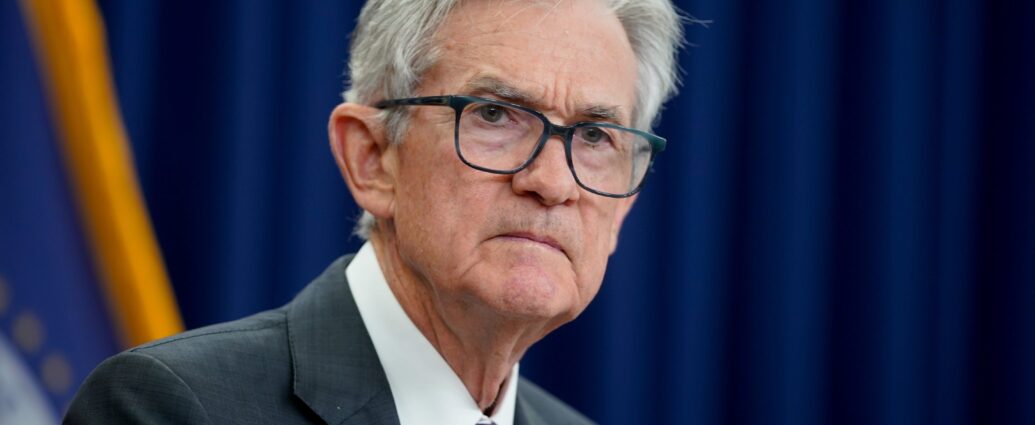
Dell Technologies Inc. (NYSE:DELL) shares saw upward momentum Friday morning. The move follows a regulatory filing by Silver Lake.

Silver Lake Reveals Aggregated Stake

According to an Amendment No. 13 to Schedule 13D filed with the U.S. Securities and Exchange Commission (SEC), Silver Lake Group and its affiliates reported a massive position.

The group may be deemed to beneficially own 50,240,830 shares of Class C Common Stock. This figure represents approximately 13.6% of the class.

Details of the SPV-2 Holding

Specifically, SL SPV-2, L.P. reported shared voting and dispositive power …

Full story available on Benzinga.com

This post was originally published here
FedEx Corp. (NYSE:FDX) on Thursday reported better-than-expected third-quarter financial results and raised its FY26 adjusted EPS guidance above estimates.

The company reported third-quarter revenue of $24 billion, beating analyst estimates of $23.42 billion, according to Benzinga Pro. The company posted third-quarter adjusted earnings of $5.25 per share, beating estimates of $4.13 per share.

“Team FedEx delivered another quarter of strong financial results and excellent service for our customers, powered by disciplined operational execution, the resilience of our global network, and the accelerating impact of our advanced digital solutions,” said Raj Subramaniam, president and CEO of FedEx.

FedEx now expects revenue to be up 6% to 6.5% in fiscal 2026, versus prior guidance for growth of 5% to 6%. The company …

Full story available on Benzinga.com

This post was originally published here

Actor who rose to fame after starring in Bruce Lee’s The Way of the Dragon also became a TV fixture with Walker, Texas Ranger

Chuck Norris, the former world karate champion who used his fight prowess to become the star of a string of low-budget but financially successful action movies, has died aged 86.

His family posted a message on social media saying Norris had died on Thursday, adding: “While we would like to keep the circumstances private, please know that he was surrounded by his family and was at peace.”

Continue reading…

This post was originally published here

Tesla, Inc. (NASDAQ:TSLA) has spent years selling the robotaxi ambition. Now, that ambition is facing something more tangible—a 50,000-vehicle deployment plan backed by Rivian Automotive, Inc. (NASDAQ:RIVN) and Uber Technologies, Inc. Common Stock (NYSE:UBER).

This isn’t another prototype or pilot. It’s scale.

Rivian and Uber say they plan to roll out up to 50,000 R2 robotaxis across 25 cities spanning the U.S., Canada, and Europe by 2031.

That immediately shifts the conversation from “who has the best tech” to “who gets there first at scale.”

From Vision to Deployment

Tesla’s approach has been clear: build a vertically integrated autonomy stack and deploy it across millions of vehicles over time. The bet is that once Full Self-Driving is solved, scale follows naturally.

But Rivian …

Full story available on Benzinga.com

This post was originally published here

In Denmark, the spread of solar panels in rural areas has become a divisive issue among voters, especially in rural areas

In one telling of the story, the golden fields of a proud farming nation are under attack. Besieged by an industrial sprawl of solar panels, they are being smothered at the behest of an urban elite.

That narrative has failed to thrive in conservative heartlands such as Texas and Hungary, which have embraced solar power while lambasting green rules. But it is taking root in Denmark, the most climate-ambitious nation on Earth. “We say yes to fields of wheat,” said Inger Støjberg, the leader of the rightwing populist Denmark Democrats in a speech in 2024. “And we say no to fields of iron!”

Continue reading…

This post was originally published here

Senior public servant wrote ‘police will be dispersing them if numbers exceed capacity’ while premier says protesters confronted after attempting to march

Police planned to disperse the crowd at a Sydney protest against the visiting Israeli president, Isaac Herzog, if it exceeded 6,000 people, according to correspondence between senior New South Wales public servants.

The messages released under freedom of information (FoI) laws contain information not referenced in public comments by the NSW premier, Chris Minns, and the police commissioner, Mal Lanyon.

Continue reading…

This post was originally published here

The White House on Friday released its framework for how it wishes Congress will address the issue of artificial intelligence.

The legislative blueprint, released on its website, outlines a half-dozen guiding principles for lawmakers to keep in mind when developing policies governing artificial intelligence. Those areas include: protecting children and empowering parents; safeguarding and strengthening American communities; respecting intellectual property rights, preventing censorship and protecting free speech, enabling innovation and ensuring American AI dominance, and educating Americans and developing an AI-ready workforce.

“The Trump Administration is committed to winning the AI race to usher in a new era of human flourishing, economic competitiveness, and national security for the American people,” the White House said in announcing its framework. “Achieving these goals requires a commonsense national policy framework that both enables American industry to innovate and thrive and ensures that all Americans benefit from this technological revolution.”

The White House said “strong federal leadership” is needed to make sure the public can trust how artificial intelligence is being used in their lives.

Members of Congress from both parties, as well as civil liberties and consumer rights groups, have pushed for more regulations on AI, saying there is not enough oversight for the powerful technology. President Donald Trump signed an executive order in December to block states from crafting their own regulations, arguing that a patchwork of rules would hurt growth in the sector.

This story was originally featured on Fortune.com

A Bitcoin (CRYPTO: BTC) wallet that had remained untouched for over 13 years moved 2,100 BTC worth $147.7 million on Friday, with the original July 2012 purchase price of just $13,685 representing a 10,000x return.

The 13-Year Hold

The transfer was initiated at 10:27 a.m. UTC Friday, with blockchain explorer Mempool data showing the transaction consolidated multiple UTXOs into a new output at the same “1NB3Z” address. 

Someone sent a small amount to a secondary address, potentially taking advantage of the current low-fee environment.

The address initially received the 2,100 BTC on Independence Day, July 4, 2012, when that amount was worth approximately $13,685. 

The wallet continued to receive numerous minor transactions in the intervening period but never …

Full story available on Benzinga.com

This post was originally published here

Owner of labrador says bottle find may be connected to poisoning that led to one of England’s last public hangings

A man in Devon believes his beloved dog has dug up a key piece of evidence in his back garden connected to a notorious Victorian murder case.

Paul Phillips, 49, told reporters that his labrador, Stanley, recovered a blue glass bottle with the words “Not to be taken” written on the side from their home in Clyst Honiton.

Continue reading…

This post was originally published here

HHS is looking into the states for ‘alleged disregard of, or confusion about’ the federal Weldon amendment

The US Department of Health and Human Services (HHS) said on Thursday that it is investigating 13 states that require state-regulated health insurance plans to cover abortion services.

HHS officials said in a news release that the department’s office for civil rights (OCR) is looking into the states for allegedly violating the federal Weldon amendment, which prohibits federal funding for programs or state or local governments that “subjects any institutional or individual healthcare entity to discrimination on the basis that the healthcare entity does not provide, pay for, provide coverage of, or refer for abortions”.

Continue reading…

This post was originally published here

Three people were suing ex-Sinn Féin leader for liability over IRA bombings in UK that left them injured

Three victims of IRA bombings who sued Gerry Adams alleging he was a member of the paramilitary group and culpable for the attacks have withdrawn their lawsuit on the last day of the civil trial.

John Clark, Jonathan Ganesh and Barry Laycock, who were injured respectively in the 1973 Old Bailey bombing, the London Docklands and Manchester bombings in 1996, were seeking symbolic “vindicatory” damages of £1 each.

Continue reading…

This post was originally published here

Mortgage rates in the U.S. jumped to a three-month high this week, adding strain to the housing market as the spring buying season begins. The 30-year fixed mortgage rate rose to 6.22% for the week ending March 19, up from 6.11% the previous week, according to Freddie Mac.

War Abroad Is Pushing Borrowing Costs Higher

The increase follows the outbreak of the Iran conflict, which has tightened global energy supplies and lifted oil prices, fueling inflation expectations. The 10-year Treasury yield, which influences mortgage rates, rose to 4.26% from 3.96% before the conflict.

Mortgage applications fell nearly 11% from the prior week. New single-family home sales dropped nearly 18% in January from the previous month and were down 11.3% from a year earlier, according to the Census Bureau.

The Federal Reserve kept interest rates at 3.5%–3.75%, …

Full story available on Benzinga.com

This post was originally published here. 

A new Ripple (CRYPTO: XRP) survey of over 1,000 global finance leaders finds 70% say firms must offer digital asset solutions to stay competitive, with stablecoins emerging as the most compelling use case for treasury operations.

The Digital Asset Necessity

Ripple’s survey reveals digital assets are no longer a fringe experiment—they’re becoming a core part of how banks, asset managers, fintechs, and corporates plan to move money, store value, and manage risk.

Stablecoins emerged as the most compelling use case, with 74% of leaders saying stablecoins can improve cash-flow efficiency and unlock working capital. 

This highlights their growing appeal as treasury tools beyond just payment rails.

Fintechs are leading adoption, with 31% using stablecoins to collect payments for customers and 29% accepting stablecoins directly.

Meanwhile, …

Full story available on Benzinga.com

This post was originally published here

Some of the most valuable private companies in the world right now have a problem that has nothing to do with their product, their team, or their market. They have too many investors, too many competing agendas, and a cap table — the record of who owns what and under what terms — that has become so layered with complexity that it is actively preventing them from moving forward. Call it cap table gridlock: the condition where a company’s ownership structure becomes the constraint on its growth, rather than capital itself.

Cap table gridlock isn’t a new concept. Founders have always had to balance investor expectations, dilution, and governance. What is new is how pronounced the problem has become, driven by three structural shifts: the concentration of venture capital into fewer, larger companies; the dominance of mega-rounds; and the continued extension of private-company lifecycles as IPO and M&A timelines stretch.

Recent data from Crunchbase underscores this reality. In 2025, a small handful of AI companies raised an outsized share of total venture dollars, while a significant majority of capital flowed into $100 million-plus rounds. AI alone accounted for nearly half of global venture funding. The result is a late-stage ecosystem defined less by broad participation and more by scale, concentration, and complexity.

For founders, that complexity shows up most acutely on the cap table.

Large startups today often carry multiple classes of preferred equity, layered liquidation preferences, bespoke investor rights, and shareholders with very different time horizons. Some investors are underwriting long-term category dominance. Others are seeking liquidity. Still others are managing portfolio exposure after years of extended private markets. When companies stay private longer — as many are choosing or being forced to do — those competing incentives compound.

The practical consequence is gridlock. Companies still need capital to grow and invest — but raising traditional equity can reopen valuation debates that no longer reflect operating fundamentals, trigger dilution that disproportionately impacts certain stakeholders, and intensify misalignment among investors who agree on the company’s promise but disagree on timing, structure, or risk. What once might have been an uncomfortable board conversation becomes a strategic impasse.

In some cases, that impasse goes beyond financing. A single shareholder or class of shares may hold blocking rights that can delay or prevent a sale at what management, the board, and the majority of investors view as an optimal time. When incentives diverge, governance provisions designed to protect stakeholders can instead constrain strategic flexibility. Gridlock stops being a financing problem and becomes an exit problem.

This dynamic is particularly visible among large, capital-intensive companies. These businesses require enormous upfront investment, often well ahead of predictable revenue. They also command valuations that make repricing difficult without signaling weakness or inviting unnecessary scrutiny. As IPOs are delayed and private markets absorb more of the growth lifecycle, founders are being asked to solve a problem that neither traditional venture equity nor private debt were designed to address on their own.

Structured equity — financing that sits between traditional venture equity and straight debt, often with flexible terms designed to avoid repricing the entire equity stack — is gaining attention because it offers flexibility in a market where flexibility is increasingly scarce. When designed thoughtfully, it can provide growth or bridge financing without forcing a wholesale repricing of existing equity, helping companies extend runway, fund expansion, or manage liquidity needs while preserving alignment across stakeholders.

The capital markets founders operate in today are structurally different from those of 2018 or even 2021 — capital is concentrating into fewer companies, mega-rounds are layering complexity onto cap tables, and the path to public markets is no longer linear or time-bound. The tools designed for faster IPO cycles and less concentrated markets are not fit for purpose in a world where private companies routinely remain private for a decade or more.

Some might argue that companies should simply raise equity at lower valuations, tighten spending, or wait for public markets to reopen. In some cases, that may be the right answer. But for many large startups, those options carry real tradeoffs — sacrificing momentum in winner-take-most markets, destabilizing governance at critical moments, or deferring necessary investment in the hope that timing improves.

The more interesting question is not whether structured equity replaces traditional venture capital — it doesn’t — but whether founders have access to a broader set of capital strategies that reflect the realities of modern growth companies.

Cap table gridlock is emerging as one of the defining challenges for unicorns in 2026 precisely because it sits at the intersection of success and constraint. These are not struggling businesses — they are often category leaders with strong demand, ambitious roadmaps, and long runways ahead. But their scale and longevity in private markets have introduced frictions that founders must now actively manage.

As capital continues to concentrate and private timelines extend, those frictions will only become more common. The founders who navigate this era successfully will be the ones who treat capital structure as a strategic tool — one that requires as much deliberate thought as product, hiring, or go-to-market. The cap table isn’t just a financial document. In 2026, it’s a leadership challenge.

The opinions expressed in Fortune.com commentary pieces are solely the views of their authors and do not necessarily reflect the opinions and beliefs of Fortune.

This story was originally featured on Fortune.com

Defense secretary had said relatives of service members killed in refueling tanker crash told him ‘do not stop until the job is done’

The father of a US military member killed in the Iran war has contradicted Pete Hegseth’s claim that bereaved families urged him to “finish” the job in the Middle East.

Hegseth, the defense secretary and a former weekend Fox News host, told reporters at a Pentagon briefing on Thursday that he had spoken with relatives of all six service members killed in last week’s refueling tanker crash during a “dignified transfer” of their remains at Delaware’s Dover air force station the night before.

Continue reading…

This post was originally published here

Jonathan Horn scooped best sports feature prize for a series on AFL, while Chris Hopkins won for pictures of a cancer sufferer caring for her son

Sports writer Jonathan Horn and photographer Chris Hopkins have won Melbourne Press Club awards for their work for Guardian Australia.

Guardian Australia was recognised with eight nominations in a range of categories in the 31st annual Quill awards, which were presented in Melbourne on Friday night.

Continue reading…

This post was originally published here