Europe averts its Trumpian trade nightmare
2025-07-27
A deal with America chooses certain tariffs over risky retaliation
This post was originally published here

A deal with America chooses certain tariffs over risky retaliation
This post was originally published here
Foreign companies are sharing the load. For now
This post was originally published here
Hegemons should care about even puny countries
This post was originally published here
A fierce battle is under way in China
This post was originally published here
The more useful stablecoins and tokens prove to be, the greater the risk
This post was originally published here
There are advantages to the old-fashioned working day
This post was originally published here
America’s cooling labour market is bad news for those who move about
This post was originally published here
Yes. How badly will become clear in the next crisis
This post was originally published here
Businesses are ignoring the street of hundred-dollar bills
This post was originally published here
Which countries would be hit hardest by levies on electronics and pharmaceuticals?
This post was originally published here
At a time of high interest rates, there are bargains to be found
This post was originally published here
The Trump administration will take any help it can get
This post was originally published here
Trump’s tariffs have brought a double serving of pain
This post was originally published here
A new form of capitalism may explain its success
This post was originally published here


The average net worth that Americans feel is needed to qualify as wealthy has surprisingly declined, compared to last year, though it is still an eye-popping figure, Charles Schwab found.
The financial services company said in the latest edition of its “Modern Wealth Survey” that Americans now view $2.3 million as the benchmark for counting as wealthy, pointing to what they see as a worsening economy.
That marked a $200,000 decrease from 2024, when Americans said the net worth required to be classified as wealthy averaged $2.5 million, according to the survey.
The “threshold” they have cited for being deemed wealthy has been above $2 million since 2022.
Meanwhile, Americans surveyed for Charles Schwab’s yearly “Modern Wealthy Survey” reported thinking an average net worth of $839,000 was necessary for being “financially comfortable,” the company found.
GET FOX BUSINESS ON THE GO BY CLICKING HERE
The average that Americans felt was needed to be “financially comfortable” came in at $778,000 last year, meaning the amount has gone up year-over-year.
How big of a net worth Americans typically thought was necessary to be wealthy and financially comfortable varied among the different generations, the survey found.
For Baby Boomers, the average net worth for being rich was $2.8 million, higher than the other three generations, per Charles Schwab.
The report said both Generation X and Millennials felt a $2.1 million net worth made someone wealthy, while Generation Z pegged the necessary fortune much lower, at $1.7 million.
When it came to financial comfort, Baby Boomers once again put forward the highest average net worth: $943,000. Behind them were Millennials, at $847,000, and Gen X, at $783,000, the survey showed.
The average net worth that was needed to be “financially comfortable” among Gen Z was just $329,000.
RETIREMENT ACCOUNT BALANCES DIP IN 1ST QUARTER, BUT SAVERS KEEP CONTRIBUTING
Overall, 63% of those surveyed reported that it “feels like it takes more money to be wealthy today when compared with last year,” Charles Schwab said. For 73% who felt that way, they cited inflation.
Inflation measured by the Consumer Price Index in May posted a 0.1% increase from the prior month while being 2.4% higher than a year ago, the Bureau of Labor Statistics reported last month.
Many – 62% – of respondents that said they thought “more money” was needed to be rich pointed to the economy. Taxes and higher interest rates, meanwhile, were the reasons cited by over four in ten for that perception, according to the survey.
The range of the Federal Reserve’s benchmark interest rate is currently 4.24% to 4.5%.
About 35% of Americans indicated they felt they were “wealthy now” or “on track to be wealthy,” with 11% reporting the former and 24% saying the latter, according to Charles Schwab.
Gen Z had the rosiest views on being “wealthy or on track” to reaching that status, at 43%. A close share of Millennials – 42% – reported those sentiments, the survey found.
CLICK HERE TO READ MORE ON FOX BUSINESS
Charles Schwab also said those “who are saving, investing, and have a financial plan are more optimistic about their wealth status or ability to reach wealth.”
Happiness and funds stood out as the biggest factors in how Americans define wealth, according to the survey. They were cited by 45% and 44%, respectively.
That median wealth per U.S. adult was $124,041 in 2024, according to a separate report released last month by UBS.
The total number of millionaires in America hit 23.8 million last year, marking a 1.5% increase from the prior year, that report said.
The battle to reduce risk has shaped centuries of ventures
This post was originally published here
Around the world, marketmakers now face extra scrutiny
This post was originally published here
Will old folk catch the bug?
This post was originally published here
Markets are supposed to look forward; plenty of investors look back instead
This post was originally published here
To appease the world’s biggest market, countries must anger the world’s biggest trader
This post was originally published here
Donald Trump issues threats—and grants deadline extensions
This post was originally published here
Jiangsu’s party cadres find success with a bizarre idea
This post was originally published here
It is astonishingly dynamic, even under the weight of tariffs
This post was originally published here
Airstrikes and sanctions leave the country poor. They do little to halt its nuclear development
This post was originally published here
Pity the firm’s rivals
This post was originally published here
Vietnam is the latest country to secure concessions
This post was originally published here
Even when a protectionist system is dismantled, its problems can endure
This post was originally published here
The Biden administration added to the problem. Now the “Big, Beautiful Bill” could help solve it
This post was originally published here
Unfortunately for China’s leader, his own policies are often to blame for them
This post was originally published here
Across the rich world, governments are splashing the cash. What could go wrong?
This post was originally published here
Pity Tommy Norris. And his real-world equivalents
This post was originally published here
It involves the use of an obscure, French programming language
This post was originally published here
Not that American investors need a guide—a booming industry is doing the job for them
This post was originally published here
Polymarket and Kalshi are soaring in popularity. With a few tweaks, they could really take off
This post was originally published here

FICO said on Monday that it is going to incorporate buy now, pay later (BNPL) data into credit scores as the payment method surges in popularity.
The FICO Score 10 BNPL and FICO Score 10 T BNPL will be the first credit scores from a leading credit scoring provider to incorporate this data. FICO said the scores represent a “significant advancement in credit scoring, accounting for the growing importance” of such loans in the U.S. credit ecosystem.
“Buy Now, Pay Later loans are playing an increasingly important role in consumers’ financial lives,” Julie May, vice president of B2B Scores at FICO, said. By expanding its FICO Score 10 Suite with these new models, May said the company is “enabling lenders to more accurately evaluate credit readiness, especially for consumers whose first credit experience is through BNPL products.”
HERE’S WHY THE AVERAGE US CREDIT SCORE IS FALLING
FICO said it utilized input from the largest lenders in the U.S. and that there was a broad consensus that integrating BNPL data into credit scoring “is a critical advancement that allows lenders to make more informed, accurate decisions while responsibly expanding credit access.”
FICO said these scores will provide lenders with greater visibility into consumers’ repayment behaviors and will enable a more comprehensive view of their credit readiness.
Lending services such as Afterpay, Klarna, Affirm and PayPal have risen to prominence as cash-strapped consumers looked to stretch their wallets as they contend with persisting inflation, high interest rates and student loan payments, which resumed in October 2023 after a pause due to the COVID-19 pandemic.
The services allow consumers to make purchases and pay for them in installments, often with no interest or fees. However, interest is tacked on to certain plans, and consumers can get hit with a late fee if they don’t have adequate funds in their account to cover the payments.
RISKS OF BUY NOW, PAY LATER: ‘TICKET TO OVERSPENDING,’ EXPERT SAYS
Traditionally, they have been utilized for big-ticket items. However, these buy now, pay later financing options have become so popular in the current economic environment, that a growing number of consumers are even leveraging them to pay for necessities like food.
GET FOX BUSINESS ON THE GO BY CLICKING HERE
Data from an April LendingTree report shows that 25% of such users have used the service to buy groceries, up from 14% a year ago.
Across the West the number of new arrivals is plummeting
This post was originally published here

Retirement remains top of mind for many Americans, whether they are approaching their so-called “golden years” or have many years to go before leaving the workforce.
How much money a person needs to have saved to retire without financial stress is an important consideration in the retirement preparation process, and that can vary depending on various factors, including where someone intends to live and their retirement income sources.
A study released this week by GOBankingRates calculated the amount of money that a “comfortable” retirement would require without income from Social Security factored in and the associated yearly expenses a retiree would face in each U.S. state.
RETIREMENT ACCOUNT BALANCES DIP IN THE 1ST QUARTER, BUT SAVERS KEEP CONTRIBUTING
The analysis comes as Social Security, a common source of retirement income, is looking at potential financing issues with its trust funds in the future. The trustees for Social Security and Medicare recently found that if Social Security’s Old-Age and Survivors Insurance and Disability Insurance trust funds were combined, the trust funds would be able to pay 100% of scheduled benefits until 2034, one year earlier than reported last year. After that, the trust funds would be able to pay only 81% of scheduled benefits, meaning Social Security recipients would see a mandatory 19% cut automatically.
For the GOBankingRates study, the benchmark for a “comfortable” retirement was a person holding twice the amount of money as the cost of living expenses.
NEARLY HALF OF GENERATION X IS NOT CONFIDENT ABOUT RETIREMENT
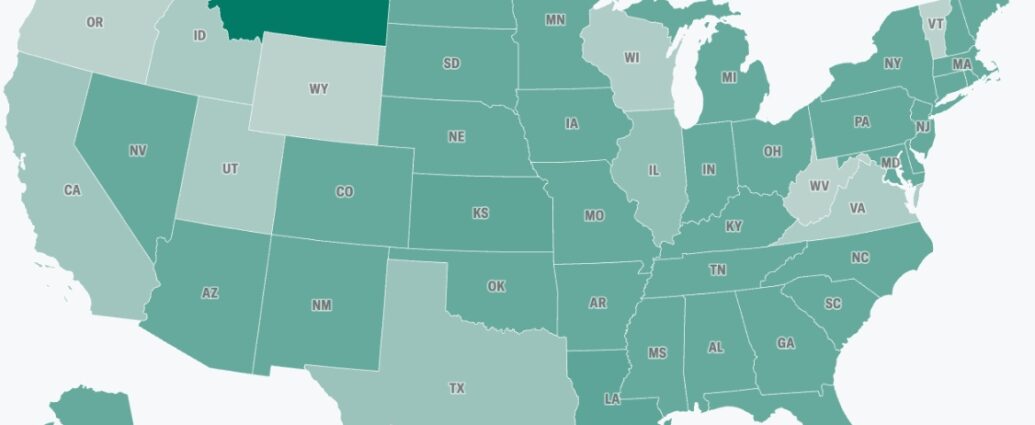
Hawaii tops the list of where the most savings would be necessary to retire “comfortably” at 60 years old without Social Security, while West Virginia, nicknamed the Mountain State, required the least, it said.
GOBankingRates found the nest egg that a person would need to accommodate a comfortable retirement at 60 years old sans Social Security in each state.
Alabama ($70,492 cost of living per year): $1,409,839
Alaska ($110,457 cost of living per year): $2,209,137
Arizona ($100,281 cost of living per year): $2,005,627
Arkansas ($67,502 cost of living per year): $1,350,045
California ($155,117 cost of living per year): $3,102,333
Colorado ($114,744 cost of living per year): $2,294,882
Connecticut ($105,428 cost of living per year): $2,108,563
Delaware ($94,392 cost of living per year): $1,887,834
Florida ($97,119 cost of living per year): $1,942,374
Georgia ($86,005 cost of living per year): $1,720,096
Hawaii ($186,062 cost of living per year): $3,721,237
Idaho ($101,912 cost of living per year): $2,038,236
Illinois ($79,736 cost of living per year): $1,594,716
Indiana ($74,029 cost of living per year): $1,480,575
Iowa ($71,373 cost of living per year): $1,427,463
Kansas ($71,534 cost of living per year): $1,430,672
Kentucky ($71,410 cost of living per year): $1,428,204
Louisiana ($67,482 cost of living per year): $1,349,639
Maine ($98,612 cost of living per year): $1,972,231
Maryland ($101,991 cost of living per year): $2,039,812
Massachusetts ($136,626 cost of living): $2,732,517
Michigan ($73,780 cost of living per year): $1,475,595
Minnesota ($88,321 cost of living per year): $1,766,414
Mississippi ($65,523 cost of living per year): $1,310,451
Missouri ($73,667 cost of living per year): $1,473,335
Montana ($102,916 cost of living per year): $2,058,322
Nebraska ($76,792 cost of living per year): $1,535,846
Nevada ($103,661 cost of living per year): $2,073,215
New Hampshire ($110,761 cost of living per year): $2,215,216
New Jersey ($118,338 cost of living per year): $2,366,765
New Mexico ($81,627 cost of living per year): $1,632,542
New York ($105,619 cost of living per year): $2,112,384
North Carolina ($86,857 cost of living per year): $1,737,146
North Dakota ($78,734 cost of living per year): $1,574,682
Ohio ($73,120 cost of living per year): $1,462,391
Oklahoma ($69,161 cost of living per year): $1,383,214
Oregon ($111,541 cost of living per year): $2,230,814
Pennsylvania ($78,582 cost of living per year): $1,571,642
Rhode Island ($109,811 cost of living per year): $2,196,222
South Carolina ($81,586 cost of living per year): $1,631,721
South Dakota ($81,949 cost of living per year): $1,638,979
Tennessee ($81,474 cost of living per year): $1,629,482
Texas ($81,985 cost of living per year): $1,639,693
Utah ($110,623 cost of living per year): $2,212,458
Vermont ($97,999 cost of living per year): $1,959,971
Virginia ($96,141 cost of living per year): $1,922,813
Washington ($126,952 cost of living per year): $2,539,048
West Virginia ($64,715 cost of living per year): $1,294,300
Wisconsin ($84,485 cost of living per year): $1,689,700
Wyoming ($88,792 cost of living per year): $1,775,841
In early June, a Gallup survey found 50% of non-retired U.S. adults that own a retirement savings account felt they “expect to have enough to live comfortably in retirement.”
STUDY SHOWS HOW LONG SOCIAL SECURITY, $1.5M NEST EGG WOULD LAST IN 50 STATES
Confidence was lower among those that lacked a retirement savings account, with only 31% reporting they anticipated having sufficient funds for comfortable golden years.
Eric Revell contributed to this report.
The answer is not hedge funds or quant shops or short-sellers
This post was originally published here
Politicians are reaching for increasingly extreme measures
This post was originally published here
Politicians have a yen for handouts
This post was originally published here
The Nothing Ever Happens Market
This post was originally published here

How people tackle their finances can vary but, according to new research from PYMNTS, there are two ways that are most common.
PYMNTS found just 40% of American consumers are “planners,” meaning their strategy for money had more foresight.
That figure has gone down compared to the roughly half who tackled their personal finances that way in February of last year, according to the outlet.
Meanwhile, for 60% of consumers, financial matters are dealt with as they come, earning them the moniker “reactors,” PYMNTS reported.
CLICK HERE TO READ MORE ON FOX BUSINESS
For the former, they tended to have at least $2,500 saved and keep their credit card balances below $2,000 on average, as well as make regular payments on their balances, according to the outlet.
The latter typically amassed higher balances and had lower amounts of savings, per PYMNTS. They also reported taking care of their credit card balances less frequently.
The drop in “planners” could mean consumers are feeling more pain in their wallets, according to PYMNTS.
The two groups typically had different priorities when it came to money, with retirement being front of mind for many so-called “planners” and knocking down debt being a focus for “reactors,” per the outlet.
A separate report released earlier this month by Fidelity Investments found the average 401(k) account balance in the first quarter was $127,100, while the balances for IRA and 403(b) accounts averaged $121,983 and $115,424, respectively.
RETIREMENT ACCOUNT BALANCES DIP IN 1ST QUARTER, BUT SAVERS KEEP CONTRIBUTING
Northwestern Mutual found in mid-April that Americans think they need $1.26 million saved to retire “comfortably.”
PYMNTS reported that nearly one-third of financially-reactive consumers reportedly identified reducing their debt as a top priority.
Americans collectively had $18.2 trillion in debt as of the first quarter of the year, according to the Federal Reserve Bank of New York.
For the other type of consumer, investments and savings accounted for 12% of what they financially allocated for themselves on a monthly basis, PYMNTS also reported.
DEBT CRISIS DEEPENS AS 1 IN 4 AMERICANS FORCED TO CHOOSE BETWEEN BILLS AND BASICS
Additionally, the survey shed light on how different generations stacked up in terms of how they tackled finances, according to the outlet.
For Generation Z, 73% of those within that age group were considered “reactors,” it said.
Members of the Baby Boomer generation, meanwhile, were more likely to be “planners,” with the survey pegging the share in that generation at 54%.
When it comes to income, more of those taking home big bucks have started seeing themselves as “reactors” as inflation and other factors weigh on them.
Approximately 52% of high-income consumers labeled themselves as “reactors” in the survey.
The proportion of earners characterized as “planners” posted a 25% drop between February of last year and January of this year, according to PYMNTS.
The real median income for American households was over $80,600 in 2023, according to the latest data from the U.S. Census Bureau.
The bottom has fallen out of the job market
This post was originally published here
Hong Kong is hot. The mainland very much is not
This post was originally published here
We investigate possible scenarios
This post was originally published here
Do not make the mistakes of the first Gilded Age
This post was originally published here
National security is a weak argument for battery subsidies
This post was originally published here
Another star prepares to move from London to New York
This post was originally published here
America is trapped by its industrial fantasies
This post was originally published here
With the costs of the trade war abundantly clear, officials seek to restore their truce
This post was originally published here
Solo spenders are a new economic force
This post was originally published here
Managing one’s finances can be challenging, especially when faced with conflicting — and often wrong — information fed to people, especially on social media.
Buying into common misconceptions surrounding money can be harmful, putting someone on their back foot when it comes to financial health.
Jonathan Kim, a personal finance expert and the head of finance at online savings platform Raisin, took aim at in an interview with FOX Business, including the idea that “it’s not worth saving unless you can put away a lot,” buy now, pay later being a good budgeting tool, and a high salary being synonymous with financial success.
He also pushed back against the suggestion that people do not need savings accounts and that saving money should not occur before someone is debt-free.
“Some of these thoughts about paying off debt before saving, and not having a full understanding of why you might need savings and why certain debt actually might not be terrible, I think, is a widespread thing,” Kim said.
STUDENT LOAN DELIQUINCIES SURGE, SENDING CREDIT SCORES PLUNGING FOR BORROWERS
The misconception that “it’s just not worth saving right now unless you can put away a lot” is a common one that he said he has seen on social media.
Kim said it’s “pretty easy to fall into this trap where you’re thinking, ‘If I can’t save X percent or X dollar amount, it’s just not worth the effort,’ and that’s a little too outcome-oriented for me.”
He said consistency with saving was important, noting that even “starting with something like $10 a week can help build that financial resilience and can build a habit that sticks with you as you progress.”
When it comes to high salaries and financial success, Kim said, there is “this myth and this propaganda” that a high salary equates to financial success when, in reality, financial health is more about managing money wisely.
Taking home a big paycheck is “obviously a wonderful thing, but I think it’s also very true that lifestyle creep is a very, very real thing, and if you don’t have the financial discipline and conscious saving and spending habits, it’s actually quite easy to just let lifestyle creep happen to you, and you find yourself struggling financially even after you’ve gotten that raise or that promotion or that new job,” Kim said.
Budgeting can be a helpful tool to prevent lifestyle creep, Kim said, while also pushing back on the idea that it has “to be perfect” to work.
“You can have just a general understanding of what’s going in and what’s going out to get you started,” he said. “And once you have that tracked, if you look at it over time, you can see ‘oh, I was only spending X amount, now I’m spending X times two. What happened there?’”
He also said that budgeting helps people “spend intentionally” and does not mean someone has to forgo “everything that brings you joy” to solely focus on necessities.
Kim touched on buy now, pay later services and whether it can be a good budgeting tool.
Buy now, pay later has become increasingly common in recent years as people look to split up and finance smaller purchases.
“If you are buying now and paying later because you don’t have the money now, that means you can’t afford it,” Kim told FOX Business. “So if you can’t afford it today, you can’t afford it and so by that context, buy now, pay later encourages overspending, and that can lead to you accumulating debt, which then earns interest, and then you find yourself going down that rabbit hole of bad financial habits.”
FINANCIAL EXPERT WARNS AGAINST THE HIDDEN TRAPS OF ‘BUY NOW, PAY LATER’ SERVICES
He said that was “kind of intertwined” with another misconception of people having to pay off all their debt before socking away money as savings.
“If you have high interest debt, like credit card debt, a variable mortgage, student loan debt, anything that could really hurt you or an interest rate can just go up, you certainly want to pay that off,” Kim said. “But at the same time, the other side is that you may be lucky enough to be a person where you got a mortgage five years ago and your mortgage rate is very, very low. In that sense, it wouldn’t make sense to pay that off immediately.”
Building savings while simultaneously making a dent in debt can be very beneficial.
Kim said it was important to have a financial plan and pay off debt but noted “things can happen in your life,” so setting up an emergency fund by saving can prevent the snowballing of debt and interest should something happen.
He also said having a savings account was better than just using a checking account.
When someone keeps all their money in a checking account, it can be “actually easier to spend and harder to track your goals,” according to Kim.
He noted balances in checking accounts can rise and fall with expenditures and income, making savings difficult to monitor. Many also offer very low or no interest on funds “so your money is actually not working for you,” according to Kim.
GET FOX BUSINESS ON THE GO BY CLICKING HERE
A dedicated savings account can establish a “physical boundary, in some senses, where you can see that that money is separate, and you can see it grow over time, which gives you a sense of accomplishment and keeps you going in some sense as it builds,” he said.
They can have high interest rates that will help the savings passively grow over time, he added.
Our estimate of their impact will update every month
This post was originally published here
The former IMF, Bank of Israel and Federal Reserve official died on May 31st
This post was originally published here
He will not like the remedy, however
This post was originally published here
Overseas investors at first—then Americans
This post was originally published here
Markets have no fundamental laws, which is why they are so interesting
This post was originally published here

Retirement account balances dipped in the first quarter due to stock market turbulence. Still, people kept socking away money for their retirement, according to new data from Fidelity Investments.
The financial services company analyzed more than 50 million retirement accounts, finding that the average balances of 401(k), IRA and 403(b) accounts all saw small declines during the first three months of 2025.
The average 401(k) account balance decreased 3% quarter over quarter to $127,100, according to Fidelity Investment’s Q1 2025 retirement analysis.
IRA accounts had average balances of $121,983 and 403(b) accounts held $115,424 on average in the first quarter, 4% and 2% lower than the prior quarter, respectively.
THIS MIDWESTERN STATE IS CONSIDERED ONE OF THE BEST PLACES TO RETIRE, NEW STUDY SAYS: SEE THE LIST
Fidelity largely attributed those declines to “market swings.”
The market was turbulent during the first quarter amid uncertainty surrounding tariffs and other policy issues, including popular index funds.
Still, retirement savings rates “stayed consistently high,” according to Fidelity.
For 401(k) accounts, employee contribution rates hit 9.5% during the first quarter, with the employer contribution rate coming in at 4.8%, according to its analysis.
Combined, the 14.3% savings rate for 401(k) accounts marked a “record” and the “closest it’s ever been to Fidelity’s suggested savings rate of 15%,” the company said.
RETIREMENT PLANNING: THE DIFFERENCES BETWEEN A TRADITIONAL AND ROTH IRA
Holders of 403(b) accounts, meanwhile, had a rate of 11.8% on average.
“Although the first quarter of 2025 posed challenges for retirement savers, it’s encouraging to see people take a continuous savings approach which focuses on their long-term retirement goals,” Sharon Brovelli, president of workplace investing at Fidelity, said in a statement. “This approach will help individuals weather any type of market turmoil and stay on track to reach their retirement goals.”
During the first quarter, which was plagued with market volatility, 17.4% of 401(k) holders upped the size of their contributions, while only 4.9% lowered theirs, the report found.
Meanwhile, contribution rates among 14.6% of 403(b) holders went up in the first quarter.
Only a small percentage of people with those types of retirement plans altered their asset allocation during the first quarter, with just 6% of 401(k) users doing so and 4.7% for 403(b), it found.
NEARLY HALF OF GENERATION X IS NOT CONFIDENT ABOUT RETIREMENT, SURVEY FINDS
Fidelity’s analysis also showed that people with IRAs upped the amount of money that they put in those retirement accounts in the first quarter by 4.5% compared to 2024’s first quarter.
A separate survey released Monday by Gallup found 59% of U.S. adults have funds put away in a retirement savings account.
Among those with retirement savings plans that have not yet left the workforce, half reported they “expect to have enough to live comfortably in retirement,” according to Gallup.
We find that the Emiratis are flouting the cartel’s rules on a grand scale
This post was originally published here

Using “buy now, pay later” (BNPL) has become increasingly common in recent years as people look to split up and finance purchases they make.
According to Credit Sesame financial analyst Richard Barrington, some key steps people should take as they utilize BNPL include budgeting beforehand, reviewing the terms of the plan, determining what fees could be associated and being prepared for automatic payments.
“If you need BNPL to be able to pay for something, you have to question how you’re going to come up with the money to make the BNPL payments when they come due,” he said, noting budgeting ahead of time can help someone figure out if they can foot the bill for what they’re buying and any debt they could build up because of it.
BUY NOW, PAY LATER PITFALLS: MANY CONSUMERS AREN’T PAY LOANS
He recommended reviewing what income will come in “over the term of the BNPL payments” and then subtracting “all the essential expenses you’ll have during that time” to help “see if you’ll have enough left over to cover BNPL payments.”
“If not, you risk missing one of those BNPL payments and incurring late fees,” he said.
Budgeting beforehand can “also help you avoid not being able to afford one of those essential expenses because you committed too much money” to BNPL, according to Barrington.
The Credit Sesame financial analyst urged people taking out BNPL loans to take a close look at the terms of the plan they’re signing up for.
“Know how much you have to pay and when,” Barrington said. “Also pay attention to what happens if you don’t make a payment on time.”
Knowing the timing and size of the BNPL payments can help avoid incurring a late fee, he said.
BNPL late fees averaged $7 for a loan taken out on a $135 purchase, according to the Federal Reserve Bank of Richmond.
Barrington advised “avoid signing a BNPL agreement you can’t take home and read first.”
“Many BNPL arrangements are made at the point of sale, like in a store. That means you’re trying to understand the terms while you’re in a hurry and with lots of distractions around,” he said. “Instead, take the agreement home with you to read, and then come back to the store to make the purchase. If it doesn’t seem worth that effort, perhaps you don’t really need to buy the item.”
BNPL can have “strict payment terms” that can lead to late fees, so it’s important to know what the costs associated with the plans could look like, according to Barrington.
“These fees may look like they’re fairly low dollar amounts, but since BNPL purchases are generally for relatively low-priced items, they can represent a large percentage of the purchase price,” he explained.
Some ways people can steer clear of late fees from BNPL include budgeting and knowing the terms of the installment plan they’re using.
On top of that, he said, creating calendar reminders or using automatic payment options can be helpful.
When it came to automatic BNPL payments, Barrington noted people should “pay close attention to the amount and schedule” because “otherwise you may find yourself hit with an overdraft fee if your bank account doesn’t have sufficient funds to cover the payments.”
COSTCO ROLLS OUT BUY NOW, PAY LATER FOR BIG ONLINE PURCHASES THROUGH AFFIRM
Some BNPL services make enrollment in automatic payments mandatory, he said.
However, people should not take out more than one out at a time, according to Barrington.
“People often turn to BNPL loans when they’re having trouble making ends meet,” he said. “That’s not going to get any easier if they take on multiple BNPL obligations that they’re going to have to come up with the money for in the months to come.”
He said to “avoid using BNPL for anything whose useful life lasts less time than it will take you to finish paying off the BNPL loan.”
BUY NOW, PAY LATER USAGE FOR GROCERIES NEARLY DOUBLES AS CONSUMERS STRUGGLE WITH FOOD COSTS
Another tip that Barrington had was to look into secured credit cards or “becoming an authorized user on someone else’s card” instead of BNPL.
“Secured credit cards or having someone sign you on as an authorized user of their card can be a way in for people who don’t have good enough credit to qualify for a card on their own,” he said.
Credit requirements can differ from card to card. Americans had FICO scores of 715 on average last year, according to Experian.
The regulatory pendulum swings violently
This post was originally published here
Global trade turmoil presents a rare opportunity
This post was originally published here
The country’s sprawling industrial policy is beyond mere human comprehension
This post was originally published here
American trade policy is in chaos
This post was originally published here
Analysing it is more important than ever. Mitigating it is a nightmare
This post was originally published here
And any jobs-pocalypse seems a long way off
This post was originally published here
Long-term debt is getting costlier, and not just in America
This post was originally published here

President Donald Trump’s “big, beautiful bill” cleared the House and is making its way through the Senate.
Still, critics point out the bill, which is over 1,000 pages, will add trillions to what is already ballooning government debt hovering at $36 trillion and deficits. However, U.S. Treasury Secretary Scott Bessent believes this can be managed.
“We think that we can both grow the economy and control the debt. What’s important, Bill, is that we grow the economy faster than the debt. What I would tell your viewers to focus on, what I am focused on, what Secretary Yellen was focused on is what is the total debt to GDP because we can grow our way out of this,” Bessent said during an appearance Friday on Fox’s “America’s Newsroom” with Bill Hemmer.
NATIONAL DEBT TRACKER: AMERICAN TAXPAYERS (YOU) ARE NOW ON THE HOOK FOR $36,214,475,432,210
Still, the bill contains several provisions that will benefit American workers and everyday households. FOX Business explains how your money may be affected.
Hardworking Americans won’t have to pay taxes on the tips they make. While this is good for service employees, it may mean lost revenue for the government…continue reading here
Typically, you start a 401(k) when you begin working, getting matched contributions from your employer. The bill may expand similar investment vehicles to newborns and other child tax credits…continue reading here.
High-tax blue states, such as New York, likely secured a win with a big bump for SALT, a deduction for state and local taxes, previously capped at $10,000…continue reading here
GET FOX BUSINESS ON THE GO BY CLICKING HERE
If you own or buy a car made in the U.S. using an auto loan, the interest is on track to be eligible for a deduction…continue reading here.
Trump made it clear the Medicaid program, which provides basically free health insurance to Americans who meet income requirements, won’t be gutted. Not everyone is convinced…continue reading here
Changes to food stamps and nutrition assistance, formerly known as SNAP, or the Supplemental Nutrition Assistance Program, are part of the tax bill. Here’s what may change…continue reading here
America’s tech giants are a point of vulnerability
This post was originally published here
David Webb was an exemplary shareholder
This post was originally published here
Aidan Toner-Rodgers was enjoying a meteoric rise at MIT. Then questions started to be asked about his work
This post was originally published here
The president prompted a similar divide last time round
This post was originally published here
We interview JPMorgan Chase’s boss, and his lieutenants
This post was originally published here
And it is now under threat
This post was originally published here
He should expect billions, not trillions
This post was originally published here
Forget technocracy. The top rate is set by gut instinct
This post was originally published here
Retail investing suffers from partisanship
This post was originally published here
Progress in trade talks has so far been slow
This post was originally published here

Americans have trillions of dollars of wealth locked up in their homes, and passing it on at death can get messy quickly.
The typical way of outlining who should get the house in a will can cause delays after death—so much so that most states have set up a new way for homeowners to document their wishes. It is called a transfer on death deed, and it has taken off in the past 15 years. New York and New Hampshire added the option last year.
These are blunt instruments, however, and they don’t account for all the complications of life. People make mistakes filling out the forms. Heirs get cut out inadvertently. The overall estate plan can conflict with the deed.
AMERICA’S HOUSING CRISIS: REALTOR.COM CEO SAYS THERE IS WAY TO SOLVE IT
And then it can go really wrong.
A Minnesota man named his niece as the beneficiary on one of these forms, but his ex-wife torched the home a few days after he died. That left his niece with just the land, and she lost a fight to get the insurance proceeds for the house. Courts ruled that he was the one insured but the form made the niece the sole owner, and the insurance didn’t cover her.
More people are having to decide whether to sell a home that has soared in value and pay a big capital-gains tax bill, or hold on to it to give to their children tax-free after they die.
Baby boomer homeowners hold $17 trillion in home equity. Three-quarters of them are planning to leave their current home or the proceeds from its sale to their children or other relatives, according to Freddie Mac.
“There are so many pitfalls that you can step in,” said Frank Pugh, a lawyer in Leesburg, Va.
Traditionally, people with wealth write a will to outline what they want to happen with their property when they die. After death, a court then supervises the transfer of assets, a process known as probate that can be time-consuming and expensive.
To avoid probate, some people will set up a trust, and put their home and other assets in it, with detailed instructions for the trustee. But trusts, whereby the trustee distributes assets at death without court involvement, require attention to make sure assets are titled properly.
IS THE US HOUSING MARKET BECOMING A BUYER-FRIENDLY MARKET?
Transfer on death deeds were created as a no-fuss option to avoid probate. It is akin to listing a beneficiary on a 401(k) or on a payable-on-death form for a brokerage account. When the homeowner dies, the beneficiary named on the deed gets the house right away.
“It’s the difference between off-the-rack and custom tailoring,” said Thomas Gallanis, a professor at George Mason University’s law school who was the principal drafter for a model law on TOD deeds in 2009.
Rules vary by state, but in most cases the deed needs to be notarized and recorded at the local courthouse where the property is located.
Homeowners can revoke a transfer on death deed at any time—which is unlike adding someone to a deed as a joint owner.
Lawyers use these deeds often, typically in conjunction with a trust, said Jen Gumbel, an estate planner in Rochester, Minn. She has seen deeds being invalidated because do-it-yourself owners fill them out themselves, failing either to describe the property accurately or to get a spouse to sign off. “These are really technical documents,” she said.
States are still making tweaks to the deed laws. Minnesota updated its law last year in response to the case in which the owner’s ex-wife torched the house. Beneficiaries are now covered by insurance for up to 30 days, as long as the owner gave a copy of the deed and beneficiary information to the insurer before dying.
Things can get more complicated when there is outstanding debt on the property. Skyler Woodard, a 32-year-old welder, has been in a fight for the roughly 200-acre family farm in Nodine, Minn., since 2018, when his father died of cancer.
GET FOX BUSINESS ON THE GO BY CLICKING HERE
His parents bought the farm on a rent-to-own contract from his maternal grandparents in 1994. His father got it in a divorce settlement in 1999, and continued making the payments to the grandparents. His father named Woodard as beneficiary of the farm on a transfer on death deed, but the grandparents asserted it violated an anti-transfer provision in the contract and canceled the contract. The Minnesota Court of Appeals agreed with the grandparents, allowing them to take back the farm. The state Supreme Court declined to review the case.
“He was trying to give me the farm,” Woodard said. He is pursuing an unjust enrichment case against his grandmother now, because his father had made payments on the farm for 23 years. The lawyer for the grandmother had no comment.
A transfer on death deed might successfully pass along the house but still complicate how expenses, debts and taxes are paid, said Stacy Singer, national practice leader for trust and wealth advisory services at Northern Trust. Those are all things that can be spelled out in a will or trust but not in a deed.
CLICK HERE TO READ MORE ON FOXBUSINESS.COM
In one case that Singer handled, an 80-year-old man left his girlfriend his $700,000 house via a transfer on death deed. She got a surprise $25,000 tax bill to pay her share of the Illinois estate tax.
She probably could have avoided that tax bill if her boyfriend had just left her the house as a specific bequest in his will.

The Federal Reserve is keeping rates steady at its targeted range of 4% to 4.25% and is waiting to see how President Donald Trump’s administration’s tariffs will impact the economy.
For now, Federal Reserve Chair Jerome Powell said that the central bank is in the right place to monitor the impact tariffs will have on the economy before making a decision on further interest rate cuts. For now, the mandate remains the same: get inflation to a 2% target rate. The decision comes even with a negative first-quarter GDP reading. US GDP decreased at an annual rate of 0.3%. This was the first quarter of negative GDP growth since the first quarter of 2022.
“While gross domestic product recorded a mild decline in the first quarter, prompting concerns about a recession, broader economic data underscore ongoing resilience,” the National Apartment Association’s new Vice President of Research, George Ratiu, said in a statement. “The main risk to economic activity is continuing financial pressure on households coming from higher monthly bills, combined with the looming threat of rising layoffs.”
The Fed had anticipated two interest rate cuts for this year, but the impact of how President Trump’s tariffs will play out has derailed this plan. Powell said that the Fed is in a good place to think out policy rates to respond promptly and to potential developments, including rate cuts or holding them steady.
“Despite heightened uncertainty, the economy is still in a solid position,” Powell said at a press conference on Wednesday. “The unemployment rate remains low, and the labor market is at or near maximum employment. Inflation has come down a great deal but has been running somewhat above our 2% longer-run objective.”
If you are struggling with high inflation, consider taking out a personal loan to pay down debt at a lower interest rate, reducing your monthly payments. Visit Credible to find your personalized interest rate without affecting your credit score.
BIDEN CANCELS MORE STUDENT LOANS WITH ONE WEEK LEFT TO HIS TERM
With no rate cut in sight, housing affordability will remain a central challenge for most Americans, whether they are looking to buy or rent, according to Raitu.
Mortgage rates are likely to remain in the high 6% range they’ve held for the last six months without action from the Fed. Home prices are roughly 50% higher than they were in 2019. That means that with current mortgage rates, buyers are facing a $2,200 monthly payment on a median-priced home.
”The best-case scenario for mortgage rates is to hover just above the 6% mark for the next two years,” said Victor Kuznetsov, Imperial Fund Asset Management co-founder and managing director. “The average American household has adopted a wait-and-see strategy regarding mortgage rates, as they also seek to reduce their monthly consumer spending amid current economic uncertainty.
“The good news is that employment and home prices remain strong, so families will be in a better position to buy or refinance a home in the coming months, especially if rates dip below 6%,” Kuznetsov continued.
Mortgage rates are expected to remain flat through the summer housing market. The Mortgage Bankers Association forecasts that the Fed will resume cutting short-term rates in the year’s second half. “Heading into the Fall, if inflation cools as expected, mortgage rates will begin to dip slowly and steadily, finishing out 2025 around 6%,” Voxtur CEO Ryan Marshall said.
If you want to become a homeowner, you can find the best mortgage rates by shopping around. Visit Credible to compare your options without affecting your credit score.
FHFA ANNOUNCES HIGHER MORTGAGE LOAN LIMITS FOR 2025
Some buyers aren’t waiting for interest rates to drop, and lending has picked up recently as consumers readjust their outlook and expectations, according to Michele Raneri, TransUnion vice president and head of U.S. research and consulting.
“While the possibility still exists for potential rate cuts later this year, the economic picture is complicated, and it’s too early to know if or when those cuts might happen,” Raneri said. “We’re starting to see some positive signs in lending – mortgages, home equity loans and auto financing are showing signs of life after a slow couple of years.
“However, these gains will likely remain incremental until rates begin ticking down, as many borrowers are reluctant to take on a loan at today’s rates, particularly if they currently have a loan at a significantly lower rate,” Raneri continued.
If you’re worried about the state of the economy, you could consider paying down high-interest debt with a personal loan at a lower interest rate. Visit Credible to speak with a personal loan expert and get your questions answered.
SENIORS TO GET MODERATE COST OF LIVING BUMP IN SOCIAL SECURITY PAYMENTS NEXT YEAR
Have a finance-related question, but don’t know who to ask? Email The Credible Money Expert at moneyexpert@credible.com and your question might be answered by Credible in our Money Expert column.

Consumer prices fell 0.1% in March, according to the Consumer Price Index (CPI) released by the Bureau of Labor Statistics (BLS). This is the first monthly drop since July 2022.
Annual inflation increased 2.4% compared to a 2.8% increase registered in February. Core inflation, which excludes volatile energy and food prices, grew at a pace of 2.8% over the last year, the smallest 12-month increase since March 2021. A decline of 6.3% in gas prices more than offset increases in the indexes for electricity and natural gas. Food, however, rose 0.4% in March. The meats, poultry, fish and eggs index rose 7.9% over the last 12 months and the price of eggs alone jumped 60.4%.
Inflation continues to move towards the Federal Reserve’s 2% target rate. Still, the impact of President Donald Trump’s implementation of new tariff measures could derail this progress and hinder economic growth, according to Jim Baird, Plante Moran Financial Advisors’ chief investment officer.
“As consumers brace for the impact of tariffs on prices on a host of staples and discretionary goods, there’s considerable uncertainty on what that near-term magnitude of the impact will be for growth and inflation, although the direction for each is clearer,” Baird said. “That’s sent economists scrambling to update their forecasts to lower growth and increase expected inflation for the duration of the year.”
Despite concerns about the effects of President Trump’s tariffs, the Fed continues to hold interest rates steady, and it’s not expected to make any significant changes soon, including a potential rate cut. While tariffs could lead to higher inflation and slower economic growth, the Fed is waiting for more clarity on the full impact of these policies before deciding on any course of action.
If you are struggling with high inflation, consider taking out a personal loan to pay down debt at a lower interest rate, reducing your monthly payments. Visit Credible to find your personalized interest rate without affecting your credit score.
MORTGAGE RATES HIT A TWO-MONTH LOW THIS WEEK, REMAIN UNDER 7%
President Trump’s tariffs are also contributing to an increased risk of recession. Several major financial institutions, including Goldman Sachs and J.P. Morgan, have raised their recession probabilities. According to Baird, part of the problem is that as prices rise due to tariffs, consumers may decide to curb their spending.
“Sentiment has soured in recent months, and there are already signs of not only a more cautious mood but more constrained spending,” Baird said. “Prices may rise, but that doesn’t mean that consumers will pay any price for any product. Some may grumble but continue to spend, but many are much more likely to trade down to cheaper alternatives or delay discretionary purchases.
“That reality raises the probability of a more notable slowdown in the pace of the economy, with the risk of recession also rising,” Baird continued.
You can take out a personal loan before future rate hikes to help pay down high-interest debt. Visit Credible to find your personal loan rate without affecting your credit score.
CALIFORNIA’S HOMEOWNERS INSURANCE INDUSTRY FACES ROUGH ROAD AHEAD AS WILDFIRES CONTINUE
March shelter inflation data showed it dropped to 4.0% from 4.2% in February. That’s good news since shelter inflation has been a major force in keeping inflation elevated in recent years and could help move the needle on interest rates.
Mortgage rates continue to trend down, remaining under 7% for the twelfth consecutive week and could boost spring sales, according to Freddie Mac Chief Economist Sam Khater.
“As purchase applications continue to climb, the spring homebuying season is shaping up to look more favorable than last year,” Khater said.
The average 30-year fixed-rate mortgage was 6.62% for the week ending April 10, according to Freddie Mac’s latest Primary Mortgage Market Survey. That’s a decrease from the previous week, when it averaged 6.64% and lower than the 6.88% it was a year ago.
“Unfortunately, inflation remains painfully stubborn, well above the Fed’s 2% target for lowering rates,” said Gabe Abshire, Move Concierge CEO. “Considering the housing sector has lower exposure to the current global trade environment, it would be helpful for the Fed to lower rates and boost the Spring and Summer home buying market.”
If you want to become a homeowner, you can find your best mortgage rates by shopping around. Visit Credible to compare your options without affecting your credit score.
FHFA ANNOUNCES HIGHER MORTGAGE LOAN LIMITS FOR 2025
Have a finance-related question, but don’t know who to ask? Email The Credible Money Expert at moneyexpert@credible.com and your question might be answered by Credible in our Money Expert column.

Small, everyday purchases like a meal from DoorDash are now able to be financed through eat now, pay later options — a practice that some experts deem “predatory.”
“You’ve got to have enough sense to not follow the urge to finance a taco, okay? You have got to be an adult,” career coach Ken Coleman told “The Big Money Show” on Wednesday.
“This is predatory, and it’s going to get a lot of people in deep trouble.”
RISKS OF BUY NOW, PAY LATER: ‘TICKET TO OVERSPENDING,’ EXPERT SAYS
Financial wellness experts are continuously sounding the alarm to cash-strapped consumers, warning them of the devastating impact this financial strategy could have on their credit score as some lenders will begin reporting those loans to credit agencies.
Consumers may risk getting hit with late fees and interest rates, similar to credit cards.
“So your sandwich might show up on your FICO score, especially if you pay for it late,” FOX Business’ Jackie DeAngelis explained.
EXPERTS WARN HIDDEN RISKS OF BUY NOW, PAY LATER
Major players like Affirm, Afterpay and Klarna have risen to prominence at a time when Americans continue to grapple with persisting inflation, high interest rates and student loan payments, which resumed in October 2023 after a pause due to the COVID-19 pandemic.
“The Big Money Show” co-host Taylor Riggs offered a different perspective, suggesting that company CEOs have a “duty” to attract as many customers as they want.
“Unfortunately for me, this always comes down to financial literacy — which I know is so much in your heart about training people to save now by later,” she told Coleman, who regularly offers financial advice to callers on “The Ramsey Show.”
GET FOX BUSINESS ON THE GO BY CLICKING HERE
Coleman continued to come to the defense of financially “desperate” consumers, arguing that companies are targeting “immature” customers.
“I’m for American businesses being able to do whatever they want to do under the law. That’s fine. But let’s still call it what it is: it’s predatory, and they know who their customers are,” Coleman concluded. “And I’m telling you, they’re talking about weak-minded, immature, desperate people.”
FOX Business’ Daniella Genovese contributed to this report.


Socking away money for retirement is something that’s top of mind for many people.
Many Americans save money for their “Golden Years” through workplace retirement plans and individual accounts they set up, with traditional and Roth IRAs being frequently-used vehicles in the latter category.
Holders of Roth IRAs are able to make after-tax contributions to their accounts.
“Why a lot of people like a Roth IRA today is that you pay income taxes today before you put the money into the Roth IRA,” Ted Jenkin, a personal finance expert and partner at Exit Wealth, told FOX Business. “The money grows tax-deferred while it’s inside of the Roth IRA, but the great news about a Roth IRA is you never, ever pay any tax when you take it out, so it’s basically taxed once today and then you’re never ever taxed again.”
For 2025, the contribution limit for Roth IRAs is $7,000 for ages below 50 and $8,000 for those older than that, according to the IRS.
STUDY SHOWS HOW LONG SOCIAL SECURITY, $1.5M NEST EGG WOULD LAST IN 50 STATES
When a person takes out contributions from a Roth IRA, they will not have taxes or a penalty. A holder could face both if they do that for Roth IRA earnings before five years have elapsed since they’ve opened the account or they’re below the age of 59 ½, according to Fidelity.
Funds put into traditional IRAs are typically “not taxed until you take a distribution,” according to the IRS.
“Just like a Roth IRA, the dollars grow tax-deferred. However, on all that growth in the traditional IRA, ultimately you’re going to be taxed when you take it out down the road,” Jenkin said.
He noted that “can be challenging because you don’t always know what your tax brackets are going to be down the road.”
People under 50 years old can make up to $7,000 in contributions to traditional IRAs in 2025. For those above 50, it is slightly higher, at $8,000.
In contrast to Roth IRAs, contributions to traditional IRAs can be tax-deductible but, according to Jenkin, that “depends on a number of factors.”
THIS MIDWESTERN STATE IS CONSIDERED ONE OF THE BEST PLACES TO RETIRE, NEW STUDY SAYS: SEE THE LIST
He said the “big question” for deductibility was “Are you covered by a workplace retirement plan?”
“If you don’t, or your spouse does not, then you can fully deduct the traditional IRA,” he told FOX Business. “But if you have one at work, then there’s a phase out income-wise on how much income you have as to whether or not it’s deductible.”
When it comes to withdrawals for traditional IRAs, you can do so at any time but that distribution “will be includible in your taxable income and it may be subject to a 10% additional tax if you’re under age 59 ½,” according to the IRS.
For traditional IRAs, holders face a required minimum distribution they must pull out each year once they turn 73.
The differences between traditional and Roth IRAs give people planning for retirement plenty to think about as they mull which account they want to use.
Jenkin said one factor was “Do I want to be taxed now, or do I want to be taxed later?”
“When you’re younger, you’re generally in a lower tax bracket, which is why, for younger people, it’s a really great idea in my view to be putting money into a Roth IRA, because once it goes in there, you’re never taxed again.”
He also noted the Secure 2.0 Act that became law in late 2022.
“When you have a traditional IRA and you die and it goes to your kids or any other non-spouse inheritor, you have to take the money out of a traditional IRA within 10 years,” he said. “In a Roth IRA, when you die and your kids inherit the Roth IRA, they can take it out as long as they want. They’re not subject to that 10 years.”
When weighing opening a traditional or Roth IRA, Jenkin also said people should consider whether they can “leave the money in there for an extended period of time.” He said they should factor in their current tax brackets and their “overall future estate plan” for their family as well.
He told FOX Business his “lean on this would be that more and more people should be looking at opening up a Roth IRA versus a traditional IRA.”
The Investment Company Institute said in a study released Thursday that nearly 44% of American households had IRAs in mid-2024, whether that be traditional, Roth, employer-sponsored or a combination.
Traditional IRAs were owned by 32.6% of households, it found. Over 26% of households had Roth IRAs.
401(K) BALANCES HIT SECOND HIGHEST ON RECORD: FIDELITY
A separate report released by Fidelity Investments in February reported IRA accounts held average balances of $127,543 in the fourth quarter of 2024. That was an increase of 8% from the same three-month period in the prior year, according to the report.

As Generation X continues getting closer to retirement, some have less than rosy views about their retirement prospects, according to a recently released nonprobability-based study from Fidelity Investments.
Fidelity Investments found in the latest edition of its annual “State of Retirement Planning” study that 45% of Gen Xers — those between the ages of 44 and 59 — reported feeling they were “not confident” in their ability to retire “when and how they want.”
Meanwhile, 53% felt confident they could do so.
“Gen X is most likely to be what we call the sandwich generation right now,” Fidelity Investments Vice President of Retirement Offerings Rita Assaf told FOX Business. “They are caring for both children and aging parents, as well as preparing for retirement. That’s pretty costly.”
“They’re also at a time where higher cost of living, so if they’re helping with children, they most likely have kids in college or maybe they just finished college, and those costs have been much higher,” she continued. “Their day-to-day expenses are much higher. And we also know with aging parents, the healthcare and long-term care costs associated with that as well.”
Assaf said Gen X being poised to be the first “401(K) generation” has also driven those figures.
“Current retirees are primarily using still pensions as their primary way to fund their retirement savings, but Gen X, I think our study found 61% will be leveraging 401(K)s and IRAs and individual savings vehicles for retirement, so that’s a big difference as well,” she noted.
401(K) BALANCES HIT SECOND HIGHEST ON RECORD: FIDELITY
Compared to last year’s study, Gen X confidence in retiring “when and how they want” dropped 16 percentage points, something that Assaf linked to higher cost of living and members of the generation moving nearer to retirement age.
She said the survey “really highlighted the fact that with higher cost of living, there’s a bit of general concern that ‘will my retirement savings last’?”
Gen X “notably hold the most negative retirement outlook” among the four generations included in the study, according to Fidelity Investments.
The study found Gen Z and millennials felt the most confident about retiring “on their own terms,” at 75% and 71%, respectively. Meanwhile, 68% of baby boomers reported they were confident.
For Gen X, juggling children, aging parents and higher costs of living have played into that. Assaf also said that “anxiety tends to raise as you get close” to retirement.
Younger generations like Gen Z and millennials “still have a long time-horizon so they’re actually feeling more confident” and “have more time on their hands to save more and invest and reap the benefits of compound earnings,” according to Assaf.
Overall, 67% of those in their retirement planning years felt positively when it came to retiring “when and how they want,” Fidelity Investments said.
THIS MIDWESTERN STATE IS CONSIDERED ONE OF THE BEST PLACES TO RETIRE, NEW STUDY SAYS: SEE THE LIST
The study was based on a survey that involved over 2,000 “adult financial decision makers” with a minimum of one investment account.
Socking away sufficient money, inflation and high costs of living, striking the balance of covering expenses now versus saving for retirement and figuring out the amount of funds needed for retirement were among the issues respondents identified as those posing the most challenge, according to the study.
Meanwhile, among current retirees, the Golden Years were “going as planned” for 72%, the study reported. A similar share — 70% — also felt their retirement planning set them up sufficiently.
STUDY SHOWS HOW LONG SOCIAL SECURITY, $1.5M NEST EGG WOULD LAST IN 50 STATES
When it came to retirement income, 77% of retirees pointed to Social Security as their top source, according to the study. Behind that were pensions, at 48%, and personal savings, at 41%.
“Planning does not stop at retirement,” Assaf told FOX Business. “You have to keep evolving your planning, even when you’re in retirement.”
The savings of seven in 10 retirees have taken a hit from the rising cost of living, the survey said.
The Transamerica Center for Retirement Studies found in an August 2024 report that the median age of retirement for middle-class retirees was 62.
Americans think $1.46 million is the amount of money necessary to experience a comfortable retirement, according to a study released by Northwestern Mutual last year.

More savers are embracing the tax-advantaged accounts, and many will contribute leading up to tax day.
Young savers are flocking to Roth IRAs.
They are taking the advice of parents, workplace financial coaches and tax advisers, who have long preached the gospel of these accounts to save for retirement and even big purchases.
By getting the money in early, the thinking goes, they are giving it time to grow tax-free. In the run-up to tax day, more savers are making last-minute contributions to max out their individual retirement accounts.
Savers such as Maria Kyriakopoulos are opening Roth IRAs in addition to saving in their workplace retirement plans. After the 23-year-old got her first full-time job as an analyst at J.P. Morgan Private Bank last July, she immediately started saving in her 401(k).
She also opened a Roth IRA. She just finished contributing to hit the $7,000 maximum allowed for 2024 and contributed $700 to get a start on saving for 2025.
“You have to save a little money on the side,” Kyriakopoulos said. She contributes anywhere from $250 to $800 a month, depending on how much she has left after paying rent, her student loan bills and other expenses.
Of those who contribute to an IRA or Roth IRA, 41% were under 40 in 2022, up from 28% in 2016, according to the latest data from the Center for Retirement Research at Boston College. And most young contributors choose the Roth option, according to the Investment Company Institute.
Many of those opening accounts are customers of financial technology firms, including those that promise money akin to 401(k) matches. Robinhood, for example, offers to match up to 3% of users’ IRA contributions.
It is “the young, hip and cool with their cellphones,” said Alicia Munnell, a senior advisor at the Center for Retirement Research.
Kelli Send, the co-founder of Francis, which provides financial planning advice to employees at their workplaces, says to first contribute to a workplace plan to take advantage of any employer match, and then open a Roth IRA.
“It’s an escape valve, if you need it,” she said. Taxpayers can always access amounts up to their Roth IRA contributions with no tax hit or early-distribution penalties. Earnings generally can’t come out tax- and penalty-free until age 59½.
HOW A DOGE DIVIDEND WOULD WORK
You can make IRA contributions for a given year any time between Jan. 1 and tax day of the following year. So taxpayers can still contribute for the 2024 tax year through April 15.
Boris Wong, a 36-year-old researcher at Vanguard, says he makes the full contribution to his Roth IRA in January. “Why do I have this ritual? If you invest on Jan. 1, you have 15 months extra of compounding,” he said.
Taxpayers must have at least as much earned income as the amount of their IRA contributions, although there is an exception for spouses. With Roth IRAs, the ability to contribute directly depends on savers’ modified adjusted gross income. Those above the income limits can put money into a traditional IRA and move it into a Roth, though there are some pitfalls.
Contributions are in after-tax dollars, but withdrawals can be tax-free. As a result, Roth accounts can be a good choice for savers who expect their tax rate to be higher — or the same — at withdrawal versus at contribution.
RETIREMENT CONTRIBUTION LIMITS FOR 2025
With traditional IRAs, the opposite is the case: Contributions are often tax-deductible, and funds typically grow tax-deferred. So those accounts can make sense for savers who want to lower their taxable income now, and expect their tax bracket to be lower when they withdraw the money.
“I wish I had put more money into Roths. Early diversification is a good idea,” said Munnell. Still working in her early 80s, she has found that she has to take more withdrawals from her traditional IRA than she needs and pay taxes.
Traditional IRAs require annual payouts once you reach 73. Withdrawals are taxed as ordinary income. By contrast, you don’t have to take any distributions from a Roth during your lifetime.
At work, Kyriakopoulos noticed a trend among young rich clients. Many of them inherited money and even though they earn, say, $50,000 at an entry-level white-collar job, they have substantial taxable portfolios. So they move money religiously to Roth IRAs.
John Longoria II rolled leftover funds from a 529 college savings plan into his Roth IRA.
John Longoria II, 24, who is making just over $40,000 as a digital marketing intern in Chicago, is drawing partly from a taxable account his parents helped him set up as a child to fund his Roth IRA. He’s also rolling over leftover funds from a 529 college savings plan into the Roth IRA, and adding some money from his paycheck.
“I try to save money any which way I can,” Longoria said, noting that he has four roommates.
One drawback of Roth IRAs is that, unlike 401(k)s where many employers automatically enroll employees in the plan and deduct contributions from their paychecks, IRA savers have to set up the accounts, make contributions and be diligent about sticking with it. Most IRA custodians let customers set up direct deposits into their IRAs.
Still, you have to pick your investments and stay on top of changing contribution limits.
Mel Meagher, a 37-year-old human resources manager in Brownsville, Wis., opened a Roth IRA at Vanguard in 2023, when the contribution limit was $6,500. She didn’t increase her contributions when the limit went to $7,000 for 2024.
Now, she is having to make up the $500 difference for 2024, on top of starting her 2025 contributions. She also puts 5% of her pay into her 401(k), which has a 5% employer match.
GET FOX BUSINESS ON THE GO BY CLICKING HERE
Why a Roth?
“I don’t want to pull it out early, but I like that there is that flexibility if something happens down the road,” she said.
Write to Ashlea Ebeling at ashlea.ebeling@wsj.com
Copyright ©2022 Dow Jones & Company, Inc. All Rights Reserved.
Appeared in the March 24, 2025, print edition as ‘Roth IRAs Are In Vogue With the Young Crowd.’
Document WP-WSJ-0002501267
© 2025 Dow Jones & Company. All rights reserved. Terms of Use Privacy Notice Cookie Notice Accessibility Reprints Follow Us on LinkedIn Feedback



The Federal Reserve just met to discuss the possibility of interest rate cuts. This time around, the Fed decided to extend the rate pause, leaving rates in the 4.25% to 4.5% range. The decision came due to stable economic activity that’s expected to grow in the first quarter. Economists largely expected this outcome.
“The Fed is going to keep rates where they are today,” predicted Melissa Cohn, regional vice president of William Raveis Mortgage. “[Federal Reserve Chair Jerome Powell] has repeatedly said that the Fed is in no hurry to cut rates. The Trump administration’s tariffs could reignite inflation, making future rate cuts unlikely, too.”
Although the Fed noted that inflation remains elevated, the unemployment rate has stabilized, and labor markets are still solid. To inch the economy closer to 2% inflation levels, the Fed ultimately decided to leave rates where they were.
“While the economic activity in the first quarter economy is still on track to report growth, American households are increasingly concerned with potential re-inflation, their job security and financial outlook, which is holding them back from making major expenditures,” Dr. Selma Hepp, CoreLogic chief economist, said in a statement. “At the same time, many are still catching up with inflation in housing and related services of the last few years.”
Despite a slowly growing economy, consumers aren’t entirely confident in the economic situation. A variety of social and political actions are still impacting American households. Newly implemented tariffs are one of the factors contributing to this uncertainty.
“The Federal Reserve’s war in fighting stubborn inflation continues to impact the day-to-day lives of American households,” explained Anya Gezunterman, director at Imperial Fund Asset Management, in a statement. “On top of this, the Fed now has to look closely at any tariff-related price increases, which would also keep interest rates higher for longer.”
“That said, as the economy seems to continue its so-called ‘soft landing,’ we expect mortgage rates to drift lower through the summer gradually, but not by more than a percentage point,” said Gezunterman.
If you are struggling with high inflation, consider taking out a personal loan to pay down debt at a lower interest rate, reducing your monthly payments. Visit Credible to find your personalized interest rate without affecting your credit score.
INFLATION EASES IN FEBRUARY, BUT TRUMP TARIFFS COULD DERAIL PROGRESS
Rates remained unchanged after the Fed meeting, but they signaled that two rate cuts would happen this year. Economists largely agree that consumers will see cuts shortly. Analysts from Barclays expect two quarter-point rate cuts, likely in June and September. They previously believed there would be just one cut in June.
“The softer labor market causes us to add another rate cut, despite higher inflation,” Barclays analysts said.
Barclay predicts a slowing labor market will raise the unemployment rate later in the year, with unemployment peaking at 4.3% in October.
The first rate cut in June is expected to “reflect [this] slower growth and rising unemployment.” The second rate cut in September is expected to indicate “a rising unemployment rate and some signs of improvement in monthly inflation prints.”
You can take out a personal loan before future rate hikes to help pay down high-interest debt. Credible can help you find your personal loan rate without affecting your credit score.
MORTGAGE RATES HIT A TWO-MONTH LOW THIS WEEK, REMAIN UNDER 7%
Many consumers don’t see the economy as stable, as made apparent by the Consumer Confidence Survey. Consumer Confidence measures the way Americans feel about business and economic conditions.
The Present Situation Index fell by 3.4 points to 136.5 in February, while the Expectations Index also dropped 9.3 points to 72.9. Below 80 on the Index typically signals a recession on the horizon. It’s the first time the Index has been this low since June 2024.
“In February, consumer confidence registered the largest monthly decline since August 2021,” said Stephanie Guichard, senior economist, Global Indicators at The Conference Board. “This is the third consecutive month-on-month decline, bringing the Index to the bottom of the range that has prevailed since 2022…Views of current labor market conditions weakened. Consumers became pessimistic about future business conditions and less optimistic about future income. Pessimism about future employment prospects worsened and reached a ten-month-high.”
More people did plan to purchase homes, showing one area of improvement. The very recent decline in mortgage rates is likely why homebuyers are more willing to buy. Car buying plans declined, however, as did plans to make bigger purchases, like TVs and other electronics.
“Average 12-month inflation expectations surged from 5.2% to 6% in February. This increase likely reflected a mix of factors, including sticky inflation, but also the recent jump in prices of key household staples like eggs and the expected impact of tariffs,” Guichard said. “There was a sharp increase in the mentions of trade and tariffs, back to a level unseen since 2019.”
Need help dealing with high debt? You can also plug in some simple information into Credible’s free online tool to determine if a debt consolidation loan is your best option.
SENIORS TO GET MODERATE COST OF LIVING BUMP IN SOCIAL SECURITY PAYMENTS NEXT YEAR
Have a finance-related question, but don’t know who to ask? Email The Credible Money Expert at moneyexpert@credible.com and your question might be answered by Credible in our Money Expert column.

It isn’t always easy to save for retirement, in part because for many people it is so far away that there’s no sense of urgency.
New research suggests a solution: Make the future feel closer.
“People struggle to save for the future, and part of the reason why is people struggle to connect with the future,” says Katherine Christensen, an assistant marketing professor at Indiana University and the study’s lead author. “We wondered, based on past research, if people felt more connected to their future selves, would they be more likely to save?”
After conducting and analyzing a series of 20 experiments to test this hypothesis, Christensen says the answer is yes.
The research found that when we think about the future, more than 80% of the time, we actually start off by thinking about the present.
“What we did is essentially flip that,” Christensen says. Start the thought process by imagining that future before you turn your thoughts back to the present and the savings goals you need to meet to make it happen.
THIS MIDWESTERN STATE IS CONSIDERED ONE OF THE BEST PLACES TO RETIRE, NEW STUDY SAYS: SEE THE LIST
While the difference is subtle, it has been shown to motivate people to save more. In one experiment carried out by the research team with more than 6,700 customers of a Swedish fintech company, people with low-balance savings accounts were 14% more likely to invest in a long-term savings product when they received a notification with language prompting them to think about the future first.
Hal Hershfield, professor of marketing, behavioral decision-making and psychology at the University of California, Los Angeles, and one of the study’s authors, says the prompts were designed with deliberately simple verbiage. “[We] had language along the lines of: ‘The year is 2034…rewind back to 2024 and consider saving for 2034 you,’ ” he says.
While the research was tailored to give institutions like banks insights into how to make customers save more, Hershfield says individual savers can apply their findings using similar wording.
“The key here is to start in the future and rewind back,” Hershfield says, “rather than the traditional approach of only starting now and zooming ahead to the future.”
SOCIAL SECURITY PAYMENTS TO INCREASE FOR PUBLIC PENSION RECIPIENTS
The authors of the new study based their hypothesis on earlier findings that people perceive trips to unfamiliar locations as lengthier than return trips of identical duration. In other words, we perceive traveling home as quicker than journeying to an unknown destination.
This cognitive quirk takes place because uncertainty creates mental distance, Christensen says. That is, people perceive the unfamiliar as being further away than the familiar. This “going home effect,” as scientists call it, holds true for how we think about years as well as miles—which is where the connection to saving for future events or life stages comes in.
POLITICS SHOULD BE DIVORCED FROM INVESTING
You’re more likely to save for a future that feels imminent, Christensen says. “Since the present is more certain than the future, we’re reducing the feeling of uncertainty” by anchoring subjects with a mental destination of familiar present-day reality, she says. “In our nudge, you basically move towards certainty.”
GET FOX BUSINESS ON THE GO BY CLICKING HERE
Martha C. White is a business and finance writer in New York. She can be reached at reports@wsj.com.
Copyright ©2022 Dow Jones & Company, Inc. All Rights Reserved. 87990cbe856818d5eddac44c7b1cdeb8
Appeared in the March 10, 2025, print edition as ‘Set Savings Goals By Picturing Future.’
Document WP-WSJ-0002246561

Retirement nest eggs and Social Security benefits are key sources of funds for many Americans as they live out their golden years in the state of their choosing.
A recently-released study from GOBankingRates looked at the financial runway that retirees would have in each state with Social Security benefits and $1.5 million socked away for retirement, finding West Virginia offered the most years before living costs would deplete their retirement savings.
The Mountain State ranked No. 1 with $1.5 million in retirement savings expected to sustain retirees there for a whopping 54 years while facing about $27,800 in living costs each year after Social Security benefits, according to the study.
The Social Security Administration (SSA) allows Americans to access their Social Security retirement benefits early starting at age 62, though payments “will be reduced a small percentage for each month before your full retirement age” if they do that, according to the SSA. One’s “full retirement age” depends on when a person was born.
SOCIAL SECURITY PAYMENTS TO INCREASE FOR PUBLIC PENSION RECIPIENTS
GOBankingRates said it used data from a slew of sources, including the Bureau of Labor Statistics, the SSA and Missouri Economic Research and Information Center, to determine its rankings of how states stack up in terms of the amount of time that Social Security and $1.5 million in retirement would last retirees residing in them.
Overall, the study indicated that those two sources of funds would provide different amounts of years of “financial security” for retirees in states across the country. States’ cost of living after Social Security ranged from $27,803 to $87,770 per year, it found.
401(K) BALANCES HIT SECOND HIGHEST ON RECORD: FIDELITY
GoBankingRates found the number of years that $1.5 million and Social Security would sustain retirees in each state was:
THIS MIDWESTERN STATE IS CONSIDERED ONE OF THE BEST PLACES TO RETIRE, NEW STUDY SAYS: SEE THE LIST

Annual inflation increased to 2.8% in February, an unexpected decline from 3.0% in January, according to the Consumer Price Index (CPI) released by the Bureau of Labor Statistics (BLS).
Inflation increased 0.2% monthly after rising 0.5% the previous month. Core inflation, which excludes volatile energy and food prices, grew at a higher pace of 3.1% in February from a year prior, decreasing slightly from the previous month’s rate of 3.3%. Housing inflation (shelter) increased by 4.2%, and food prices accelerated by 2.6% over the past 12 months, up slightly from 2.5% in January. Core inflation and housing recorded their lowest readings since 2021.
Both headline and core prices rose by 0.2% month-over-month, aligning with the Federal Reserve’s target. However, the looming uncertainty over President Donald Trump’s proposed import tariffs and their potential impact on future prices remains a cause for concern.
“The uncertainty around tariffs remains a huge source of concern for investors, consumers, and businesses alike,” Jim Baird, Plante Moran Financial Advisors’ chief investment officer, said in a statement. “Understanding that the rules of the game are changing is one thing; understanding what those rules will be and when they’ll be clearly defined are another thing entirely.”
If you are struggling with high inflation, consider taking out a personal loan to pay down debt at a lower interest rate, reducing your monthly payments. Visit Credible to find your personalized interest rate without affecting your credit score.
CALIFORNIA’S HOMEOWNERS INSURANCE INDUSTRY FACES ROUGH ROAD AHEAD AS WILDFIRES CONTINUE
According to First American Senior Economist Sam Williamson, the modest improvement in the CPI report is a positive sign for the Federal Reserve’s ongoing effort to bring down inflation. While it may not be enough to prompt a rate cut in March, it keeps rate cuts on the table.
“Small downside surprise in today’s CPI report is an encouraging sign for the Federal Reserve’s ongoing effort to bring down inflation,” Williamson said. “However, the modest improvement is still not enough to prompt a March rate cut, but it does potentially give the Fed greater flexibility to consider more rate cuts later this year.”
The Federal Reserve, which held interest rates at 4.25% to 4.50% in January, is taking a cautious approach. This is in response to strong economic indicators that have given the central bank more room to wait. Federal Reserve Chair Jerome Powell has stated that the central bank intends to remain cautious about additional rate cuts, as long as the job market remains solid and prices continue to climb.
“Many categories made encouraging disinflation progress last month, including food, energy, and shelter,” Williamson said. “Prices for new vehicles and airline fares actually decreased month over month. However, the impact of new tariffs likely hasn’t materialized yet, leaving uncertainty around inflation as we approach spring, supporting the Fed’s cautious approach in the coming months.”
You can take out a personal loan before future rate hikes to help pay down high-interest debt. Visit Credible to find your personal loan rate without affecting your credit score.
FHFA ANNOUNCES HIGHER MORTGAGE LOAN LIMITS FOR 2025
Americans who rent or are looking to buy a home still feel the pain of surging housing costs. Shelter inflation, a significant component of overall inflation, is a key factor that needs to be addressed to bring inflation back to the Fed’s 2% target. However, lower shelter inflation won’t impact housing affordability or the lack of housing supply.
“The bad news is that rental rates and home prices aren’t going to decline en masse, particularly given the underinvestment in single-family homes in the post-housing bust era,” Baird said. “Higher prices are likely here to stay. The good news is that shelter inflation has fallen by nearly half from 8.2% nearly two years ago to 4.2% over the past year. That’s a considerable, persistent decline to date, with further runway to return to the pre-COVID era norm.”
A recent realtor.com report on the housing supply gap showed that it reached 3.8 million in 2024 and said it would take 7.5 years to close the housing gap and solve a supply shortage that has been the main driver of the housing affordability crisis.
If you want to become a homeowner, you can find your best mortgage rates by shopping around. Visit Credible to compare your options without affecting your credit score.
MORTGAGE RATES HIT A TWO-MONTH LOW THIS WEEK, REMAIN UNDER 7%
Have a finance-related question, but don’t know who to ask? Email The Credible Money Expert at moneyexpert@credible.com and your question might be answered by Credible in our Money Expert column.

There’s good news for potential homebuyers: mortgage rates continued to trend down this week. In January, rates hit 7.04%, the highest level since last May. This week, however, 30-year rates dropped to 6.76% for fixed-rate mortgages, according to Freddie Mac.
“This week, mortgage rates decreased to their lowest level in over two months,” Freddie Mac Chief Economist Sam Khater said. “The drop in mortgage rates, combined with modestly improving inventory, is an encouraging sign for consumers in the market to buy a home.”
Last week, 30-year mortgage rates averaged 6.85%, so this week’s drop in rates is somewhat significant. Rates for 15-year mortgages also dropped this week from 6.04% to 5.94% for fixed-rates.
If you think you’re ready to shop around for a home loan, consider using Credible to help you easily compare interest rates from multiple lenders in minutes.
JANUARY INFLATION GIVES FED MORE REASON TO HOLD ON INTEREST RATE CUTS
Home prices are dropping in many areas, although they’re still not anywhere near pre-pandemic prices. About 23% of sellers cut their listing prices in January, Zillow found.
“Homeowners are finally coming back to the market as the effects of rate lock ease over time, but buyers are still struggling with high monthly costs,” Zillow Chief Economist Skylar Olsen said.
“Sellers are in a good position and are willing to make price cuts to close a deal,” Olsen said. “Home equity is near record highs, and the general economy and financial markets are surprisingly strong. Homes are selling faster than they did before the pandemic.”
Home values are still up 44% compared to before the pandemic, with prices rising 2.6% from last year. Despite high home prices and stubborn buyers, more sellers are putting their homes on the market as the “rate lock” effect is beginning to weaken.
New listings rose nearly 12% year-over-year in January. Sellers appear tired of waiting for rates to break and are listing their homes in response to various life events. Zillow found that 78% of sellers were influenced by events like a new job or changing family sizes.
Many of these sellers are still getting more than they originally listed their home for. Nearly 25% of homes sold in December of last year sold for more than the original listing price. That’s higher than the 19% of homes before the pandemic.
If you’re looking to purchase a home, Credible can help you find the best mortgage rate for your financial situation.
CALIFORNIA’S HOMEOWNERS INSURANCE INDUSTRY FACES ROUGH ROAD AHEAD AS WILDFIRES CONTINUE
Despite rising rental costs, renting is still, by-and-large, cheaper than owning a home, according to a Realtor.com report.
Pittsburgh and Detroit are the only two metros with lower average listing prices, and they are two of the most affordable cities to buy. The average price in Pittsburgh is $229,700 and is $239,950 in Detroit. Rent is increasing in both these cities, so buying a home may be cheaper in the long run.
“For most Americans, owning a home is still a big part of the American Dream, yet the lower monthly costs of renting in all but two of the 50 largest markets are a key consideration,” Realtor.com Chief Economist Danielle Hale said. “This relative cost advantage is one of the reasons we expect an increase in renter households and declines in the homeownership rate in 2025.”
Renting may be cheaper than owning, but rent costs are still high, even though rents are technically falling in general across the country. Rent costs in January 2025 are lower than in 2024 and 2023, but they still exceed rent prices from January 2020 by $257, Realtor.com found.
To see if you qualify for a mortgage based on your current credit score and salary, visit Credible, where you can compare multiple mortgage lenders at once.
FHFA ANNOUNCES HIGHER MORTGAGE LOAN LIMITS FOR 2025
Have a finance-related question, but don’t know who to ask? Email The Credible Money Expert at moneyexpert@credible.com and your question might be answered by Credible in our Money Expert column.


Balances for 401(k) retirement accounts hit the “second-highest average on record” in the final quarter of 2024, according to new data from Fidelity Investments.
The financial services company found in its newly-released fourth-quarter retirement analysis that balances for that type of retirement plan averaged $131,700.
That figure marked a jump of 11% year-over-year, according to Fidelity.
Compared to 2024’s third quarter, however, average balances for 401(k)s posted a 0.5% decline, the analysis showed. The third quarter was when 401(k) plans notched their “highest average on record” for balances, with an average of $132,300.
The rate at which 401(k) retirement plan holders socked away money inched up year-over-year to 14.1% in the fourth quarter, according to Fidelity.
IF YOU ARE 60 YEARS OLD, NEW 401(K) RULES COULD SAVE YOU MONEY
Similar to 401(k)s, average balances for two other popular retirement vehicles — IRAs and 403(b)s — saw small declines of 1% from the third quarter but showed year-over-year increases.
Fidelity pegged the average balance for 403(b) accounts at $117,800 in the fourth quarter, up 11% compared to a year ago.
Meanwhile, IRA accounts held average balances of $127,543. That’s an increase of 8% from the fourth quarter of 2023, according to the report.
Fidelity’s fourth-quarter analysis included over 50 million retirement accounts.
Overall, the financial services company said people building nest eggs “experienced a year of positive growth” in 2024.
Retirement contribution rates went up for almost 40% of those saving for their golden years, Fidelity also reported. On average, the increase was 2.9%.
THIS MIDWESTERN STATE IS CONSIDERED ONE OF THE BEST PLACES TO RETIRE, NEW STUDY SAYS: SEE THE LIST
“As we have for several quarters now, we observed upwards savings trends in Q4. This is encouraging news and is particularly important for many Gen X savers, who are able to make catch-up contributions,” Head of Fidelity Wealth Roger Stiles said in a statement. “This is an important consideration as the April tax deadline approaches where investors may be able to contribute to an IRA for potential tax deductions for 2024.”
The deadline for individual tax return filing is April 15, according to the IRS.
Fidelity also highlighted the retirement saving efforts of Generation X — people born between 1965 and 1980 — in its latest analysis.
When it came to IRAs, Gen Xers boosted their average contributions 16% year-over-year, according to the financial services company.
IRS INCREASES 401(K), OTHER 2025 RETIREMENT PLAN CONTRIBUTION LIMITS
Meanwhile, Gen Xers that have been putting money in 401(k) accounts regularly over 15 years achieved average account balances of $589,400, a jump of 18% from the same period last year, per Fidelity.
Americans think $1.46 million is the amount of money necessary to experience a comfortable retirement, according to a study released by Northwestern Mutual last year.
The Transamerica Center for Retirement Studies found in an August 2024 report that the median age of retirement for middle-class retirees was 62.

The Internal Revenue Service has doled out millions of tax refunds amid the ongoing 2025 tax filing season.
More than 8 million tax refunds have gone out during the 2025 season as of Feb. 7 and, according to the IRS, those refunds have averaged $2,065 each.
When taxpayers receive their refunds, addressing debt, socking away money in an emergency fund and contributing to retirement are some good avenues for using those funds, experts said.
TAX TIP: DON’T FILE UNTIL YOU GET ALL NECESSARY DOCUMENTS
Jonathan Ford Jr., president of JFJ Advisory Services, said paying high-interest debt “would be one of my top recommendations” for people looking to put their tax refund to use.
“Any outstanding credit card debt would be very good to pay down, personal loans, anything financed at especially double-digit percentage rates but anything really above the current market rates could be a really good target for paying down,” he told FOX Business.
Meanwhile, Karla Dennis, the CEO and founder of tax strategy firm KDA, Inc., said tackling high credit card debt, specifically, could be a good use of someone’s tax refund.
U.S. household credit card debt amounted to a collective $1.21 trillion at the end of December, according to the Federal Reserve Bank of New York.
“The cost of their debt is eating away at the money that they could be spending on something else so I would definitely pay down all of my credit card debt” if possible, Dennis said.
“The next thing that I would do with the refund is, I would make sure I had some emergency money, at least $1,000 of emergency cash,” Dennis said.
Emergency funds give people the ability to “purchase things in the event of an emergency,” she said.
“If you maybe this month can’t make your rent, you can pull from your emergency fund,” Dennis continued. “With the price of consumer goods going up, especially food, you can utilize your emergency fund for that, but it really does need to be for an emergency-type situation. I think a lot of consumers look at saved money as ‘oh, let me use this money for want.’ It really needs to be a need.”
Ford said putting money in an emergency fund “would probably be [his] top” recommendation for a tax refund, especially if someone doesn’t already have one or hasn’t fully funded theirs.
A recent U.S. News survey indicated 42% of Americans lack one.
“The emergency fund is pretty much always the number one thing that I have to look at before I come up with any plan, is make sure that we’re building out the emergency savings,” he explained. “The benefit of having the emergency fund is just being able to sleep at night and if you do have a $1,000 or $2,000 expense pop up … then you can pay that expense, and it doesn’t interrupt any other aspect of your financial life.”
He said he tells his clients to try to sock away “three to six months” in an emergency fund because it “provides a little deeper safety net.”
Both Ford and Dennis also said tax refund recipients should consider setting some aside for retirement.
“Once I established my emergency fund, I would then invest some of that money, maybe in an IRA or a Roth IRA, even if I only put in a couple hundred bucks or $500,” Dennis told FOX Business. “I think consumers need to know that investing builds up over time, and you may or may not have the full contribution amount of, say, $7,000 or $6,000, to fully fund your retirement account, but if you could start building a nest egg now, which is putting in a little amount, I think that would be very helpful.”
Ford said he often tells clients to invest in a Roth IRA.
GET FOX BUSINESS ON THE GO BY CLICKING HERE
“There’s additional tax savings there because in the Roth you only pay taxes on the money you contribute,” he explained. “Whereas with the traditional, you pay on the money you withdraw, and so you’re getting taxes on the growth as well, whereas you don’t in the Roth.”
More than 42% of U.S. households had some form of IRA in 2023, according to a report from the Investment Company Institute.
With the arrival of one’s tax refund, there may be a desire to use some of it on something other than improving your finances.
“I do recommend, and I have myself always recommended, taking a small, small percentage of that – maybe less than 25% – and maybe treat yourself to something nice, if there’s something you’ve been having your eye on for a while,” Ford told FOX Business. “I do think buying something to make yourself happy is an important step in making sure you are able to stay on track with your financial goals.”
Dennis said it “depends on what your finances look like” whether you should treat yourself with your tax refund.
“Tax refund money is your money that you’ve allowed the government to keep all year,” she said. “You really need to establish a budget and, within your budget, there should be an allocation of a certain amount of money to go for fun things if you can afford it. But I think a lot of taxpayers are under the misnomer ‘Oh, this is extra money coming in to me.’ No, it’s your money that the government has kept.”
The time it takes to receive a tax refund can vary, depending on how one filed their taxes, the IRS said.
TAXPAYERS LEAVING THOUSANDS OF DOLLARS ON THE TABLE AT TAX TIME: EXPERT
Taxpayers who filed electronically usually get them within 21 days, the agency’s website said. For amended or paper tax returns, refunds usually take four weeks or longer.
The IRS has a webpage where taxpayers can check up on the status of their refund.

Annual inflation increased to 3% in January, rising above expectations and giving the Federal Reserve further reason to slow down interest rate cuts.
Inflation increased 0.5% monthly, slightly exceeding expectations and above the previous month’s increase of 0.4%, according to the Consumer Price Index (CPI) released by the Bureau of Labor Statistics (BLS). Core CPI, which excludes food and energy, rose by 0.4% in January, coming in at the same level as December’s increase. This brought the year-over-year rate to 3.3%.
Shelter costs rose 0.4% and were the most significant contributor to the monthly increase in January, accounting for nearly 30% of the monthly increase in all items. Gas was up 1.8% over the month. Food prices continued to rise, increasing 0.4% last month. The food at home index rose 0.5%, driven primarily by the soaring costs of eggs, which increased 15.2% in January.
“The unexpected acceleration in inflation marks the third consecutive monthly uptick in the consumer price index and extends a reflationary trend since two consecutive flat months for the index in May and June 2024,” Jim Baird, Plante Moran Financial Advisors’ chief investment officer, said in a statement. “Against a backdrop of solid demand, inflation has accelerated. It’s a reality that may spook consumers who remember the Covid-19 era price spike all too well.
“It will also make President Trump’s proposed import tariffs a tougher sell than was the case during his first term, when both inflation and interest rates were exceptionally low,” Baird continued.
If you are struggling with high inflation, you could consider taking out a personal loan to pay down debt at a lower interest rate, reducing your monthly payments. Visit Credible to find your personalized interest rate without affecting your credit score.
SENIORS TO GET MODERATE COST OF LIVING BUMP IN SOCIAL SECURITY PAYMENTS NEXT YEAR
The increase in inflation, combined with a stable jobs market and economic growth, has given the Federal Reserve more room to work.
The Federal Reserve held interest rates at 4.5% to 4.75% in January, prompted by strong economic indicators that gave the central bank more room to wait. Federal Reserve Chair Jerome Powell said that the central bank intend to remain cautious about additional rate cuts so long as the job market remains solid and prices continue to climb.
“The murkiness of evolving trade policy creates a significant unknown for Fed policymakers who will have to grapple with the potential conflicting policy challenges of slower real growth and higher inflation,” Baird said. “While even bearish forecasts are a far cry from the stagflationary environment of the 1970s, the playbook would seemingly still apply.
“Arresting inflation is likely to remain the priority for the Fed, even at the expense of near-term growth,” Baird said. “The fear of inflation expectations becoming unanchored is just too much for policymakers to ignore.”
You can take out a personal loan before future rate hikes to help pay down high-interest debt. Visit Credible to find your personal loan rate without affecting your credit score.
FHFA ANNOUNCES HIGHER MORTGAGE LOAN LIMITS FOR 2025
All signs point to the Fed holding interest rates higher for longer, which means consumers will continue to be impacted by stubbornly elevated interest rates impacting a range of credit products, including credit cards, mortgages, unsecured personal loans and auto loans, according to Charlie Wise, TransUnion’s senior vice president of research and consulting.
“Consumers should avoid building and carrying large credit card balances, particularly in light of very high interest rates on this type of debt, and whenever possible pay more than the monthly minimums due on their cards,” Wise said in a statement.
Additionally, Wise advised that consumers keep a close watch on their credit profiles and keep them in the best shape possible so that when rates finally drop to a more manageable level, they are ready to refinance their existing debts into more affordable loans.
Using a personal loan to pay off high-interest debt at a lower rate could help you reduce your expenses and put money back in your wallet. You can visit Credible to find your personalized interest rate today.
BIDEN CANCELS MORE STUDENT LOANS WITH ONE WEEK LEFT TO HIS TERM
Have a finance-related question, but don’t know who to ask? Email The Credible Money Expert at moneyexpert@credible.com and your question might be answered by Credible in our Money Expert column.







If you’ve been conscious lately and haven’t heard of Apple Computer, you’d better have your ears examined. But don’t worry if that name zooming up from the Apple tombstone doesn’t ring a bell. Hambrecht & Quist, which co-managed Apple’s (AAPL) first public offering with the prestigious Wall Street firm of Morgan Stanley, is a San Francisco upstart only 13 years old. In 1980 Merrill Lynch, the industry leader, did 45 times as much underwriting business as Hambrecht & Quist. But when it comes to financing small high-technology companies like Apple, Hambrecht & Quist has a special touch.
The firm is both underwriter and venture capitalist. It has five venture-capital funds, with about $100 million in assets, which it manages primarily for large institutional investors. The oldest one invested in over 100 companies in ten years and returned an average of 29.8% a year, compounded. The second fund, launched two years ago, has returned a breathtaking 59.9% a year. A competitor, Sanford R. Robertson, a partner of San Francisco’s Robertson Colman Stephens & Woodman, remarks: “If you can beat them it’s like winning a game of golf against Arnold Palmer.”
Hambrecht & Quist pours its venture capital into fledgling enterprises, gets seats on the boards, and often takes the companies public. It underwrote 25 equity issues worth more than $400 million this year, its best ever. But its several roles—as investor, director, underwriter—have raised questions about whose interest it serves, its own as investment banker or that of all the shareholders.
 Click to enlarge.
The firm’s founders—William R. Hambrecht, 45, and George Quist, 55—are as venturesome as the entrepreneurs they underwrite. The son of a San Francisco milkwagon driver who emigrated from Denmark, Quist played his way through Berkeley and Stanford on football scholarships. He likes to point out that he’s “the only living person” who has been captain of both those arch-rival teams. After college he joined Price Waterhouse as a CPA, later worked for Kaiser Gypsum, and, when he was 26, became president of Mandrel Industries, a money-losing manufacturer of precision instruments. Through mergers and acquisitions he built Mandrel’s annual sales from $600,000 to $20 million and eventually sold out to Ampex, a maker of videotape recorders and data-processing equipment. In 1961 he started Explosive Technology, which makes devices for missiles, and later sold it to Ducommun Inc. Then he joined Bank of America as president of its venture-capital operation.
Tall, boyish-looking Bill Hambrecht, the son of a Mobil Oil manager, grew up on Long Island, and graduated from Princeton in 1957. He got his first exposure to the world of high technology when he took a job with Security Associates, a Florida investment-banking firm. He sold securities and managed underwritings for small technology companies even though, he confesses, “science was always my worst subject.” But he caught on, and in 1965, shortly after Francis I. du Pont & Co. acquired the firm, Hambrecht was dispatched to San Francisco to set up a corporate-finance office.
Collaborating on several West Coast venture-capital deals, Hambrecht and Quist became kindred entrepreneurial spirits. One evening in 1968, after spending the day together studying the investment possibilities of a budding San Diego outfit, they stopped for a drink at the Kona Kai Club. It didn’t take too many Scotches before Hambrecht started complaining to his buddy: du Pont wanted him back in New York, but he was having fun underwriting little companies. “I really wanted to be responsive to smaller technical companies,” he says. “But it was difficult to do that in a large New York firm.” After a couple of drinks and a couple of bottles of wine, they decided to strike out on their own.
With Silicon Valley nearby, it takes just picoseconds to pursue a hot tip.
Over black coffee the next morning, Quist says, the idea “still sounded good.” On the plane back to San Francisco they hastily drew up a business plan. In those heady times, backers weren’t hard to find. They raised $1 million that very day from Prentice Hale, then chairman of Carter Hawley Hale department stores, and Henry McMicking, a major investor in Ampex, among others who became limited partners.
Hambrecht and Quist invested most of that $1 million in new ventures. To pay the rent, they cajoled Smith Barney, Lehman Bros., and other big firms to hand over underwriting jobs they considered too small or risky to handle. The “rejects” Hambrecht & Quist took public included Spectra-Physics, Datapoint, and Tymshare—now big names on the Big Board.
When the equity market fizzled in 1974, Hambrecht & Quist underwrote just two issues all year. The limited partners, who by then had invested $4.8 million, got jittery. Liquidating part of their venture-capital portfolio and taking out a $2-million personal loan, Hambrecht and Quist paid back most of the limited partners’ capital. They cut their own salaries in half and closed their New York office. Hambrecht put his 17-room Marin County house up for sale, but there were no takers. “In 1974,” he says, “we used to sleep every other night.”
In the 45-mile stretch between San Jose and San Francisco called Silicon Valley lives a computer-age version of the American dream. It turned to reality recently when Apple Computer went public at $22 a share. Venture capitalist Arthur Rock, who invested $57,600 in the company three years ago, ended up with stock worth $14 million; Teledyne Chairman Henry Singleton’s investment of $320,800 blossomed into $26 million. Impressive enough, but nothing like what happened to Apple’s young founders, Steven P. Jobs, 25, and Stephen G. Wozniak, 29.
Graduates of Santa Clara’s Homestead High School, Jobs and Wozniak dropped out of college. The self-taught computer whizzes went to work for local electronics companies. The two began collaborating five years ago at the Home Brew Computer Club in Palo Alto. They designed their first machine in Jobs’s bedroom, built it in his parents’ garage, and showed it to a local computer-store owner, who promptly ordered 25. Demand for the “personal” computer, mainly from hobbyists, soon outstripped the young men’s ability to produce, so they began looking for help.
Enter A. C. Markkula Jr., 38, who had been marketing manager at Intel, the fast-growing producer of integrated circuits. “Mike” Markkula was soon convinced that the two Steves, as they are known at Apple, were on to something big. He put up $91,000, secured a line of credit, and later raised some $600,000 from venture capitalists. Markkula became chairman of the company in May 1977, and Michael Scott, 37, signed on as president a month later, taking a 50% pay cut from his job as a director of manufacturing at National Semiconductor.
You don’t need an Apple computer to tell you that at least four new multimillionaires are now roaming the Silicon Valley. The four men own 40% of the company, which earned $11.7 million on sales of $117 million last year. At the public-offering price, Scott’s shares were worth $62 million, Wozniak’s $88 million, Markkula’s $154 million, and Jobs’s $165 million. Wozniak spread the wealth among his relatives. His parents and siblings own nearly $3 million in Apple stock. His wife, Alice, owns $27 million. They are separated.
—Grant F. Winthrop
From those days they learned to stay small and keep overhead down. Hambrecht & Quist’s scruffy quarters look like government offices in the Depression. No Eames chairs, no Kirman carpets, no Touch-Tone telephones. The staff totals 90, with only three professionals in the syndicate department and five in corporate finance.
Employees are treated more like entrepreneurs than hired hands. Institutional salesmen have to pay half their expenses, including secretaries’ salaries, telephone calls, and airplane tickets. Analysts not only write research reports but also help put together prospectuses and study venture-capital deals. They earn less than the industry average in base salary, but can cash in on hefty bonuses depending on their contribution to profits. The annual paycheck for an analyst can run as high as $300,000.
For more on Apple, watch this Fortune video:
Only a few investment-banking firms have venture-capital funds—Blyth Eastman Paine Webber, the Rothschild family’s New Court Securities, Donaldson Lufkin & Jenrette—and none of the others plays its hand as aggressively as Hambrecht & Quist. Of its venture-capital funds three are exclusively for Europeans, partly for tax reasons. The firm invests $150,000 to $2 million in a young company’s second round of financing; it rarely puts up seed capital. It takes shares as small as 0.2% (Cetus Scientific Laboratories, a gene-splicing outfit) and up to 50% (Margaux Controls, a manufacturer of energy-saving devices). The funds contribute 70% of the investment and Hambrecht & Quist’s partners put up the rest. Then one of the senior partners goes on the board. Between them Hambrecht and Quist serve as directors of 23 companies.
Hambrecht & Quist isn’t free to bully.
The partners prod the management on strategic planning, product development, and finance, and are on call around the clock to help chief executives solve their problems. So when the time comes to go public, Hambrecht & Quist is well positioned to get the underwriting job. The boardroom also becomes a listening post to learn of other opportunities. Last month Hambrecht & Quist agreed to invest $1.4 million in VLSI Technology, a semiconductor outfit in Los Gatos, California, after getting a tip from David Evans, chief executive of Evans & Sutherland, a designer of computer-graphics systems of which Hambrecht is a director. With Silicon Valley in its backyard, the firm can follow a lead practically within picoseconds. “I always ask a company who else is doing something interesting in the field,” says Hambrecht. “It’s important to invest in a company that has its competitors’ and suppliers’ respect—not in one that Wall Street thinks is hot.”
 Click to enlarge.
Three years ago Hambrecht & Quist’s research department wanted to buy a word-processing machine and, after listening to sales pitches from IBM, Xerox, and Wang, settled on an obscure outfit from Boulder called NBI. Once Hambrecht bought the machine he called up NBI President Thomas Kavanagh and asked if he needed money. He did, and Hambrecht & Quist snapped up an 8% stake in the company at $4.20 a share. Last year it took NBI public at $20. The shares are now trading around $65.
How big a man thinks
In finding winners, Hambrecht & Quist looks for a unique technology, good products, a strong balance sheet, and common-sense-oriented managers. The balance sheet is more critical than the income statement. “You can show beautiful profits,” Hambrecht says, “by burying inventories.” Competent managers, he adds, pull the whole thing together: “You can tell by the way a guy hires how big he thinks. The guy who hires weak people is the one youhave to worry about.” What finally sold Hambrecht on NBI was that its top executives came from places like Storage Technology, Xerox, and Data General.
Hambrecht & Quist has been fooled at least a dozen times in its more than 100 venture-capital investments. Last year it put $1 million into Logisticon, a Sunnyvale, California, manufacturer of automated systems for warehouses. “The problem was that the president was a perennial optimist,” says Hambrecht. “He was always betting the company would have a big order and so he got stuck with a lot of inventory.” Last summer Hambrecht & Quist successfully urged the board to change management. Hambrecht says that if he had spent more time with the company, he could have avoided the problem. Now he reports Logisticon is “starting to approach profitability.”
 Click to enlarge.
When the firm gets stuck with a loser, it may call in its corporate doctor, Quentin T Wiles. A 61-year-old former executive of TRW, “Q. T.” Wiles makes house calls. He moves into the company, takes over as chief executive, and stops the bleeding. His fourth and most recent patient is Granger Associates, a Santa Clara manufacturer of telephone systems for Third World countries. Granger ran into trouble when its newly installed telephone system in Iran was confiscated by the revolutionary government without restitution. Called in when the company reported a $3-million loss last year, Wiles has put three profitable quarters back to back.
As its business picked up with the market for small stocks over the last three years, Hambrecht & Quist invited Wiles and other investors to become limited partners. For the most part, the firm’s 13 limited partners are high-powered venture capitalists on the West Coast. Each has put $50,000 to $150,000 into the firm, and they can join Hambrecht & Quist’s general partners in venture-capital deals. The limited partners also bring in business. One’of them, Thomas J. Perkins, a member of the San Francisco venture-capital firm of Kleiner Perkins Caufield & Byers, introduced Genentech to Hambrecht & Quist, which took the gene-splicing company public in October.
“You want people to feel they invested in a winner.”
A lot of investment bankers criticize the close connection between Hambrecht & Quist’s venture-capital and investment-banking operations. Declares John Castle, president of Donaldson Lufkin & Jenrette: “If Hambrecht & Quist puts its money in a venture, you can bet it will end up being the underwriter too.” He calls this “a shotgun approach” and “investment-banking exploitation.” Those are strong words considering that investment bankers have been directors of large companies for years. Felix Rohatyn of Lazard Frères sits on the ITT board and Lehman’s Peter Peterson on RCA’s; in each case the firm represented on the board handles investment-banking business for the company.
Critics insist there’s a difference with Hambrecht & Quist. With 10% ownership of a company, the firm may have considerable clout with inventor-managers who are unsophisticated about finance. If Hambrecht & Quist were eager for more underwriting business, critics argue, it could pressure a company into going public even if the time weren’t right. In bringing out an issue, it could underprice the shares, making them easy to sell and currying favor with institutional buyers at the expense of its clients.
The potential for wrongdoing clearly exists, but critics are hard-pressed to cite specific instances. Hambrecht & Quist may have an influential director on the board, but it isn’t free to bully. Nowadays, the boards of high-tech companies tend to be sprinkled with several venture capitalists savvy about finance. With their own investments at stake, they are sure to oppose any action detrimental to the company.
Hambrecht & Quist has a reputation for standing by entrepreneurs in hard times even when doing so isn’t to the firm’s short-term advantage. Modular Computer of Fort Lauderdale was on the verge of bankruptcy two years ago. “Certainly Bill [Hambrecht] stood to gain if the company was sold,” says ModComp Chairman Alexander W. Giles, “but he said it would be a shame to sell and never once went against management on any issue.” Defending his own position, Hambrecht says: “If you’ve got your own money up, you’re on the board to protect your investment. Sure I want to do the underwriting, but not at the expense of the shareholders.”
Controversy also surrounds the pricing of new issues. Hambrecht says his rule of thumb is to set the price high enough to raise the capital needed but low enough so that in a few weeks, after immediate speculative trading has abated, the stock will have appreciated 10% to 20%. “When you’re selling stock to the public for the first time,” he says, “you want people to feel that they invested in a winner.” Alfred “Bud” Coyle of Blyth Eastman Paine Webber agrees: “The worst thing is to price a new issue too high and then let it fall. You want happy customers.”
The trouble with corporate nestlings is they can fly away.
An issuing company might logically argue that it would like to capture some of that extra 10% to 20% for itself. And if there’s a bigger run-up, the question is whether the stock was badly underpriced. When Blyth and Hambrecht & Quist brought out Genentech, they set the price at $35 a share and it hit a high of $89 the first day; it has since settled back to the high 30s. The price for Genentech, a company without product or profit—and unlikely to have either for years—was based on a guess of what the market would bear.
A $1.2-billion Apple
Morgan Stanley and Hambrecht & Quist priced Apple at $22. The price ran up to $29 during the first day of trading, a 30% gain. In calculating the price, Hambrecht & Quist compared Apple with nine somewhat similar companies, including Magnuson Computer, Tandem Computer, Rolm, and Paradyne. These companies were selling at an average of about 18 times anticipated 1981 earnings. But the underwriters figured that Apple’s spectacular growth rate—earnings went up 700% in the last three years—and a faddish enthusiasm for the stock made the company worth a lot more, perhaps 35 to 45 times anticipated earnings.
 Click to enlarge.
The sale placed the total market value of Apple, a company that earned $11.7 million in the fiscal year that ended last September, at $1.2 billion. By comparison, St. Regis Paper, which earned $158.5 million last year, has a market value of $1.1 billion. At a stock price of $22, Apple’s earnings would have to more than double this fiscal year, to 55 cents a share, for its multiple to be as low as 40. Massachusetts refused to allow the issue to be sold there, on the ground that it was overpriced; Apple wasn’t offered in 25 other states where laws are stringent.
After the go-go Sixties, the big Wall Street firms lost interest in underwriting new issues. Although the spread, or margins, is high—typically 7.5% of the value of the offering vs. 4% for a large offering of an established corporation—the dollars earned pale by comparison. But now that investors are again infatuated with high-technology issues, Hambrecht & Quist has lots of competitors to contend with, including such heavy hitters as Shearson, Kidder Peabody, Blyth Eastman Paine Webber, and Morgan Stanley. “If you don’t get associated with these [high-technology] companies,” says Robert Baldwin, president of Morgan Stanley, “you’ll miss out on the winners of the future.” Morgan Stanley has targeted 20 technology companies it wants as clients; Apple is the first.
For a small, specialized investment banker, the trouble with nurturing corporate nestlings is that they can grow up and fly away. As Datapoint matured, it left Hambrecht & Quist for Kidder Peabody. Four-Phase, a leading producer of video-display computer systems, was picked up by Lehman Bros. Hambrecht, who has been content to share initial underwritings with big Wall Street houses, has discovered that friendly co-managers can become fierce rivals when competing for new clients.
Heightened competition took its toll two months ago, when Network Systems, a Minneapolis-based manufacturer of data-communications equipment, decided to go public. Hambrecht & Quist thought itself certain to get the business. It had sunk $567,000 in venture capital into the company and owned about 3% of the stock. But the job was awarded to Shearson, San Francisco’s Montgomery Securities, and Dain Bosworth of Minneapolis—the first time Hambrecht & Quist had ever lost an initial underwriting for one of its venture offspring. “We got outsold,” Hambrecht admits. “The competition convinced them we were too busy. Maybe they were right.”
Hambrecht & Quist may have been hurt by its “stay lean” mentality. An investment banker who has co-managed offerings with the firm complains: “When we’re drafting a prospectus, there’s a new person every day from Hambrecht & Quist who doesn’t know what was done the day before.” Many potential clients see the firm as depending on a single partner. Quist, the administrator, is not as active as Hambrecht in making deals or drumming up business. Clients gravitate to Hambrecht, the imaginative intellect, a man of energy and drive who is willing to live out of a suitcase four days a week in search of deals.
This year, Hambrecht and Quist sought to broaden the firm’s base by diluting their 30% interests and creating three additional managing partners. Each of the five now owns 12%. Hambrecht thinks the firm needs to add at least 12 to its staff of about 30 professionals just to handle current business. Tops on the list is finding a senior corporate-finance executive to handle business on the East Coast. (“I don’t want to go on a board east of Denver,” says Hambrecht. “Traveling kills time.”)
Nor will Hambrecht & Quist be content to let clients keep outgrowing its services. To hold onto them, it wants to add to its venture-capital and equity-underwriting operations the ability to handle Eurodollar offerings, project financings, bond underwritings, and mergers and acquisitions. Hambrecht would like to do all this without abandoning the firm’s high-technology niche. “I want to be the best risk-type investment-banking firm in the business,” he says. “I’d like to see us end up as a major like Lazard Frères—smart people with a specialty.”
One outsider calls that “self-delusion.” Only time will tell whether Hambrecht & Quist can cultivate an orchard full of Apples, and keep Wall Street from picking them.
Research associate: Grant F. Winthrop
A version of this article was originally published in the January 12, 1981 issue of Fortune.
This story was originally featured on Fortune.com